









20-Day Manaslu Circuit Trek with Tsum Valley: Itinerary, Permits & Difficulty


Trip Overview


Manaslu Circuit Trek with Tsum Valley Overview
The Manaslu Circuit Trek with Tsum Valley entails adventure hiking along with spiritual, cultural, and natural sightseeing. During this 20-day trek, provides the opportunity to absorb unsurpassed experiences while traversing charming villages, ancient temples, grand mountains.
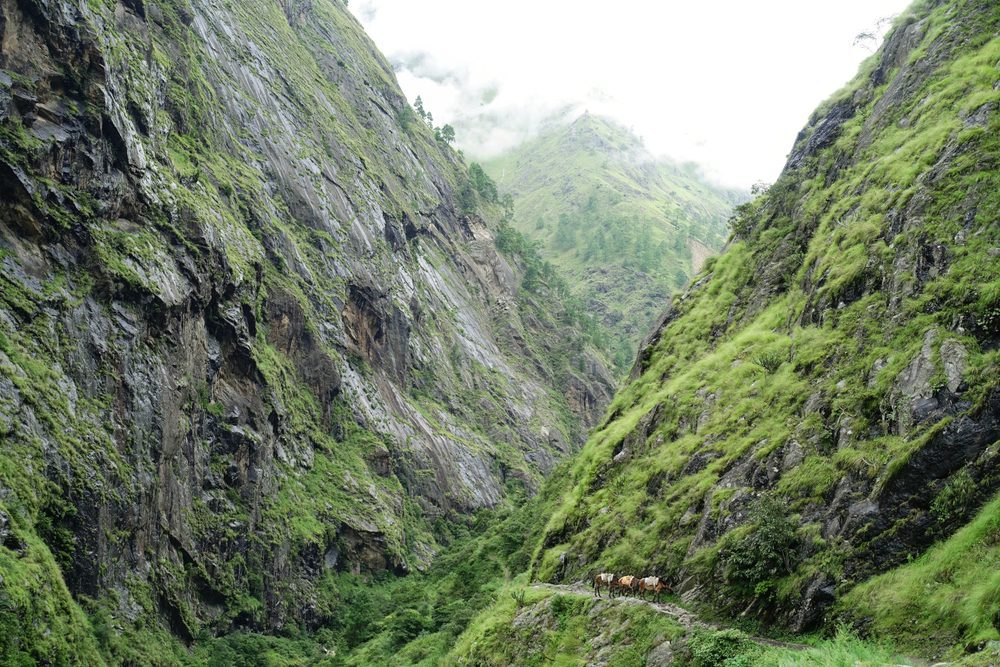
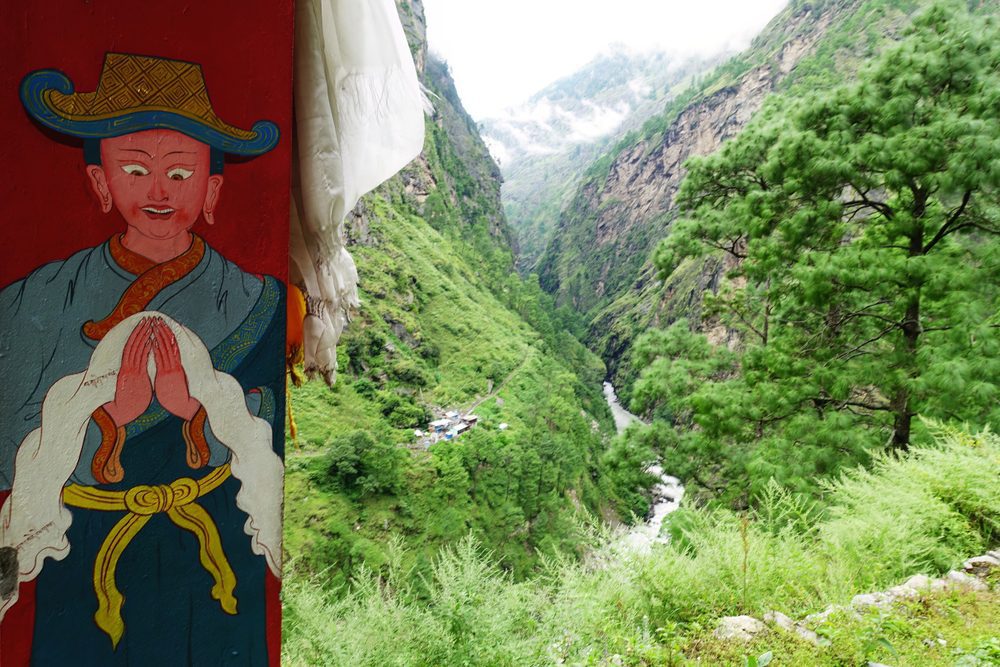
The starting of your journey to Manaslu Circuit Trek takes form in a beautiful drive from Kathmandu to Machha Kola. The route offers exquisite views of mountains, local landscapes, and the day-to-day activities of people living in the region. The trail goes along Budhi Gandaki River while covering some dense jungles and rural settlements, gradually moving towards higher altitudes. Tibetan and Nepali cultures overlap in Jagat, Deng, and Namrung villages which are dotted with monasteries and still traditional. As you trek through Nepal’s alpine woodlands, vibrant rhododendron forests, waterfalls alongside rocky trails, you will experience captivating scenery mesmerizing even by this country’s standards. Among these breathtaking areas is Larkya La Pass which at 5160 meters (16 929 ft) marks the highest altitude point of the trek. You will travel back to Kathmandu after such fascinating journey from Besisahar. This trek will make for an unforgettable experience that you will remember for the rest of your life.
The Manaslu Circuit Trek combined with Tsum Valley is an astonishing trek that offers culture and an accentuated physical challenge. This trek also allows one to appreciate the breathtaking landscape of Nepal’s Himalayas, its diverse Tibetan Buddhist customs, mingle with people from different cultures. For those in search of a meaningful journey off the beaten path, this trip is perfect.
Trip Highlight
- Explore Tsum Valley, a hidden Tibetan Buddhist sanctuary.
- Cross the Larkya La Pass (5,160m) with breathtaking views.
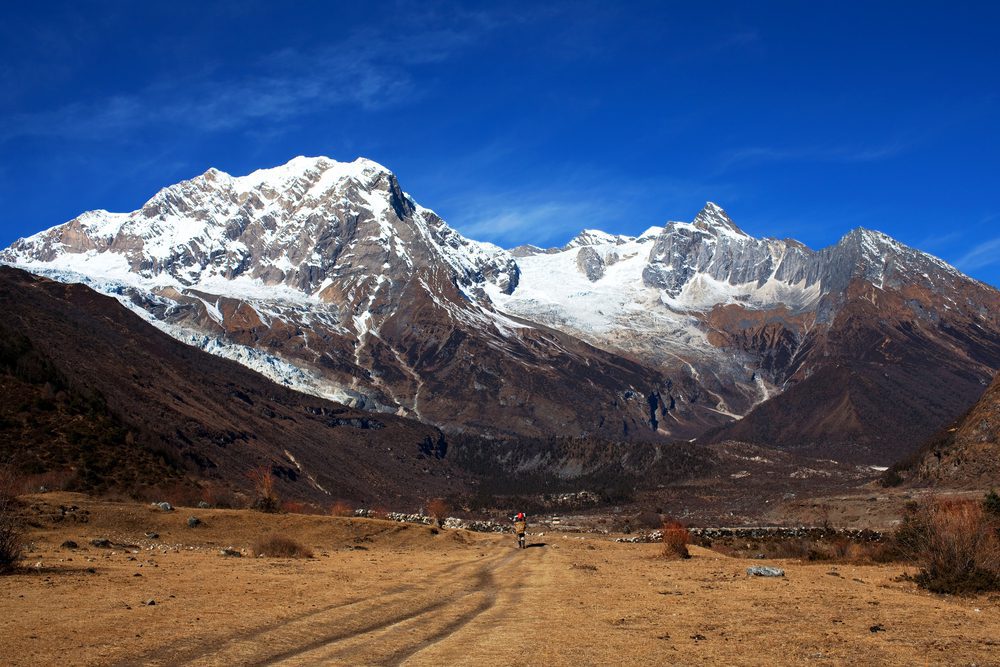
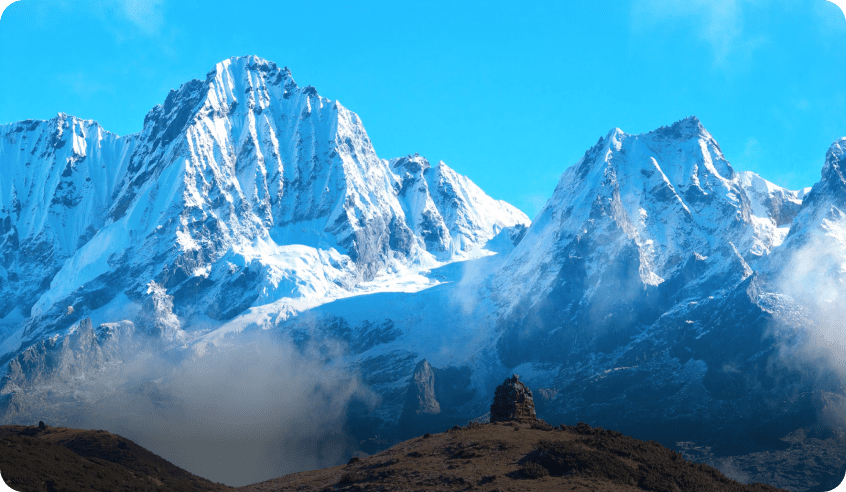
- Experience the stunning scenery of Mt. Manaslu, Himalchuli, and Ganesh Himal.
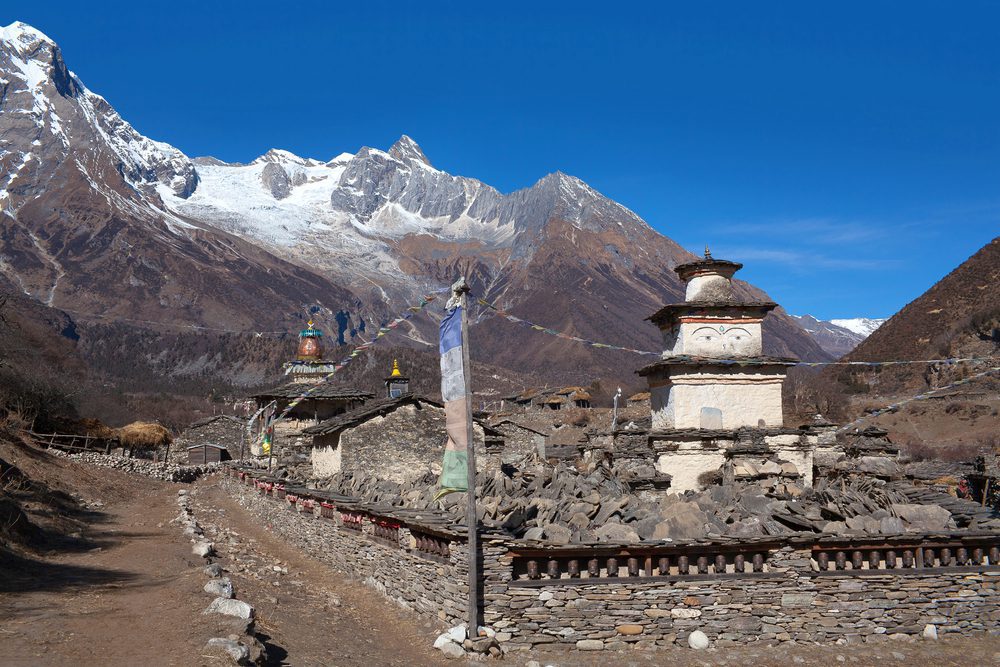
- Explore Tibetan culture and the traditional Tibetan homes, stupas, monasteries (chortens), and friendly locals of the Sama Gaon and Samdo villages.
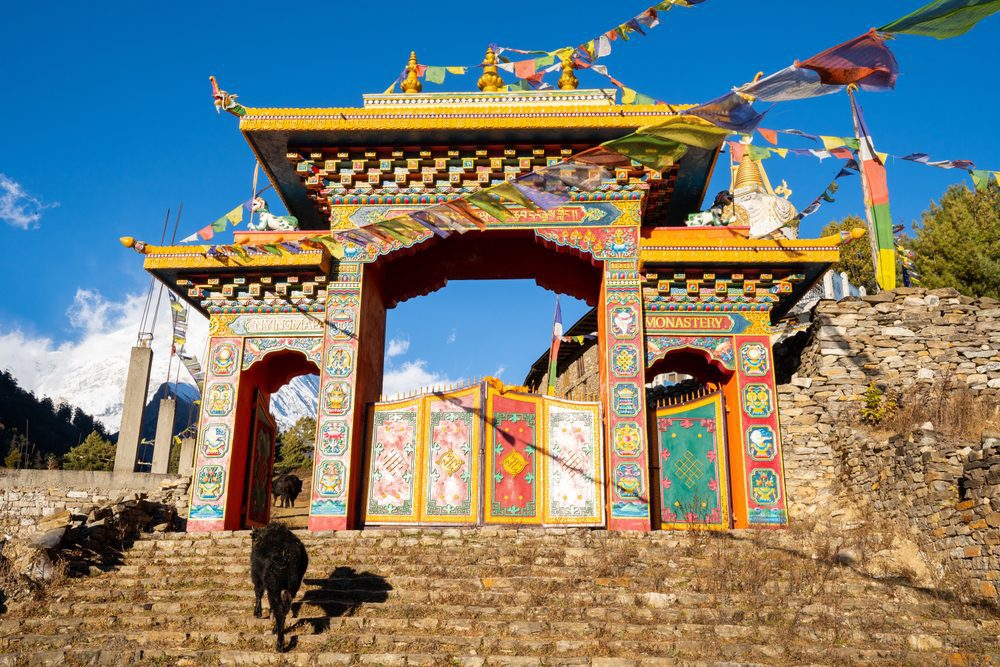
- For a peaceful spiritual experience, go to Manaslu Monastery, Pungyen Monastery, and Nubri Monastery.
- Enjoy the peaceful nature along the route as it is less crowded compared to the Everest & Annapurna regions.
- Discover and take in the beauty of the Manaslu Glacier in Sama Gaon.
- Enjoy the breathtaking vista of the suspension bridge, waterfalls, and Budhi Gandaki River, which all contribute to the trek’s lovely environment.
Itinerary
Your Journey, Step by Step
Drive from Kathmandu to Machha Khola (900m) – 8-9 hrs
You will start your day with a picturesque drive from Kathmandu to Machha Khola, which is around 140 kilometers away and usually takes 8 to 9 hours. Your journey will be more thrilling since you will be able to take in the attractions of hills, rivers, waterfalls, and villages as you go. The route follows the valley of the Budi Gandaki River, passes through cities like Dhading Besi and Arughat, and passes over twisting mountain roads.
You will arrive at Machha Khola after for 1 to 2 hours drive from Soti Khola. When you first arrive at Machha Khola, you will find simple teahouses that provide lodging and meals. You can stroll around the village and immerse yourself in the natural beauty and culture of the region.
Stay overnight in Machha Khola.
Trek from Machha Khola to Jagat (1,340m) – 6-7 hrs
You will begin your first walk from Machha Khola after enjoying a delicious breakfast. The trek starts with an easy climb through lush woodlands by crossing suspension bridges across the Budi Gandaki River. As you go through tiny settlements like Khorlabesi and Tatopani, you can relax and refresh yourself at a natural hot spring. You will get to Dobhan, a charming village nestled away beside the river. As you make your way through thick forests and terraced farms, you’ll encounter more suspension bridges that provide stunning views of the surroundings. After some walking, you will eventually arrive at Jagat, a checkpoint for the Manaslu Conservation Area. You will get to experience its traditional Gurung homes, stone-paved streets, and get a glimpse of the local people’s lifestyle.
Stay overnight in Jagat.
Trek from Jagat to Lokpa (2,240m) – 6-7 hrs
You will travel from Jagat to Lokpa, which is roughly 17 kilometers long and takes 6–7 hours. You enter the restricted Tsum Valley region on this day, which offers a mix of cultural experiences and scenic beauty. You will travel through the bigger Gurung village of Philim as well as smaller villages like Salleri and Sirdibas. The route takes you to Ekle Bhatti, a tiny village in a river gorge, after Philim. The trail then climbs through bamboo forests, providing a calm setting as you get closer to Lokpa. After some hours of trek, you will finally reach Lokpa, which is the gateway to Tsum village. You can find various traditional Tibetan-style houses and stunning views of surrounding peaks like Himalchuli and Boudha Himal. You can relax and refresh your body, and prepare for another epic journey.
Stay overnight in Lokpa.
Trek from Lokpa to Chumling (2,386m) – 5-6 hrs
Today, you will trek from Lokpa to Chumling after enjoying a delicious breakfast in Lokpa.
First stunning views of Ganesh Himal. You will trek for 5-6 hours, covering roughly 6 kilometers. After descending into the valley of the Lungwa River, the trail climbs through dense juniper, pine, and rhododendron forests. You will also cross the Syar Khola before reaching Chumling, a town at 2,386 meters above sea level.
After some hours of trekking, you will reach Chumling, which is a peaceful village located in the Tsum Valley, known for its traditional Tibetan culture and stunning natural beauty. You can see the stunning views of the neighboring peaks, including Ganesh Himal. When you get there, you can experience the spiritual heritage of the area by visiting nearby monasteries like Panago Gompa and Gurwa Gompa. You can rest and acclimate in the village’s peaceful setting.
Stay overnight in Chumling.
Trek from Chumling to Chhokang Paro (3,010m) – 5-6 hrs
You will trek roughly 10 kilometers in 5–6 hours from Chumling to Chhokang Paro, also called Chhekampar. You will travel further into the Tsum Valley on this trip, which offers breathtaking natural beauty and a fascinating cultural experience. The trek starts with a descent past small settlements and terraced fields. The trail gradually increases as you move on, passing through thick pine and rhododendron trees. You’ll cross several suspension bridges over the Siyar Khola and its smaller river and pass several villages like Gho. As you go ahead, you will gradually ascend across rocky terrain and wide meadows, which provide amazing views of the neighboring peaks, such as Himalchuli and Ganesh Himal.
Then, after hours of trekking, you will reach Chhokang, situated on a plateau at an elevation of 3,010 meters. You get to experience various traditional Tibetan-style houses, prayer flags fluttering in the wind, and ancient monasteries. You can relax and refresh in one of the teahouses.
Stay overnight in Chhokang Paro.
Trek from Chhokang Paro to Mu Gompa (3,700m) – 6-7 hrs
You will hike for roughly six to seven hours from Chhokang Paro to Mu Gompa. The route to Mu Gompa offers a window into the region’s traditional Tibetan Buddhist culture as it winds through parched landscapes and yak farms. An extra walk to the 4the,060-meter-high Dhephyudonma Gompa provides more cultural insights and stunning views. This is an exceptional opportunity to experience the spiritual legacy of the Tsum Valley while taking in the breathtaking Himalayan scenery. After some hours of trekking, you will reach the largest monastery in the area, Mu Gompa, which provides a tranquil setting with expansive views of the surrounding mountains.
Stay overnight in Mu Gompa.
Rest Day at Mu Gompa (Acclimatization & Exploration)
Today, you will get a day off at Mu Gompa to rest and explore. The area’s spiritual heritage can be understood through the monastery’s collection of Buddhist deity sculptures and sacred literature. You can explore the neighborhood, talk to the monks, and take in the peaceful surroundings on your day off. Beautiful views of the surrounding peaks can be seen on the optional trek to Kalung (3,810 meters). With prayer flags, chortens, and mani walls decorating the landscape, the area is steeped in Tibetan Buddhist culture.
Along the trek, you might also see wildlife like blue sheep, Himalayan tahr, and other bird species. This day offers a special chance to take in the breathtaking Himalayan scenery while immersing yourself in the spiritual heritage of the Tsum Valley.
Trek back to Chumling – 6-7 hrs
You will spend roughly 6–7 hours on your way from Mu Gompa to Chumling. This trip gives you a new perspective on the towns and landscapes you’ve already seen, enabling you to enjoy the area from a different angle. The trail offers views of the magnificent Ganesh Himal as it passes through peaceful towns with Tibetan inspirations, lush woods, and suspension bridges. You can come across monks and local people along the route, giving you the chance to interact with the vibrant local culture. You can rest and think back on the events of the previous days in Mu Gompa, where the day comes to a close.
Stay overnight in Chumling.
Trek from Chumling to Deng (1,860m) – 6-7 hrs
You will travel from Chumling to Deng, which takes roughly 6–7 hours. This trail offers a welcome change of scenery as it takes you through verdant rhododendron trees. You will return to the main Manaslu Circuit trail after crossing several suspension bridges over the Budhi Gandaki River on your descent. You may watch local life and agriculture as the road goes through small settlements. When you get to Deng, which is 1,860 meters above sea level, you will be able to witness the unique culture of this Gurung community, which is renowned for its terraced fields and traditional way of life. Deng is a peaceful spot to rest and get ready for the next part of your journey.
Stay overnight in Deng.
Trek from Deng to Namrung (2,630m) – 6-7 hrs
You will hike from Deng to Namrung on Day 11 of the Manaslu Circuit Trek, a distance of roughly 19.5 kilometers (12.1 miles) in 6–7 hours.
The trip starts with a slow climb along the Budhi Gandaki River through lush forests and terraced farms. As you travel through tiny settlements like Ghap and Prok, the presence of mani walls, chortens, and prayer flags makes Tibetan culture more noticeable. You get breathtaking vistas of snow-capped peaks, including the first hints of Mount Manaslu, as you get closer to Namrung. With a height of 2,630 meters (8,628 feet), Namrung is a crucial checkpoint on the Manaslu Circuit, where permits are frequently examined. You get to experience Tibetan-influenced areas, with stone houses, prayer wheels, and a serene atmosphere. Before continuing your journey, it’s a great spot to relax and get acclimated.
Stay overnight in Namrung.
Trek from Namrung to Lho (3,180m) – 4-5 hrs
On Day 12 of the Manaslu Circuit Trek, you will travel from Namrung to Lho, which is 3,180 meters above sea level, for 4 to 5 hours. Through terraced meadows and rhododendron trees, this area provides stunning views of Himalchuli and Ganesh Himal. You will come across traditional Tibetan Buddhist culture along the trail, which is represented by the stone buildings and prayer flags in villages like Lihi and Sho.
When you get to Lho, spend some time at the Ribung Monastery, one of the oldest places of worship in the area. The monastery provides panoramic views of the surrounding mountains and offers a peaceful environment for reflection. You will experience the local way of life and get ready for the next part of your journey.
Stay overnight in Lho.
Trek from Lho to Samagaon (3,530m) – 4-5 hrs
On Day 13 of the Manaslu Circuit Trek, you will hike for about 4 to 5 hours from Lho (3,180m) to Samagaon (3,530m). As you travel through alpine meadows and traditional Tibetan towns, you can get breathtaking views of Mount Manaslu, Himalchuli, and Peak 29. On the way, you might stop by the Ribung Monastery in Lho, which is a sacred place for the Nubri people. The peaceful village of Samagaon, encircled by snow-capped peaks, offers an ideal setting for a break and acclimatization.
A visit to Pungyen Gompa, which is around 4,050 meters above sea level, is an optional side trip from Samagaon. With stunning views of Mount Manaslu and the surrounding glaciers, the climb to the monastery takes roughly four to five hours round-trip. You can spend this day taking in the Manaslu region’s natural beauty and cultural legacy, which will help you get ready for the difficulties and rewards of the future.
Stay overnight in Samagaon.
Acclimatization Day at Samagaon
After spending a day in Samagaon acclimating to the high altitude, you will go to Samdo. Through community research, you will learn more about the lifestyles and Buddhist culture of the locals. In addition to walking to the Manaslu Base Camp (4,800 m), which is a 4-5 hour walk away, the journey leads to Birendra Lake (3,691 m), which is barely 3 km from Sama Gaon and offers views of the azure lake. The best view of the surrounding mountains can be found there.
Your journey will then continue up the bridge to Pungyen Monastery. The vistas of peaks, glacier lakes, mani walls, and prayer flags are serene and beautiful, making your journey more memorable. Additionally, you will get the opportunity to meet and get to know the locals. You can return after the amazing realization, which takes two to three hours.
Trek from Samagaon to Samdo (3,875m) – 4-5 hrs
Today, you will start your trek from Samagaon to Samdo. You will spend a couple of hours walking while taking in the stunning mountain views.
You will cross a wooden bridge over the Budhi Gandaki, where the river divides into two, after continuing your descent. You will keep going till you reach Samdo village, a Tibetan refugee village, after passing through a stone archway. Samdo is where you’ll eat lunch. You have the remainder of the day to yourself. Samdo village is the final permanent village before the Larkya La Pass, so you can have a quick look around.
Stay overnight in Samdo.
Trek from Samdo to Dharamsala (4,460m) – 4-5 hrs
After breakfast, you will begin your journey from Samdo across the Budhi Gandaki River’s ascent. After that, you will arrive at the Tibetan market, Larkya Bazaar. On the journey, you will witness Larkya Glacier and cross two wooden bridges.
After four hours of hiking, you will arrive in Dharmasala, also known as Larkya La Phedi, where you may eat lunch while taking in the breathtaking views of the mountains and hillsides. You should get ready for Larkya La Pass, which is the most difficult part of the journey.
Stay overnight in Dharamsala.
Cross Larkya La Pass (5,160m) & Trek to Bimthang (3,720m) – 8-9 hrs
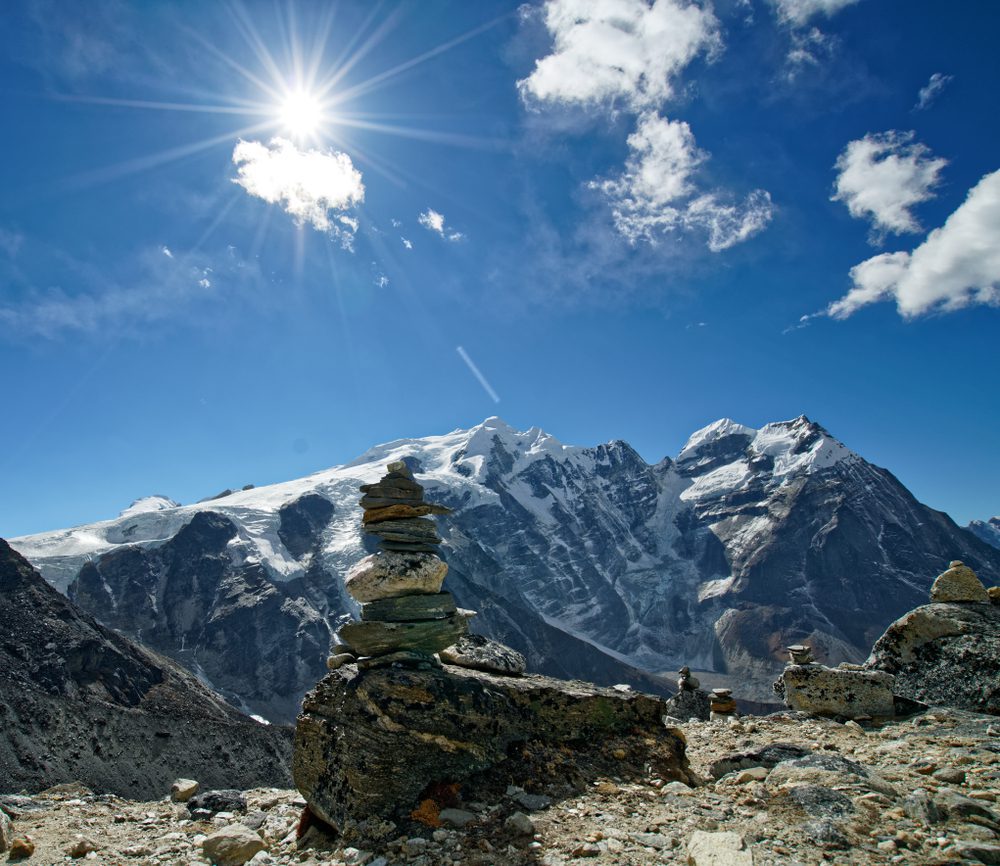
Your journey will take you to the 5,160-meter (16,929-foot) Larkya La Pass on this specific day. Since you will be crossing the pass before the afternoon, you must get up early, eat breakfast, and leave the teahouse early. Even if your walk may be difficult in bad weather and snow, it is still possible. You can cross the pass if you go gradually, although this is the hardest part of the journey. You may enjoy the most magnificent views of the Himalayan peaks after you reach the summit. Mt. Annapurna II, Himlung Himal, Nardi Chuli, Cheo Himal, Gyaji Kung, and Kang are all visible.
In two to three hours, you will arrive at Bimthang village after crossing the Larkya Phedi. This is a beautiful valley encircled by snow-capped mountains. There are tea houses accessible for you to rest in.
Stay overnight in Bimthang.
Trek from Bimthang to Dharapani (1,960m) – 6-7 hrs
Your journey to Dharapani will begin after breakfast in Bimthang. You will then gradually descend through alpine meadows and a rhododendron forest.
After that, you will arrive at Dharapani, where the Annapurna Circuit joins the trip.
Since this is the last day of your trek, the trip starts with a jeep ride from Dharapani to Besisahar, the trek’s destination and the entryway to the Annapurna Circuit. After that, you can travel from Besisahar via bus.
Stay overnight in Dharapani.
Drive from Dharapani to Kathmandu via Besisahar – 7-9 hrs
Today is the last day of your trek to the Manaslu Circuit. It’s a long journey from Besisahar to Kathmandu, taking about six to seven hours. Despite the somewhat uneven roads, you can take in the views of Nepal’s rivers, hills, and valleys.
You can take a jeep from Besisahar to Pokhara, which takes four to five hours, if you’re in a rush. After that, you have less than an hour to board a flight to Kathmandu.
With the wonderful experiences you had on the walk, you may head home after being escorted to your accommodation in Kathmandu.
Stay overnight in Kathmandu.
Departure from Kathmandu
On Day 20, after returning to Kathmandu, you have the option to explore the city’s rich cultural landmarks before your departure. You can visit several cultural heritage sites, temples, and experience the vibrant culture of Kathmandu. This will leave you with amazing memories and inspiring moments of your life through their culture, traditions, architecture and scenic views of nature, mountains and many more.
You will depart with the most thrilling and amazing memories of the trek to the Manaslu Circuit. Safe travels, and may your journey home be as memorable as your trek through the Manaslu Circuit!
Customize this trip with help from our local travel specialist that matches your Interests.
Customize This Trip
Inclusions
What’s Covered in Your Adventure
- Private car service to and from the airport.
- Two nights at a standard hotel in Kathmandu with breakfast.
- Three meals a day: breakfast, lunch, &dinner.
- You will be provided with Trekking Lodges (Tea Houses) during the trek.
- Kathamndu to Machhi Khola by bus manaslu resticted area permit (special permit )
- Manaslu Conservation Area permit Annapurna Conservation Area Permit (ACAP)
- A highly experienced, helpful, knowledgeable, friendly, English-speaking guide with all of his salary, food, drinks, lodging, transportation, and insurance covered.
- Tsum Valley restricted area permit (Special permit)
- Setting up a service for an emergency helicopter (paid by your Travel Insurance)
- You can rent a sleeping bag, a down jacket, and a free duffel bag (return it after the trip)
- Taxes and official costs are paid to the government.
- Certificate of completion of the trip.
- Oximeter to check your pulse, oxygen saturation, and heart rate twice a day (very helpful to check for signs of Altitude Mountain Sickness, or AMS). This ensures that your trek is in the safest hands possible, regardless of your level of experience.
- Dharapani to Beshishar to Kathmandu by bus.
- Food that you will eat in Kathmandu for lunch and dinner.
- The cost of a visa to enter Nepal
- Your insurance for travel and medical care.
- International airfare, your expenses
- All of the alcoholic and non-alcoholic cold and hot drinks you buy on trek (along the way and in the Tea Houses at night).
- All of the sweet desserts, like chocolate, cake, pie, and pudding ( The tea houses have hot showers and places to charge your phone, which will cost you about 2$ to 5$.)
- Tip to the guide (Tipping is expected).
- Strong, helpful Sherpa porters with the right safety gear and walking gear, as well as a salary, food, a place to live, and insurance. (one porter for two people). It will cost you $400.
Maps
Navigate Your Journey
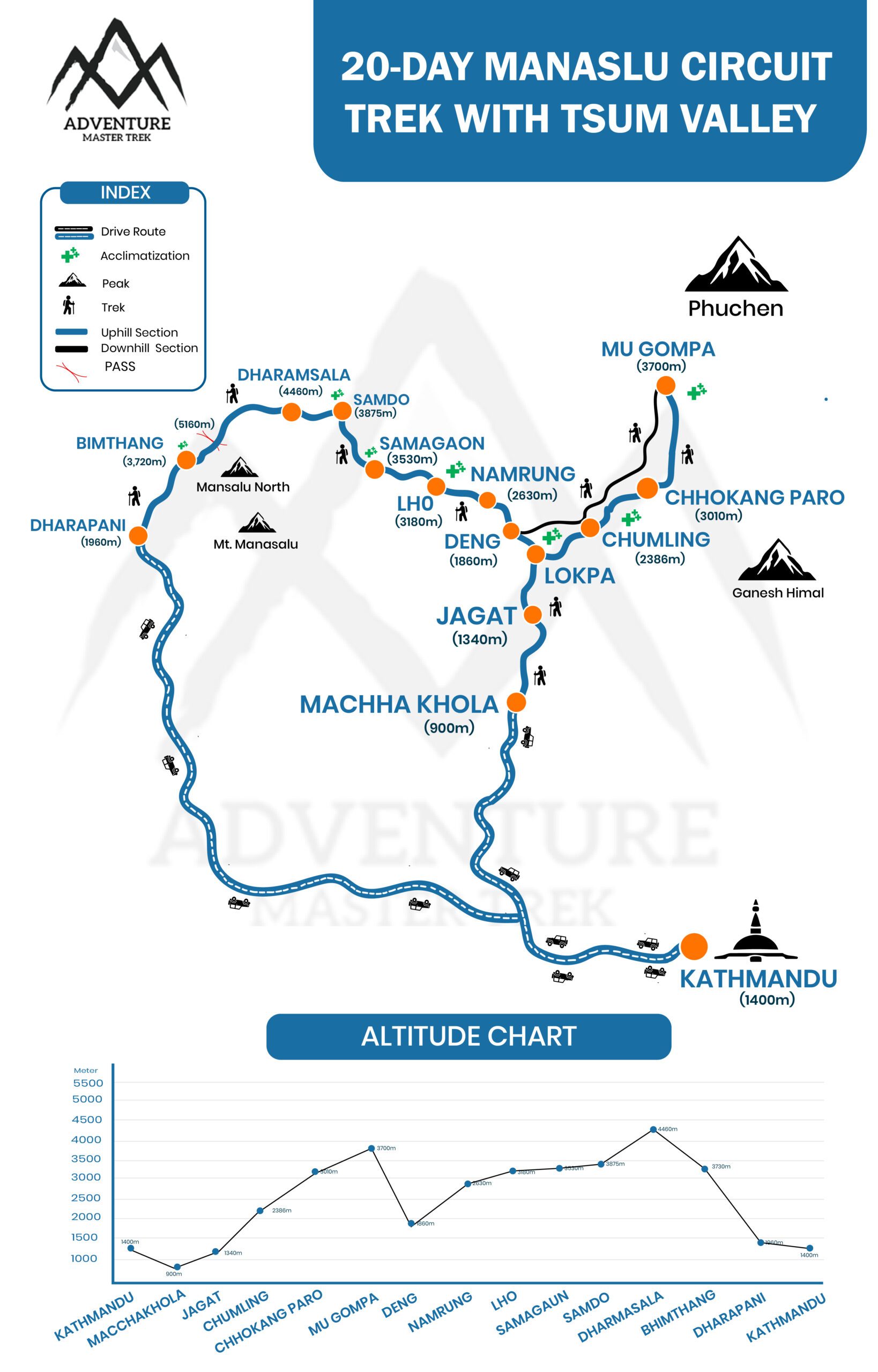
Good to Know
Your Journey, Step by Step
Food and Drinking Water in Manaslu Circuit trek with Tsum Valley
While trekking the Manaslu Circuit, including Tsum Valley, you will mainly stay in teahouses that provide simple yet delicious meals. Noodles, soups, dal bhat (rice with lentils and vegetables), and occasionally momos (dumplings) or eggs are considered common foods. In larger communities, meat meals like yak or chicken may be served. It provides you with enough energy for trekking and is fresh without being stuffy. As you move forward, the menu’s selections become more limited and simple. Drinks include coffee, tea, ginger tea, hot chocolate, lemon tea, soft drinks, and hot and cold water.
The most crucial aspect of trekking, particularly at higher elevations, is staying hydrated. You can refill your water bottle at any of the many rivers, streams, and taps along the walking path.
However, before drinking, natural water should always be cleaned. Along the way, there are tea houses that will boil water for you, but it could take a while and at times cost a little. The higher you go in the tea house, the more expensive it might get to buy water bottles. For purifying water, you should therefore always have a portable water filter, tablet, or UV sterilizer with you. 3-4 liters should be consumed daily, especially at higher elevations.
Electricity and Internet Service on Manaslu Circuit Trek
Some locations on the Manaslu Circuit Trek, including Tsum Valley, provide internet and electricity, but not all of them do. While solar power may typically be used to charge a phone or camera in lower villages, energy may be limited or only available for a few hours in higher places. It can cost a little to charge your devices.
Internet access is also limited. Wi-Fi is available for a charge in some teahouses, although it’s frequently unreliable and slow, especially in rural locations. There might not be any wifi or service in many areas of the hike. In higher elevation regions like Samagaon, Lho, and Dharmasala, certain tea houses might have Wi-Fi. But the connection is usually very bad and may be more expensive. Here, internet connectivity is usually provided through satellite connections, and due to the higher altitude demand, network overload may occur. Bring a power bank, download maps, and other essential information before the walk.
Accommodation and Acclimatization on Manaslu Circuit Trek
You will mostly stay in teahouses or small lodges on the Manaslu Circuit Trek with Tsum Valley. These establishments are modest but comfortable, providing basic rooms, common restrooms, and occasionally a shared dining space. The rooms typically offer blankets, but it’s a good idea to pack a comfortable sleeping bag because it can get cold at night. After an exhausting hike on the route, the teahouses offer soup, rice, and noodles as well as a place to relax and recharge.
The trek quickly ascends to high elevations, so acclimatization is crucial. In order to prevent altitude sickness, your body requires time to adjust to the reduced oxygen levels. You can relax your body in villages like Sama Gaon and Samdo in order to get ready for the high-altitude walk. In the meantime, you can explore the village and get a taste of the way of life of the locals. By resting well, pacing yourself, and staying hydrated, you reduce the risk of altitude sickness and make your trek safer and more enjoyable. Taking care of acclimatization lets you appreciate the amazing views and experience without problems.
Altitude Sickness in Manaslu Circuit Trek
On the Manaslu Circuit Trek, altitude sickness is possible, especially when you get closer to higher heights like the 5,160-meter (16,929 ft) Larkya La Pass, and the Tsum Valley route heights of about 3,700 meters. When your body finds it difficult to adapt to the reduced oxygen levels at high elevations, you may experience altitude sickness.
Headaches, nausea, dizziness, exhaustion, breathing difficulties, and trouble falling asleep are some of the symptoms of altitude sickness. To reduce the danger, you should stop the trek if you experience any altitude sickness symptoms and take medication such as Diamox (acetazolamide). You should prioritize your safety, eat warm soups, stay hydrated, and avoid exhausting yourself further to minimize the risk of altitude sickness. It is best to avoid alcohol and tobacco, and drink 3 to 4 liters of water every day to stay hydrated. By being aware of the symptoms, taking precautions, and acting quickly when altitude sickness appears, hikers can lower the dangers and have a memorable and safe trip.
Group Size in Manaslu Circuit Trek
Since the Manaslu Circuit Trek is a restricted area, solo trekking is not permitted, hence, a minimum of two trekkers are required. For a complete experience, the majority of trekking firms recommend group sizes ranging from two to twelve individuals.
One guide is usually enough for groups of up to 8-12 hikers. In order to maintain safety and efficient communication, larger parties might need more guides and porters. Typically, there is one porter for every two hikers, and each porter can carry up to 20 kg of equipment. Smaller groups of 4-6 people often have benefits, including simpler scheduling, smoother coordination, and easier access to lodging in the tea houses along the way. Even while they could be less expensive, larger groups might encounter difficulties like teahouse capacity constraints and less scheduling flexibility. For the hike, you will need a licensed guide, who will be set up by a recognized trekking firm. In the guide, you can ask whatever questions you want. They will guide you, handle the necessary permits, and assist you with any issues that may arise during the trek.
Safety and Security in Nepal and Manaslu Circuit Trek
Although Nepal is the safest place to trek, it’s still important to be aware of the dangers of altitude sickness associated with high-altitude trekking in Nepal.
Although the Manaslu Circuit journey is safe, it can be difficult because of altitude sickness, the fatigue of climbing high mountains like the Larke La Pass, long hiking days, rough terrain areas, and unpredictable weather. Additionally, you should bring a certified and knowledgeable guide who is familiar with the trekking route. You should properly hydrate yourself every day and acclimate to higher elevations to prevent altitude sickness and exhaustion. Hiking requires the use of appropriate equipment. Therefore, you must take the appropriate safety measures before beginning your hike.
Difficulty in Trek
At 5160 meters above sea level, Larkya La Pass is the most challenging part of this hike. You can have altitude sickness as a result of the slow elevation gain. Trekking can sometimes take seven or eight hours, which can be quite taxing and difficult for you. The roads can get rough, muddy, and rocky as you get closer to higher elevations. The weather’s difficulty may also present challenges.
Permits For Manaslu Circuit Trek
The Manaslu Circuit Trek is a restricted region and is situated within protected conservation zones, thus, it requires many permissions. Here are some permits required for the Manaslu Circuit Trek with Tsum Valley:
Manaslu Conservation Area Permits (MCAP): The Nepal Tourism Board and the ACAP entry sites, including Soti Khola, are accessible.
Manaslu Restricted Area Permit (RAP): It can be obtained from the Nepal Department of Immigration in Kathmandu or a certified trekking agency. For the restricted area between Jagat and Sama Gaun, a Manaslu Restricted Area Permit (RAP) is necessary.
Annapurna Conservation Area Permit (ACAP): Accessible at the ACAP entry sites, such as Soti Khola or at the Nepal Tourism Board in Kathmandu.
Trekkers Information Management Systems Card (TIMS optional)
Tsum Valley Permit (if applicable): An extra permit is needed if you plan to continue your journey to Tsum Valley.
These permits are the most important and must be carried with you throughout the trek.
Required Documents for Permits for Manaslu Circuit Trek :
- Validated passwords for a minimum of six months
- A valid tourist visa for Nepal is available at Tribhuvan International Airport.
- Each permit requires two passport-sized pictures.
- Permit copies and travel insurance copies
Money Exchange
The remote nature of the area and the lack of banking services demand careful financial planning before starting the Manaslu Circuit Trek. You need to bring Nepali cash for your trip. There are numerous money exchange locations in Thamel, Kathmandu, where you may exchange your currency. Tribhuvan International Airport also offers currency exchange, but it costs a lot more than the other locations.
There are no ATMs or money exchange facilities along the Manaslu Circuit Trek. You can only withdraw money in Arughat, which is the starting point of the trek. In the teahouses and motels along the trip, only Nepali money is accepted, so ensure you have enough cash to cover all expenses.
Travel Insurance for Manaslu Circuit Trek with Tsum Valley
You will need to have travel insurance for the Manaslu Circuit Trek. Your travel insurance must provide coverage for both trip cancellation and personal injury expenses. Here are some things your travel insurance should cover:
- Emergency Medical Coverage: When trekking above 2,500 meters, ensure your policy covers all altitude sickness-related medical expenses.
- Evacuation: In case of a serious injury or medical emergency, you might require an emergency helicopter evacuation from a remote area to a hospital in Kathmandu.
- Protection for Trip Interruptions: Purchase short-term protection insurance if you need to cancel your trip due to a significant illness or emergency while trekking.
- Lost Gear: Coverage for personal items such as a cell phone, equipment, etc., in case of loss.
- High-Altitude Trekking: Ensure your insurance covers high-altitude trekking, as you will be trekking at altitudes over 5,000 meters. Rescue services from high altitudes or helicopter evacuation must be included. This is necessary because there aren’t many medical services along the trail, and you may need to cover personal injury costs and trip cancellation.
Trekking Equipment for trek to Manaslu Circuit with Tsum Valley
General Essentials
- Passport & Permits: Bring your passport with extra copies and passport-sized photos for permits. Carry your TIMS (Trekker’s Information Management System) card, Manaslu Restricted Area Permit, and Tsum Village permit.
- Luggage: Use a duffel bag (around 70L) for your main luggage, which porters typically carry. A daypack (25–30L) is essential for carrying water, snacks, a camera, and extra layers during the trek.
- Sleeping Bag: Opt for a sleeping bag rated for at least -15°C (5°F) to ensure warmth during cold nights.
- Cash: Carry Nepali rupees for tips, snacks, and small purchases along the trail.
Upper Body Clothing
- Base Layers: Pack moisture-wicking thermal tops and bottoms (merino wool or synthetic) for warmth.
- Mid Layers: Include a fleece jacket or down jacket for insulation.
- Outer Layers: A waterproof and windproof shell jacket is crucial for protection against rain and wind.
- Sun Protection: Bring sunglasses with UV protection and a sun hat to shield yourself from the sun.
- Accessories: A scarf or neck gaiter can protect your neck and face from wind and dust.
Torso & Lower Body Clothing
- Trekking Pants: Choose lightweight, breathable, and quick-drying pants. Convertible pants (zip-off style) offer versatility.
- Thermal Bottoms: Pack thermal or fleece-lined bottoms for warmth during colder evenings
- Waterproof Pants: Essential for protection against rain and snow.
Handwear
- Lightweight Gloves: Useful for mild cold conditions.
- Insulated Gloves: Necessary for colder weather at higher altitudes.
- Mittens: Optional, but can provide extra warmth during extreme cold.
Footwear
- Hiking Boots: Ensure they are waterproof with ankle support. Break them in before the trek to prevent blisters.
- Camp Shoes: Lightweight sandals or sneakers for relaxation at the campsite.
- Socks: Bring 4–5 pairs of hiking socks (preferably wool or synthetic) and 2–3 pairs of liner socks to reduce friction and prevent blisters.
- Gaiters: Protect your boots from snow and mud.
- Microspikes: Optional, but useful for icy trails.
Undergarments
- Moisture-Wicking Underwear: Essential for comfort during long treks.
- Sports Bras: For women, pack 2–3 sports bras made from breathable materials.
Medication & First Aid
- Altitude Sickness Medications: Consult with your doctor about medications like Diamox.
- Pain Relievers: Carry ibuprofen or paracetamol.
- Bandages & Antiseptic Cream: For treating minor injuries.
- Cough Syrup & Thermometer: Useful for respiratory issues and monitoring body temperature.
- Sunscreen & Lip Balm: With high SPF to protect against UV rays.
Other Essentials
- Water Bottles: Carry 3–4 liter capacity. Water purification tablets or a filter are recommended for safe drinking water.
- Toiletries: Include a toothbrush, toothpaste, biodegradable soap, wet wipes, and a small towel.
- Flashlight/Headlamp: With extra batteries for nighttime visibility.
- Hand Sanitizer: For hygiene when water is scarce.
- Camera: To capture the stunning scenery.
- Snacks: Energy bars, nuts, and chocolates for quick energy boosts.
- Power Bank: For charging electronic devices.
- Dry Bags: To keep electronics and valuables dry.
- Notebook & Pen: For journaling your trekking experience.
- Earplugs & Eye Mask: For better sleep in shared accommodations.
Booking Policy of Manaslu Circuit Trek
Booking a trek on the Manaslu Circuit involves specific policies due to the region’s restricted status.
1. Advance Payment & Booking Confirmation
- To secure your place, a 30% deposit of the entire trip cost is needed.
- When you arrive in Kathmandu, you can pay the remaining balance.
- Paying the entire amount in advance is an additional choice.
- To finalize the reservation, you need to send:
- The cost of the reservation
- An electronic copy of your passport
- Additional data is required, including travel insurance details or an emergency contact.
2. Payment Methods
For your convenience, we provide a variety of payment methods:
Online Payment: Use our website’s payment gateway to make a secure online payment.
Debit/Credit Cards: Visa, MasterCard, and other debit/credit cards are accepted, but there is a 4% bank service fee. Transfer money straight to our bank account by wire transfer or bank transfer (transaction fee).
Cash or Check: You have the option of paying with cash or a check if you’re in Kathmandu.
3. Final Payment
The remaining balance is typically due 30–45 days before departure, depending on the type of trip. You can pay with cash, a card, or a bank transfer when you get there.
4. Booking Modifications & Rescheduling
- Please give us at least 30 days’ notice if you must change the date of your trek.
- Depending on the circumstances, date adjustments may be contingent upon availability and additional fees.
5. Travel Insurance Requirement
Every trekker has to have full-coverage travel insurance that covers evacuation, high-altitude medical emergencies, trip cancellations, and delays.
6. Last-Minute Booking
All trekkers must have full vacation coverage that covers medical situations at high altitudes such as evacuation, trip cancellations, and delays.
FAQs
Your Questions, Answered
When is the best time to trek the Manaslu Circuit?
The ideal seasons to trek the Manaslu Circuit are spring (March to May) and autumn (September to November), as they offer stable weather, clear skies, and great views of the mountains.
What permits do I need for the Manaslu Circuit Trek?
You’ll need the Manaslu Restricted Area Permit (RAP), Manaslu Conservation Area Permit (MCAP), Annapurna Conservation Area Permit (ACAP), and Tsum Valley permit if you are planning to visit it.
What is the highest point of the Manaslu Circuit trek?
The highest point of the Manaslu Circuit trek is the Larkya La Pass, situated at 5,160 meters above sea level.
Can I go for the solo trek in the Manaslu Circuit Trek with Tsum Valley?
No, solo trekking is not allowed on the Manaslu Circuit trek with the Tsum Valley. You must book your trip through a registered trekking operator that will manage the required permissions and supply a certified guide if you want to go on this trek.
Is a guide necessary for the Manaslu Circuit Trek?
Yes, the Manaslu Circuit Trek requires a guide. Because the Manaslu region is considered a restricted area by the Nepalese government, trekkers must travel in groups of two or more and be guided by a professional guide.
Can I customize my itinerary?
Yes, you can customize your itinerary based on your preferences and fitness level. Most trekking agencies allow for itinerary customization, which makes it much more beneficial for your travel.
What type of accommodation is available during the Manaslu Circuit trek?
The accommodations during the Manaslu Circuit trek range from basic teahouses to more comfortable lodges. Rooms are typically shared, and amenities are modest.
Are tea houses available along the trekking route?
Yes, there are tea establishments along the Tsum Valley route and the Manaslu Circuit Trek. These teahouses are simple hotels managed by families that provide trekkers with simple lodging and food.
What Documentation Will I Require for the Manaslu Tsum Valley Trek?
You will need several documents, like a 6-month valid passport, a Nepal visa, passport-sized photos, and copies of permits to ensure a smooth and legal trekking experience.
Do I need travel insurance?
Yes, your travel insurance should cover emergency medical coverage, evacuation, lost gear, protection from trip interruption, and high-altitude trekking to ensure you are well prepared and protected throughout the trek.
Do I need to tip my guide and porter?
Tipping your guide and porter during the Manaslu Circuit and Tsum Valley Trek is expected. Although it is not mandatory but it’s a significant way to support their livelihoods and recognize their hard work.
What is the difficulty of the Manaslu Circuit Trek?
The Manaslu Circuit trek is a moderately challenging trek due to its rocky terrain, unpredictable weather, especially at higher altitudes, and the risk of altitude sickness. Though with proper preparation and a positive mindset, trekkers can navigate the challenges and enjoy the journey through one of Nepal’s most beautiful regions, Manaslu.
How can I prevent altitude sickness?
You can prevent the risk of altitude sickness during the Manaslu Circuit trek by ascending cautiously, drinking enough water, and allowing for acclimatization days. If necessary, take medication like Diamox, which may be prescribed in certain situations, but always get medical advice first.


View Our Similar Packages
Discover our top tours, loved by thousands of travelers annually. Choose the adventure that inspires you and embark on a journey tailored to your desires.
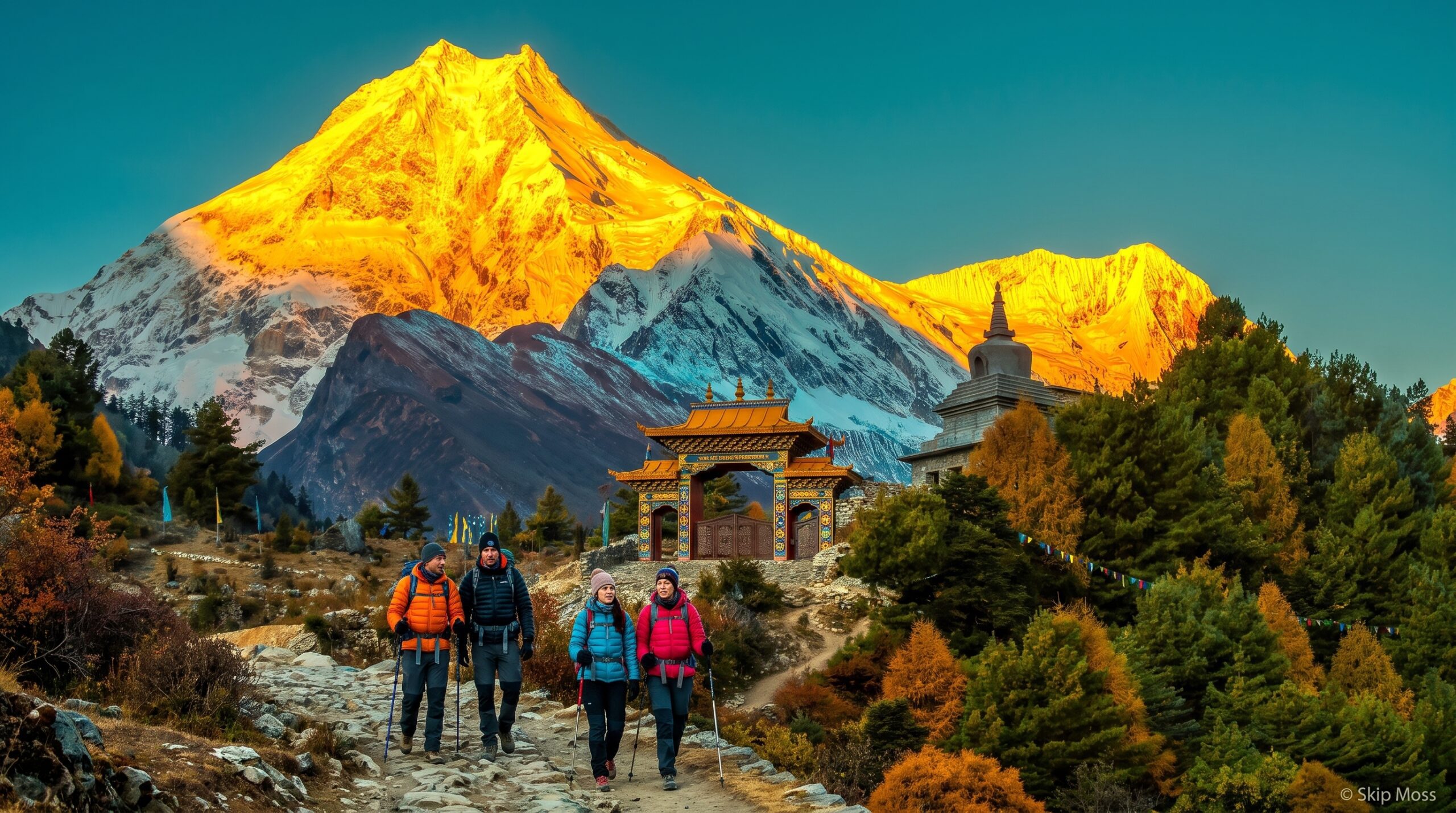

 Nepal
Nepal
 13 Days
Add Review
Reviewing for 20-Day Manaslu Circuit Trek with Tsum Valley: Itinerary, Permits & DifficultyRequest a Callback - 20-Day Manaslu Circuit Trek with Tsum Valley: Itinerary, Permits & Difficulty
Submit the form and we will be back to you shortly
Request a Callback - 20-Day Manaslu Circuit Trek with Tsum Valley: Itinerary, Permits & Difficulty
Submit the form and we will be back to you shortly
Narayanhiti Palace Museum

Narayanhiti Palace Museum


