







18-Day Everest Three Passes Trek


Quick Trip Facts


Everest Three High Pass Trek Overview
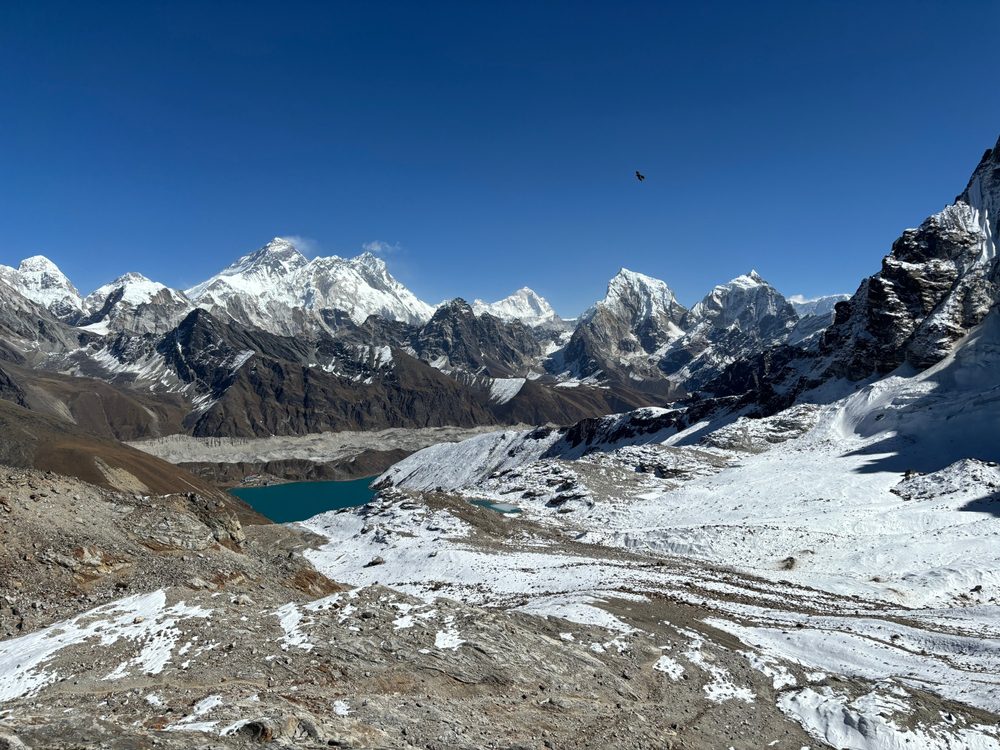
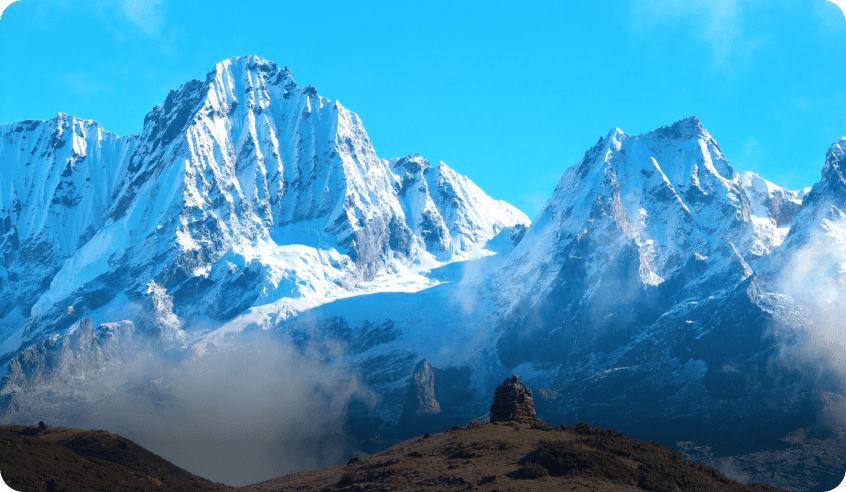
The Everest Three Passes Trek is definitely one of the most spectacular and rewarding trekking experiences in the world. It allows you to be fully immersed in nature, more specifically in the Himalayas. It gives trekkers a one-of-a-kind opportunity to view some of the world’s most beautiful and tallest peaks.
The Three Passes Trek is widely regarded as the ultimate Everest region adventure — a challenging, deeply rewarding, and visually extraordinary circuit that takes trekkers over three of the highest and most dramatic mountain passes in the Khumbu, connecting valleys and landscapes that most visitors to the Everest region never get to experience. While the standard Everest Base Camp trek follows a single well-worn trail up and back through the main Khumbu valley, the Three Passes Trek loops through the entire region in a grand arc — crossing Kongma La at 5,535 metres, Chola Pass at 5,420 metres, and Renjo La at 5,360 metres, and linking the three most iconic destinations in the Khumbu: Everest Base Camp, the Gokyo Lakes, and the Thame valley — all in a single continuous journey.
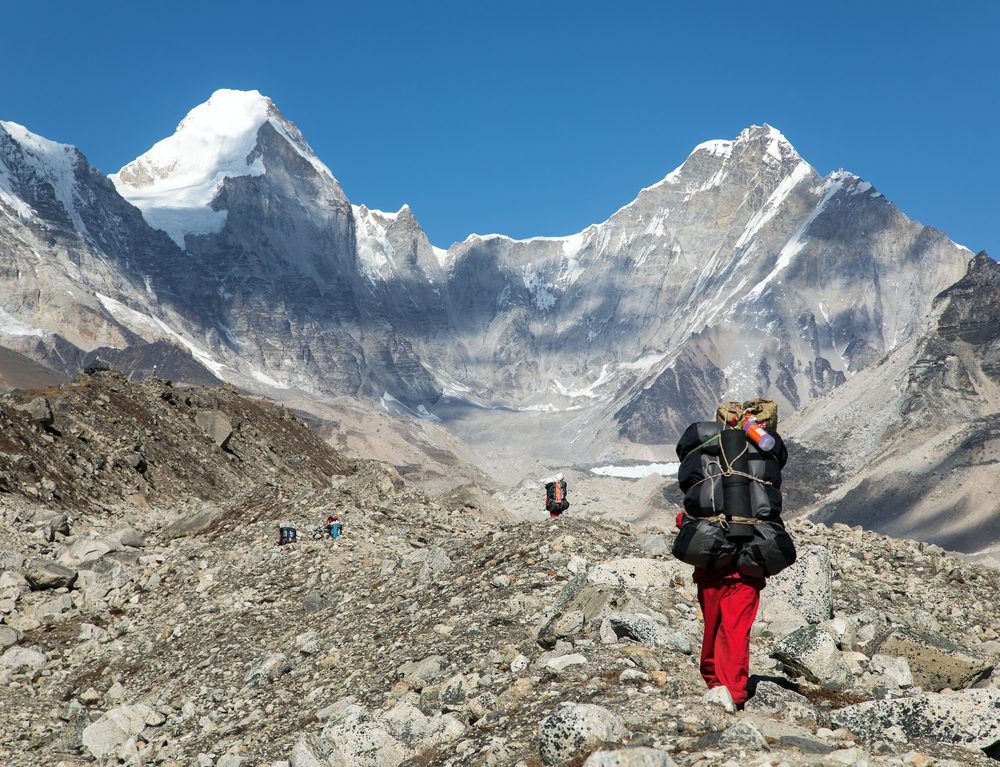
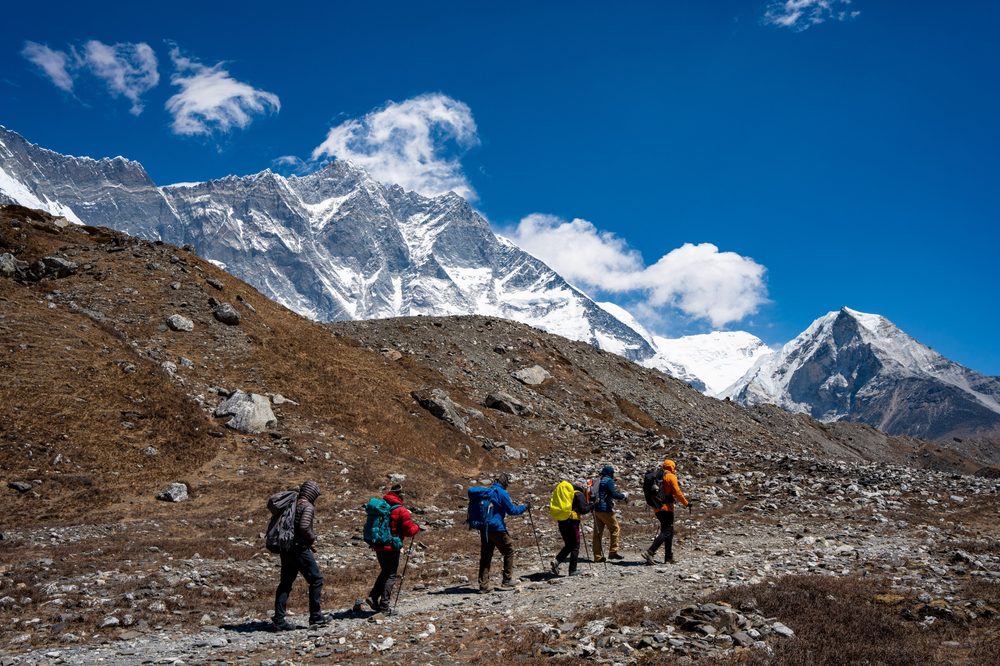
Kongma La is the highest of the three passes and one of the most demanding days on the entire route — a steep and exposed crossing above the Khumbu glacier that connects the Chhukung valley with Lobuche and rewards the effort with some of the most dramatic close-up views of Lhotse, Nuptse, and the Khumbu Icefall found anywhere on any trekking route in Nepal. The pass sits in genuinely high-altitude terrain where the cold, the thin air, and the steep scree and snow slopes demand both physical fitness and a steady head for exposed mountain terrain. Crossing it on a clear morning, with the full sweep of the Khumbu laid out below and the giants of the Everest massif towering on all sides, is one of the standout experiences of the entire trek.
Chola Pass at 5,420 metres is the most technically interesting of the three crossings — a glaciated high mountain pass that involves walking on snow and ice on the upper section and requires careful footing, particularly in early season when the snow is harder and the descent more committing. The crossing connects the Lobuche valley with the Gokyo valley, and the transition from the rocky brown landscape of the Khumbu glacier moraines to the turquoise lakes and sweeping glacier views of the Gokyo side is one of the most dramatic and memorable moments on the entire circuit. Your guide will assess conditions on the day and determine the safest line across — this is not a pass to rush or underestimate.
Renjo La at 5,360 metres is perhaps the most photogenic of the three — a high saddle above the Gokyo Lakes that delivers an aerial bird’s-eye view of the entire lake chain laid out below in one sweeping panorama, with Everest, Cho Oyu, and a dozen other peaks filling the skyline above. The descent from Renjo La into the Thame valley is long and steep but deeply beautiful, passing through yak pastures and remote herding settlements before eventually connecting with the trail back to Namche Bazaar. Together the three passes create a complete and immersive circuit of the Khumbu — a journey that reveals the Everest region in its full, extraordinary breadth.
What separates the Three Passes Trek from every other route in the Everest region is the sheer variety it delivers — glacier walking, sacred lakes, two of Nepal’s finest mountain viewpoints in Gokyo Ri and Kala Patthar, a visit to Everest Base Camp, the spiritual depth of Tengboche Monastery, and three high-altitude pass crossings that each offer their own distinct character and challenge. It is a trek that demands serious preparation, genuine fitness, and a high tolerance for altitude — but for those who arrive ready, it is simply one of the greatest mountain journeys anywhere on earth.
Trip Highlights
- Complete Circuit of the Everest Region and traverse all three high mountain passes: Kongma La (5,535m), Cho La (5,420m), and Renjo La (5,360m).
- The Epic Himalayan Route connects Everest Base Camp, Gokyo Lakes, Chukhung, and Thame through remote, dramatic trails.
- Enjoy the delightful sunrise hike to Kala Patthar (5,545m) and the expansive views of the mountains obtained from the summit of Gokyo Ri (5,360m) and Nangkartshang Peak (5,083m) as well.
- From Gokyo Lakes you can admire the remarkable Gokyo Lakes, one of the highest freshwater lake systems in the world.
- Cross and uncross it between climbing up the huge moraines and visiting high passes with a change of view and unmatchable Raw Himalayan beauty.
- Experience the Sherpa Culture & Monasteries and get immersed in the local customs by visiting Namche Bazaar, Tengboche Monastery and remote Sherpa villages.
- Trek in the Sagarmatha National Park, a UNESCO-recognized area known for its biodiversity and unique Himalayan ecology. Everest Three Passes Trek Itinerary
- Cross three of the highest and most dramatic mountain passes in the Khumbu — Kongma La (5,535m), Chola Pass (5,420m), and Renjo La (5,360m) — each offering a completely different character, challenge, and panoramic reward
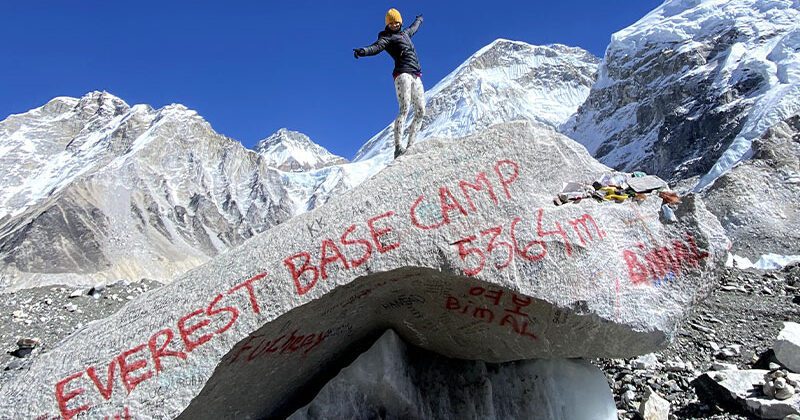
- Stand at Everest Base Camp at 5,364 metres and take in the full scale of the Khumbu Icefall — the legendary launching point for every Everest expedition — in one of the most iconic locations in the mountaineering world
- Summit Gokyo Ri at 5,357 metres for a simultaneous 360-degree panorama of four eight-thousanders — Everest, Lhotse, Makalu, and Cho Oyu — spread across the horizon in a single breathtaking view
- Hike to Kala Patthar at 5,545 metres for the finest close-up sunrise view of Mount Everest available to non-climbers anywhere in Nepal
- Walk alongside and across the massive Khumbu Glacier and its dramatic icefalls, especially visible from the moraines near Lobuche where the scale of the ice is genuinely overwhelming
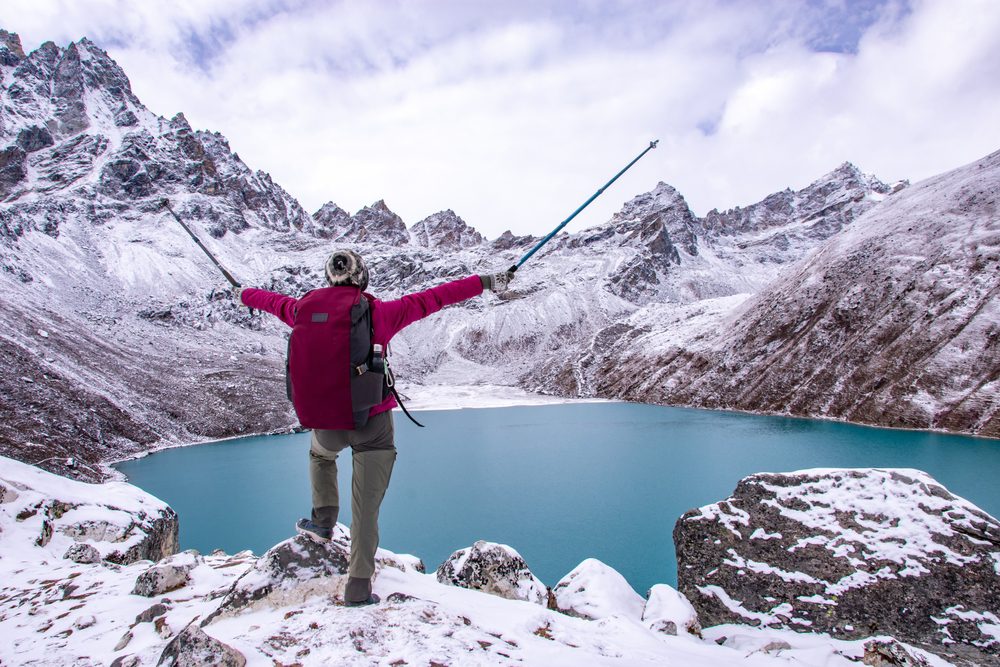
- Visit the sacred turquoise Gokyo Lakes — a chain of six glacial lakes between 4,700 and 5,000 metres that are among the most beautiful and spiritually significant high-altitude lakes in the entire Himalayan range
- Explore the magnificent Tengboche Monastery at 3,867 metres — the most important Buddhist monastery in the Khumbu, set against a backdrop of Ama Dablam, Everest, and Lhotse in one of the most dramatic monastery settings in the world
- Trek alongside smaller serene high-altitude lakes including Thangnak Lake, which reflect the surrounding peaks in their still waters and add a quieter, more meditative beauty to the upper sections of the route
- Enjoy distant views of Island Peak (Imja Tse) at 6,189 metres and Mera Peak rising above the southern Khumbu — a reminder of the climbing possibilities that extend beyond the trekking trails
- Spot Himalayan wildlife throughout the journey — Himalayan tahr on the rocky ridges, snowcock in the high alpine zones, yak herds grazing on the upper pastures, and a remarkable variety of endemic alpine plants in the lower valleys
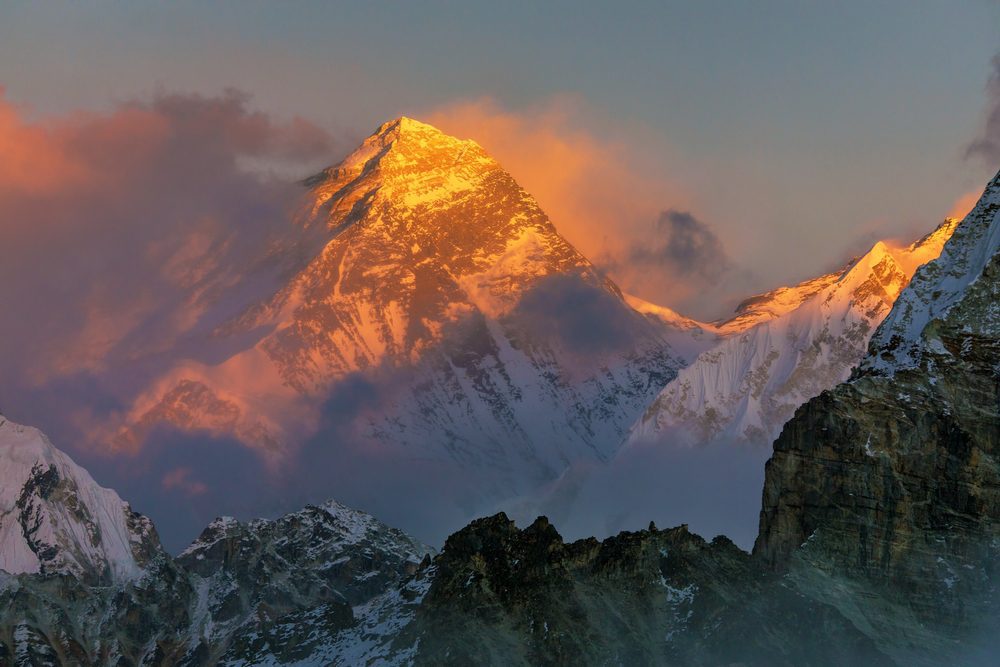
- Watch the sunset paint Ama Dablam, Cho Oyu, and the surrounding giants in deep gold and rose from the high ridges and teahouse windows of the upper Khumbu — moments that make the hard days entirely worthwhile
- Experience the full breadth and variety of the Everest region in a single continuous journey — from the lush rhododendron forests of the lower Dudh Koshi valley to the raw glacial terrain of the high passes and everything extraordinary in between
Itinerary
Fly Kathmandu to Lukla, Trek to Phakding (2,610m) 3-4 hr
The day begins early — mountain flights to Lukla depart in the morning when the air is still and the visibility at its clearest, so expect a pre-dawn breakfast and an early transfer to the airport where the excitement of the journey ahead starts to feel very real. The flight itself is one of the great Himalayan experiences before the trek has even properly begun — just 30 to 35 minutes in a small twin-propeller aircraft skimming low over forested ridges and river valleys as the mountains grow steadily larger in the window, culminating in the legendary approach to Tenzing-Hillary Airport at 2,860 metres where the short runway drops away at the end into a deep valley and the landing feels like nothing you’ve experienced on a commercial flight before. Touching down in Lukla to the crisp mountain air, the smell of juniper smoke, and the sound of yak bells is the moment the adventure truly starts — you are in the Khumbu now, and everything from here is on foot. After sorting packs, meeting the porter team, and a quick tea stop in one of Lukla’s small teahouses, the trail drops down through pine and rhododendron forest alongside the rushing turquoise waters of the Dudh Koshi river, crossing several suspension bridges draped in prayer flags as the valley opens up around you and the scale of the landscape begins to sink in. The walk to Phakding takes around three to four hours at a gentle acclimatisation pace — your first day on the trail is deliberately easy, designed to let your body begin adjusting to the altitude and your legs find their rhythm on the rocky mountain path before the bigger days ahead.
Stay overnight in Phakding
Trek from Phakding to Namche Bazaar (3,440m) [5-6 hrs]
After breakfast at Phakding, we will continue the trek northward up the Dudh Koshi river, crossing several suspension bridges and going through pine forests and native villages. At Monjo, you will officially enter Sagarmatha National Park, a UNESCO World Heritage Site. The trail leads on to the famous Hillary Suspension Bridge and then we are met with a steady and steep uphill climb through wooded switchbacks. At various places on the way up, we will get our first look at Mt. Everest peeking out behind ridges, which will be an unforgettable experience. Late in the afternoon we will arrive at Namche Bazaar, the colorful Sherpa town nestled in a natural amphitheater, where we will rest for the night. Stay overnight at Namche Bazaar.
Stay overnight in Namche Bazaar.
Trek from Namche Bazaar to Tengboche (3,867m) [5-6 hrs]
Your trek starts from Namche Bazaar to Tengboche after an early breakfast. The trail gently climbs and offers incredible views of Everest, Ama Dablam, and Thamserku along the way. As you walk through beautiful rhododendron and pine forests, you will pass many small villages and prayer flags fluttering in the wind. After crossing the Dudh Koshi River, the trail moves steeply toward Tengboche. Upon arrival, you will visit the famous Tengboche Monastery, which is the largest and most important monastery in the Everest region, set against a stunning mountain backdrop. You may even witness the monks performing evening prayers. It’s a peaceful and spiritual place to end the day.
Stay overnight in Tengboche.
Trek from Tengboche to Dingboche (4,410m) [5-6 hrs]
After a peaceful morning in Tengboche, we leave on our trek to Dingboche. The trail descends through a forest, crosses the Imja Khola river and climbs gradually to the village of Pangboche, one of the oldest settlements in the area, to arrive for lunch. You’ll be well impressed by the views of Ama Dablam, which seems to beckon to you just ahead, and Lhotse and Island Peak are distant figures but dominate areas of the broad background.
The landscape opens out shortly after Pangboche to a more alpine area with sparser forest to the tops of the mountains, the rocky land giving place to the broad and grassy plains of Dingboche, charming with its wide fields and grazier, with its charming of broad fields and wall-enclosed terraces, set prettily in the middle of sweeping mountains, giving to the mind a peace-inducing view. This village is often used for acclimatization exercises, furnished with a capital time and great quiet, much benefitting its exertions at such a geographical altitude. You will sleep here tonight in the walls of Dingboche, a peace-loving shelter surrounded by the unrivaled mountain scenery of Everest.
Stay overnight in Dingboche.
Acclimatization Day in Dingboche—Hike to Nangkartshang Peak (5,083m) [3-4 hrs]
This day is a rest day (the sixth) in Dingboche to allow your body time to acclimatize to the higher altitude. In the morning, you will begin a succession of days in Dingboche. In the morning, after having breakfast, you will enjoy a short, steady walk to Nangkartshang Peak, where you can see splendid views of Makalu, Island Peak, the village of Dingboche, and Lhotse, the giant rock that rises above Everest Mountain. This walk is rather steep up to the top, but it is easily done, and everybody can go so long as one never fails to take the great exertion required to enable one to enjoy the scenery on the whole way.
On attaining the top, it gives such a mutual reward, which improves its views seen about also at all quarters of the flat top of the mountain. You will spend the night by retracing your steps to Dingboche. Free for the rest of the day. On a leisurely day you can enjoy a walk about the village or, while absent during a hot drink, enjoy the rest of your overnight stay. In Dingboche, spend another night at the hotel to prepare for the next day, allowing you to rest and enjoy the beautiful scenery while benefiting your health from this experience.
Stay overnight in Dingboche.
Trek from Dingboche to Chhukung (4,730m) [3-4 hrs]
The walk of day 7 is shorter and easier, giving you a chance to relax and enjoy the beautiful mountain views as you head to Chhukung. The trail goes gently uphill through rocky paths and open meadows. Chhukung is a small, quiet village and an important stop because it’s where you’ll prepare to cross the Kongma La Pass later.
The village allows great views of the mountains that are close by, such as Island Peak and Lhotse, and it is a peaceful place to rest and prepare for the next part of your trek. Stay overnight here in the peace and fresh air of the mountains.
Stay overnight in Chhukung.
Cross Kongma La Pass (5,535m) – Trek to Lobuche (4,940m) [7-8 hrs]
The 8th day is a considerable and challenging day in crossing the Kongma La Pass, the highest of the three, being 5535 meters. Early in the morning is a steep ascent of the pass and although it is hard, there are lovely views from the top of its position looking down at large mountains like Lhotse, Makalu and Nuptse that are near you.
The way down from the top of the Pass is stony and passes over ice and glacier for some distance which although slow and sometimes dangerous, can be very pleasant. You will not notice the time fly by with the change of scenery about you. By the afternoon you will arrive at Lobuje, the village lying near the Khumbu Glacier. It is a long and tiring day, but to cross this high pass now is a wonderful achievement. You will be resting here overnight and preparing for the rest of your journey.
Stay overnight in Lobuje.
Trek from Lobuche to Everest Base Camp (5,364m) – Back to Gorak Shep (5,164m) [6-7 hrs]
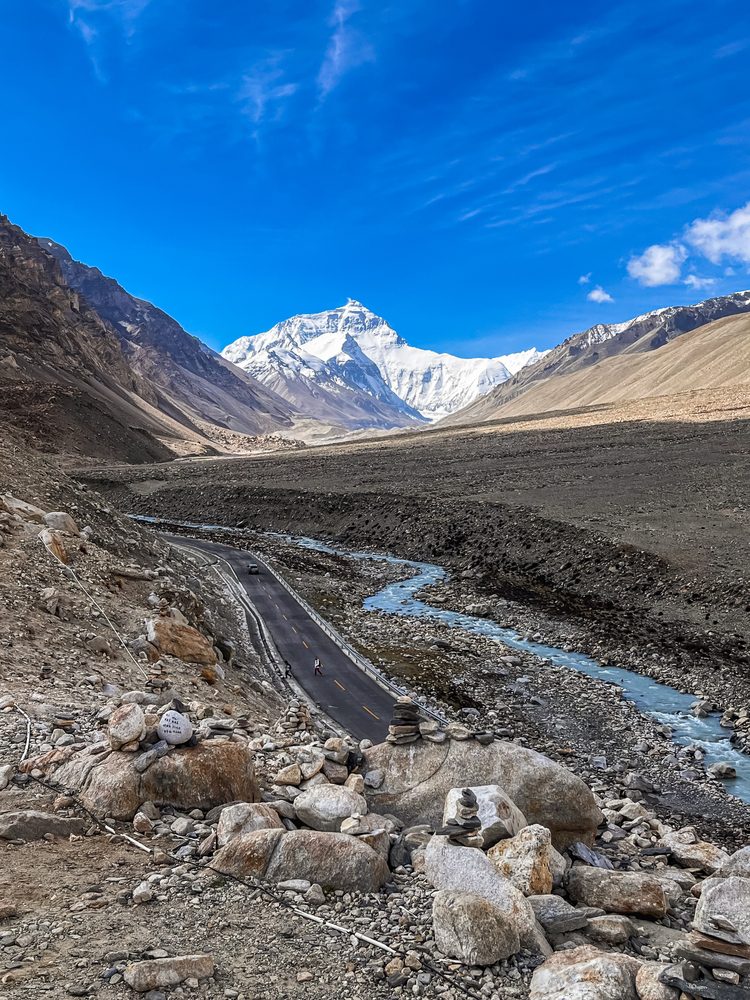
Today is one of the most delightful experiences of the journey, having gotten to Everest Base Camp, the point from which ascending climbers start toward the highest point of the world. The way from Lobuje is stony and follows the edge of the Khumbu Glacier until you reach the Base Camp and gives very fine views of the ice features and peaks covered with snow and the famous Khumbu Icefall.
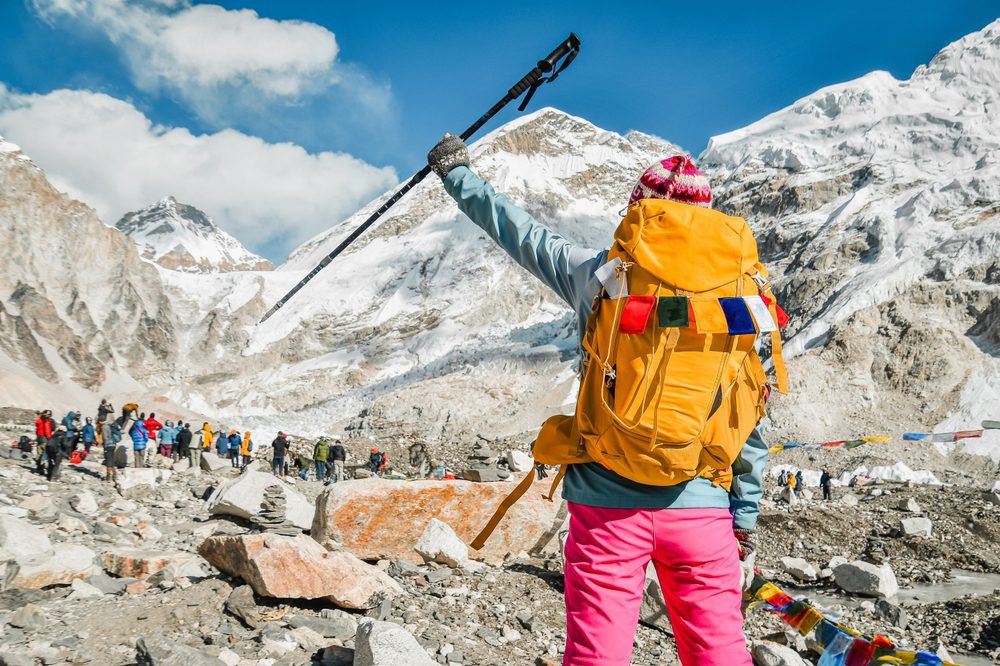
After a few hours of walking, you’ll arrive at base camp, where you can take photos, enjoy the views, and soak in the moment of standing at 5,364 meters. While you can’t see the top of Everest from here, being at its base is an experience in itself, and after spending time at the base camp you will walk back down to the small settlement known as Gorak Shep for your overnight stop. This is a long and tiring but unforgettable day.
Stay overnight in Gorak Shep.
Hike to Kala Patthar (5,545m) – Trek to Dzongla (4,830m) [6-7 hrs]
Rising early, you will start on your hike to Kala Patthar, which is regarded as the best viewing point for that magnificent sunrise over Everest. Although the climb is steep and cold, reaching the summit makes all the effort worthwhile. The morning sun will backlight the peaks surrounding Everest, Nuptse, and Pumori, providing you with close-up views. The trek offers one of the most breathtaking views.
Stay overnight in Dzongla.
Cross Cho La Pass (5,420m) – Trek to Dragnag (4,700m) [6-7 hrs]
This day of the three high passes of the Everest trek will be hard but exhilarating; it is the day that you are to cross Cho La Pass, which is the second high pass of the trek, at an altitude of 5,420 meters! The day starts early and the climb is steep that can be very icy and slippery and attention must be paid to keeping on your feet. The views from the top are magnificent, and snow-capped peaks and glaciers meet the eye.
After reaching the summit, the trail descends through rocky and glacial sections before arriving at Dragnag, which is a tiny settlement close to the Gokyo Glacier. It is a long, exhausting stage, but the magnificent mountain scenery makes it most rewarding. You will spend the night at Dragnag and prepare to explore the Gokyo area next.
Stay overnight in Dragnag.
Trek from Dragnag to Gokyo (4,790m) [3-4 hrs]
The trek is shorter and easier on the 12th day so that you can enjoy the breathtaking scenery. You will cross the Ngozumpa Glacier, which is the longest glacier in the whole of the Himalayas. This will take you to Gokyo, a beautiful village that is situated by a series of turquoise lakes. The Gokyo Lakes are the highest freshwater lake system in the world, and their deep blue color, which is surrounded by snow-capped peaks, is a wonder. Once the views and the necessary photographs have been taken, you will return to Gorak Shep for breakfast and then continue on your downward trek towards Dzongla, a small isolated village in the midst of mountains. The trails here are picturesque and not too crowded with visitors, and after the trek in the morning, it was a satisfying, peaceful, and restful walk. You will spend the night here in Dzongla, ready for crossing the Cho La Pass on the morrow.
Stay overnight in Gokyo.
Hike to Gokyo Ri (5,357m) – Explore Gokyo Valley
At 5,357 meters, Gokyo Ri is a famous lookout point that you will visit after breakfast. You will get up early and start your walk there. You will be rewarded with an amazing view of some of the world’s biggest peaks, such as Everest, Cho Oyu, Makalu, and Lhotse. The walk is steady but not too hard, and the view is breathtaking. After taking in the beautiful views of the mountains, you can walk through the peaceful Gokyo Valley to get to the 5th Gokyo Lake, which is also known for its beautiful blue water. Today is a great day to enjoy the peace and beauty of this unique part of the Himalayas on a walk. You’ll stop in Gokyo town to rest and spend the night.
Spend the night in Gokyo.
Cross Renjo La Pass (5,360m) – Trek to Lungden (4,380m) [7-8 hrs]
Today, you’ll go over your third and last high pass, Renjo La, which is 5,360 meters high. It is hard to climb, but the views of the Gokyo Lakes below and the beautiful Everest mountain range in the distance are well worth it.
Once you get to the top, you’ll start the long descent to Lungden, a Sherpa town that is hidden in beautiful mountains and known for being quiet and friendly. This quiet town is a great spot to rest and think about how wonderful the trip has been so far. You’ll spend the night in Lungden, where the quiet and clean mountain air will be wonderful.
Stay in Lungden for the night.
Trek from Lungden to Namche Bazaar (3,440m) [6-7 hrs]
You’ll start your long, mostly downhill walk back to Namche Bazaar on the 15th day of your trek. As you go down, the scenery changes as green fields and trees start to show up again. The air is warmer and lighter at lower elevations.
Along the way, you’ll see peaceful towns and beautiful mountain views. When you go back to Namche Bazaar, it feels like you’re going back to a busy place where you can rest, look around, and eat a satisfying meal. Today you hiked all day and now you’ll rest here for the night.
Spend the night in Namche Bazaar.
Trek from Namche Bazaar to Lukla (2,860m) [6-7 hrs]
As you walk back from Namche Bazaar today, you’ll go through the towns of Monjo and Phakding, which you know well, on your way to Lukla. The trail gets easier as you approach the river and mountains you saw on the way up.
When you reach Lukla, the end of your hike, you and your team will celebrate with a special dinner to share stories and memories. Before going back to Kathmandu, you’ll spend the night in Lukla and get some much-needed rest.
Stay in Lukla for the night.
Fly from Lukla to Kathmandu
Today, if the weather is excellent, you’ll fly back to Kathmandu from Lukla in the morning. The return trip is short, but it gives you one last chance to see beautiful mountains.
After your long hike, you’ll have time to rest and unwind in Kathmandu. You can also visit the city’s famous churches and cultural sites or go to busy markets to buy souvenirs. Take a break, eat something tasty, and enjoy the lively city life. You’ll feel proud of your amazing trip as you sleep in Kathmandu.
Stay in Kathmandu for the night.
Departure from Kathmandu
The final day marks the end of your unforgettable adventure in Nepal. After enjoying your final breakfast, you’ll be transferred to Tribhuvan International Airport for your international flight home.
As you prepare to leave, take a moment to reflect on all the amazing experiences you’ve had like walking among the world’s highest peaks, crossing challenging mountain passes, meeting friendly Sherpa people, and soaking in the rich culture of Nepal. The trek may be over, but the memories, friendships, and stories you’ve gained will stay with you forever. Safe travels, and may your journey home be as smooth and peaceful as your time in the Himalayas!
Customize this trip with help from our local travel specialist that matches your Interests.
Customize This TripInclusions
- Private car service to and from the airport. (International &domestics )
- Two nights at a standard hotel in Kathmandu with breakfast
- Three meals a day, including breakfast, lunch, and dinner.
- You will be provided with Trekking Lodges (Tea Houses).
- Khumbu Pasang Lhamu Rural Municipality.
- Kathmandu to Lukla and back to Kathmandu, or (Ramechap to Lukla, back to Kathmandu flight) with an airport transfer and airport tax within Nepal.
- A highly experienced, helpful, knowledgeable, friendly, English-speaking guide with all of his salary, food, drinks, lodging, transportation, and insurance covered.
- Setting up a service for an emergency helicopter (paid by your Travel Insurance company).
- You can rent a sleeping bag, a down jacket (if you don't have your own) & Duffel bag provided.
- Taxes and official costs are paid to the government.
- Certificate of completion of the trip
- Oximeter to check your pulse, oxygen saturation, and heart rate twice a day (very helpful to check for signs of Altitude Mountain Sickness, or AMS). This will make sure that your trek is in the safest hands possible, no matter how experienced you are.
- Food that you will eat in Kathmandu for lunch and dinner.
- The cost of a visa to enter Nepal is $30 for a 15-day stay.
- Your insurance for travel and medical care.
- International airfare, your expenses.
- All of the alcoholic and non-alcoholic cold and hot drinks you buy on the trek.
- All of the sweet desserts, like chocolate, cake, pie, and pudding.
- The tea houses offer hot showers and phone charging stations, with prices ranging from $2 to $5.
- Tip to the guide (Tipping is expected).
- A max 15kg bag is allowed on the flight to Lukla.
- One porter for two people will cost USD 320.
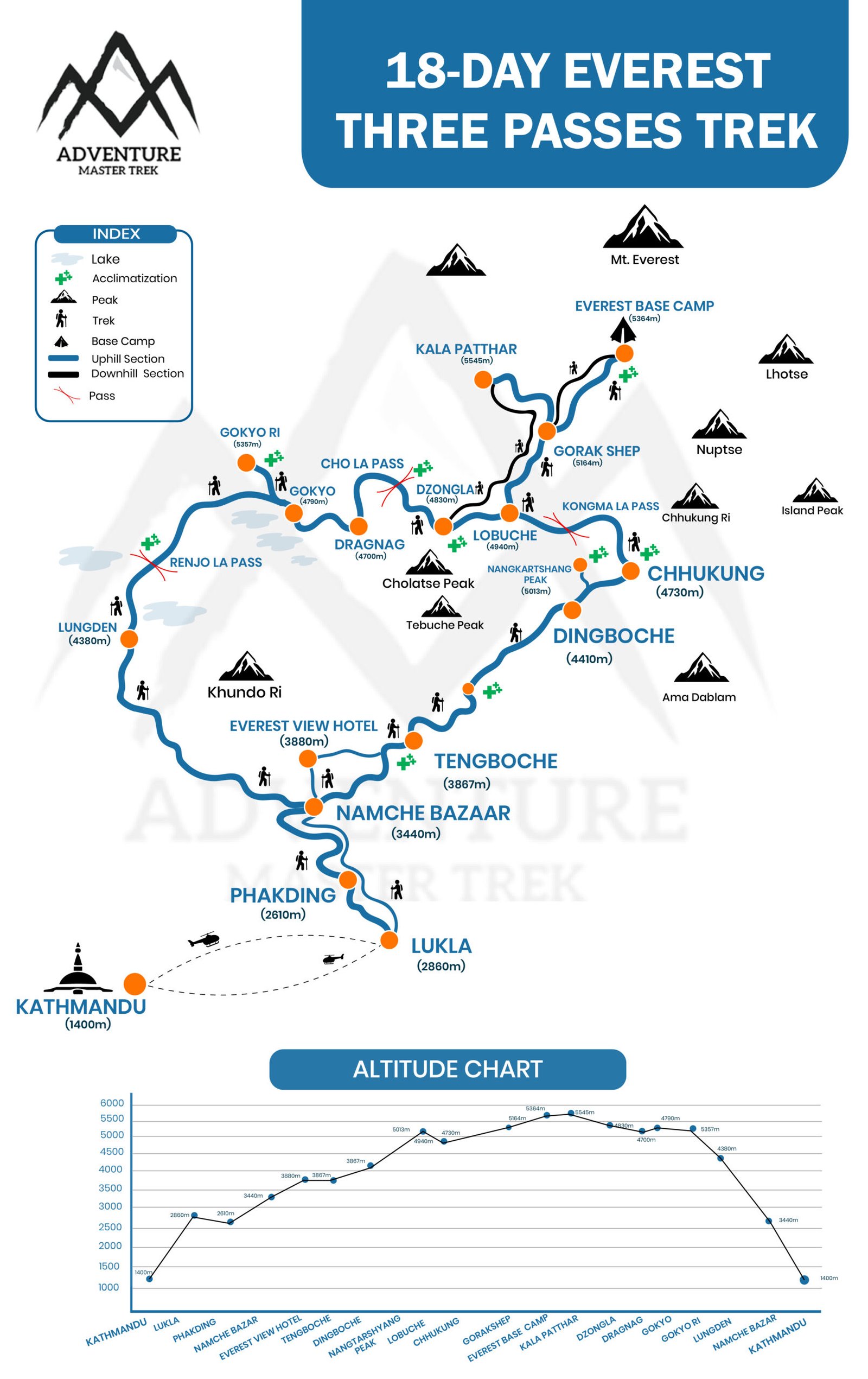
Maps
Navigate Your Journey
Good to Know
Important Tips
Every foreign citizen except the citizen of India will require a visa to enter Nepal. If you are
interested to trek on Nepal then you will have to go through the following process to get the tourist
visa of Nepal.
Accommodation During the Everest Three Pass Trek
Accommodation during the trek is at small lodges called teahouses, which are simple places run by the local people, where one can sleep and eat, and rest. Most rooms consist of two single beds with mattresses, pillows, and blankets. It is advisable to bring one’s personal sleeping bag, especially because of the cold weather of high altitudes. The bathrooms are usually shared, and hot shower accommodation in some places costs additional.
As you go higher, the teahouses become more basic, but they still offer warm meals like dal bhat (rice and lentils), noodles, soup, and tea. The dining room is often heated with a stove, and that’s where trekkers gather to eat and stay warm. Even though the rooms are simple, teahouses are friendly, welcoming, and a comfortable place to rest after a long day of trekking.
Acclimatisation is the single most important factor in the success of the Three Passes Trek, and the two dedicated rest days built into the itinerary at Namche Bazaar and Dingboche are not optional extras — they are the foundation on which everything above is built. Namche Bazaar at 3,440 metres is where most trekkers first genuinely feel the altitude, and the rest day here follows the well-established climb-high sleep-low principle — you’ll hike up to the Everest View Hotel ridge at around 3,880 metres or the hillside above town to stimulate your body’s red blood cell production, before returning to sleep at the same level, giving your physiology the adaptation stimulus it needs without the stress of staying higher overnight.
Beyond the science, the day in Namche is genuinely enjoyable — the town is the most vibrant stop on the entire route with bakeries, gear shops, a weekend market, and the excellent Sherpa Museum telling the story of Everest climbing and Khumbu culture better than anywhere else on the trail, and on a clear morning the ridge above town delivers your first proper views of Everest, Lhotse, and the iconic spire of Ama Dablam rising above the valley.
The second acclimatisation day in Dingboche at 4,410 metres is equally critical — by this point you are well above the altitude where AMS becomes a serious risk, and the day hike up to Nagarjun Hill at around 5,000 metres gives your body another significant adaptation push while delivering extraordinary views of Makalu, Lhotse, Island Peak, and the upper Imja Khola valley stretching away to the east. Drink three to four litres of water on both days, eat well even when your appetite is reduced, rest genuinely when your body asks for it, and communicate any symptoms — however minor they seem — to your guide immediately, because getting the acclimatisation right at Namche and Dingboche is what makes the three pass crossings, Kala Patthar, Gokyo Ri, and everything above 5,000 metres not just possible but safe.
Electricity and Internet Services on the Everest Trek
Electricity is available at most teahouses and lodges in the major villages along the route — Namche Bazaar, Tengboche, Dingboche, Lobuche, and Gokyo — typically costing $2 to $5 USD per device per charge, though some dining rooms offer free charging while you eat. Above these established villages, in more remote spots like Chhukung, Dzongla, and at the high passes themselves, electricity is either unavailable or highly unreliable, so you cannot count on it when you need it most. Power runs at 110V to 220V AC and a universal travel adapter is worth packing. The single most important piece of electrical preparation for this trek is a fully charged power bank of at least 20,000 mAh carried with you from Namche — it will keep your phone, camera, and headlamp batteries alive through the remote upper sections of the route where lodge charging simply isn’t an option.
| Location | Altitude | Electricity | Charging Cost | Wi-Fi | Wi-Fi Cost | Mobile Signal |
| Lukla | 2,860m | Reliable, hydropower | Free – $1 | Available, decent speed | Free – $2 | Ncell/NTC 4G good |
| Namche Bazaar | 3,440m | Reliable, hydro and solar | $1 – $2 | Widely available | $1 – $3 | Good 3G/4G |
| Tengboche | 3,867m | Solar, mostly reliable | $2 – $3 | Available, slow | $3 – $5 | Weak, patchy |
| Dingboche | 4,410m | Solar, limited hours | $2 – $3 | Available, card system | $3 – $5 | Weak, unreliable |
| Chhukung | 4,730m | Solar, weather dependent | $3 – $4 | Very limited | $5 – $7 | No reliable signal |
| Kongma La Pass | 5,535m | None | Power bank only | None | — | No signal |
| Lobuche | 4,940m | Solar, limited | $3 – $4 | Very limited, card system | $5 – $8 | No signal |
| Gorak Shep | 5,164m | Solar, very limited | $4 – $5 | Very slow, card system | $7 – $10 | No signal |
| Everest Base Camp | 5,364m | None | Power bank only | None | — | No signal |
| Kala Patthar | 5,545m | None | Power bank only | None | — | No signal |
| Dzongla | 4,830m | Solar, limited | $3 – $4 | Very limited | $5 – $7 | No signal |
| Chola Pass | 5,420m | None | Power bank only | None | — | No signal |
| Gokyo Village | 4,790m | Solar, limited | $3 – $5 | Available, card system | $5 – $10 | No signal |
| Gokyo Ri | 5,357m | None | Power bank only | None | — | No signal |
| Renjo La Pass | 5,360m | None | Power bank only | None | — | No signal |
| Lungden Village | 4,380m | Solar, limited | $3 – $4 | Very limited | $5 – $7 | No signal |
<span”font-weight: 400;”>Wi-Fi and Internet on the Three Passes Trek
Wi-Fi is available at teahouses in the main villages including Namche Bazaar, Tengboche, Dingboche, Lobuche, and Gokyo, typically costing $3 to $5 USD per hour or a flat daily fee depending on the lodge. Speeds are slow and the connection is unstable — perfectly adequate for messaging, emails, and small photo uploads but not reliable enough for video calls, streaming, or anything that demands consistent bandwidth. Above the established villages and on the high passes expect no connectivity at all. A local SIM card from Ncell or Nepal Telecom with a data package is often more reliable than lodge Wi-Fi in the lower and mid sections of the route, and downloading offline maps, guides, music, and anything else you need before leaving Namche is strongly recommended. Above Namche, treat internet access as an occasional bonus rather than a daily expectation — this trek is fundamentally about disconnecting, and the mountains more than make up for the lack of signal.
Group Size for Everest Three Passes Trek
The group size for the 18-day Everest Three Passes Trek can vary, but most trekkers go in small groups of 2 to 10 people. Smaller groups are more flexible, easier to manage, and create a more personal and enjoyable experience. You can also join a guided group trek, which usually has around 6 to 12 people, including a guide and porters.
Some experienced trekkers choose to go solo or with just one partner, but because the Three Passes route is challenging and remote, having a guide or being in a group is safer and more supportive. A smaller group also means less impact on the environment and better chances to connect with locals and fellow trekkers. Whether you go with friends, join a group, or hire a guide, the most important thing is to travel with people you’re comfortable with and who share a similar pace and trekking style.
Altitude Sickness during the trek to Everest Three Passes
Altitude sickness is a common concern on the Everest Trekking because the trail goes above 5,000 meters several times. As you go higher, the air has less oxygen, which can cause symptoms like headache, nausea, tiredness, loss of appetite, and trouble sleeping. This can happen to anyone, even if you’re fit. To avoid altitude sickness, it’s important to walk slowly, drink plenty of water, and take rest days to let your body adjust.
Most trekkers spend a couple of nights in places like Namche Bazaar and Dingboche to help with acclimatization. If symptoms worsen, the best treatment is to rest, descend to a lower altitude, and avoid pushing through serious signs. Having a guide or being with someone experienced can help in spotting early symptoms. With the right pace and care, most people complete the trek safely and enjoyably.
Difficulty in Everest Three Passes Trek
The Everest Three Passes Trek is a tough but amazing adventure. It is long and includes crossing three high mountain passes, which are very steep and can be snowy or icy. You will walk many hours every day, often in cold and windy weather, and the high altitude makes it harder to breathe and walk.
This Everest trek is best for people who are fit and have some hiking experience. You don’t need special climbing skills, but you do need to be ready to take your time, rest well, and listen to your body. With good preparation and a steady pace, most people can finish the trek and enjoy the incredible views and experience.
Safety and Security in the Everest Base Camp Trek
Safety and security on the Everest Base Camp Trek are essential because the trail goes through remote and high-altitude areas. The biggest risks are altitude sickness, bad weather, and difficult trails, so it’s important to be prepared and take things slowly. Trekking with a guide or a group helps a lot for safety, as they know the route well and can help if problems arise.
It is also important to carry a good first-aid kit and keep in touch with your team. The local people are friendly and welcoming, and there are rescue services available in case of emergencies, but they can take time to reach you. Overall, if you follow safety advice, listen to your body, and prepare well, the trek is safe and a wonderful experience.
Travel Insurance for Everest Three Passes Trek
It is highly recommended to have travel insurance while hiking the Everest Three Passes Trek, which covers the unique risks associated with trekking in remote, high-altitude regions. Your insurance should cover:
Emergency medical coverage: All of your altitude sickness-related medical costs should be covered by your emergency medical coverage when you travel over 2,500 meters.
Evacuation: You might require an emergency helicopter evacuation from a remote area to a hospital in Kathmandu if you have a serious injury or medical emergency.
Protection for trip interruptions: You should purchase short-term protection insurance if you have to cancel your trip due to a significant illness or injury while trekking.
Lost gear: Protection against losing personal items such as a phone, trekking equipment, or other belongings.
High-altitude trekking: Make sure you have insurance that specifically covers high-altitude trekking, as the Everest Three Passes Trek reaches elevations above 5,000 meters on passes like Kongma La, Cho La, and Renjo La.
Money Exchange for Everest Trek
When trekking the Everest Three Passes, it’s best to exchange most of your money into Nepalese Rupees (NPR) before you start or when you arrive in Kathmandu. Money exchange is easy in the city, with many banks and exchange shops offering good rates. Along the trek, there are a few places like Namche Bazaar where you can withdraw cash from ATMs, but they are limited and don’t always work.
It’s a good idea to carry enough cash with you for the whole trek, as credit cards are rarely accepted in teahouses. Also, keep smaller notes handy for buying snacks, drinks, or tips. Planning your money well will help you avoid problems and enjoy your trek without worry.
Permits Required for the Everest Three Passes Trek
Trekking the Everest Three Passes Trek requires several permits to ensure safety, conservation, and proper regulation of tourism. These permits help protect the natural environment and local communities while making sure trekkers have a safe and enjoyable experience. Mainly two permits are required SNP and the Khumbu permit. TIMS is typically not required but can be helpful in your safety and security. The required permits for the Everest Three High Pass trek are briefly discussed here:
Sagarmatha National Park Permit (SNP)
This permit is needed to enter Sagarmatha National Park, a protected area that covers much of the Everest region and the trekking route.
Khumbu Pasang Lhamu Rural Municipality Permit
The local administration of Khumbu Pasang Lhamu Rural Municipality, which includes some of the trekking region, has granted this permit. It promotes community development and local infrastructure.
TIMS (Trekkers’ Information Management System) Card
This is a general trekking permit required for all trekkers in Nepal. It helps authorities keep track of trekkers for safety and management.
If you are in Nepal, you can apply for these permits yourself or get help from a trekking agency. Many trekking agencies assist in securing all the necessary permits, making the process easier and quicker.
Required Documents
- A passport with at least 6 months’ validity
- Valid Nepal tourist visa
- 2 passport-sized photos
- Copies of all trekking permits
- Copy of travel insurance
Trekking Equipment for Everest Trekking
Having the right equipment is essential for the Everest Three Passes Trek. The trail is long, high, and the weather can change quickly. Good gear will keep you warm, safe, and comfortable through cold nights, strong sun, and windy or snowy conditions. Here’s a simple list of the must-have trekking equipment for this journey:
General
- A passport with at least 6 months’ validity and extra copies
- Permits: Sagarmatha National Park Permit and TIMS Card
- Sleeping bag (rated for -10°C or colder)
- Cash in Nepalese Rupees
- Duffel bag for the porter
- Daypack for essentials
Upper Body
- UV protection sunglasses
- Sun hat and warm woolen hat
- Neck gaiter or buff
Torso
- Moisture-wicking base layers
- Fleece or a light insulated jacket
- Down or synthetic insulated jacket
- Waterproof and windproof shell jacket
Lower Body
- Quick-dry trekking pants
- Thermal leggings or long johns
- Shorts for lower elevations
- Waterproof pants
Hands
- Light gloves
- Insulated waterproof gloves
Footwear
- Waterproof trekking boots with ankle support
- Wool or thermal socks
- Camp shoes or sandals
Undergarments
- Moisture-wicking underwear
- Sports bra (for women)
- Thermal base layer bottoms
Health and First Aid
- Altitude sickness medication (Diamox)
- Sunscreen and lip balm with high SPF
- Basic first aid kit
- Personal medication
Other Essentials
- Hand sanitizer
- Water bottles or hydration system (3+ liters)
- Toiletries (toothbrush, wet wipes, soap)
- Headlamp or flashlight with extra batteries
- Quick-dry towel
Optional
- Trekking poles
- Camera with extra batteries
- Energy snacks (bars, nuts, chocolate)
- Power bank
- Dry bags or waterproof covers
- Notebook or journal
- Earplugs and an eye mask
Booking Policy for the Everest Three Passes Trek
Advance Payment & Booking Confirmation
A 30% deposit of the total trip cost is required to secure your place on the Everest Three Passes Trek. This ensures your booking is confirmed and your adventure is reserved.
The remaining balance can be paid upon your arrival in Kathmandu, giving you flexibility and peace of mind. If you prefer, you can also choose to pay the full amount in advance for added convenience.
To finalize your reservation, please send:
- The trip cost deposit for the Everest Three Passes Trek (18 days)
- A clear electronic copy of your passport
- Additional details such as travel insurance information and an emergency contact
- Payment Methods
We offer several easy payment options to make your booking process smooth and secure:
- Online Payment: Use the secure payment gateway on our website for fast and safe transactions.
- Debit/Credit Cards: Visa, MasterCard, and other major cards are accepted. A 4% bank service fee applies. You may also transfer funds directly to our bank account via wire transfer (transaction fees may apply).
- Cash or Check: If you are already in Kathmandu, you can pay in cash or by check for added convenience.
- Final Payment
The remaining 70% balance must be paid before your trek begins. You can settle this payment when you arrive in Kathmandu by cash, card, or bank transfer, whichever works best for you.
- Booking Modifications & Rescheduling
If you need to change or reschedule your trek, please notify us at least 30 days in advance. Changes will be subject to availability and may incur additional fees depending on the circumstances.
- Travel Insurance Requirement
To ensure your safety and peace of mind throughout the challenging Everest Three Passes Trek, comprehensive travel insurance is mandatory. Your policy should cover emergency evacuation, high-altitude medical issues, lost or damaged equipment, trip cancellations, and delays.
- Last-Minute Booking
We do accept last-minute bookings up to 48 hours before departure, but availability is limited, especially during peak trekking seasons. To guarantee your spot on this popular 18-day trek, we strongly recommend booking well in advance.
Cancellation Policy for the Everest Three Passes Trek
If You Cancel More Than 60 Days Before the Trek
- You’ll usually get most or all of your money back (sometimes minus a small processing fee).
- Some companies refund 90%, others hold a small deposit
If You Cancel 30 to 59 Days Before
- You may get back 50% of what you paid.
- The other 50% is often kept to cover bookings and preparations.
If You Cancel Less Than 30 Days Before
- No refund in most cases.
- Some companies may offer you credit to use later within a year.
If the Company Cancels Due to Weather or Natural Disasters
- You’ll usually get a full refund or the option to reschedule.
- They won’t refund if you cancel because of personal reasons (like illness or change of plans), unless your travel insurance covers it.
Transportation on the Three Passes Trek
The Three Passes Trek begins with a flight from Kathmandu to Lukla — a thrilling 35 to 45 minute mountain flight on small 12 to 19 seat aircraft operated by airlines including Summit Air, Tara Air, Sita Air, and Yeti Airlines, landing at Tenzing-Hillary Airport at 2,860 metres for approximately $225 USD per person one way. Flights are entirely weather-dependent and delays or cancellations due to fog and strong winds are common, so always build at least one buffer day into your Kathmandu schedule on both ends of the trek — this is not optional on a route of this length and complexity. The alternative for those who want to avoid flight uncertainty entirely is an eight to twelve hour drive from Kathmandu to Salleri or Jiri followed by seven to ten days of trekking to reach Lukla on the classic old route — it adds significant time but provides much more gradual acclimatisation and passes through beautiful lower Khumbu countryside that the vast majority of trekkers never see.
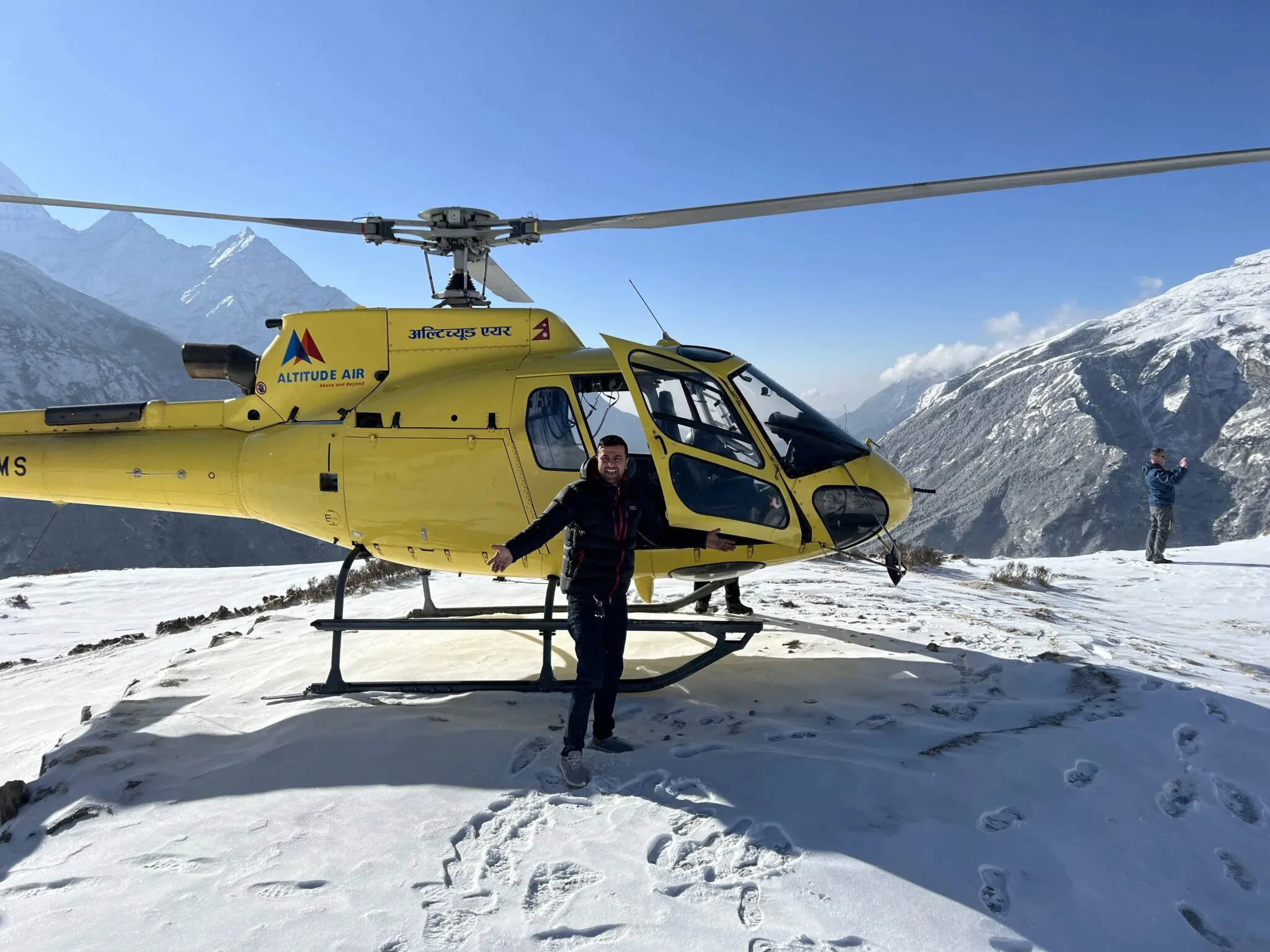
Once in Lukla, all movement is on foot — trails averaging 8 to 12 kilometres per day and four to seven hours of walking connect every village, teahouse, and pass on the route, with porters carrying loads of up to 20 to 25 kilograms and yaks and dzo transporting heavier supplies between the established villages. For the return journey or in the event of an emergency, helicopter transfers are available from Gokyo, Lobuche, and Gorak Shep back to Kathmandu at approximately $350 to $450 USD per person — a popular and practical option for trekkers who want to save time on the return or who need urgent medical evacuation, and a strong reminder of why comprehensive travel insurance covering helicopter rescue is absolutely non-negotiable on a route that spends this much time in remote high-altitude terrain.
Guide and Porter on the Three Passes Trek
Your guide on the Three Passes Trek is far more than a navigator — they are your safety net, your cultural interpreter, your acclimatisation manager, and the single most important factor in whether this expedition ends at the summit or at a lower altitude than planned. The Three Passes Trek is one of the most remote, high-altitude, and logistically complex trekking routes in Nepal, spending multiple consecutive days above 4,500 metres and crossing three passes above 5,300 metres where the consequences of a wrong decision or an undetected case of altitude sickness can escalate very quickly.
All guides on this route hold a valid licence from the Nepal Mountaineering Association or the Trekking Agencies Association of Nepal, carry wilderness first aid training, and have documented experience leading trekkers specifically through the Khumbu region — most are Sherpa by background, raised in the villages you pass through, and bring a depth of knowledge about this specific terrain, its weather patterns, its dangers, and its culture that simply cannot be replicated from a guidebook.
On a practical level your guide monitors your health every single day, manages the pace of the trek to protect against altitude sickness, makes the critical call on whether conditions on the passes are safe enough to cross, handles all lodge bookings and logistics along the route, and communicates with local communities on your behalf — while also bringing the entire journey to life through the stories, history, and cultural insight that transform a physically demanding trek into a genuinely enriching human experience. A private guide is strongly recommended for this route without exception — one-to-one attention at this altitude and in this terrain is not a luxury, it is a genuine safety consideration.
Your porter is the quiet foundation that makes the Three Passes Trek physically achievable for most people, and the difference between trekking with one and without is felt more acutely on this route than almost any other in Nepal. Carrying your main duffel bag up to the industry-standard maximum of 20 to 25 kilograms, your porter frees you to walk each day with just a light daypack — a difference that becomes increasingly significant as the trek progresses into its second week and the cumulative fatigue of consecutive high-altitude days begins to build. Most porters working this circuit are local men from the Khumbu or surrounding Solukhumbu region with years of experience on these specific trails, and their familiarity with every lodge, every shortcut, and every shift in the mountain weather is an asset that extends well beyond simply carrying a bag.
The standard daily rate is $20 to $25 USD fully inclusive of their food, accommodation, and insurance, with a tip of at least $5 to $8 per day expected and genuinely appreciated at the end of the trek — for a person who has carried your belongings over three passes above 5,300 metres in all conditions, it is the very least they deserve. For a solo trekker the standard arrangement is one guide and one porter, scaling to one guide and two porters for groups of two to four people, with an additional assistant guide added for every four to five members on larger departures — and on the pass crossing days in particular, having the right ratio of experienced support to trekkers is a safety consideration that no reputable agency should compromise on.
FAQs
How long does the Everest Three Passes trek take?
The Everest Three Passes trek usually takes about 18 days. This includes time for resting and acclimatizing your body to the high altitudes to avoid sickness.
How hard is the Everest Three Passes trek?
The Everest Three Passes trek is difficult because of the high altitudes, long walking days (6-8 hours), and sometimes rough or snowy trails. You need to be physically fit and mentally prepared.
What are the three passes I will cross?
You’ll cross Kongma La (5,535m), Cho La (5,420m), and Renjo La (5,360m). These passes are steep and can be covered with snow or ice depending on the season.
Is hiring a guide necessary?
A guide is not required by law, but having a guide is highly recommended. Guides help with navigation, safety, and local knowledge, and can assist if you get sick or injured.
What permits do I need for the trek?
You’ll need a Sagarmatha National Park Permit and a TIMS (Trekkers’ Information Management System) Card. These permits help protect the environment and keep track of trekkers for safety.
How high will I be trekking?
The passes are all above 5,300 meters (around 17,400 feet), which is very high and means you need to be careful with altitude sickness.
What is altitude sickness, and how can I avoid it?
Altitude sickness happens when your body struggles to adjust to low oxygen at high elevations. Symptoms include headache, nausea, dizziness, and fatigue. To avoid it, walk slowly, rest often, stay hydrated, and don’t climb higher too quickly.
Where do I sleep during the trek?
You’ll stay in teahouses, which are simple lodges or guesthouses offering basic rooms, food, and a warm place to rest.
What food will be available on the trek?
You’ll mostly find local dishes like dal bhat (rice and lentils), noodles, soups, and momos (dumplings). Food is nutritious and filling to keep your energy levels up.
Can I charge my phone or camera?
Yes, but electricity is limited, and you often have to pay to charge your devices. Carrying a power bank is a good idea for backup.
Is the internet available on the trail?
Wi-Fi is available in some villages but is often slow or unreliable, especially at higher altitudes.
What clothes and gear should I bring?
You should bring layers, moisture-wicking base layers, warm fleece or down jackets, waterproof jackets, sturdy trekking boots, hats, gloves, and a warm sleeping bag.
How much does the trek cost?
The costs can vary depending on guides, accommodation, permits, food, and flights. The budget to cover all these, for emergencies or tips, can cost you extra.
Can I trek alone?
You can, but trekking with a guide or group is safer and more enjoyable. Solo trekking increases risks if you get sick or injured.
How fit do I need to be?
You need good fitness because of long walking days, steep climbs, and high altitude. Training beforehand helps a lot.
Is it safe to trek alone?
Solo trekking is riskier because you have no one to help if you get altitude sickness or an injury. It’s safer with a guide or group.
How do I get to the starting point?
Most trekkers fly from Kathmandu to Lukla, a small mountain airport near the Everest region. Flights are weather-dependent.
What kind of accommodation is on the trail?
Teahouses offer basic rooms with simple beds and shared bathrooms. Facilities are more basic the higher you go.
What if there is an emergency?
Emergency rescues, including helicopter evacuations, are available but can be delayed by weather or location. Guides and trekking agencies usually assist in emergencies.
Can I drink water from the taps?
It is safer to purify water by boiling, using filters, or water purification tablets to avoid stomach illnesses.
Are ATMs available along the trek?
ATMs are only in bigger villages like Namche Bazaar. You should carry enough cash to cover expenses in more remote areas.
Should I bring trekking poles?
Yes, trekking poles help reduce strain on your knees, improve balance, and make walking on steep or uneven terrain easier.
Do I need travel insurance?
Yes, you must have travel insurance that covers high-altitude trekking, medical emergencies, and helicopter evacuation. It’s very important for your safety.
What is the total distance of the Three Passes Trek?
The total trekking distance is approximately 160 to 180 kilometres depending on the exact route taken, side trips included, and whether the Chhukung Ri or Gokyo Ri extensions are added.
What are the three passes on this trek?
The three passes are Kongma La (5,535m), Chola Pass (5,420m), and Renjo La (5,360m) — each crossing a different high-altitude ridge and connecting the major valleys of the Khumbu region.
What are the major highlights?
The standout highlights are Everest Base Camp, Kala Patthar sunrise, Gokyo Ri panorama, the turquoise Gokyo Lakes, the three dramatic pass crossings, and the Ngozumpa Glacier — the longest glacier in Nepal.
Is the Three Passes Trek suitable for beginners?
No — this is one of the most demanding trekking routes in Nepal and is best suited to trekkers with previous high-altitude experience above 4,000 metres, strong fitness, and a genuine understanding of altitude sickness risks.
What type of accommodation is available?
Accommodation is in teahouses and community lodges throughout — basic but comfortable twin rooms with shared bathrooms, thick blankets, and a heated dining room serving hot meals at every stop.
Is Wi-Fi and electricity available on the trek?
Wi-Fi and electricity are available in the major villages like Namche, Dingboche, Lobuche, and Gokyo for a small fee, but above these villages both become unreliable or unavailable entirely — carry a fully charged power bank from Namche.
Is food safe to eat at high altitude?
Stick to freshly cooked hot meals at teahouses, avoid tap and stream water entirely, and always drink boiled or bottled water — food safety is generally good on this route but your immune system is more vulnerable at altitude.
How much should I budget for food per day?
A realistic daily food budget is $20 to $30 USD per person covering breakfast, lunch, dinner, and hot drinks, though costs rise steadily the higher you climb and snacks or extras will push the figure higher.
What is the weather like on the Three Passes Trek?
Spring and autumn deliver the best conditions — clear skies, dry trails, and sharp mountain views — while winter brings brutal cold on the passes and the monsoon makes the entire route inadvisable with heavy rain, poor visibility, and dangerous trail conditions.
Do I need crampons or an ice axe?
Crampons or microspikes are strongly recommended for Chola Pass which crosses glaciated terrain, particularly in spring when the snow is hard — a full ice axe is not required for the standard route but your guide will advise based on current conditions.
How do I prevent altitude sickness?
Ascend slowly following the itinerary, drink three to four litres of water daily, avoid alcohol in the first week, eat regular meals, follow the climb-high sleep-low principle on acclimatisation days, and tell your guide immediately if you feel any symptoms developing.
How much weight should I carry in my daypack?
Your daypack on walking days should weigh no more than 6 to 8 kilograms — containing your water, snacks, layers, camera, first aid essentials, and personal items — with your main duffel carried by your porter.
Is tipping mandatory for teahouses, guides, and porters?
Tipping is not legally mandatory but is deeply culturally expected and makes a genuine difference to the livelihoods of the people who work hard to make your trek possible — a fair tip is $5 to $8 per day for your porter and $8 to $12 per day for your guide, given at the end of the trek.

Reviews
What Our Travelers Say


Based on 2 ratings
5




View Our Similar Packages
Discover our top tours, loved by thousands of travelers annually. Choose the adventure that inspires you and embark on a journey tailored to your desires.

 Nepal
 15 Days Days

Add Review
Reviewing for 18-Day Everest Three Passes TrekRequest a Callback - 18-Day Everest Three Passes Trek
Submit the form and we will be back to you shortly
Request a Callback - 18-Day Everest Three Passes Trek
Submit the form and we will be back to you shortly
Narayanhiti Palace Museum

Narayanhiti Palace Museum


