









Helicopter Tour to Everest Base Camp: Private Charter vs Group Sharing — Which One Is Actually Worth It?
Compare Everest Base Camp helicopter tours: private charter vs group sharing. Discover costs, comfort, and which option is truly worth it.
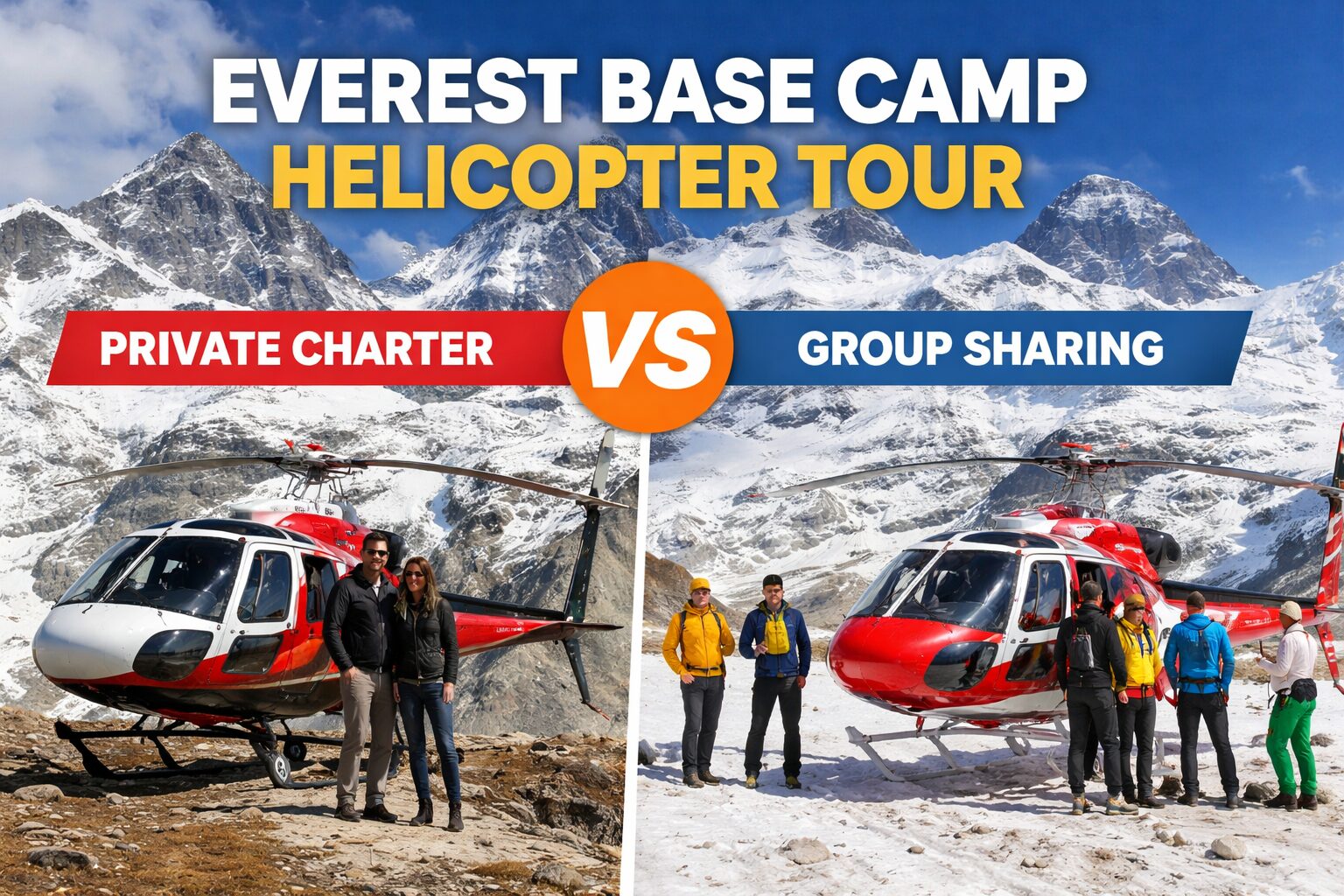
-
 Adventure Master Trek
-
27 March, 2026
-
13 mins read
-
952 Views
-
0 Comments


A real breakdown of costs, experiences, and who each option actually suits
Here is a question that comes up constantly among people planning an Everest helicopter tour, and it rarely gets answered honestly: Should you book a private charter or join a group sharing flight?
Most websites will give you a price table and call it a day. But the real answer depends on who you are, who you are travelling with, what you actually want from the experience, and — let’s be direct about it — how much the cost difference matters to you. Because the gap between the two options is not small. Depending on how you structure the booking, the difference between a group sharing seat and a private charter can range from USD 200 to well over USD 4,000.
This guide covers everything. Actual 2026 prices, how the cost structure really works, what you genuinely get differently on each option, who each one suits, and the specific scenarios where each choice makes obvious sense. By the end, the right answer for your situation should be clear.
First, Understand How Helicopter Pricing Actually Works
Before comparing private versus group, it helps to understand the fundamental cost structure — because it explains almost everything about the pricing difference between the two options.
A standard Everest helicopter tour uses an Airbus AS350 B3e or a similar high-altitude aircraft. This helicopter carries a maximum of five passengers and is specifically built for mountain aviation — it handles the thin air, unpredictable winds, and extreme altitude of the Everest region better than almost any other civilian aircraft in the world. The total cost to charter one of these helicopters for the full Kathmandu-to-Everest round trip runs at roughly USD 4,500 to USD 5,500 for the entire aircraft, depending on the operator, the season, and the specific route flown.
That full charter price is the number everything else is derived from.
When you join a group sharing flight, that total charter cost gets divided across five passengers. Each person pays their proportional share, and suddenly a USD 4,500 to USD 5,500 flight becomes roughly USD 900 to USD 1,100 per person in raw charter costs — before the operator adds their service margin, the Sagarmatha National Park permit fees, fuel surcharges, and applicable taxes. That is why group sharing per-person prices land where they do.
When you book a private charter, the entire aircraft is reserved exclusively for your party. Nobody else joins. Nobody else’s preferences factor into the timing, the pace, or the experience. You are paying for the full helicopter regardless of how many people from your group are in it.
The economics are clean and consistent. Five people sharing a helicopter is one of the most accessible bucket-list experiences in the world. One person flying alone on a private charter is one of the more expensive half-days available in travel. Everything in between is a sliding scale depending on group size — and that sliding scale is precisely where the interesting decisions happen.
Group Sharing: What You Pay and What the Experience Is Really Like
Group sharing is how the vast majority of individual travellers, solo flyers, and couples do the Everest helicopter tour. It is the standard option, and for good reason — it works well for most people.
Current 2026 pricing for group sharing tours sits at roughly USD 1,150 to USD 1,499 per person depending on the season, operator, and whether you are travelling in the winter low season or peak autumn and spring windows. The lowest rates appear in December and January. The highest appears in October and April. The difference between those extremes is real money — up to USD 350 per person for the same route and the same experience.
What you get on a group sharing flight is the complete standard itinerary: departure from Kathmandu’s domestic terminal at Tribhuvan International Airport, a brief refuelling stop at Lukla, a landing at Kala Patthar at 5,545 metres with around 10 to 15 minutes on the ground, an overfly of Everest Base Camp and the Khumbu Glacier, and then the breakfast stop at Hotel Everest View at Syangboche before the return to Kathmandu. The total door-to-door experience takes roughly five to six hours.
The helicopter holds a maximum of five passengers. Every seat is a window seat — the cabin is not wide enough for anyone to be sitting in the middle with an obstructed view. On that specific point, every passenger on a group-sharing flight gets the same view in the air as they would on a private charter. The mountain looks identical from either option during the flight itself.
What the group sharing experience actually feels like in practice is something most travel sites gloss over entirely. There is a genuine quality to sharing the first sight of Everest with four other people who are experiencing it for the first time alongside you. The collective reaction — the instinctive intake of breath when the summit comes into view, the simultaneous scramble for cameras, the eye contact across the cabin that says “are you seeing what I’m seeing” — is its own kind of experience. Some travellers actively prefer it. It adds a human dimension to a moment that could otherwise feel solitary.
The honest downsides are worth naming too. The schedule on a group sharing departure is fixed. The landing at Kala Patthar lasts 10 to 15 minutes for everyone, regardless of whether you need more time. The departure time is set by the operator. The helicopter does not take off until all seats are filled, which means if your departure has a last-minute cancellation, there may be a short wait while a replacement passenger is arranged. These are minor inconveniences in most cases, but they are real.
Group sharing suits solo travellers, couples watching their budget, anyone comfortable with a structured itinerary, and anyone for whom the per-person saving of USD 200 to USD 3,000 compared to a private option is meaningful.
Private Charter: What You Pay and What Is Actually Different
A private charter means the entire helicopter belongs to your group for the full duration of the tour. No strangers in the cabin. No waiting for other passengers to show up. No compromising on pace or timing or how long you stand at the summit viewpoint.
The current 2026 pricing for a private Everest helicopter tour runs at approximately USD 4,500 to USD 5,500 for the entire aircraft on the standard Kathmandu round-trip route. Some operators charge higher for premium itineraries that include additional landing points such as Gokyo Lakes or an extended Base Camp ground stop. The key thing to understand — and this trips people up constantly — is that this is the price per helicopter, not per person.
This is where maths becomes genuinely interesting.
A solo traveller on a private charter pays the full USD 4,500 to USD 5,500 alone. A couple splits it two ways: USD 2,250 to USD 2,750 each. Three people: USD 1,500 to USD 1,833 each. Four people: USD 1,125 to USD 1,375 each. Five people: USD 900 to USD 1,100 each — which is actually cheaper than many group sharing rates.
That last figure is worth pausing on. A group of five booking a private charter together can end up paying less per person than five individuals each buying a group sharing seat from an operator who needs to make their own margin on top of the base charter cost. The private charter becomes the better deal on both dimensions — lower cost per person and a completely exclusive experience.
What does a private charter actually deliver differently beyond the number of people in the helicopter? The real differences come down to three things: flexibility, time, and space.
Flexibility means you choose the departure time. If you want to be at Kala Patthar at first light when the sun is just catching the summit, you book a dawn departure. If your schedule requires a later morning flight, that conversation is possible. The operator works around your preferences rather than slotting you into a fixed window.
Time means your landing at Kala Patthar is not governed by a shared 10-to-15-minute window. Within the limits of what the altitude permits — and those limits are real; the helicopter cannot idle at 5,545 metres indefinitely with a cooling engine — you have more scope to extend the stop than a group sharing departure would allow. For travellers who know they will want longer than 10 minutes at the top of the world, this matters.
Space means the experience is entirely your own. Whether it is a proposal, a significant anniversary, a family milestone, a photography expedition, or simply the preference not to share an important moment with strangers, the cabin belongs entirely to your group. Nobody else is in your frame. Nobody else’s agenda influences the pace. The helicopter and everything in it is yours.
Private charter suits families with children, couples marking something meaningful, serious photographers who need time and freedom at the landing points, travellers who strongly prefer schedule control, and — most practically — any group of four or five people who can split the charter cost and end up paying comparable or lower per-person rates than group sharing.
Running the Numbers Side by Side
The clearest way to make this decision is to look at total and per-person costs across different group sizes. The numbers below use a mid-range private charter cost of USD 5,000 and a mid-range group sharing cost of USD 1,300 per person.
Solo traveller: Group sharing costs USD 1,300. A private charter costs USD 5,000. The group sharing option wins by a significant margin unless total privacy is an absolute non-negotiable.
Two people: Group sharing total is USD 2,600. Private charter total is USD 5,000 — USD 2,500 per person. The group option is still cheaper overall, though the gap has narrowed and the flexibility consideration starts carrying more weight.
Three people: Group sharing total is USD 3,900. Private charter total is USD 5,000 — roughly USD 1,667 per person. The price gap per person is now under USD 370, and for three people sharing something meaningful, the private option starts looking more reasonable.
Four people: Group sharing total is USD 5,200. Private charter total is USD 5,000. At four people, the private charter is now cheaper in total and cheaper per person — USD 1,250 versus USD 1,300 — while delivering a completely private experience. This is the point where the decision becomes straightforward for most groups.
Five people: Group sharing total is USD 6,500. Private charter total is USD 5,000 — USD 1,000 per person. The private charter is USD 300 per person cheaper than group sharing and the helicopter belongs entirely to your group. There is genuinely no reason for a group of five to choose group sharing on cost grounds.
The pattern is consistent. The economics of private charter improve significantly as group size grows. The break-even point sits somewhere around three to four people. Above that, private wins on both price and experience simultaneously.
What Neither Option Includes — and What to Budget Extra
This catches travellers off guard frequently, and it applies equally to both group sharing and private charters.
The Sagarmatha National Park entry permit is required for all visitors entering the Everest region, and it is almost never included in the advertised tour price. The Khumbu Pasang Lhamuu Rural Municipality conservation and infrastructure tax is also charged separately. Together, these fees run at approximately NPR 5,000 per person — around USD 37 to USD 40 at current exchange rates.
Breakfast at Hotel Everest View at the Syangboche stop costs approximately NPR 4,000 per person — around USD 30. It is not included in the tour price by any operator, but it is absolutely worth paying for. The food is good, the view across the terrace is one of the finest mountain vistas on earth, and you have around an hour there to genuinely sit with the experience rather than rush through it.
Domestic airport taxes add a small additional charge. Total extras per person come to approximately USD 65 to USD 75 on top of whatever the headline tour price is.
Always confirm exactly what is and is not included when comparing quotes from different operators. Two operators quoting the same headline price can represent meaningfully different total costs once extras are accounted for. Always ask: does the price include the national park permit, the municipal tax, and breakfast? Most honest operators will tell you clearly. If the answer is vague, that is worth noting.
Bring Nepali Rupees in cash on the day for permits and breakfast. Card acceptance at the permit checkpoints and at Hotel Everest View is not reliable enough to depend on.
Practical Booking Advice for Both Options
Contact operators directly rather than relying solely on online booking platforms. WhatsApp is standard practice across Nepal’s helicopter tourism industry, and most operators respond quickly. Asking for current rates directly — particularly in the low season months of December through February — often produces better pricing than the publicly listed rates, because operators are genuinely motivated to fill capacity and are more flexible on price than their websites suggest.
For peak season travel in October, April, and the surrounding weeks, advance booking of at least two to three months is genuinely recommended. Group sharing seats in October fill up. Private charter slots at preferred departure times get taken. Leaving this to the last few weeks in peak season means paying more for less flexibility.
For low season travel, the dynamic reverses. Flexibility in timing and direct negotiation produce the best results. Operators may combine you with another booking or offer a discount to fill a helicopter rather than delay a departure.
For private charters specifically, ask about the possibility of additional stops or route variations. Some operators can add a Gokyo Lakes overfly, a closer pass over the Khumbu Icefall, or an extended ground stop at Base Camp for a modest additional cost. These conversations are only possible on a private charter — but you have to ask for them.
A deposit of around 40 percent is standard to confirm a booking, with the balance paid before the flight either online or in Kathmandu. Confirm the cancellation policy clearly, particularly regarding weather. Reputable operators offer full refunds or free rescheduling when flights cannot operate safely due to weather conditions — this should be confirmed in writing before any money changes hands.
The Bottom Line
The Everest helicopter tour is one experience. The mountain is the same, the views are the same, the moment at Kala Patthar is the same regardless of which option you choose. What changes between group sharing and private charter is who is in the helicopter with you, how much control you have over the timing and pace, and how the total cost divides across your party.
For solo travellers and couples, group sharing delivers the full experience at the most accessible price point available, and the shared element of it has its own genuine quality that should not be dismissed.
For groups of four or five, the private charter calculation is almost always more compelling — similar or lower per-person cost, complete schedule control, and an experience that belongs entirely to your group.
For groups of two or three marking something significant — a proposal, a milestone, an anniversary — the premium for privacy may well be worth every dollar, entirely separate from the maths.
Do the calculation for your specific group size. Contact two or three operators directly and ask for current rates on both options for your travel dates. The right answer for your situation will become clear quickly.
The mountain deserves your full attention when you get there. Make sure the decision you make now means that’s exactly what it gets.
Comments (0)
Write a comment- First, Understand How Helicopter Pricing Actually Works
- Group Sharing: What You Pay and What the Experience Is Really Like
- Private Charter: What You Pay and What Is Actually Different
- Running the Numbers Side by Side
- What Neither Option Includes — and What to Budget Extra
- Practical Booking Advice for Both Options
- The Bottom Line
Read the latest Blogs & Insights
Explore our collection of articles and insights to gain in-depth travel knowledge, expert advice, and stay updated on the latest trends and tips.




No comments yet.