









Annapurna Base Camp Helicopter Tour Cost 2026/2027


Quick Trip Facts


Overview of Annapurna Base Camp Helicopter Tour
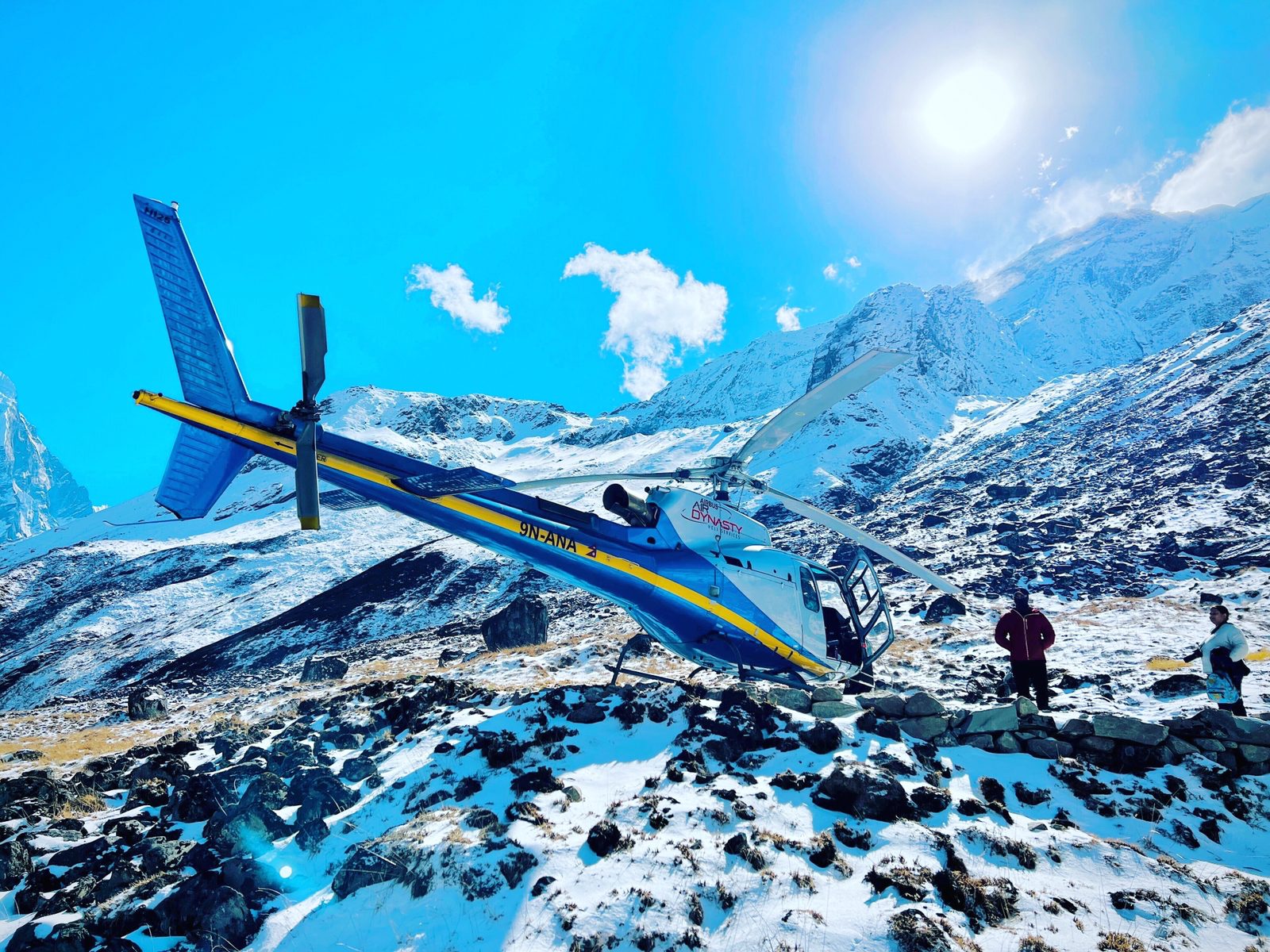
Imagine this: It’s dawn in Pokhara. You’re in a helicopter climbing toward the Himalayas. Thirty minutes later, you’re standing at 4,130 meters – 13,550 feet – surrounded by some of Earth’s most stunning mountains. You can see Annapurna South rising like a white pyramid. Machapuchare (Fishtail Mountain) juts dramatically into the sky. All around you, silence. Pure mountain silence. Just you, the peaks, and the thin air.
This isn’t a fantasy. This is your morning.
You start early. 6:00 AM pickup from your Pokhara hotel. Our driver is friendly, not rushed. The ride to the helipad takes twenty minutes. You’re already seeing the mountains in the distance, their peaks glowing as the sun rises. At the helipad, our crew welcomes you warmly. There’s a safety briefing – nothing scary, just practical stuff so you know what to expect. Then comes breakfast. Real breakfast. Hot eggs, fresh bread, fruit, coffee, tea. Not some sad hotel toast. Real food to fuel you for what’s coming.
By 7:00 AM, you’re ready. You walk to the helicopter. It’s modern, clean, impressive-looking. Our crew helps you aboard, secures your harness, settles you into your seat. The windows are huge. You can see mountains already. The engines fire up. There’s a vibration, a low rumble, and then – you’re lifting off. Pokhara drops away beneath you. You’re climbing.
What happens next is magic. The landscape transforms beneath you. Agricultural fields disappear. Forests thin out. Rivers that looked like lines on a map become silver threads winding through valleys. Small villages shrink to toy-sized dots. You’re watching Nepal’s geography change in real-time – from lowland green to high-altitude white.
Then they appear. The mountains. Not in the distance anymore. Right there. Massive. White. Real. Annapurna South is enormous. Machapuchare has this distinctive two-pronged peak – you see why they call it Fishtail. Hiunchuli stands nearby, dramatic and steep. Your heart rate picks up. You’re flying alongside these mountains. Not looking at pictures. Not reading about them. Flying alongside them. Your camera is clicking. Your phone is recording. This is it. This is what you came for.
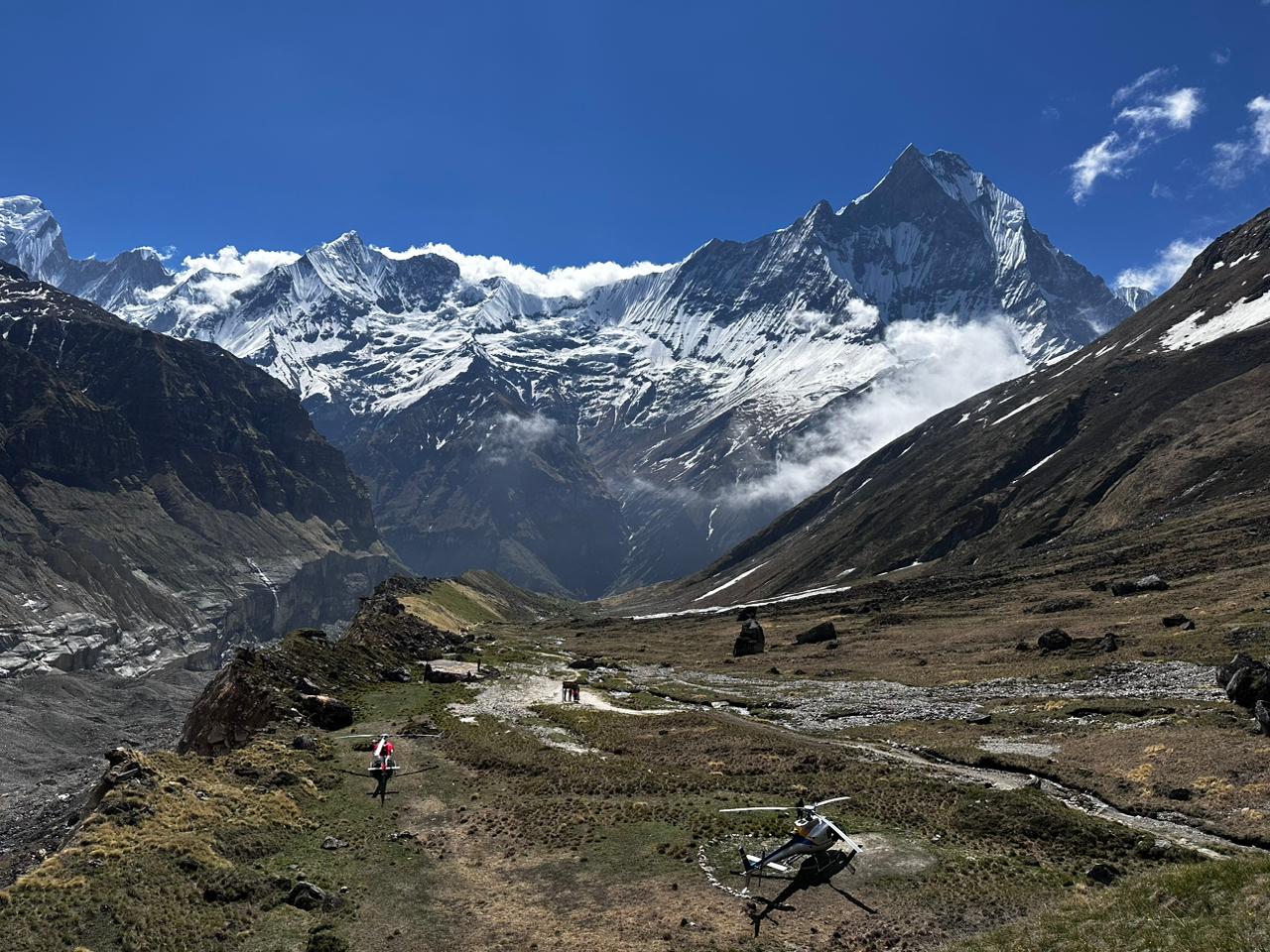
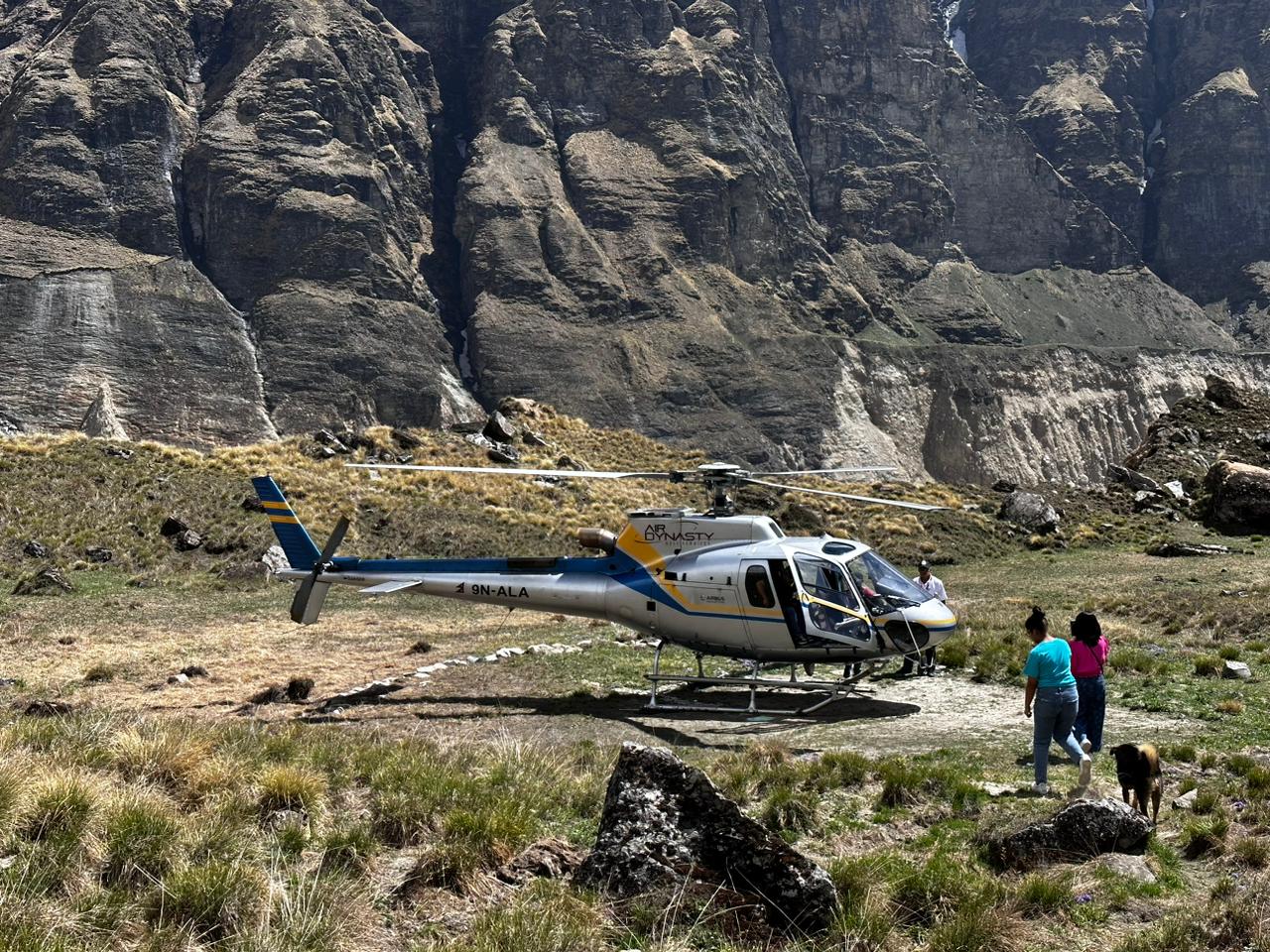
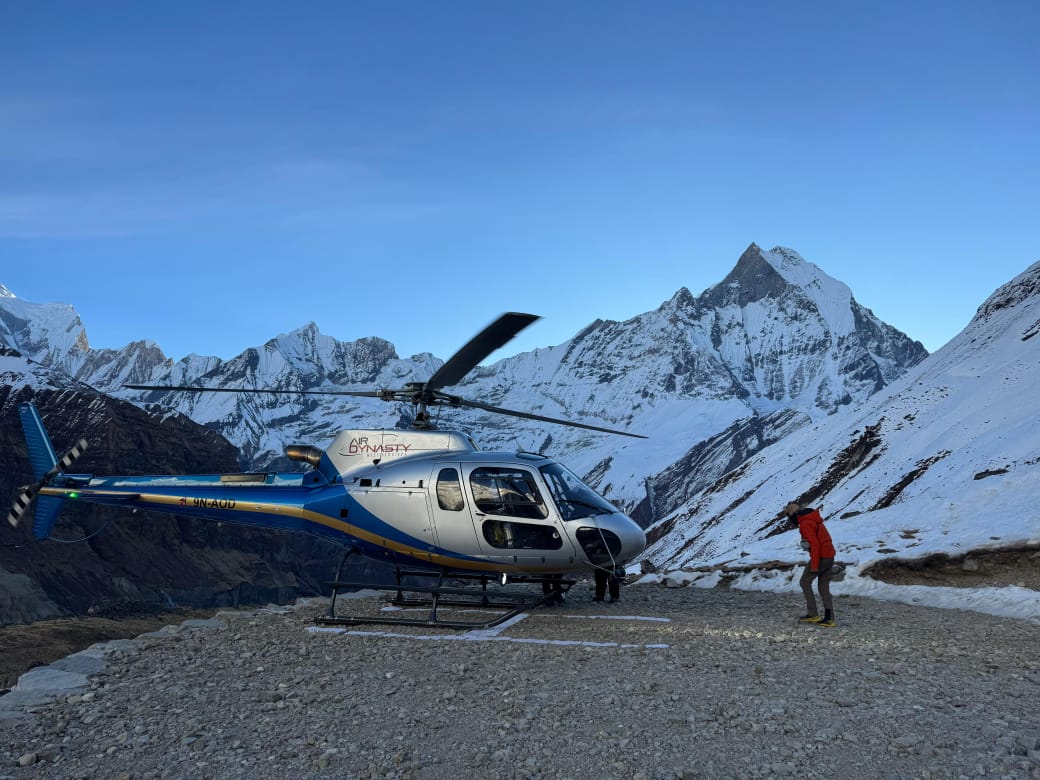
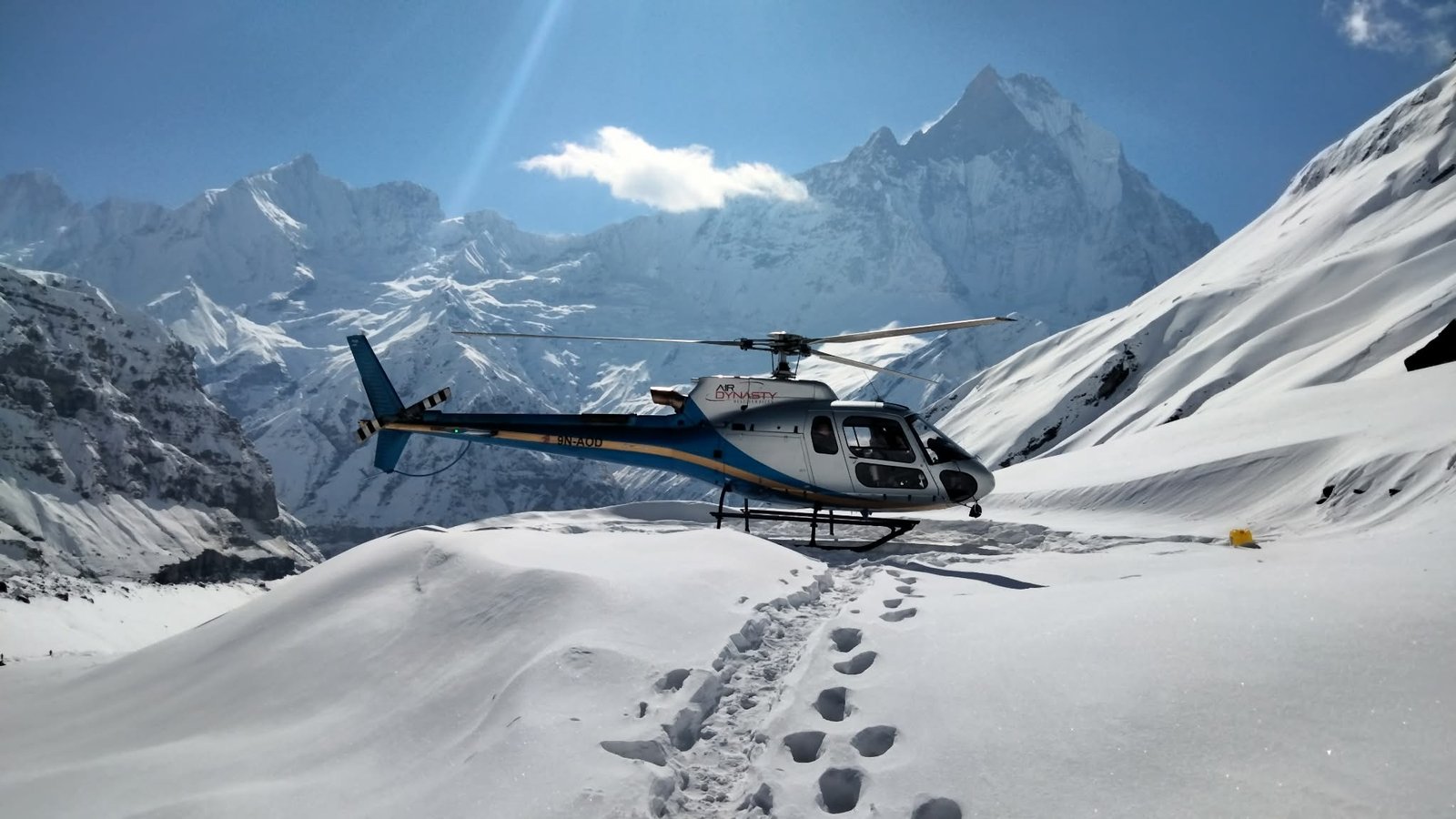
Twenty-five to thirty minutes of flying and you’re descending toward Annapurna Base Camp. The terrain below is stark – rock, ice, nothing green. It looks almost alien. Your pilot makes the approach smoothly, expertly, reading the winds and adjusting altitude with precision. This is where the skill matters. Landing at altitude requires someone who knows what they’re doing. Our pilot does.
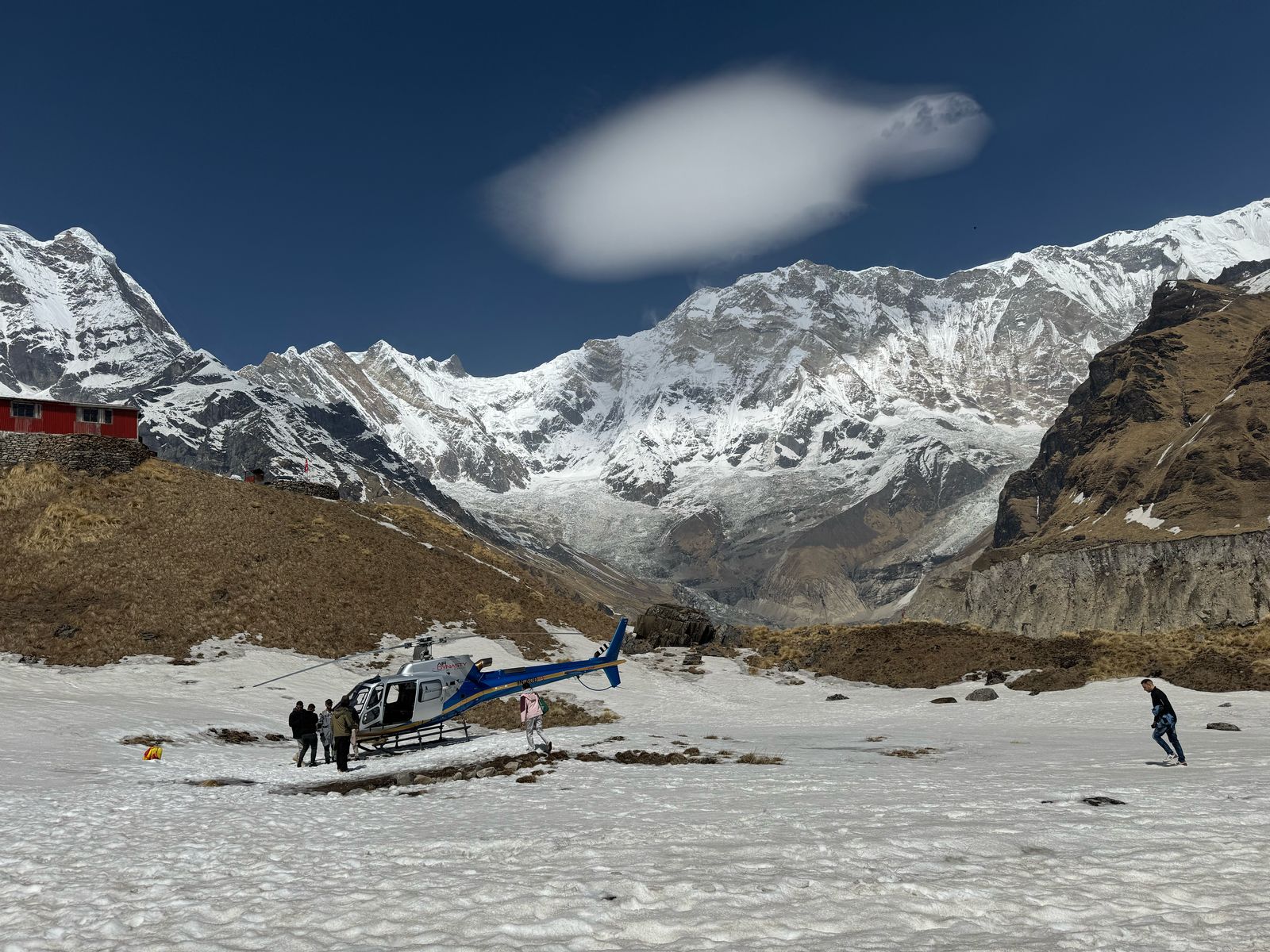
The helicopter touches down. The engines power down. Suddenly – silence. Not the roaring of engines. Just wind. Just mountains. Just the sound of your own breathing. You step out into thin, cold, pure mountain air. It hits your face. Your breathing is quicker than normal – that’s the altitude. Your movements might feel slightly slower. That’s normal too. You’re not here to climb mountains. You’re just visiting, and at this altitude for 30-45 minutes, you feel fine.
And now – you experience why you’re here. You look around. Mountains. Everywhere. In every direction. Surrounding you completely. You’re standing where mountaineers stand before attempting Annapurna I – the 10th highest mountain on Earth and one of the deadliest. Nearly one in four climbers who reach the summit of Annapurna I don’t come back alive. Standing here, you understand why. The mountain is breathtakingly beautiful. And terrifyingly powerful.
You walk around slowly. The ground is rocky, sometimes icy. You’re actually here. Breathing this air. Experiencing what climbers feel. The sky is a deeper blue than you’ve ever seen – there’s just less atmosphere up here. On clear days, you can see for over 100 kilometers. On cloudy days, you’re sitting above the clouds, watching them swirl around the peaks like waves.
Some people cry here. Not sad tears – awe tears. Some people meditate. Some people just stand there, camera clicking, because words don’t work. Some people sit and journal. Some people film messages to people back home. Whatever you do in these 30-45 minutes, you’ll remember it forever. This is one of those moments that stays with you. When you’re stressed years later, you’ll remember this. When you’re wondering if your life matters, you’ll remember standing here.
Eventually your pilot signals it’s time. You might want to stay longer – everyone does – but the schedule is tight and you’ve had your moment. You board again. As the helicopter lifts off and Annapurna Base Camp gets smaller below, you’re already missing something you haven’t even left yet.
The flight back is different. You’re calmer now. You know what to expect. You watch the landscape transform backwards – rock turning to forest, forest turning to fields, fields becoming the city of Pokhara on the horizon. Your pilot might tell you about challenging flights or point out peaks. You’re processing. You’re already knowing you’ll never forget this.
Back at the helipad by 9:00-10:00 AM. Your legs feel wobbly – altitude, adrenaline, intensity. Our crew congratulates you. Our driver takes you back to your hotel. You’re buzzing. You have the entire rest of your day ahead. Lunch, exploring, relaxing by the lake, whatever you want. You finished your greatest adventure before noon.
Days later, weeks later, months later, you’ll still be thinking about this. You’ll show photos to everyone. You’ll tell the story repeatedly. That moment at base camp – standing at the edge of the world, breathing thin air, surrounded by mountains, feeling completely and utterly alive – that becomes a touchstone. It reminds you how big the world is. It connects you to something larger than yourself. It shows you that extraordinary experiences are real and accessible.
This helicopter tour isn’t just a sightseeing trip. It’s a life experience. It’s the kind of memory that becomes part of who you are.
Highlights of your 2026/2027 experience
- You actually land at base camp, where real mountaineers prepare to climb Annapurna I You’re not just seeing it from a distance. You’re standing there. Breathing the air. Understanding why people risk their lives on this mountain
- Watch Nepal’s landscape transform from green valleys to high-altitude peaks in real-time – See the complete geographic journey in a single flight – from tropical lowlands to frozen alpine terrain
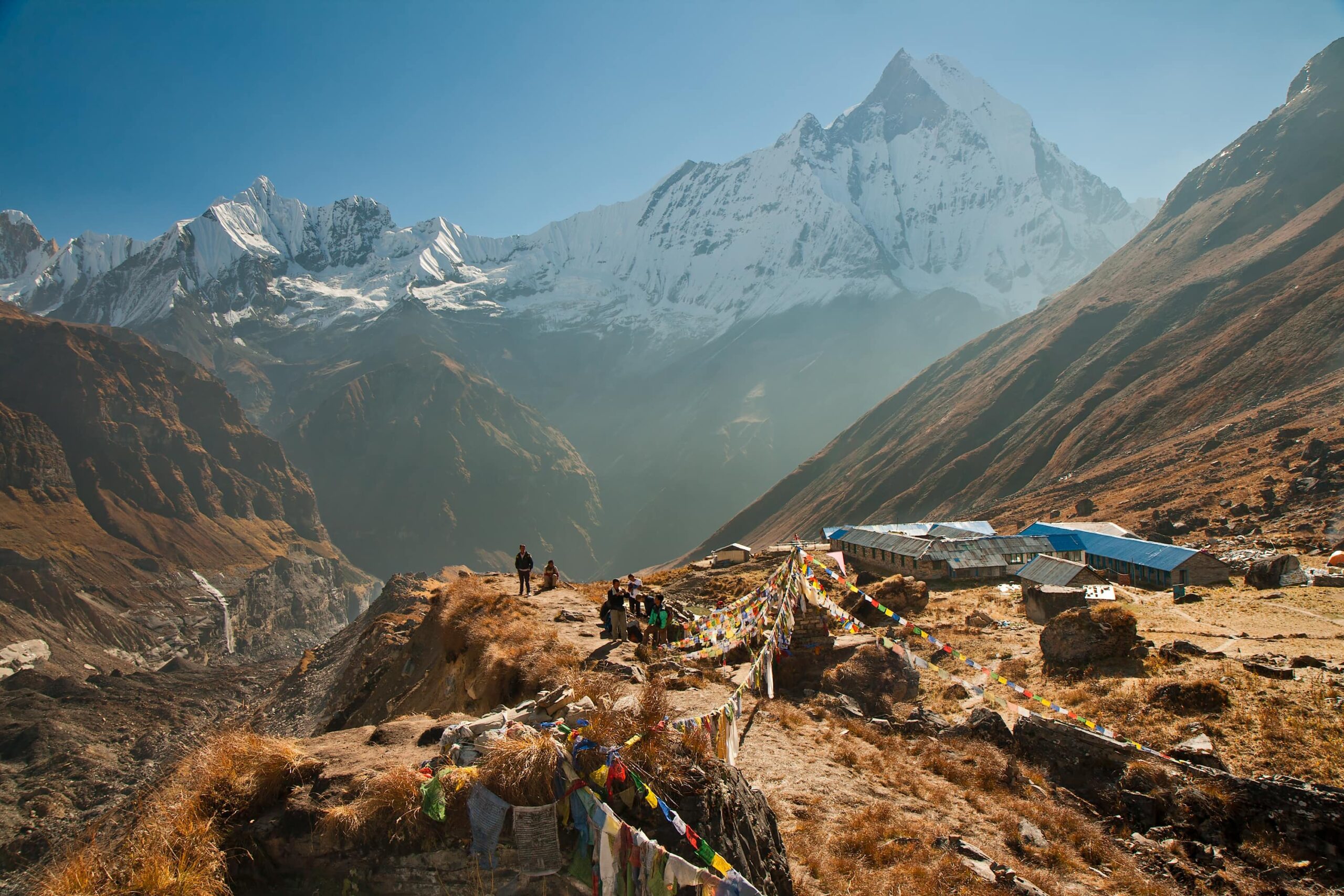
- Surrounded by world-class peaks you’ve only seen in photos – Annapurna South, Machapuchare, Hiunchuli, and the Annapurna range itself – all around you, all real, all incredible
- No fitness requirements or physical demands whatsoever – Families with kids do this. Grandparents in their 80s do this. People with injuries do this. No hiking. No climbing. No suffering. Just pure experience
- Your helicopter is piloted by experts with thousands of hours of mountain flying – These aren’t young pilots learning the job. These are professionals certified by Nepal’s Civil Aviation Authority who’ve flown in storms and fog and bad weather
- You get 30-45 minutes at base camp – completely unrushed – Walk around slowly. Take unlimited photos. Sit and absorb it. Meditate if you want. No one’s rushing you. This time is yours
- Modern comfortable helicopter with massive windows – You’re not cramped in a tiny space. The windows are huge. The ride is smooth. The seats are comfortable. You’re not suffering; you’re experiencing
- Complete life-changing adventure in just 3-4 hours – From your hotel pickup to your return, you accomplish something extraordinary. And your entire afternoon is still ahead of you
- Complimentary hot breakfast fuels your mountain adventure – Real food, real coffee, real tea. You’re properly nourished before flying. You’re not hungry or uncomfortable
- Memories and photographs that become treasured forever – These aren’t ordinary photos. These are “I was there” photographs. These are stories you’ll tell for decades. These are moments that stay with you forever
Why Book This Trip With Us?
- Reserve & Pay Later Lock in your spot now, pay when it’s convenient for you – no pressure, no rush.
- 24/7 Instant Response Questions at 3 AM? We’re here. Want to book last-minute? Let’s make it happen. Our team doesn’t sleep.
- Free Cancellation Life happens. If plans change, cancel up to a week in advance with no fees or hidden charges – it’s that simple.
- Expert Team Since 2009 We’ve been running mountain tours for over 15 years. We know what we’re doing, and we do it really well.
- No Hidden Costs & Secure Payment. What you see is what you pay. Everything is transparent. Your payment is encrypted and safe – we use the same security as banks.
- 100% Satisfied Clients. Thousands of travelers have trusted us with their Himalayan adventure. They keep coming back and telling their friends.
Itinerary
Check-in and Safety Briefing
You’ll arrive at the domestic terminal of Pokhara Airport around 6:30 AM, giving roughly 30 minutes before departure. During this window:
- Check-in: ID/passport verification, ticket confirmation, and passenger weight check (helicopters have strict weight limits per seat, usually 100–120 kg per passenger including luggage)
- Security screening: Standard airport security similar to any domestic flight
- Safety briefing: Staff explain seatbelt use, how to safely approach/board/exit the helicopter (importantly, always from the front or sides, never near the tail rotor), luggage placement, headset use for communication, and emergency protocols
- Boarding: You’ll be guided to the helipad a few minutes before the scheduled departure
Helicopter Departs from Pokhara Airport
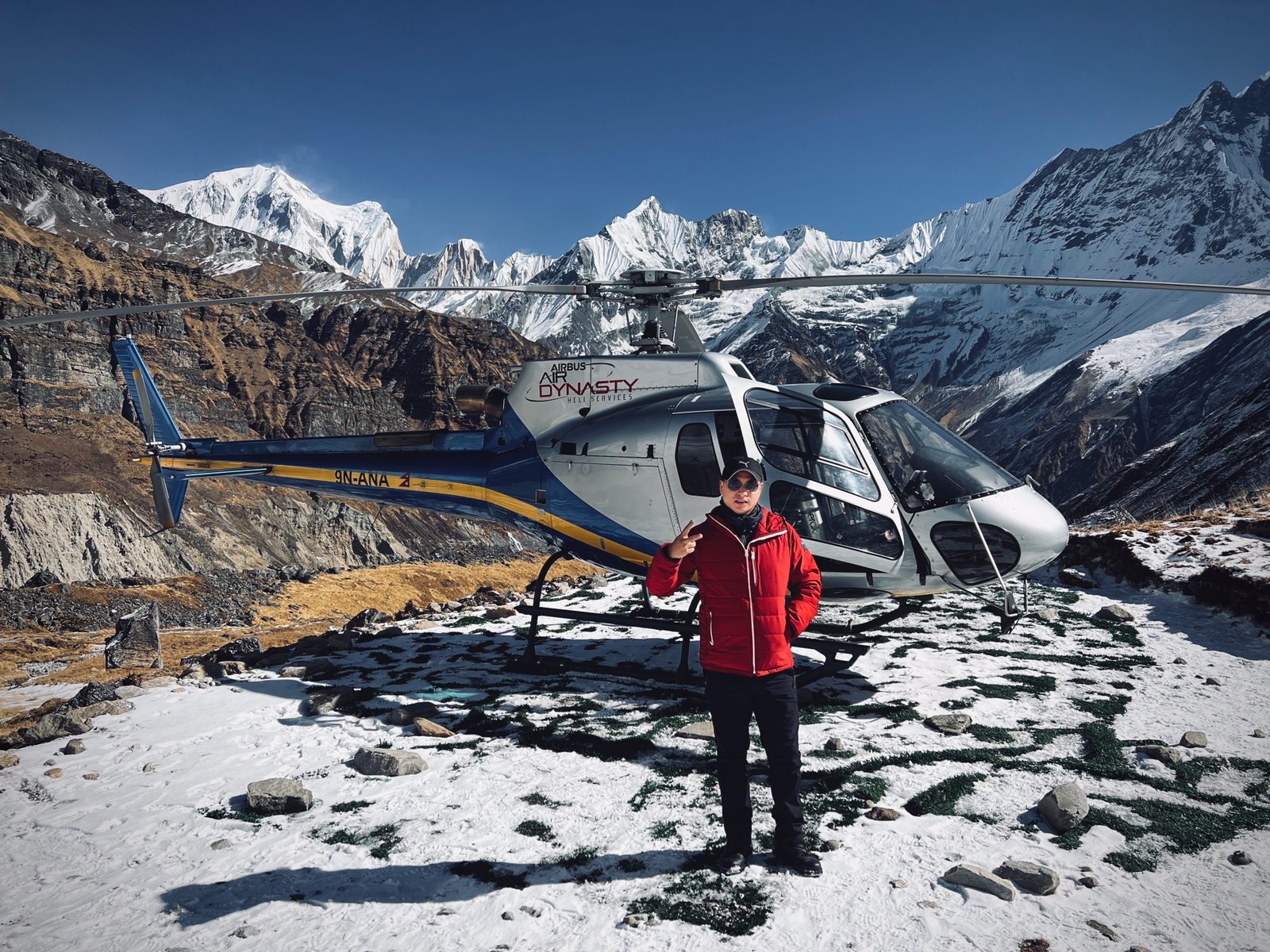
Exact takeoff at 7:00 AM. Pokhara sits at approximately 827 m (2,713 ft) elevation. The helicopter (typically an Airbus H125/AS350 — the standard for high-altitude Nepal operations) lifts off and begins climbing north toward the Annapurna range. You’ll get initial views of Phewa Lake and the Pokhara valley receding below.
Scenic Flight Over Forests, Villages, and Rivers
This is roughly a 25-minute cruise segment (07:00–07:25 AM) covering about 35–40 km one-way. During this stretch:
- 0–5 minutes: Climbing out over Pokhara valley and the surrounding hills
- 5–15 minutes: Flying over the Modi Khola river gorge, dense forests (rhododendron, oak, pine depending on elevation), and terraced hillside farms
- 15–25 minutes: Passing traditional Gurung and Magar villages such as Landruk, Chhomrong, or Ghandruk (exact route varies by operator and weather), then entering the narrowing gorge that leads into the Annapurna Sanctuary — a dramatic natural amphitheater ringed by 7,000–8,000 m peaks
The helicopter steadily gains altitude throughout this segment, from ~827 m to over 4,000 m.
Land at Annapurna Base Camp (4,130 m)
Touchdown at ABC around 07:35 AM, roughly 35 minutes after departure. At this elevation, you are standing among the highest mountains on Earth:
- Annapurna I – (8,091 m) – 10th highest mountain in the world
- Machapuchare (“Fishtail”) – a sacred, unclimbed peak
- Hiunchuli and Annapurna South – flanking peaks completing the amphitheater
The itinerary’s note of “30–45 min max landing time” refers to the operator’s regulatory/operational ceiling for how long a helicopter is permitted to sit at that altitude (engine and safety considerations) — not the length of your visit, which is shorter (see below).
Time at Base Camp (Approximately 15 Minutes)
This ~15-minute window is your actual time on the ground, and it’s kept deliberately brief:
- Altitude concerns: At 4,130 m, oxygen levels are significantly lower than at sea level; some passengers may feel mild dizziness, breathlessness, or headache, especially without prior acclimatization
- Helicopter performance: Thin air at high altitude reduces rotor lift efficiency, so pilots minimize idle/ground time as standard safety practice
- Rapidly changing weather: Mountain cloud cover can build within 30–60 minutes, so operators keep a tight schedule to ensure a safe return flight
What you’ll do: Step out onto the landing area, take photographs of the 360-degree mountain panorama, and briefly take in the sanctuary setting. Temperatures here are cold year-round (often below freezing, especially early morning), so wear warm layers, even if Pokhara felt mild.
Depart Annapurna Base Camp
The helicopter lifts off for the return leg. This timing is firm since pilots plan the round trip to land back in Pokhara before mid-morning weather changes set in.
Arrive Back at Pokhara Airport
Return flight takes approximately 30 minutes (07:55–08:25 AM), generally retracing the outbound route over the villages, forests, and river valleys, descending gradually from 4,130 m back to Pokhara’s 827 m.
Transfer to Your Hotel in Pokhara
After landing, a short walk to arrivals, then your private vehicle transfers you back to your hotel, arriving a few minutes later depending on distance. This marks the end of the tour, roughly 2 hours and 30 minutes door-to-door.
Customize this trip with help from our local travel specialist that matches your Interests.
Customize This TripInclusions
- International & domestic hotel pickup and drop-off by private car
- 30-45 minutes landing time at Annapurna Base Camp
- Flying over Annapurna Base Camp and the surrounding mountain peaks
- Oxygen cylinders in a helicopter
- Medical kits onboard
- Life insurance during a helicopter flight (provided by the Civil Aviation Authority)
- Government tax and service charge
- Annapurna Conservation Area Project (ACAP) permit – 3,000 NPR per person
- Airport tax – 400 NPR per person
- Medical/life insurance (optional additional coverage)
- Nepal visa
- Breakfast – 3,500 NPR per person
- Personal gear (down jacket, wind & waterproof trousers)
Maps
Navigate Your Journey
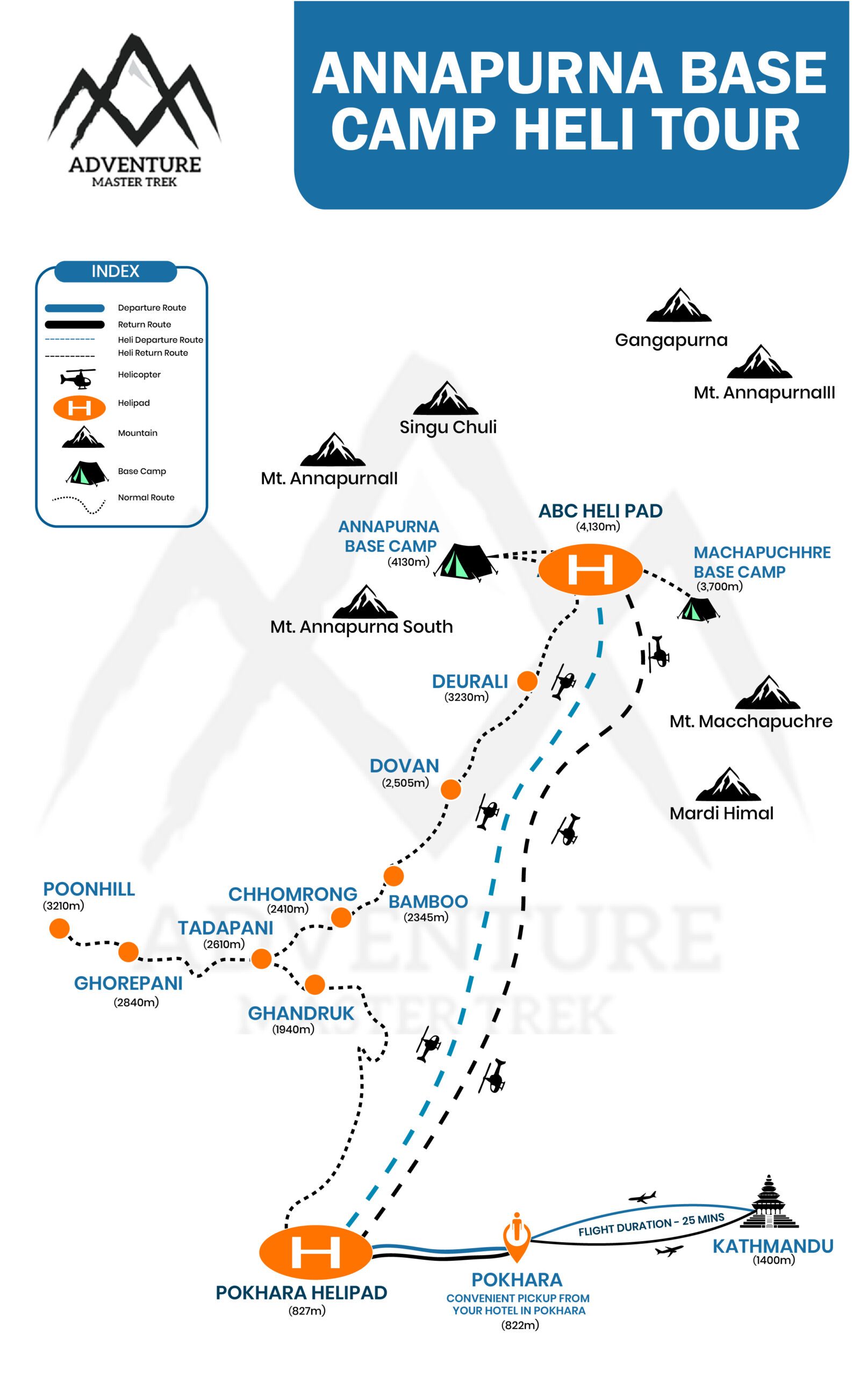
Good to Know
ABC vs EBC Helicopter Tour Comparison
When choosing between the Annapurna Base Camp and Everest Base Camp helicopter tours, both offer breathtaking Himalayan experiences — but they differ significantly in altitude, cost, accessibility, and overall feel. Here is a detailed side-by-side comparison to help you choose the right adventure for your time, budget, and goals.
Quick Comparison Table
| Feature | ABC Helicopter Tour | EBC Helicopter Tour |
| Altitude | 4,130m (13,550 ft) | 5,364m (17,598 ft) |
| Departure City | Pokhara | Kathmandu |
| Flight Time (One Way) | 25–30 minutes | 45–60 minutes |
| Total Trip Duration | 3–4 hours | 5–6 hours |
| Landing Time at Base Camp | 30–45 minutes | 20–30 minutes |
| Sharing Price (Per Person) | $500 | $700–$900 |
| Private Price (1 Pax) | $2,200 | $4,000–$5,000 |
| Private Price (4–5 Pax) | $800 per person | $1,000–$1,200 per person |
| Altitude Sickness Risk | Low to Moderate | Moderate to High |
| Permit Required | None (helicopter) | None (helicopter) |
| Best Season | March to May / September to November | March to May / September to November |
| Mountain Views | Annapurna South, Machapuchare, Hiunchuli | Everest, Lhotse, Nuptse, Ama Dablam |
| Difficulty | Very Easy | Very Easy |
| Fitness Required | None | None |
| Suitable For | All ages, families, seniors | All ages, families, seniors |
| Landscape Style | Green valleys and dramatic alpine terrain | Rocky high Himalayan terrain |
| Iconic Feature | Machapuchare (Fishtail Mountain) | Everest summit view |
| Breakfast Included | Yes | Yes |
| Hotel Pickup Included | Yes | Yes |
Which Tour Is Right for You?
Choosing between ABC and EBC comes down to three main factors — where you are based, your budget, and which mountains call to you most.
Choose ABC if you are:
- Based in Pokhara or planning to visit Pokhara
- Traveling on a moderate budget
- Looking for a shorter, more relaxed experience
- Drawn to the iconic Machapuchare (Fishtail Mountain)
- Traveling with young children or elderly family members
- Sensitive to altitude (ABC is 1,234 meters lower than EBC)
Choose EBC if you are:
- Based in Kathmandu
- Dreaming specifically of seeing Mount Everest up close
- Comfortable with higher altitude and slightly longer exposure
- Willing to invest more for the Everest experience
- Looking for the ultimate Himalayan bucket-list moment
Altitude Difference — What It Means for You
The 1,234 meter altitude difference between ABC (4,130m) and EBC (5,364m) is significant. At EBC, oxygen levels are noticeably thinner and altitude sickness risk is higher even during a short visit. ABC offers a more comfortable high-altitude experience, making it the better choice for first-time high-altitude visitors, families, seniors, and anyone with mild health considerations. Both tours are short enough that serious altitude sickness is rare — but EBC demands more respect for the altitude.
Cost Breakdown Comparison
| Group Size | ABC Private | EBC Private | ABC Sharing | EBC Sharing |
| 1 person | $2,200 | $4,000–$5,000 | $600 | $800–$1,000 |
| 2 people | $1,250 per person | $2,200–$2,500 per person | $500 per person | $700–$900 per person |
| 3 people | $800 per person | $1,500–$1,800 per person | $500 per person | $700–$900 per person |
| 4–5 people | $800 per person | $1,000–$1,200 per person | $500 per person | $700–$900 per person |
What You Will See on the Annapurna Base Camp Helicopter Tour
One of the most remarkable aspects of the ABC helicopter tour is how much you experience in just 3–4 hours. From the moment you lift off from Pokhara to the moment you land back, every minute delivers something extraordinary. Here are the seven most spectacular sights you will witness on this journey.
1. Annapurna South (7,219m)
Annapurna South is the mountain that dominates your view at base camp. Standing at 7,219 meters, it rises like a massive white pyramid directly above you — so close it feels almost impossible. This is not a distant peak you squint to see. It fills your entire field of vision. The sheer vertical scale of Annapurna South is something photographs cannot fully capture. You will understand why mountaineers call this one of the most beautiful and dangerous mountain faces on Earth. At base camp, standing beneath it, you feel genuinely small in the best possible way.
2. Machapuchare — The Sacred Fishtail Mountain (6,993m)
Machapuchare, known worldwide as Fishtail Mountain, is perhaps Nepal’s most visually iconic peak. Its distinctive two-pronged summit — shaped exactly like a fish’s tail — is unlike any other mountain on Earth. What makes Machapuchare especially special is that it has never been summited. The Nepalese government declared it sacred and off-limits to climbers in 1964, protecting it forever. From the helicopter and from base camp, you see it in full — dramatic, sharp, and impossibly beautiful. On clear mornings, its reflection appears in the glacial pools below.
3. Hiunchuli Peak (6,441m)
Often overshadowed by its more famous neighbors, Hiunchuli is a strikingly dramatic peak that rises steeply from the Annapurna Sanctuary. During your helicopter approach to base camp, Hiunchuli appears suddenly and powerfully — its jagged ridgeline cutting sharply against the blue sky. It is a climber’s mountain, known for its technical difficulty and challenging routes. From the air, you see exactly why. Hiunchuli adds to the sense of being completely surrounded by giants at Annapurna Base Camp — a 360-degree world of high mountain peaks in every direction.
4. Annapurna I Summit — The World’s Tenth Highest Mountain (8,091m)
Annapurna I is the tenth-highest mountain in the world and statistically one of the most dangerous. Nearly one in three early attempts on this mountain ended in death. Standing at base camp, you are looking up at the mountain that has challenged and defeated some of the world’s greatest mountaineers. You can trace the climbing routes leading toward the summit. You can see the sections where avalanches have carved paths through the snow. It is beautiful and terrifying simultaneously. This is where real expedition teams stand before attempting something that only the most elite climbers in the world dare to try.
5. The Annapurna Glacier and Moraine
As your helicopter descends toward base camp, the landscape below transforms dramatically. Green forests and farmland give way to raw, bare glacial terrain — rock, ice, and ancient moraine carved by thousands of years of glacial movement. The glacier itself is a living geological feature, slowly moving and constantly changing. From the air you see its full scale — a river of ice winding through the valley. At base camp you stand on the moraine directly, feeling the cold radiating from ancient ice beneath the rocky surface. This raw, almost lunar landscape is completely unlike anything most visitors have ever seen in person.
6. Pokhara Valley and Phewa Lake From the Air
The journey begins with Pokhara, and seeing your starting point from the air is itself a spectacular experience. As the helicopter climbs and banks toward the mountains, you look back and see Pokhara spread below — the shimmering blue mirror of Phewa Lake surrounded by green hills, the city laid out clearly, and beyond it the flat Terai lowlands stretching toward India. It is a completely different perspective of a city you have been walking through. This aerial view gives you an instant sense of Nepal’s extraordinary geographic diversity — from tropical lowlands to frozen peaks in just 30 minutes.
7. The Himalayan Sunrise From 4,130 Meters
Departing at 6:00 to 7:00 AM means you witness one of nature’s greatest shows — the Himalayan sunrise. As your helicopter climbs, you watch the first light hit the high peaks before anything below is touched by the sun. The mountains glow gold, then orange, then brilliant white as sunlight moves down their faces. The sky transitions from deep blue to purple to gold to clear morning blue. The clouds below — if there are any — catch the light and turn pink and orange. This is not an ordinary sunrise. This is a sunrise from altitude, surrounded by 7,000 and 8,000-meter peaks, in some of the clearest air on Earth.
Annapurna Base Camp Helicopter Tour — Difficulty Rating
Many people wonder whether they are physically capable of doing this tour. The short answer is yes — almost certainly. The ABC helicopter tour requires no trekking, no climbing, and no physical fitness whatsoever. Here is an honest, complete breakdown of what is actually involved so you know exactly what to expect before you book.
Overall Difficulty Rating
1 out of 5 — Very Easy
This is the easiest way to experience Annapurna Base Camp. There is no physical preparation required. You sit in a comfortable helicopter, fly to base camp, walk around for 30–45 minutes on relatively flat rocky ground, and fly back. The entire experience is designed to be accessible to everyone.
Physical Demands
| Activity | Difficulty Level |
| Boarding and exiting the helicopter | Very Easy |
| Walking at base camp | Very Easy |
| Steps near tea house and viewpoint | Very Easy |
| Standing and photography | Very Easy |
| Sitting during the flight | Very Easy |
There is no hiking involved. The helicopter landing area at base camp is relatively flat with some loose rock and occasional uneven ground. You may encounter a few small steps near the tea house. That is the full extent of the physical activity required.
The Main Challenge — Altitude
Despite the very low physical difficulty, altitude deserves honest discussion. Annapurna Base Camp sits at 4,130 meters where the air contains significantly less oxygen than at sea level. Because you arrive instantly by helicopter — without the gradual acclimatization that trekkers experience over 7–8 days — some people notice the altitude immediately upon landing.
Common mild symptoms at 4,130m:
- Slightly faster breathing than normal
- Mild headache
- Light dizziness when moving too quickly
- Slight fatigue
Because you are at altitude for only 30–45 minutes, serious altitude sickness is extremely rare. If any symptoms appear, your pilot can begin descent immediately.
Who Can Do This Tour
| Passenger Type | Suitability |
| Children aged 5 and above | Suitable |
| Teenagers | Suitable |
| Adults of all fitness levels | Suitable |
| Seniors in their 70s and 80s | Suitable |
| People with mobility limitations | Suitable — can stay near helicopter |
| People who cannot trek | Suitable — this replaces trekking entirely |
| People with mild heart conditions | Doctor consultation recommended first |
| Pregnant women | Not recommended |
| People with severe lung disease | Doctor approval required |
| People with uncontrolled high blood pressure | Doctor approval required |
Private VS Group Sharing Annapurna Base Camp Helicopter Tour
A private helicopter is exclusively booked for your group. No other passengers share the aircraft. Maximum 5 passengers per helicopter, with 4 passengers recommended for optimal comfort and safety.
Private Helicopter Advantages
- Complete control over departure time – fly when you want, not when other groups are ready
- Flexible routing – circle peaks longer, adjust flight path for photography opportunities
- No strangers – your group experiences the moment together privately
- Window seat guarantee – everyone gets optimal viewing positions
- Customizable experience – timing, route, and pace adjusted to your preferences
- Exclusive mountain access – dedicated pilot attention and crew service
- Group dynamics control – share memories with only your selected companions
- Photography priorities – unlimited time for angles, lighting, and composition
Flight Operations (Private)
- Departure: Flexible scheduling (6:00 AM standard, afternoon available upon request)
- Flight time Pokhara to ABC: 25-30 minutes
- Landing time at base camp: 30-45 minutes maximum
- Flight time ABC to Pokhara: 25-30 minutes
- Total air time: 50-60 minutes
- Total trip duration: 3-4 hours, including ground logistics
Sharing Helicopter Experience
A shared helicopter divides capacity with other travelers. Multiple groups fly together in one aircraft (up to 5 total passengers). Fixed departure times when sufficient bookings are confirmed. Not all passengers get window seats (middle positions available).
Group Sharing Advantages
- Significantly reduced cost – split helicopter operating expenses across more passengers
- Meet fellow adventurers – share the experience with like-minded travelers
- Community atmosphere – collective awe at base camp creates bonding moments
- Fixed scheduling – predetermined departure times (no waiting for bookings)
- Professional logistics – established routes and timings from years of operation
- Budget-friendly option – most affordable way to experience ABC
- Social memory-making – exchange stories and photos with fellow travelers
- Environmental efficiency – maximize helicopter utilization, fewer flights needed
Flight Operations (Shared)
- Departure: Fixed scheduled times (6:00 AM standard)
- Flight time Pokhara to ABC: 25-30 minutes
- Landing time at base camp: 30-45 minutes maximum
- Flight time ABC to Pokhara: 25-30 minutes
- Total air time: 50-60 minutes
- Total trip duration: 3-4 hours, including ground logistics
- Window seat availability: Priority seating for early bookers; middle seat possible for later reservations
HELICOPTER SPECIFICATIONS (BOTH OPTIONS)
Aircraft: AS 350 Écureuil (Squirrel)
- Single-engine high-altitude design
- Maximum altitude capability: 6,000+ meters
- Passenger capacity: 5 maximum (4 recommended)
- Large panoramic windows for unobstructed views
- Modern safety equipment and communication systems
- Proven reliability in Himalayan operations
- Comfortable seating designed for extended flights
Annapurna Base Camp helicopter tour
| Group size | Private | Sharing |
| 1 pax | $2,200 | $600 |
| 2 pax | $1,250 | $500 |
| 3 pax | $800 | $500 |
| 4/5 pax | $800 | $500 |
Annapurna Base Camp Helicopter Tour — Permit & Cost
Understanding exactly what permits you need — and what they cost — removes one of the most common sources of confusion for first-time visitors to Nepal. The good news for helicopter tour passengers is that the permit situation is dramatically simpler than for trekkers. Here is everything you need to know.
Do Helicopter Tour Passengers Need Permits?
Technically, helicopter operations fall under Civil Aviation Authority of Nepal (CAAN) jurisdiction rather than trekking or conservation area management. This means as a helicopter passenger, your operator’s aviation certifications cover your flight. However, because you are physically landing inside the Annapurna Conservation Area, the ACAP permit is required and should be included or arranged through your operator.
Annapurna Conservation Area Permit (ACAP)
The ACAP permit is the primary permit required for anyone entering the Annapurna Conservation Area — whether trekking or arriving by helicopter.
| Nationality | Cost |
| Foreign nationals | NPR 3,000 (~USD 22–25) |
| SAARC nationals (India, Bangladesh, etc.) | NPR 1,000–1,500 (~USD 7–11) |
| Children under 10 | Free |
This permit directly funds conservation of the Annapurna Sanctuary — protecting the wildlife, forests, and ecosystems of one of Nepal’s most important natural areas. It is checked at entry points to the conservation zone.
TIMS Card — Do You Need One?
The Trekkers’ Information Management System (TIMS) card is primarily designed for trekkers walking the routes into the Annapurna region. For pure helicopter tours with no trekking component, the TIMS card is generally not required. However, requirements can vary slightly by operator and season. Your tour operator will confirm whether TIMS is needed for your specific booking — most helicopter tour operators confirm it is not required.
Airport Departure Tax
Nepal charges a domestic airport departure tax of NPR 400 (~USD 3–4) when departing from Pokhara airport or helipad facilities. This is a standard government charge separate from your helicopter tour cost.
| Fee | Amount |
| Airport departure tax | NPR 400 (~USD 3–4) |
Complete Permit Cost Summary
| Permit / Fee | Foreign National | SAARC National | Handled By |
| ACAP Permit | NPR 3,000 (~$22–25) | NPR 1,000–1,500 (~$7–11) | Tour operator |
| TIMS Card | Not required | Not required | N/A |
| Airport Tax | NPR 400 (~$3–4) | NPR 400 (~$3–4) | Paid at airport |
| Aviation permits | Included | Included | Operator’s license |
How Permits Are Processed
You do not need to visit any government office or stand in any queue. When you book your helicopter tour, simply provide a clear copy of your passport to your operator. They handle all permit applications, processing, and fees on your behalf. Permits are ready before your departure day. The only thing you need to bring on the day is your original passport for checkpoint verification.
How Long Is the Annapurna Base Camp Helicopter Flight?
Flight duration is one of the most frequently asked questions about this tour, and the answer depends on your departure city and what’s included in your total experience. Here is a complete, honest breakdown of every time segment from pickup to hotel return.
Flight Time from Pokhara (Standard Route)
| Segment | Duration |
| Hotel pickup to helipad | 20–30 minutes (by car) |
| Breakfast at helipad | 30–45 minutes |
| Safety briefing & boarding | 15 minutes |
| Pokhara to ABC (flying) | 25–30 minutes |
| Time at base camp | 30–45 minutes |
| ABC to Pokhara (flying) | 25–30 minutes |
| Helipad to hotel (return) | 20–30 minutes |
| Total Experience | 3–4 hours |
| Total Air Time | 50–60 minutes |
Flight Time from Kathmandu (Extended Route)
For travelers departing from Kathmandu, the distances are greater and the total experience is longer. This option is ideal for travelers who are not visiting Pokhara but want the ABC experience directly from the capital.
| Segment | Duration |
| Hotel pickup to airport | 30–45 minutes |
| Kathmandu to ABC (flying) | 1.5–2 hours |
| Time at base camp | 30–45 minutes |
| ABC to Kathmandu (flying) | 1.5–2 hours |
| Airport to hotel (return) | 30–45 minutes |
| Total Experience | 5–6 hours |
| Total Air Time | 3–4 hours |
Landing Time at Base Camp
Your helicopter touches down at Annapurna Base Camp for 30–45 minutes on standard tours. This time is completely yours — walk around, take photographs, sit quietly, absorb the mountains, visit the tea house. No one rushes you during this window. Private helicopter passengers can negotiate extended landing time (up to 60 minutes or more) for an additional cost.
What Affects Flight Duration?
Several factors can slightly adjust actual flight times:
Weather conditions — Pilots may take slightly longer routes to avoid wind or turbulence, adding 5–10 minutes each way.
Passenger weight and load — Heavier loads mean slightly more fuel consumption and occasionally slightly adjusted routing.
Wind direction — Headwinds slow the helicopter; tailwinds speed it up. Variations of 5 minutes either way are normal.
Traffic at helipad — During peak season (October and April), multiple helicopters operate simultaneously. Brief waits at the helipad are possible.
Looking for a Multi-Day Trek in the Annapurna Region?
Nepal’s Annapurna region has many options for long-distance trekking, from quick trips to more difficult long-distance routes. All trekkers, both novice and seasoned, will find beautiful views of the Himalayas, exposure to local culture, and wonderful experiences on all the treks available here. Following is a summary of some popular treks for 2026:
1. Mardi Himal Base Camp Helicopter Tour
Mardi Himal is Annapurna’s best-kept secret. Sitting at 4,500 meters — higher than ABC — Mardi Himal Base Camp offers dramatically different perspectives of the Annapurna range with a fraction of the crowds. While ABC receives thousands of helicopter visitors each season, Mardi Himal remains relatively quiet, giving you an intimate, exclusive mountain experience that feels genuinely remote.
The views from Mardi Himal are exceptional — Machapuchare appears from a completely different angle, and Annapurna South presents a face most visitors never see. The terrain is rawer, wilder, and more dramatic. For travelers who’ve already done ABC, Mardi Himal offers something entirely new. For first-timers who want to avoid ABC’s popularity, this is an outstanding alternative.
Key Details:
- Altitude: 4,500m (14,763 ft)
- Flight time from Pokhara: 30–35 minutes
- Landing time: 30–45 minutes
- Cost: Approximately 10–15% more than ABC helicopter tour
- Crowd level: Very low
2. Annapurna Base Camp Helicopter Tour + Return Trek (5 Days)
For travelers who want the best of both worlds — aerial access and trekking experience — this 5-day combination is the perfect solution. You fly to Annapurna Base Camp by helicopter for the dramatic arrival, experience base camp fully, and then trek back down through the classic ABC trekking route over 4–5 days.
This option gives you the iconic aerial mountain views and base camp arrival by helicopter, then the gradual, immersive trekking experience through rhododendron forests, traditional villages, and mountain trails on the return. You experience the Annapurna Sanctuary from two completely different perspectives. The downhill trek is significantly easier than the uphill approach, making this a genuinely manageable adventure even for moderate-fitness travelers.
Key Details:
- Total duration: 5 days
- Starts: Pokhara (helicopter in)
- Ends: Pokhara (trek out via Jhinu Danda or Nayapul)
- Includes: Helicopter flight, accommodation, guide, meals
- Best for: Travelers wanting trekking experience without the full uphill effort
3. Muktinath Helicopter Tour
Muktinath is one of Nepal’s most sacred destinations — a holy site of enormous significance to both Hindus and Buddhists, sitting at 3,800 meters in the Mustang region. The Muktinath Temple, with its 108 sacred water spouts and eternal flame, draws pilgrims from across South Asia. By helicopter, you reach this sacred site in approximately 45–55 minutes from Pokhara, bypassing the long overland journey through the Kali Gandaki valley.
Beyond its spiritual significance, Muktinath delivers extraordinary scenery — the dramatic transition from green Annapurna terrain to the arid, almost Tibetan landscape of Upper Mustang is visible during the flight. The Kali Gandaki Gorge — the world’s deepest gorge — appears below you. Dhaulagiri and the Annapurna range frame the journey magnificently.
Key Details:
- Altitude: 3,800m (12,467 ft)
- Flight time from Pokhara: 45–55 minutes
- Significance: Sacred Hindu and Buddhist pilgrimage site
- Combination option: Often combined with Mustang tour
- Best for: Spiritual travelers, cultural seekers, those wanting Mustang scenery
4. Mustang Helicopter Tour
Upper Mustang is one of the most otherworldly landscapes in Nepal — a high-altitude desert kingdom that looks more like Tibet than anything else in Nepal. Ancient cave cities carved into cliffsides, centuries-old Buddhist monasteries, the walled city of Lo Manthang, and extraordinary red-and-ochre rock formations make Mustang visually unlike anywhere else on Earth. The Mustang helicopter tour lets you access this remote kingdom — which once required special restricted-area permits to enter — in a single day from Pokhara.
Flying into Mustang, the landscape transforms dramatically. Lush green hills give way to barren, wind-carved rock formations in shades of red, brown, and orange. The Kali Gandaki valley stretches below, impossibly deep. Lo Manthang‘s ancient walled city appears like something from another century — because it essentially is.
Key Details:
- Destination: Lo Manthang, Upper Mustang
- Flight time from Pokhara: 60–75 minutes
- Permit required: Restricted Area Permit (arranged by operator)
- Unique feature: Ancient walled city, Tibetan-style landscape
- Best for: Cultural adventurers, photographers, those wanting truly unique Nepal experiences
5. Tilicho Lake Helicopter Tour
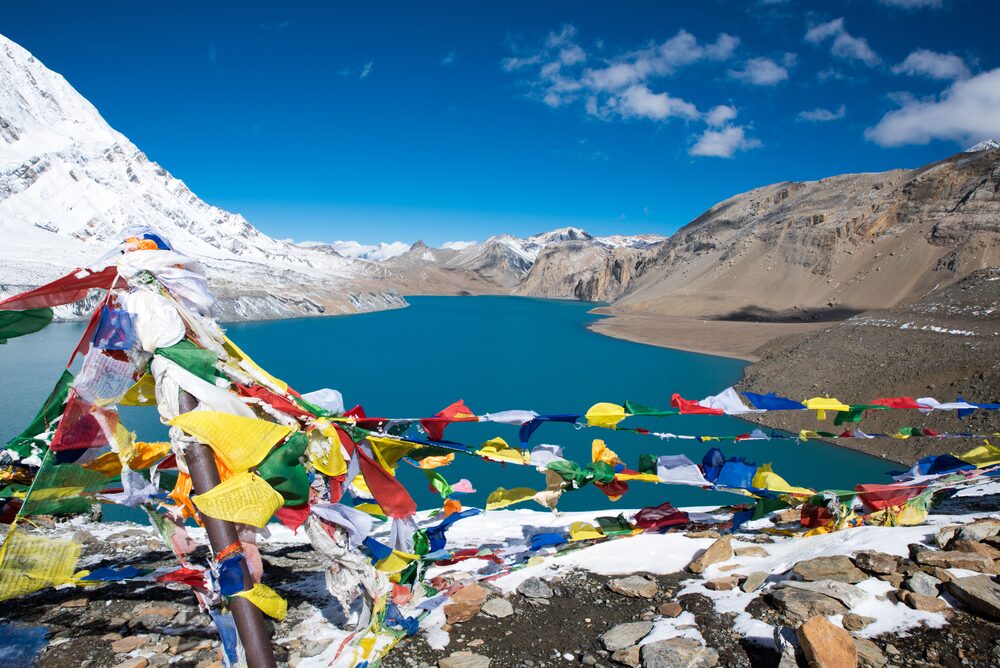
Tilicho Lake sits at 4,919 meters, making it one of the highest lakes in the world. Its deep turquoise-blue color against the stark white and grey mountain terrain creates one of Nepal’s most surreal and beautiful landscapes. Reaching Tilicho Lake by trekking requires 10–12 days and significant physical fitness. By helicopter, you can stand at the lake’s shore in a single morning from Pokhara.
The aerial approach to Tilicho is magnificent — the Annapurna III and Gangapurna peaks dominate the northern skyline, and the dramatic Tilicho Peak rises above the lake itself. The silence at the lake is profound — broken only by wind, the distant creak of glacial ice, and the sound of your own breathing in thin mountain air. For travelers who’ve seen ABC, Tilicho offers a completely different, higher, and even more remote experience.
Key Details:
- Altitude: 4,919m (16,138 ft) — one of the world’s highest lakes
- Flight time from Pokhara: 35–45 minutes
- Terrain: High-altitude lake, glacial surroundings
- Unique feature: Extraordinary blue lake color at extreme altitude
- Best for: Those wanting the highest-altitude helicopter experience in the Annapurna region
Altitude Sickness & Annapurna Base Camp Helicopter Tour: What You Need to Know for a Safe Experience
Annapurna Base Camp sits at 4,130 meters where the air has 40% less oxygen than at sea level. Your body notices this immediately. The good news? You’re only there for 30-45 minutes on a helicopter tour, not spending days trekking uphill. Most people experience zero altitude problems.
When altitude sickness happens, it feels like a mild hangover. You might get a headache – that’s the most common symptom. Maybe some dizziness, like standing up too fast. Possibly mild nausea or feeling a bit tired. Your breathing might be quicker than normal. All of these are mild and usually go away as soon as you descend.
Here’s how to avoid trouble: Spend one day in Pokhara before your flight so your body starts adjusting. Drink water constantly – dehydration makes altitude sickness worse. Skip alcohol the night before. Eat light meals, not heavy food. Sleep well the night before your flight. At base camp, walk slowly. Don’t run around like you’re at sea level. Your body is working harder up there.
If you’ve had altitude sickness before, tell us. If you have heart problems, lung issues, high blood pressure, or are pregnant, get your doctor’s approval before booking. These conditions can be affected by altitude.
If you start feeling bad at base camp – headache, nausea, dizziness – tell your pilot immediately. He can descend slightly or head back early. Your safety and comfort matter more than the schedule.
Recommended flight times for the Annapurna Base Camp Helicopter Tour
- Early morning (6:00 AM – 8:00 AM) — Best visibility, clearest mountain views, and minimal turbulence before the valley winds pick up.
- Mid-morning (8:00 AM – 10:00 AM) — Still excellent conditions; slightly more flexibility if there are early morning delays.
- Avoid afternoon flights (after 12:00 PM) — Clouds and thermal turbulence typically build up after midday, reducing visibility around Annapurna.
- October – November — Peak autumn season; crisp, clear skies and stunning panoramic views.
- March – May — Spring season; good visibility with blooming rhododendrons below.
- Avoid monsoon season (June – September) — Heavy clouds and rain make flights unreliable and views poor.
Weight & Age Limitations
There’s no age limit for this tour. We’ve had kids as young as 5 flying and grandparents in their 80s. The only real question is: Can you physically get into and out of a helicopter? And are you comfortable with flying?
Very young kids (under 5) are technically possible, but honestly challenging. The helicopter is loud, it’s intense, and very young children can’t easily tell you if something’s uncomfortable. Usually not recommended, but we’ve done it.
Kids aged 5 and up? Absolutely. They love it. They handle altitude fine. They create amazing memories.
Teenagers and adults have no age restrictions. Seniors? No problem at all. Age alone doesn’t stop you from flying.
Weight-wise, the helicopter has a maximum operating limit of about 500 kg total weight for everything – passengers, fuel, equipment. This means we need accurate weight information from your group for safety calculations. If you or someone in your group is significantly overweight, just tell us. We’re not going to judge anyone or refuse anyone based on weight. We just need accurate numbers so we can manage the helicopter properly and safely. Weight distribution matters for flight safety and fuel management – it’s a technical requirement, not a judgment call.
If you’re pregnant, we recommend skipping the helicopter tour. The vibration, the altitude, the intensity – it’s not ideal for pregnancy. If you’re pregnant and really want to fly, talk to your doctor first, then talk to us. We might be able to work something out, or we might recommend waiting until after you’ve had your baby.
Health & Safety Guidelines
Before you book, tell us if you have any of these: Heart conditions, high blood pressure you can’t control, lung disease or breathing problems, severe fear of flying or claustrophobia, severe vertigo or fear of heights, recent surgery (especially chest or stomach surgery), serious ear problems, previous severe altitude sickness, or pregnancy. None of these automatically disqualifies you – they just mean you should get medical advice first.
Every passenger gets a safety briefing before flying. Our crew explains how the helicopter works, what different sounds mean, where emergency exits are, how to use your harness properly, what to do in extremely unlikely emergency situations, and basic boarding procedures. It’s not scary – it’s just practical information so you know exactly what to expect. You’ll feel informed and confident.
Mountain flying depends on the weather. If conditions aren’t safe, we cancel the flight. No exceptions. This is non-negotiable. A dangerous flight isn’t an adventure – it’s asking for disaster. When we cancel due to weather, we reschedule you to the next available good-weather date at no extra cost. Your safety matters more than our schedule.
Base Camp is remote. If something serious happens medically, helicopter evacuation is possible but complicated and expensive. If you have serious medical conditions that might get worse at altitude, you absolutely need a doctor’s clearance before booking.
If you wake up the morning of your flight feeling sick – bad cold, food poisoning, flu – tell us immediately. We’ll reschedule without penalty. Your comfort matters more than keeping the flight schedule.
Bring all your regular medications in original bottles with clear labels. Bring enough for your entire Nepal trip, plus extra. Nepal has pharmacies in cities, but the selection is limited. You might not find your specific medication, so don’t count on it.
Get travel insurance that covers helicopter evacuation, medical costs in Nepal, and trip cancellation or delays. It’s cheap insurance for peace of mind.
Packing list for ABC Helicopter tour
General
- Original passport and a few passport-size photos for permit registration
- Required permits: Annapurna Conservation Area Permit (ACAP) & TIMS card
- Warm sleeping bag for cold nights (rentable in Kathmandu or Pokhara)
- Enough cash in Nepali rupees, as there are no ATMs on the trail
- Duffel bag (your porter will carry this)
- A light daypack for your water, snacks, and personal items
Upper Body
- UV-protection sunglasses for strong mountain sun
- A sun cap for daytime and a warm hat for cold mornings
- Neck gaiter or buff to protect from dust and wind
Torso
- 2 quick-drying trekking shirts (long or short sleeve)
- A fleece or wool layer to keep you warm in the evenings
- A puffy jacket (down or synthetic) for higher altitudes
- A rain jacket or windbreaker in case of bad weather
Lower Body
- 2 pairs of comfortable hiking trousers
- 1 pair of thermal leggings for cold nights or mornings
- Rain pants to wear over your trekking pants when needed
- Light pajama pants or track pants for sleeping and relaxingHands
Hands
- Thin gloves for mild cold
- Warm gloves (preferably waterproof) for colder days near base camp
Footwear
- 3–4 pairs of warm, breathable trekking socks
- A pair of strong, broken-in hiking boots with ankle support
- Slip-on shoes or Crocs for use around the lodge
Undergarments
- 4–5 pairs of quick-dry underwear
- Sports bra or comfortable support (if needed)
- Optional: extra base-layer bottoms for layering at night
Medication and First Aid
- Altitude tablets (consult your doctor for Diamox)
- High SPF sunscreen and lip balm to avoid sunburn
- Basic painkillers and tablets for cold, upset stomach, or motion sickness
- Plasters/band-aids, antiseptic wipes, and blister tape
- Any personal or prescription medicine you may need
Other Essentials
- Hand sanitizer and tissue packs
- Reusable water bottle or hydration bladder (2L recommended) + water purifier
- Toiletries: small toothpaste, brush, biodegradable soap, wet wipes
- Torch or headlamp with spare batteries
- Trekking poles (helpful for steep or uneven trails)
- Power bank for charging electronics
- Waterproof pouch or dry bag to keep electronics and clothes dry
Optional
- Lightweight snacks: granola bars, dried fruit, nuts
- A small journal or notebook
- Eye mask and earplugs for better sleep in teahouses
- Small padlock for your room or backpack
- A bit of tape or string for emergency fixes
Annapurna Base Camp Helicopter Tour Group Pricing
| Group size | Private | Sharing |
| 1 pax | $2,200 | $600 |
| 2 pax | $1,250 | $500 |
| 3 pax | $800 | $500 |
| 4/5 pax | $800 | $500 |
Why Annapurna Base Camp Helicopter Tour
- Access extreme altitude in hours – Reach 4,130 meters in 3-4 hours instead of 7-8 day trek
- Perfect for time-limited travelers – Complete mountain experience fits into 1-2 day Nepal itinerary
- No physical strain required – Helicopter eliminates uphill climbing; accessible to all fitness levels and ages
- Spectacular aerial views – See Annapurna South, Machapuchare, Hiunchuli, and surrounding peaks from a helicopter perspective
- Land at mountaineering base camp – Stand where climbers prepare to summit Annapurna I (one of the world’s deadliest mountains)
- Stable weather windows – January-May and September-November offer excellent visibility and minimal cancellations
- Affordable compared to alternatives – Shared tours from $400-500 per person; private options available
- Family-friendly adventure – Suitable for children, seniors, and people with mobility limitations
- No permits or bureaucracy – Only passport and visa required; helicopter operator handles all regulatory clearances
- Life-changing experience – Profound connection to the Himalayan mountains in minimal time investment
Booking Policy for the ABC Helicopter Tour
1. How to Verify Your Reservation
We require a 30% deposit of the entire trip cost to reserve your spot. The rest of the money can be paid when you get to Pokhara or Kathmandu. You can also choose to pay the whole amount ahead of time if you’d like to.
In order to confirm your ticket, we will need:
- The deposit you paid
- A good picture or scan of your passport
- Details like trip insurance information and a person to call in case of an emergency
2. How to Pay Your Bills
There are a few easy ways to pay with us:
How to Pay Online: You can safely make a payment on our site.
Credit Cards: You can use Visa, MasterCard, and other major credit cards, but there is a 4% bank fee.
3. Last Payment
The last 70% of your trip costs must be paid before the journey starts. You can pay with cash, a card, or a bank payment when you get there.
4. Getting new dates
If you need to change your trip plans, please let us know at least 30 days in advance. If it’s possible, we’ll do our best to change your holiday. There may be extra costs if you need to change your hotel or helicopter ticket.
5. You need travel insurance
Everyone who goes hiking needs to have up-to-date travel insurance that covers medical care, trip cancellations, emergency air evacuations, and hiking at high altitudes.
6. Booking at the Last Minute
You can make plans up to 48 hours before your trip, but there may not be enough room, especially in the spring and fall when the tours are very popular. We recommend making reservations as soon as possible to ensure helicopter access and room availability.
Cancellation Policy for the ABC Helicopter Tour
1. Cancellation by the Guest
- Full refund (30 days or more before departure; no bank or transaction fees applied).
- 30% of the entire trip cost will be reimbursed between 10 and 29 days before departure.
- 50% of the entire trip fee will be refunded five to nine days before departure.
- Less than five days prior to departure: You can postpone your trip without incurring additional fees, but there won’t be a refund.
- No money will be given back for services that were not used because of sickness, injury, or coming back early after the walk began.
2. The company calls off the meeting
If something out of our control, like a natural disaster or a change in the government, forces us to cancel the trek, you will get your money back in full.
You can move your vacation to another open date at no extra cost.
3. Delays or cancellations due to bad weather
We will do our best to change your plans or redo the hike at no extra cost.After taking out the money you already spent on permits, transportation, and lodging, you will get 30% of your money back if you decide to cancel because of delays.
4. The “no-show” rule
You won’t get any credit if a friend suddenly doesn’t show up on the day you pick them up.
5. Need for travel insurance
It is very important that you get full travel protection that covers evacuation, medical crises, high-altitude treks, and trip cancellations.
FAQs
Do you have daily departures?
Yes, we fly every single day during the best seasons (January to May and September to November). Standard departure is 6:00 AM from your hotel. If you’re not a morning person, afternoon flights (1:00 PM to 3:00 PM) are available if you ask – it just depends on the weather. During off-season months (June to August and December), the weather gets more unpredictable, so flights depend on conditions, but we’ll still try to get you up there.
Is helicopter flying safe in winter?
Winter is actually the best time to fly. The air is calm and stable – no turbulence, no weird wind patterns. Visibility is incredible – you can see for over 100 kilometers on clear days. The peaks are snow-covered, which looks absolutely stunning. You’ll be cold, yes, but the flying is smooth and safe. Winter is when professional mountain pilots actually prefer flying in the Himalayas.
How safe is paying online?
Completely safe. We use the same security that banks use. Your credit card information is encrypted and never sits on our servers. We’re PCI-DSS certified, which means we meet international payment security standards. You can also do reserve-now-pay-later – put down a small deposit to lock in your date, then pay the full amount later when you’re ready. Multiple payment options available: credit cards, bank transfers, whatever works for you.
How high does the helicopter fly at Annapurna Base Camp?
You land at exactly 4,130 meters – that’s 13,550 feet. This is the actual base camp where real mountaineers prepare to climb Annapurna I. It’s high enough to feel the altitude (you’ll breathe a bit quicker), but not so high that you can’t walk around comfortably for 30-45 minutes. The helicopter can actually fly much higher – over 6,000 meters – so we’re well within safe limits.
How experienced are your pilots?
Our pilots aren’t rookies. They have thousands of hours flying in the Himalayas. They’re certified by Nepal’s Civil Aviation Authority with special mountain flying qualifications. Minimum 2,000+ hours required. They’ve flown in storms, fog, bad weather – you name it. They know these mountains inside out. Regular training, regular medical check-ups, perfect safety record. Your life is in expert hands.
How long is the helicopter ride from Pokhara to Kathmandu?
From Pokhara: 25-30 minutes to get there, 25-30 minutes to get back. About an hour of flying time total. From Kathmandu: 1.5 to 2 hours each way – about 3-4 hours of flying. Kathmandu is further away, so it takes longer. But the longer route from Kathmandu shows you more of Nepal’s landscape as you fly – rivers, valleys, mountains gradually getting bigger.
How is the weather? How does it affect the tour?
Weather changes everything. January to May: Clear skies, great visibility, cool but comfortable. June to August: Monsoon rains, clouds everywhere, can’t see the mountains. September to November: Post-monsoon clarity, absolutely beautiful, perfect conditions. December: Hit or miss – sometimes clear, sometimes snowy. We check the weather 24 hours before your flight. If it looks bad, we reschedule you. No flying in unsafe conditions – ever.
What happens if the flight is cancelled?
If weather forces cancellation, we will reschedule you to the next good-weather day at zero extra cost. You pick another date that works. If the weather keeps blocking you for days, we will give you a full refund. Or we reschedule multiple times for free until the weather cooperates. The only exception: if you try rescheduling more than 3 times and still can’t fly, we charge $25 for ground transportation costs. But you get your money back for the helicopter. Simple as that.
Do I need an extra day in Nepal?
Nope. You’re back at your hotel by 10:00 AM. The whole thing is 3-4 hours. You can do the helicopter tour in the morning and still have your entire afternoon free. Want to go paragliding? Go. Want to rent a boat on the lake? Go. Want a massage? Absolutely. Many people combine the helicopter tour with other Pokhara activities on the same day.
What are the extra charges if the tour is cancelled due to weather?
None. Weather cancellations are free to reschedule – unlimited times. We’ll keep trying until conditions are good enough to fly. If you somehow can’t fly after multiple reschedule attempts (very rare), the only charge is $25 for ground transportation because our driver picked you up multiple times. But your entire helicopter payment gets refunded. We don’t make money off cancelled flights – we make money when we actually fly you.
What can I see on the ABC tour?
You’re surrounded by mountains. Annapurna South is huge and white. Machapuchare (locals call it Fishtail Mountain) has this distinctive two-pronged peak. Hiunchuli rises dramatically. You see Annapurna I itself – the 10th highest mountain in the world. Below you: glaciers, moraines, rocky terrain, and deep valleys. You fly over forests and farmland, getting to base camp. The whole journey shows you Nepal’s landscape transformation from green valleys to bare alpine rock.
Can you land at Mardi Himal Base Camp?
Yes, we can. Mardi Himal is even higher (4,500 meters) and way less crowded than ABC. Fewer tourists, same incredible views, different perspective on the Annapurna range. It costs a bit more – roughly 10-15% extra compared to ABC. If you want something slightly different or want to avoid the ABC crowds, Mardi Himal is your answer. Let us know, and we’ll give you specific pricing.
What light gear do I need to bring?
Just basics. Warm jacket because it’s cold up there. Long-sleeve shirt. Comfortable pants. Warm hat. Gloves if you want them. Sunglasses – the sun is intense at altitude. Good walking shoes that are already broken in. Warm socks. Sunscreen (SPF 50+) because you’ll burn fast. Lip balm because the wind dries your lips out. A water bottle so you can stay hydrated. A camera for photos. Pack it all in a small day pack (20-30 liters). You’re gone 3-4 hours, not camping for a week.
Do I need to carry extra cash?
No. Pokhara has ATMs everywhere. You can withdraw Nepali Rupees whenever you need them. Credit cards work at hotels and restaurants. We accept credit cards for the helicopter. Bring your credit card and maybe $50-100 cash for tips, small purchases, snacks – that’s plenty. Don’t stress about carrying large amounts of cash. Modern Pokhara has a good banking infrastructure.
What is the minimum group size?
Two people minimum for shared helicopter flights – it doesn’t make economic sense to fly with just one person. Solo travelers pay $500 on shared flights (super affordable). If you’re solo and want a private helicopter, that’s $1,800 (expensive, obviously). Couples can do shared for $450 each ($900 total) or private for $1,000 each ($2,000 total) – way better deal. Groups of 4-5 get the best per-person pricing on private helicopters.
What documents do I need to bring?
Just your passport and your Nepal visa. That’s it. The passport needs to be valid for at least 6 months. Get your visa on arrival in Kathmandu (15, 30, or 90-day options) or arrange it beforehand through a Nepali embassy. No special permits, no trekking permits, no bureaucracy. Bring your booking confirmation so we know who you are. Travel insurance documents are good to have. That’s everything you need.
Can I take photos and videos at base camp?
Take as many as you want. Seriously. That’s what everyone does. Bring your camera, phone, whatever. The light, the mountains, the perspective – it’s all incredibly photogenic. Pack extra batteries and memory cards because you’ll fill them up. Clear your phone storage beforehand. A cleaning cloth for wiping fingerprints off helicopter windows helps. Morning light and clear skies = best photos. Your pictures become lifetime memories of this.
What if I have medical conditions?
Tell us upfront. Heart problems, lung issues, high blood pressure, severe anxiety, fear of flying, recent surgery, ear problems, previous altitude sickness – let us know. We might ask you to get a doctor’s clearance. We’re not trying to exclude you; we’re making sure you’re safe. Bring all your medications in original bottles. Get travel insurance with medical coverage. If your doctor okays it, you’re good to go. Most people with medical conditions fly successfully with proper planning.
How much water should I drink?
Drink a lot. Altitude makes you dehydrated without you realizing it. We provide water at the helipad before the flight. Bring a water bottle and drink throughout the flight and at base camp. Sip frequently instead of gulping large amounts. If you bring electrolyte powder, mix it with water for better absorption. Avoid alcohol and coffee 24 hours before flying – they dehydrate you. Staying hydrated prevents altitude sickness headaches.
Can children fly on this tour?
Yes. Kids age 5 and up do great. They handle altitude well and create amazing memories. They love helicopters. Kids under 5 are technically possible, but the noise and intensity make it challenging – we don’t recommend it. Bring kids’ medications if they need them. Make sure kids are dressed warmly and have sunscreen. One adult should supervise per child. The experience is totally family-friendly.
What is the cancellation policy?
Cancel 7+ days before: Free, full refund. Cancel 3-7 days before: 25% fee. Cancel 1-3 days before: 50% fee. Cancel within 24 hours: 75% fee. Weather cancellations: Free rescheduling, no penalties. Weather is the only time we don’t charge cancellation fees. If you need to cancel for personal reasons, just give us advance notice. Travel insurance can cover cancellation costs if you have it.
Are meals provided besides breakfast?
Breakfast is complimentary – hot food, coffee, tea, whatever you want before the flight. Lunch isn’t provided because you’re back by 10:00 AM. You can grab lunch in Pokhara after returning. Tons of restaurants – Nepali food, international cuisine, whatever you’re in the mood for. If you want snacks during the helicopter, pack light snacks (though many people don’t eat on helicopters due to motion concerns). Definitely bring water.
Can I fly if I'm pregnant?
We recommend waiting. Helicopter vibration, altitude, and intensity aren’t ideal for pregnancy. If you’re pregnant and really want to try, get your obstetrician’s approval first. Then talk to us – we might suggest waiting until after delivery. Your baby’s safety comes first. Lots of pregnant women experience mountains after having their babies, when they can fully enjoy it without physical concerns.
Can I choose my seat?
On private helicopters, everyone gets a window seat — it’s guaranteed. There are a maximum of 4–5 passengers and the helicopter is exclusively yours, so seat selection is completely flexible. On shared helicopters, window seats are allocated on a first-booked, first-served basis. Early bookers get window positions. Later bookings may receive middle seats. If window seats matter to you — and they do for photography — book early or book private.
Are hotel pickup and drop-off included?
Yes. Hotel pickup and drop-off in Pokhara is included in your tour cost. Our driver arrives at your hotel at 5:30 AM for the standard morning departure, transfers you to the helipad, and returns you to your hotel after the tour. If you are departing from Kathmandu, pickup and drop-off at your Kathmandu hotel is also included. No taxi or additional transport arrangements required on your part.
How much does breakfast cost?
Breakfast is listed as excluded in the cost section at NPR 3,500 per person (~USD 26–28). This covers a full hot breakfast at the helipad — eggs, fresh bread, fruit, coffee, and tea. It is a proper sit-down breakfast, not a snack. Most guests include breakfast when booking as it is strongly recommended before flying at altitude. Eating well before the flight helps your body manage the altitude landing more comfortably.
How much is the airport tax?
<span”font-weight: 400;”>Nepal’s domestic airport departure tax is NPR 400 per person (~USD 3–4). This is a standard Nepalese government charge applied at Pokhara airport and helipad facilities. It is listed as a cost excluded from the tour price. Payment is made at the departure point on the day of your flight. Your tour operator will remind you to bring this amount in Nepali Rupees on your departure morning.

Reviews
What Our Travelers Say


Based on 2 ratings
5




View Our Similar Packages
Discover our top tours, loved by thousands of travelers annually. Choose the adventure that inspires you and embark on a journey tailored to your desires.
Save 22%
-

-
-
-
-
- (61)

 Nepal
Nepal
 1 Days
$1400
$1800
-
-
-
-
-
- (41)
Nepal
6 Days
Price Upon Request
Save 7%
-
-
-
-
-
- (39)
Nepal
17 Days
Price Upon Request
Add Review
Reviewing for Annapurna Base Camp Helicopter Tour Cost 2026/2027Request a Callback - Annapurna Base Camp Helicopter Tour Cost 2026/2027
Submit the form and we will be back to you shortly
Request a Callback - Annapurna Base Camp Helicopter Tour Cost 2026/2027
Submit the form and we will be back to you shortly
Narayanhiti Palace Museum

Narayanhiti Palace Museum


