








Everest Base Camp Altitude Sickness: Your Complete Guide to Prevention, Symptoms & Acclimatization
Learn how to prevent, recognize, and manage altitude sickness on Everest Base Camp. Complete guide to symptoms, acclimatization, and safety tips.
-
 Adventure Master Trek
-
5 March, 2026
-
16 mins read
-
199 Views
-
0 Comments


You’ve booked the trek. You’ve trained for months. You’ve dreamed about standing at the foot of the world’s highest mountain. But somewhere between Kathmandu and Base Camp, a single invisible enemy can stop even the strongest trekker in their boots — altitude sickness.
If you’re planning the Everest Base Camp trek, understanding altitude sickness isn’t optional. It’s the difference between making it to 5,364 meters and being evacuated by helicopter from Dingboche. This guide covers everything you actually need to know — not the watered-down version, but the real, practical information that experienced trekkers and mountain medicine specialists rely on.
What Is Altitude Sickness, and Why Does It Happen at EBC?
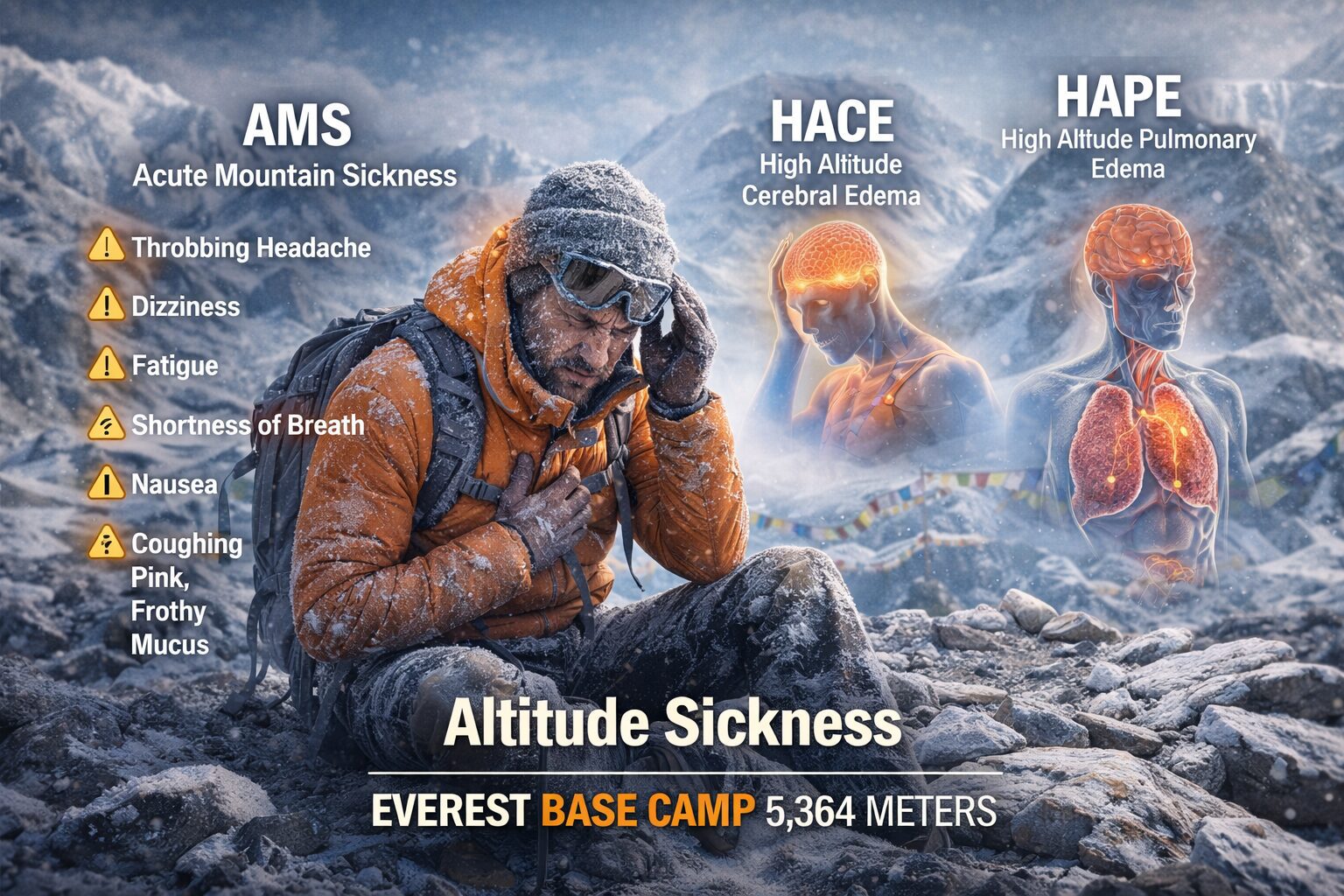
Altitude sickness — medically known as Acute Mountain Sickness (AMS) — occurs when your body climbs faster than it can adapt to thinning air. The higher you go, the less oxygen is available per breath. At sea level, the air is roughly 21% oxygen. By the time you reach Everest Base Camp at 5,364 meters, your lungs are working with nearly 50% less available oxygen than they’re used to.

Your body’s response? It tries to compensate. Breathing gets faster. Heart rate increases. Fluid can leak from capillaries into surrounding tissue. If the ascent is too rapid, these compensations can’t keep up, and that’s when altitude sickness sets in.
Here’s the part that trips people up: altitude sickness doesn’t discriminate. According to a study published in Wilderness and Environmental Medicine, approximately 40% of trekkers on the EBC route experience symptoms of AMS. The CDC confirms that even on standard acclimatization schedules, altitude illness can affect close to 30% of trekkers at higher elevations. Your age, gender, and fitness level provide zero protection.
Elite marathon runners have been evacuated from the Khumbu valley. Sherpa guides with decades of experience at altitude still treat their clients who grew up at sea level with patience and caution — because they know the mountain doesn’t care how fit you are.
What does matter is how fast you ascend, how well you hydrate, how seriously you take rest days, and how honestly you report symptoms.
The Three Faces of Altitude Illness: AMS, HACE, and HAPE
Not all altitude sickness is the same. Understanding the three distinct syndromes can literally save your life on the trail.
Acute Mountain Sickness (AMS) is the most common and, in its mild form, the most manageable. It typically begins within 2 to 12 hours of reaching a higher altitude and presents as a dull headache, fatigue, loss of appetite, mild nausea, and disrupted sleep. Many trekkers mistake these symptoms for dehydration or jet lag — which is exactly why they get into trouble.
AMS usually appears above 2,400 meters (about 7,900 feet). On the EBC route, that means you could start feeling it as early as Namche Bazaar (3,440m), and most trekkers notice something by the time they reach Tengboche (3,870m) or Dingboche (4,410m).
Mild AMS is manageable. Rest, hydration, and refusing to ascend further while symptoms persist will resolve it in most cases. The danger comes when trekkers push through, treating a headache as a minor annoyance rather than a message from their body to stop.
High Altitude Cerebral Edema (HACE) is essentially what happens when AMS becomes a neurological emergency. Fluid accumulates in the brain. Symptoms look alarming: confusion, loss of coordination, severe disorientation, slurred speech, and eventually loss of consciousness.
HACE is rare below 4,300 meters but becomes more likely as you approach and exceed that threshold. Treatment requires immediate descent — minimum 300 to 1,000 meters — and dexamethasone if available. There is no waiting it out. There is no acclimatizing through it. Descent is the only real option.
High Altitude Pulmonary Edema (HAPE) involves fluid accumulating in the lungs rather than the brain, and it is arguably the more immediately life-threatening of the two. It can develop independently of AMS or as a progression from it, typically above 3,500 meters.
The warning signs include a persistent cough, shortness of breath at rest, chest tightness, and in severe cases, a gurgling sound when breathing or coughing up pinkish frothy mucus. HAPE kills more trekkers and climbers at high altitude than any other cause.
Like HACE, treatment requires immediate descent, supplemental oxygen if available, and urgent medical evacuation.
If you see these symptoms in yourself or anyone in your group — act immediately, without debate.
Recognizing the Symptoms: A Practical Checklist
Knowing the difference between “I’m tired from a long day of trekking” and “I have AMS” can be confusing on the trail. Here’s a straightforward breakdown of what to look for at each stage.
Mild AMS (warning signs — stop ascending, rest, monitor closely):
- Throbbing headache, especially behind the eyes or at the forehead
- Nausea with or without vomiting
- Fatigue that seems disproportionate to the day’s exertion
- Loss of appetite
- Difficulty sleeping, even when exhausted
- Mild dizziness when standing up
Moderate AMS (do not ascend; descend if symptoms don’t improve within 24 hours):
- Severe headache that doesn’t respond to ibuprofen or paracetamol
- Persistent vomiting
- Extreme fatigue — difficulty moving from your teahouse bed
- Significant shortness of breath, even at rest
- Noticeably decreased coordination
Severe AMS / HACE / HAPE (descend immediately — this is an emergency):
- Confusion, disorientation, or altered mental state
- Inability to walk a straight line
- Persistent dry cough becoming wet and productive
- Breathlessness at complete rest
- Coughing up frothy, pinkish fluid
- Extreme lethargy or unconsciousness
A useful field test for HACE: ask the affected trekker to walk heel-to-toe along a straight line. Anyone who struggles significantly is showing a neurological symptom that warrants immediate descent regardless of what they say they feel.
The Acclimatization Schedule That Actually Works
This is the most important section of this guide. Your itinerary matters more than your fitness. Period.
The golden rule at altitude is to never ascend more than 500 meters per day in sleeping elevation once you’re above 3,000 meters. The phrase experienced guides repeat constantly is climb high, sleep low — which means you can hike to a higher point during the day, but you return to a lower elevation to sleep. This technique forces your body to produce more red blood cells and adjust to lower oxygen levels without the prolonged exposure that causes problems overnight.
Here’s what a safe acclimatization schedule looks like on the standard EBC route:
Lukla (2,860m) → Phakding (2,610m) You actually descend slightly on day one, which is a relief. The trail is gentle. Don’t rush. Let the mountain introduce itself slowly.
Phakding → Namche Bazaar (3,440m) The climb to Namche is the first real altitude jump on the trek, and it’s where the first symptoms can appear. The final switchbacks up to Namche are steep, and your body will be working hard. Take it slow. Drink water. Arrive, eat, sleep.
Namche Bazaar — Two Nights Minimum This is non-negotiable. Namche is one of two essential acclimatization stops, and spending two nights here gives your body the time it needs to adjust before continuing upward. On the acclimatization day, don’t rest completely in your lodge. Instead, hike up to the Everest View Hotel at 3,880m or the nearby village of Khumjung, then descend back to Namche to sleep. This “climb high, sleep low” day is one of the most effective tools you have.
Namche → Tengboche (3,870m) → Dingboche (4,410m) The route climbs gradually through Tengboche, with its famous monastery and jaw-dropping views, before rising to Dingboche. By the time you reach Dingboche, you’ll feel the altitude clearly. The air is noticeably thinner, nights get cold, and the landscape turns stark and stunning.
Dingboche — Two Nights Minimum The second mandatory acclimatization stop. Again, use the day to hike higher — up to Nagarjun Hill or toward the ridge above Dingboche — and return to sleep lower. This mirrors what your body needs to adapt to the zone above 4,000 meters.
Dingboche → Lobuche (4,940m) → Gorak Shep (5,164m) Above 5,000 meters, the air becomes noticeably sparse. Every step feels heavier. This is when the mental component of the trek becomes just as important as the physical. Sleep at Gorak Shep, not at EBC.
Gorak Shep → Everest Base Camp (5,364m) → Return to Gorak Shep Most trekkers visit EBC from Gorak Shep, spend a short time taking photos, and return to Gorak Shep to sleep, since the air at EBC is too thin for an overnight stay. This is correct practice — don’t try to camp at Base Camp unless you’re part of a climbing expedition.
Gorak Shep → Kala Patthar (5,545m) → Descent Many trekkers hike to Kala Patthar before dawn for the sunrise view of Everest. It’s the highest point on the standard EBC trek and one of the most rewarding. After that summit, the descent begins — and most people feel significantly better with every hundred meters they drop.
A 14-day itinerary is generally safer than a 12-day one. The extra days aren’t wasted time — they’re insurance.
Diamox (Acetazolamide): What It Is, How It Works, and When to Use It
Diamox — the brand name for acetazolamide — is the most widely used medication for altitude sickness prevention and treatment. It’s worth understanding properly, not just as a backup plan, but as an active tool in your safety kit.
How Diamox works: It slightly acidifies the blood, which stimulates the respiratory center in the brain to breathe more deeply and frequently. More breaths per minute means more oxygen intake per hour. According to the CDC, acetazolamide hastens acclimatization to high-elevation hypoxia — a process that normally takes 3 to 5 days happens in roughly one day when taking the medication. It also acts as a mild diuretic, which reduces fluid buildup in the brain and lungs that causes HACE and HAPE.
Does it work? Yes. Research published in the High Altitude Medicine & Biology Journal found that Diamox reduces the incidence of AMS by up to 50% in trekkers ascending above 3,500 meters. That’s a meaningful reduction in risk.
Dosage: The typical dose for prevention is 125–250 mg twice daily, starting one day before ascent and continuing for several days at altitude. Consult your doctor to determine the right dose for your situation. Always get a prescription before your trek — don’t buy it blind at a pharmacy in Kathmandu, though it is available there.
When to consider taking it:
- You’ve experienced AMS on a previous high-altitude trek
- You’re on a tight itinerary with limited acclimatization time
- You live at low altitude and haven’t been at elevation recently
- Your doctor recommends it based on your medical history
Important caveats: Diamox is not a replacement for acclimatization. It’s a supplement to smart trekking, not a ticket to rush the route. It also has side effects — most commonly, a tingling sensation in fingers and toes, increased urination, and occasionally mild nausea. These are generally manageable and temporary. One practical tip: take a test dose at home before your trip to see how your body responds, since some of the side effects can mimic mild AMS symptoms, which you don’t want to confuse on the mountain.
People with sulfa allergies should not take Diamox without medical guidance, as it belongs to the sulfonamide family.
10 Proven Prevention Tips That Save Trekkers Every Season
1. Go slow — especially above 3,000 meters. The pace at which most guided groups travel feels frustratingly slow to fit, eager trekkers. That slowness is intentional. The “pole pole” approach (Swahili for “slowly slowly,” used by Kilimanjaro guides and adopted by experienced Himalayan guides) works because it limits physical exertion, which reduces oxygen demand.
2. Drink 3–4 liters of water daily. At higher altitudes, your body loses fluids faster through breathing and perspiration, even if you don’t feel sweaty. The dry mountain air accelerates this effect, making dehydration a serious risk. Dehydration makes AMS worse. Carry a reliable water purification system and treat all water sources. Add electrolytes if you’re sweating heavily.
3. Avoid alcohol for the first several days. Alcohol impairs breathing during sleep, when your body does most of its acclimatization work. It also dehydrates you. The celebration beer can wait until you’re back in Namche on the way down.
4. Skip sleeping pills. Even mild sedatives suppress breathing during sleep. This is the opposite of what your body needs at altitude. Many trekkers struggle with insomnia at high elevation — this is normal. Accept it, rest horizontally, and let your body breathe naturally.
5. Eat carbohydrate-rich foods. Your body metabolizes carbohydrates more efficiently in low-oxygen environments than it does proteins or fats. Dal bhat, noodle soups, rice dishes, and boiled potatoes are more than just Nepali comfort food — they’re physiologically smart choices for altitude trekking.
6. Follow the “climb high, sleep low” principle religiously. On every acclimatization day, hike above your sleeping elevation and return to sleep lower. This is the most effective natural acclimatization technique available.
7. Never ascend with symptoms. This is the rule that trekkers break most often, usually because they’re embarrassed to slow down the group, worried about flight schedules, or convinced their headache is just dehydration. If you have symptoms of AMS — any symptoms — you do not ascend. Rest at current elevation until they resolve. If they don’t resolve within 24 hours, or if they worsen, you descend.
8. Tell your guide how you actually feel. Experienced Himalayan guides can’t help you if you’re performing wellness. Tell them about the headache. Tell them about the nausea. This isn’t complaining — it’s safety-critical information.
9. Get travel insurance that covers helicopter evacuation. Emergency helicopter evacuations from the Khumbu region are expensive — often running into the thousands of dollars. Insurance that specifically covers high-altitude trekking and medical evacuation is not optional for an EBC trek. Confirm your policy before you fly.
10. Don’t helicopter into altitude. Some trekkers try to skip the lower approach by taking a helicopter directly to Namche or higher. This dramatically increases AMS risk. The gradual walk from Lukla is part of your acclimatization, not just the journey to the destination.
Medical Resources on the EBC Route
You’re not entirely on your own out there. The Khumbu region has better medical infrastructure than most high-altitude trekking destinations in the world.
Namche Bazaar has medical facilities offering basic treatment for altitude sickness, injuries, and infection. If you’re developing symptoms by the time you reach Namche, this is an appropriate place to be assessed.
Himalayan Rescue Association Clinic, Pheriche (4,371m) is the most well-known dedicated altitude medicine resource on the route. The HRA is a non-profit organization that operates a seasonal clinic here, staffed by volunteer physicians specializing in high-altitude medicine. If you’re symptomatic above Namche, getting to Pheriche for an assessment could change your decision about continuing the trek. They also offer free altitude awareness lectures that are worth attending.
Everest ER at Base Camp operates during the spring climbing season as a tent-based emergency medical facility at EBC itself. It provides immediate first aid and can coordinate helicopter evacuation.
Helicopter evacuation is available throughout the region and is the fastest way to descend in a medical emergency. This is why insurance matters.
What to Do If Someone in Your Group Gets Seriously Ill
Stay calm. Act fast. Do not debate.
If someone shows signs of HACE (confusion, loss of coordination, altered mental state) or HAPE (breathlessness at rest, wet cough, frothy sputum):
Descend immediately — even at night, even if it means hiking in the dark. Every hundred meters of altitude lost can make a life-saving difference. A minimum descent of 300 to 1,000 meters is recommended, depending on severity.
Administer supplemental oxygen if available. Lodges in Namche, Dingboche, and sometimes other teahouses carry emergency oxygen. Some guided tours carry portable oxygen cylinders.
If you have dexamethasone in your first aid kit (4 mg), administer it for HACE. This is a corticosteroid that can rapidly reduce brain swelling while you organize evacuation — it buys time, but it does not replace descent.
For HAPE, nifedipine can help if available, but again, descent is the primary treatment.
Contact your evacuation insurance provider as soon as possible to initiate helicopter rescue coordination. Your guide will know how to do this.
The person who is ill will often argue that they feel fine, that they don’t need to descend, that they just need to rest. This is a symptom, not a reliable assessment. Altitude-induced cognitive impairment affects judgment. The people around them need to make the decision.
A Few Things Nobody Tells You Before the Trek
Sleep at altitude is genuinely strange. Many trekkers experience a phenomenon called Cheyne-Stokes breathing — periods of increasingly deep breaths followed by a brief pause in breathing. It’s alarming to experience or witness, but it’s a normal part of altitude adjustment and is not dangerous in otherwise healthy trekkers. Diamox can actually reduce this pattern.
Your pulse oximeter will lie to you. Many trekkers carry fingertip pulse oximeters to monitor blood oxygen saturation, and while these devices can be useful, they create anxiety as often as they provide useful data. An oxygen saturation reading of 80–85% at 5,000 meters can be entirely normal. What matters more is how you feel and whether your symptoms are improving or worsening.
Garlic soup is more than a teahouse tradition. Garlic is widely used in Himalayan communities as a natural altitude remedy, and while it won’t replace acclimatization or Diamox, it does support circulation and has mild vasodilatory effects. Drink it. Enjoy it. The yak butter tea is optional.
The descent feels miraculous. Every trekker who has suffered through a brutal headache at Gorak Shep will tell you the same thing: once you start dropping elevation on the way home, the relief is almost immediate. The body is remarkably good at recovering from altitude stress when given lower elevation to recover in.
The Bottom Line

Reaching Everest Base Camp is one of the most profound experiences a person can have on foot. The Khumbu valley is breathtaking in a way that photographs don’t fully capture. The culture, the mountains, the people, the sheer scale of the landscape — it stays with you.
But the mountain is indifferent to your timeline and your fitness level. Altitude sickness is real, it’s common, and in its severe forms it can kill within hours of onset.
The trekkers who make it to Base Camp safely — and who actually enjoy the journey rather than surviving it — are the ones who go slowly, hydrate obsessively, take their rest days seriously, tell their guide the truth about how they feel, and never confuse determination with wisdom.
Acclimatize properly. Carry Diamox as a backup. Get your evacuation insurance sorted before you land in Kathmandu. And if your body tells you to stop, listen.
The mountain will still be there next season. You need to be too.
Comments (0)
Write a comment- What Is Altitude Sickness, and Why Does It Happen at EBC?
- The Three Faces of Altitude Illness: AMS, HACE, and HAPE
- Recognizing the Symptoms: A Practical Checklist
- Mild AMS (warning signs — stop ascending, rest, monitor closely):
- Moderate AMS (do not ascend; descend if symptoms don’t improve within 24 hours):
- Severe AMS / HACE / HAPE (descend immediately — this is an emergency):
- The Acclimatization Schedule That Actually Works
- Diamox (Acetazolamide): What It Is, How It Works, and When to Use It
- 10 Proven Prevention Tips That Save Trekkers Every Season
- Medical Resources on the EBC Route
- What to Do If Someone in Your Group Gets Seriously Ill
- A Few Things Nobody Tells You Before the Trek
- The Bottom Line
Read the latest Blogs & Insights
Explore our collection of articles and insights to gain in-depth travel knowledge, expert advice, and stay updated on the latest trends and tips.




No comments yet.