








Kathmandu to Everest Flight Tour: Shared vs. Private — A Real Cost Comparison for 2026/2027
Compare Kathmandu to Everest flight tours: shared vs private options, costs, experience, flexibility, and which is best for your Himalayan trip in Nepal !
-
 Adventure Master Trek
-
24 March, 2026
-
14 mins read
-
6 Views
-
0 Comments


The world’s most dramatic helicopter ride, and how much you’ll actually pay for it.
Somewhere between your third cup of Nepali tea in Thamel and your second scroll through Instagram photos of people standing in front of Everest, the idea hits you: What if I didn’t trek at all?
What if, instead of fourteen days of blisters, altitude headaches, and freeze-dried noodles, you simply boarded a helicopter in Kathmandu one morning, flew through the clouds, hovered above the Khumbu Glacier at 5,500 metres, ate breakfast at the highest hotel on Earth, and were back in time for dal bhat by early afternoon?
The Everest helicopter tour is one of those travel experiences that sounds almost too good to be real — and yet, for thousands of visitors every year, it’s exactly that. But the moment you start digging into the logistics, one question immediately takes over everything else: shared flight or private charter, and what’s the actual difference in cost?
This post breaks it all down — no fluff, no hard sell. Just an honest look at what each option involves, what you’ll pay, what you’ll get, and how to figure out which one is right for you.
First, Let’s Understand What This Tour Actually Is
Before you compare prices, it helps to picture what the tour involves, because it’s genuinely unlike anything most travellers have ever done.
Your day starts early — think 5:30 or 6 AM. A private car picks you up from your hotel in Kathmandu and takes you to the domestic terminal at Tribhuvan International Airport. After a quick briefing, you board a helicopter — typically an AS350 B3e, a nimble high-altitude workhorse that holds up to five passengers plus the pilot.
The first leg takes you northeast across the Kathmandu Valley and into the hills, with farmland and river valleys unfolding below. After roughly 40–50 minutes, you touch down at Lukla — yes, that Lukla, the one with the famously short, cliffside runway that makes for great YouTube compilations — for a brief refuelling stop.
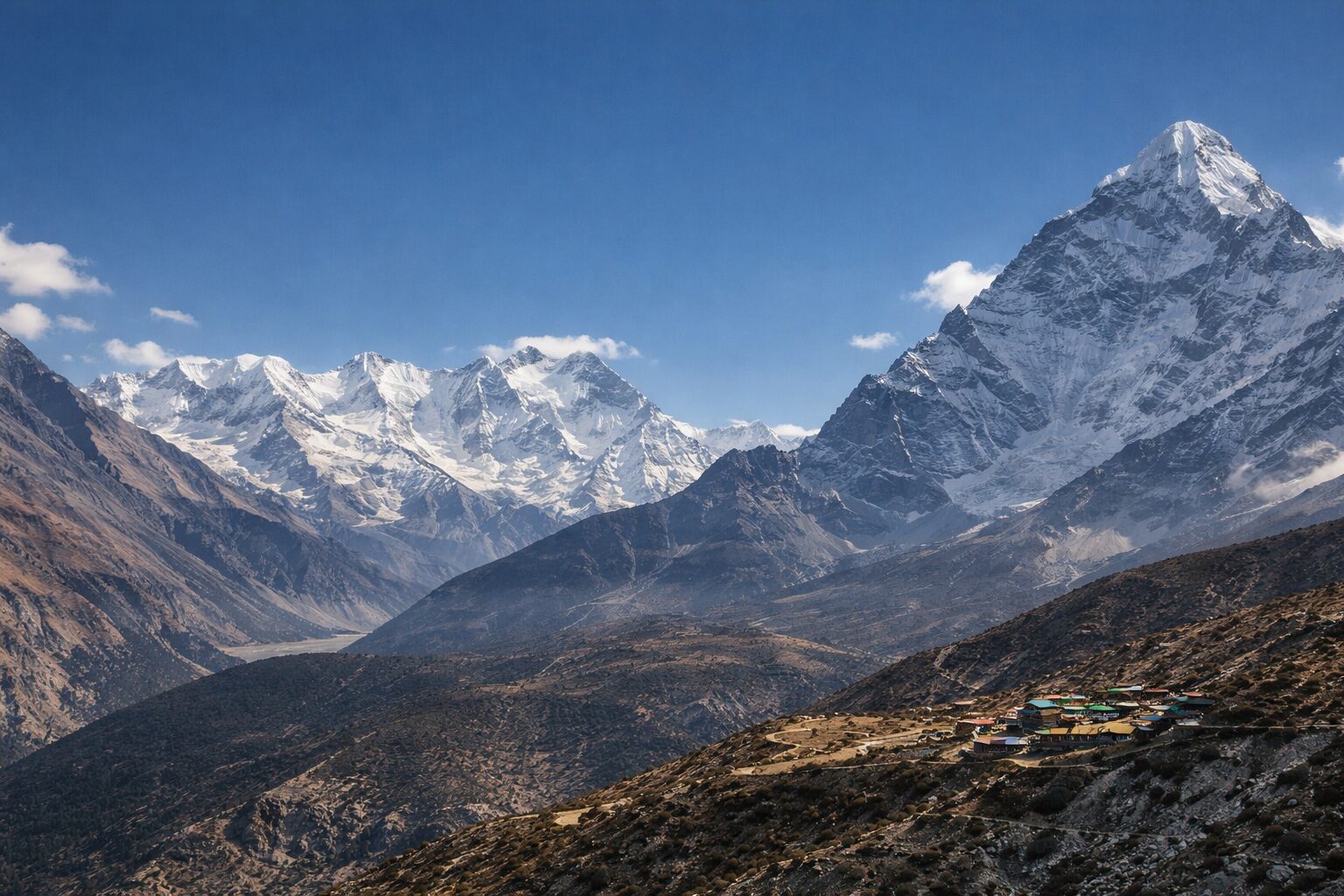
From Lukla, the real drama begins. The helicopter climbs higher, threading its way through the Khumbu Valley. Below you, the classic trekking trail passes through Namche Bazaar, Tengboche Monastery, and Dingboche. But where trekkers spend ten to twelve days covering this same ground on foot, you’re doing it in under an hour. The peaks start stacking up around you — Ama Dablam’s sharp needle, Lhotse’s vast south face, Nuptse’s long ridge — and then, unmistakably, Everest itself.
Depending on your tour type, the helicopter will either fly over Everest Base Camp and Kala Patthar for aerial views, or it will actually land at Kala Patthar (at around 5,545 metres) for five to ten minutes — enough time to step out, gasp at the altitude, and take the most jaw-dropping photographs of your life.
The final stop is Hotel Everest View at Syangboche (3,880 metres), the highest hotel in the world, where you’ll have breakfast with a panoramic view of the Everest range from your table. Then it’s back to Lukla for another refuel, and home to Kathmandu.
The whole thing takes roughly four to six hours from door to door. It’s a day that’s genuinely hard to describe to people who haven’t done it.
The Two Ways to Do It: Shared vs. Private
Now, here’s where it gets interesting — and where the price gap can feel startling if you haven’t researched it.
There are two fundamentally different ways to book this experience. Most operators offer both, and they’re not just different price points for the same thing. They actually shape your day in meaningfully different ways.
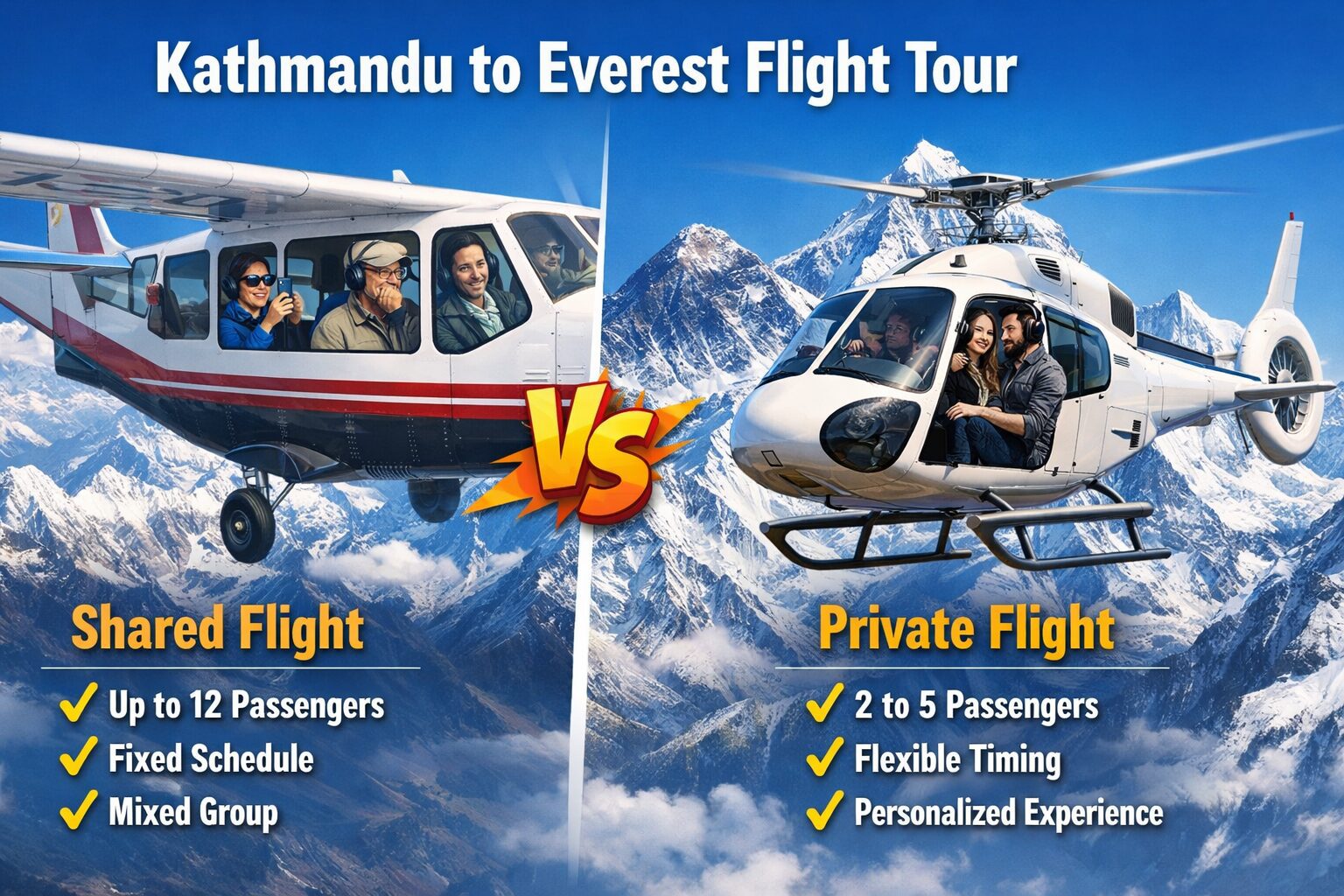
Shared (Group Joining) Helicopter Tours
A shared tour — also called a group joining flight — means you’re flying with other travellers who have also booked individual seats. The tour operator pools together solo travellers, couples, and small groups until a helicopter’s seats are filled, then schedules the departure.
Helicopters used on these tours typically carry four to five passengers. You won’t necessarily know your fellow passengers before you show up, which for some people adds a fun social element, and for others is a mild source of anxiety. In practice, most people who book these tours are curious, adventurous travellers who are delighted to be there — the conversations on the way back to Kathmandu are almost always good ones.
The shared format comes with one important operational difference you should know about: at very high altitudes — particularly above 4,200 metres — air pressure and load limits mean the helicopter can only carry two or three passengers at a time for certain legs of the journey. At Pheriche, for example, passengers are typically divided into shuttle groups for the highest-altitude section. This is not a problem, just a quirk of physics. It does mean you might be waiting a few minutes at an intermediate stop while others take their turn.
For the shared flyover tour (where the helicopter flies over Base Camp and Kala Patthar without landing at the summit), this is the standard format. Landing at Kala Patthar on a shared flight is not typically offered by most operators under current aviation guidelines, though some do offer a brief hover.
What does a shared Everest helicopter tour cost in 2026/2027?
Prices have firmed up across operators and now typically range from USD $1,250 to $1,500 per person for the full Kathmandu–EBC–Hotel Everest View–Kathmandu route. Some operators advertise entry-level prices of $900–$1,100 for simpler flyover packages without the Kala Patthar section or fewer landings, so it’s worth checking exactly what’s included.
One operator currently lists fixed group departure prices at $1,311 per person, while others advertise $1,499, including airport taxes. Most reputable operators will quote you somewhere in this ballpark. Be cautious of anything significantly below $1,000 — it usually means key elements like the Everest View Hotel breakfast, or adequate stops, have been cut.
On top of the base price, you’ll typically need to pay separately in cash on the day:
- Sagarmatha National Park entry fee: approximately NPR 3,000 (~USD $22)
- Airport tax: approximately NPR 500 (~USD $4)
- Khumbu Pasang Lhambu Rural Municipality tax: approximately NPR 2,000–3,500 (~USD $15–26)
Budget around $30–50 extra per person in cash for these permit and tax costs.
Private Charter Helicopter Tours
A private charter means the entire helicopter is yours — and only yours. You choose who comes, you control the departure time (within the operator’s scheduling), you get more flexibility at stops, and no strangers will be sharing your window seat or your breakfast table.
Private tours are particularly popular with honeymooners, families, corporate groups, and travellers who simply want the experience to feel like their experience rather than a bus tour with rotor blades. They’re also preferred by anyone who wants a landing at Kala Patthar (rather than a flyover), since at that altitude only two people can be in the helicopter for the landing itself — meaning a private charter allows you to manage the shuttling on your own terms.
The flexibility goes beyond just the guest list. Private charters can often accommodate custom routes, longer hover times, requests to circle particular peaks, and more personalised pilot commentary. Some operators also include extras like luxury hotel-to-airport transfers, nicer snacks or champagne breakfasts at Everest View Hotel, and a more curated feel throughout.
What does a private Everest helicopter charter cost in 2026/2027?
This is where you need to shift your thinking from per-person cost to per-helicopter cost. A private charter for the full Everest tour — Kathmandu return, Lukla stops, EBC flyover, Kala Patthar landing, Hotel Everest View breakfast — currently ranges from approximately USD $4,500 to $6,500 for the entire helicopter, which can carry up to five passengers.
Some operators list their private charters starting around $4,000 for simpler itineraries, while tours that include a Kala Patthar landing for private parties or premium add-ons push toward $5,500–$6,500. For extremely customised VIP tours with multiple landings, extended hover times, or flights from Lukla rather than Kathmandu, prices can reach as high as $8,000–$9,000 for the aircraft.
What this means per person depends entirely on your group size:
| Group Size | Private Charter Cost (Est.) | Cost Per Person |
| 1 person | ~$5,600 | $5,600 |
| 2 people | ~$5,800 | $2,900 |
| 3 people | ~$6,000 | $2,000 |
| 4 people | ~$6,000 | $1,500 |
| 5 people | ~$6,200 | $1,240 |
This is the key insight that many travellers miss: if you’re travelling as a group of four or five, a private charter can actually cost the same or less per person than a shared flight, while giving you an entirely different quality of experience. A family of five splitting a $6,200 private charter pays $1,240 per person — effectively the same as booking five shared seats at the group rate.
The maths shifts significantly for solo travellers or couples, where a private charter remains a genuine premium. A solo traveller paying $5,600 is spending roughly four times what they’d pay on a shared flight.
What You Actually Get That’s Different
Beyond the numbers, it’s worth being honest about the experiential differences — because the price gap isn’t purely about luxury or snobbery. There are real, concrete differences in what each option delivers.
Kala Patthar landing: Under current aviation regulations, landing at Kala Patthar (the most dramatic stop, at 5,545m, with Everest looming directly in front of you) is more reliably available on private charters. On a private flight, only two people go up at a time for this portion — so if you’re a couple, you land together. On a shared tour, the experience at Kala Patthar is typically a flyover rather than a landing.
Departure flexibility: Private charters let you choose your departure slot and won’t leave without you. Shared tours have fixed departures, and operators may reschedule or push times based on how quickly they fill the helicopter.
Wait times: On a shared tour, if seats fill slowly or weather causes a short delay, you may wait at various points. On a private charter, the operation moves at your pace.
Intimacy of the experience: This is subjective, but real. Having a helicopter to yourself — watching Everest with your partner, your family, your best friends — feels different from sharing it with four strangers. Neither is wrong, but they’re different kinds of memories.
Pilot interaction: Private charter pilots tend to be more conversational, pointing out peaks by name, explaining what you’re looking at, and tailoring commentary to your group. On a shared tour, pilots are professional and attentive, but there’s less time for personalised attention.
When to Book and Best Time to Fly
Timing matters more for this tour than almost any other Nepal activity — not because of temperature or crowds, but because of visibility. Mount Everest is spectacularly unforgiving when clouds roll in. If visibility drops, flights are cancelled or rescheduled, regardless of how much you’ve paid.
Spring (March to May) is the prime season. The weather is mostly stable, the skies are clear in the early morning hours, and the mountains are at their most photogenic. March to April sees peak demand — book at least two to three months in advance if you’re travelling during this window, especially for private charters.
Autumn (September to November) is the second best season, with October being particularly reliable. Post-monsoon air is crisp and clear, and visibility is often excellent. This is also peak trekking season, so the region is busy — again, advance booking is important.
Winter (December to February) is possible on clear days, and some operators offer discounted rates during this period. The risk of cancellation is higher, mornings can be brutally cold at altitude, and you should be prepared for delays.
Monsoon (June to August) is largely off-season for this tour. Cloud cover makes visibility unpredictable, and most operators either significantly reduce departures or charge premium rates for weather guarantees that they can’t always deliver.
Whatever season you fly, all operators confirm flights on the morning of departure based on real-time weather reports. If your flight is cancelled due to weather, a reputable operator will either reschedule or refund. Always check the cancellation policy before you book.
What’s Usually Included (and What Isn’t)
Most standard shared tour packages include:
- Round-trip helicopter flight from Kathmandu
- Refuelling stop at Lukla
- Flyover of Everest Base Camp, Khumbu Glacier, and Kala Patthar
- Landing at Hotel Everest View for breakfast (breakfast may or may not be included — check carefully)
- Hotel-to-airport transfer in Kathmandu
Most standard shared tour packages do not include:
- National Park entry fees and airport taxes (pay in cash on the day)
- Breakfast at Hotel Everest View (sometimes included, sometimes an add-on)
- Travel insurance (essential — make sure yours covers helicopter rescue at altitude)
- Any extra shuttle costs if your group is overweight at high altitude
Private charters typically include everything above plus more personalised service, a Kala Patthar landing for your party (weather permitting), and sometimes upgraded breakfasts or VIP transfers.
Hidden Costs Worth Knowing About
A few things can add unexpected cost to your trip:
Weight surcharges. At altitudes above 4,200 metres, helicopters cannot safely carry full loads. If your group collectively exceeds the weight limit, operators charge for additional shuttle flights. One commonly quoted figure is around $1,500 per extra shuttle, which is typically split among group members. This is rare, but if you’re travelling in a larger group on the heavier side, it’s worth asking about in advance.
Photography from specific angles. The helicopter will do what it can for photos, but if you want very specific hover positions for professional photography, a private charter is the only way to request this — and it may involve extra time at altitude, which sometimes comes at a surcharge.
Seasonal price variation. Spring and autumn peak season prices are typically 10–20% higher than shoulder or winter rates. If you’re booking in December–February, ask about off-season discounts.
Shared or Private: The Honest Verdict
There’s no universally right answer. But here’s how to think about it:
Choose a shared tour if you’re travelling solo or as a couple, budget is a real consideration, you’re happy with a flyover rather than a Kala Patthar landing, and you’re open to a social experience with other travellers. At $1,250–$1,500 per person, it’s an exceptional experience at a fair price.
Choose a private charter if you’re travelling as a group of four or five (where the per-person cost becomes very competitive), you want the Kala Patthar landing, you value flexibility and intimacy, this is a special occasion like a honeymoon or milestone birthday, or you simply want the day to feel completely your own. A group of five paying $1,240 per person for a private charter is not paying much more than a shared flight — and getting a fundamentally different experience.
For couples specifically, the maths is tricky. Two people on a private charter at $5,800 pay $2,900 each — nearly double the shared rate. Only you can decide whether the privacy, the Kala Patthar landing, and the romance of having Everest to yourselves is worth that premium. For many couples, it absolutely is.
A Few Tips Before You Book
Book through a licensed, CAAN-registered operator. Nepal’s Civil Aviation Authority of Nepal (CAAN) regulates helicopter operations, and reputable operators will have current licensing and experienced mountain pilots. Don’t let price alone drive your decision — read reviews carefully, check that pilots have Himalayan flight experience, and verify what insurance the operator carries.
Don’t book through vague third-party websites that add layers of margin without adding value. Plenty of operators in Thamel and online have direct booking options. Getting a quote from two or three operators and comparing what’s included is a worthwhile hour of your time.
Be flexible on dates. Weather cancellations happen. If your Nepal itinerary is tight, build a buffer day so that a one-day delay doesn’t derail your whole trip.
Carry cash. Permits and airport taxes are paid in cash on the day, and the Hotel Everest View restaurant accepts cash. Bring enough Nepali rupees — or USD, which is widely accepted.
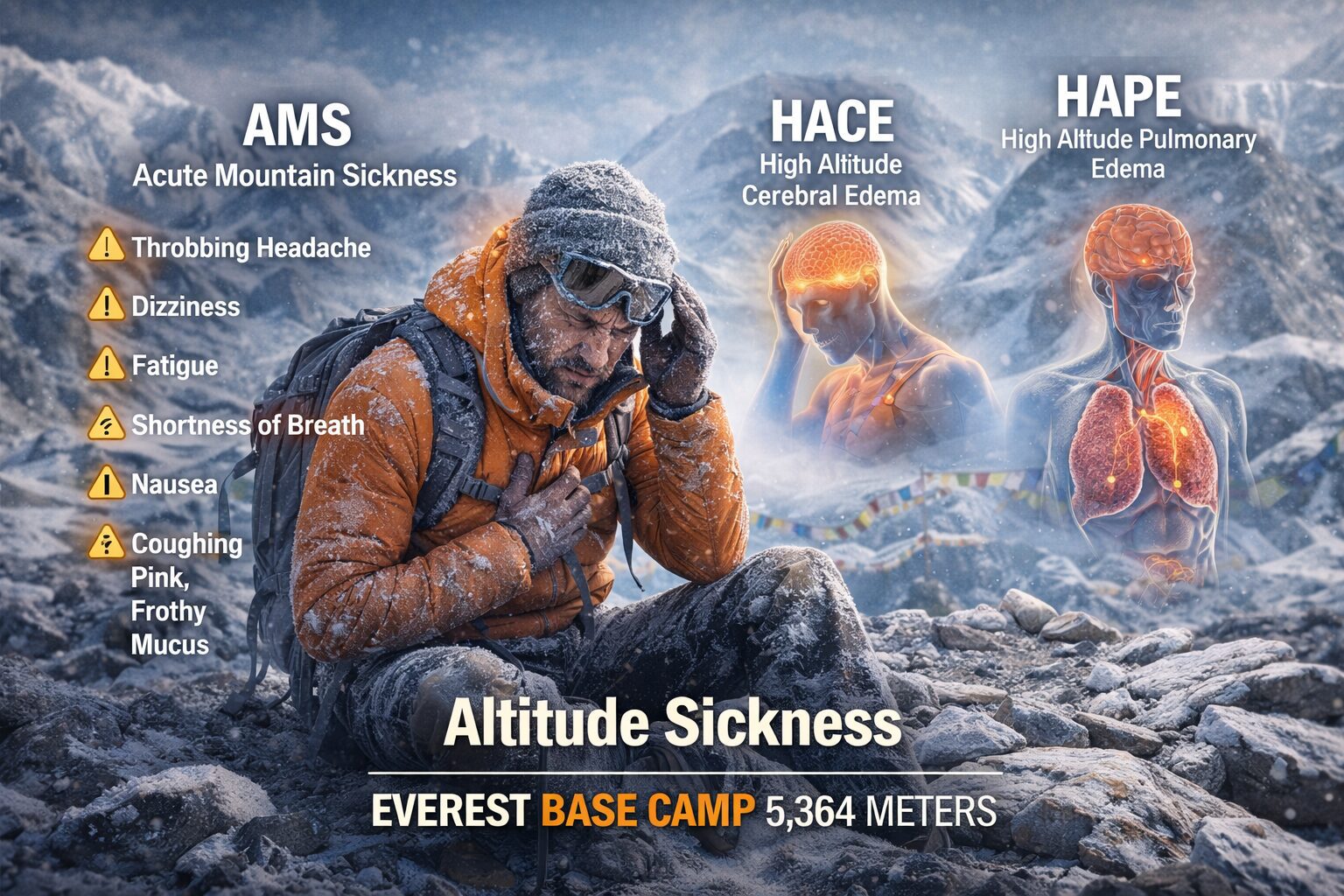
Tell your operator about any health conditions. Even though you’re not trekking, you’re still spending time at altitude. The brief stop at Kala Patthar puts you at 5,545 metres, and while the exposure is short, altitude sickness can still affect people. If you have any cardiovascular or respiratory concerns, speak to a doctor before booking.
The Bottom Line
The Kathmandu to Everest helicopter tour is one of those rare travel experiences that almost no one who does it regrets. Whether you’re paying $1,300 on a shared flight or $6,000 for a private charter, you’re going to be sitting above the clouds looking at the highest mountain on Earth — and no amount of Instagram scrolling fully prepares you for what that actually feels like.
The shared vs. private choice is genuinely one of preference and group size more than it is of quality. Shared tours are well-run, beautiful, and excellent value. Private charters are intimate, flexible, and transformative in a different way.
Run the numbers, think about who you’re travelling with and what kind of memory you want to make, and book far enough in advance that the weather is the only variable left to worry about.
The mountain will do the rest.
Comments (0)
Write a comment- First, Let’s Understand What This Tour Actually Is
- The Two Ways to Do It: Shared vs. Private
- Shared (Group Joining) Helicopter Tours
- What does a shared Everest helicopter tour cost in 2026/2027?
- Private Charter Helicopter Tours
- What does a private Everest helicopter charter cost in 2026/2027?
- What You Actually Get That’s Different
- When to Book and Best Time to Fly
- What’s Usually Included (and What Isn’t)
- Hidden Costs Worth Knowing About
- Shared or Private: The Honest Verdict
- A Few Tips Before You Book
- The Bottom Line
Read the latest Blogs & Insights
Explore our collection of articles and insights to gain in-depth travel knowledge, expert advice, and stay updated on the latest trends and tips.


No comments yet.