









5 Days Everest View Trek with Scenic Helicopter Return


Quick Trip Facts


Everest View Trek with Helicopter In and Out Overview
The 5-Day Everest View Trek with Helicopter In & Out is the perfect fusion of adventure, luxury, and breathtaking Himalayan scenery — designed for travelers who want the authentic Khumbu experience without the weeks-long commitment of a traditional Everest Base Camp expedition. Flying directly into Lukla by helicopter sets the tone from the very first moment, cutting out the lengthy road journey and plunging you straight into the heart of one of the world’s most iconic mountain landscapes. From there, a carefully curated trail winds through ancient Sherpa villages, fragrant rhododendron forests, and dramatic high-altitude terrain that has humbled and inspired climbers for generations.
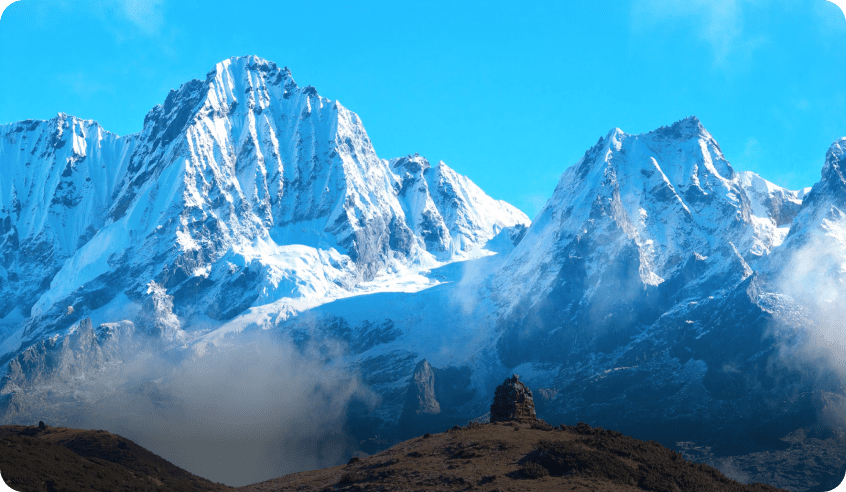
The trek’s crown jewel is the ascent to Khumjung, Namche Bazaar, and the legendary Everest View Hotel — a perch that rewards trekkers with jaw-dropping panoramas of Mount Everest (8,849 m), Lhotse, Ama Dablam, and a sweeping wall of snow-capped giants that few places on Earth can rival. Unlike longer expeditions, this five-day itinerary is meticulously designed to balance acclimatization with forward momentum, ensuring your body adjusts gradually to altitude while your itinerary remains dynamic and deeply rewarding. Every overnight stop is chosen not just for altitude management but for the cultural richness, hospitality, and scenery each location provides.
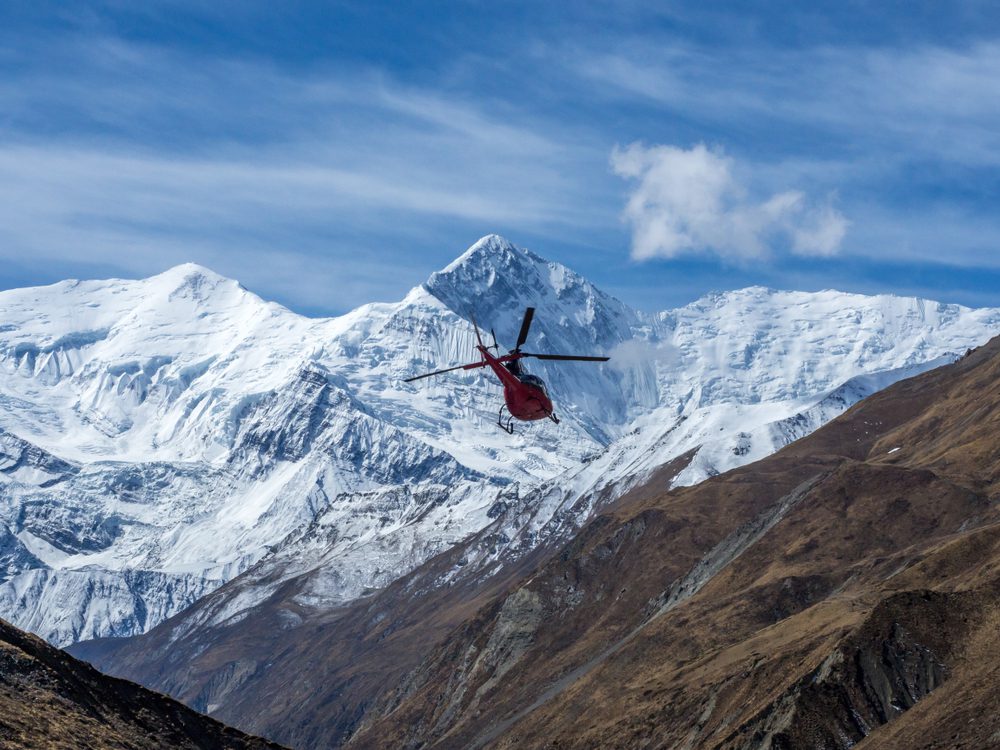
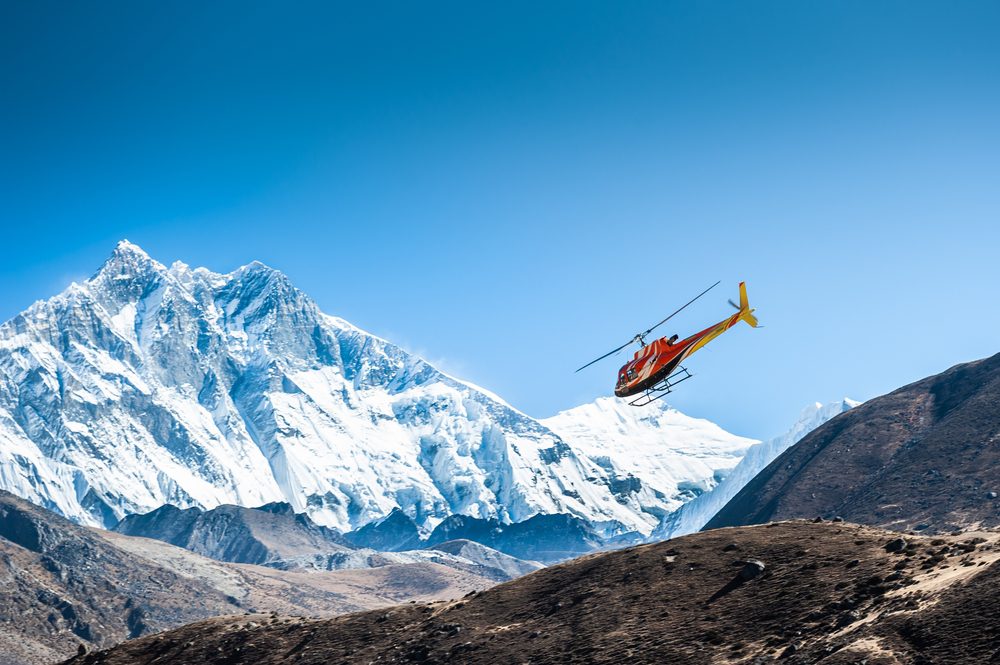
What truly distinguishes this trek is the seamless integration of helicopter transport at both ends of the journey. The return flight from the Khumbu region back to Kathmandu is nothing short of spectacular — a sweeping aerial perspective of the Himalayan range, glaciers, and winding river valleys that serves as a fitting finale to an unforgettable mountain adventure. This format appeals strongly to professionals, families with limited vacation time, and seasoned trekkers who want a high-impact, high-altitude experience packed into a compact schedule. The helicopter option also significantly reduces physical fatigue on the approach and departure, allowing more energy and focus for the actual trekking days.
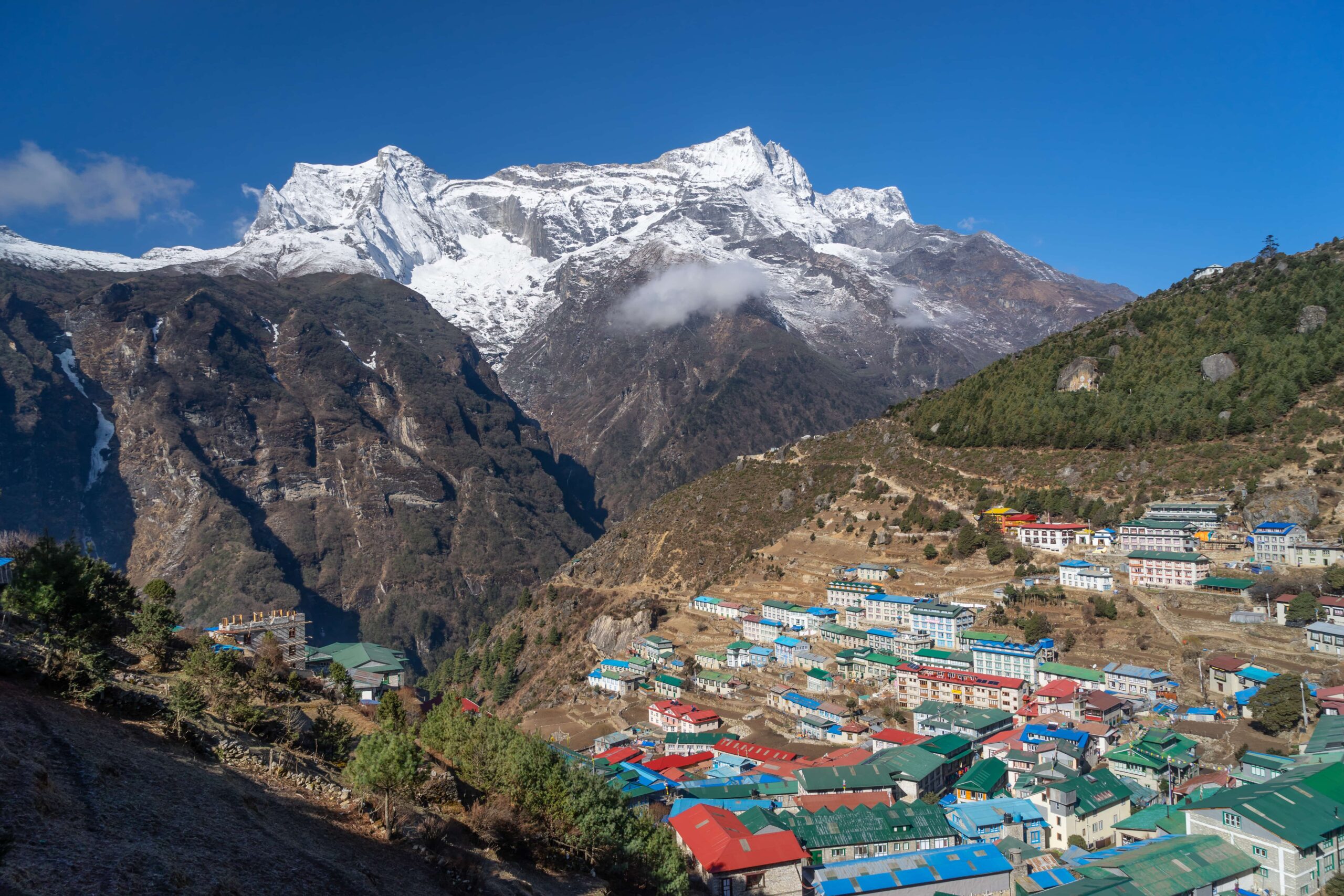
Beyond the scenery and logistics, this trek is a living cultural immersion. The Khumbu Valley is home to the Sherpa people — legendary mountaineers whose deep Buddhist heritage is visible in every mani wall, fluttering prayer flag, and monastery clinging to a cliffside. Trekkers pass through Namche Bazaar, the thriving gateway to Everest and a center of trade and culture, as well as the quieter village of Khumjung, home to a school founded by Sir Edmund Hillary himself. Guided by experienced, certified Sherpa guides and supported by a carefully vetted team, this five-day journey offers a rare and precious window into one of the most spectacular and spiritually resonant corners of our planet.
Trip Highlights
- Take a breathtaking trip from Kathmandu to Lukla, including a short , safe landing .
- Take a leisurely two to three-hour trip via suspension bridges, through rhododendron forests, and Sherpa settlements
- Explore the Hillary School and nearby monasteries.
- Visit traditional villages like Khumjung and feel the authentic hospitality of the Sherpa people.
- A night at the Everest View Hotel (3,880m) and breathtaking views of Everest from your balcony is an iconic hotel experience.
- A helicopter tour to Kala Patthar (5,400m) or even Everest Base Camp.
- Take in breathtaking 360° views of the Himalayas, including Everest, Lhotse, Ama Dablam, and more, without having to undertake a lengthy hike.
- Scenic helicopter flight directly into Lukla, saving days of travel and offering breathtaking aerial views of the Himalayas.
- Panoramic views of Mount Everest (8,849 m), Lhotse, Ama Dablam, Thamserku, and other iconic peaks from the Everest View Hotel.
- Exploration of Namche Bazaar — the legendary “Gateway to Everest” — with its vibrant market, Sherpa culture, and stunning mountain backdrop.
- Visit to the historic Khumjung Village and its monastery, believed to house a Yeti scalp, and the school built by Sir Edmund Hillary.
- Immersive cultural encounters with the Sherpa community, including visits to ancient monasteries, prayer wheel corridors, and mani stone walls.
- Exhilarating return helicopter flight over glaciers, river valleys, and snow-capped peaks back to Kathmandu.
Itinerary
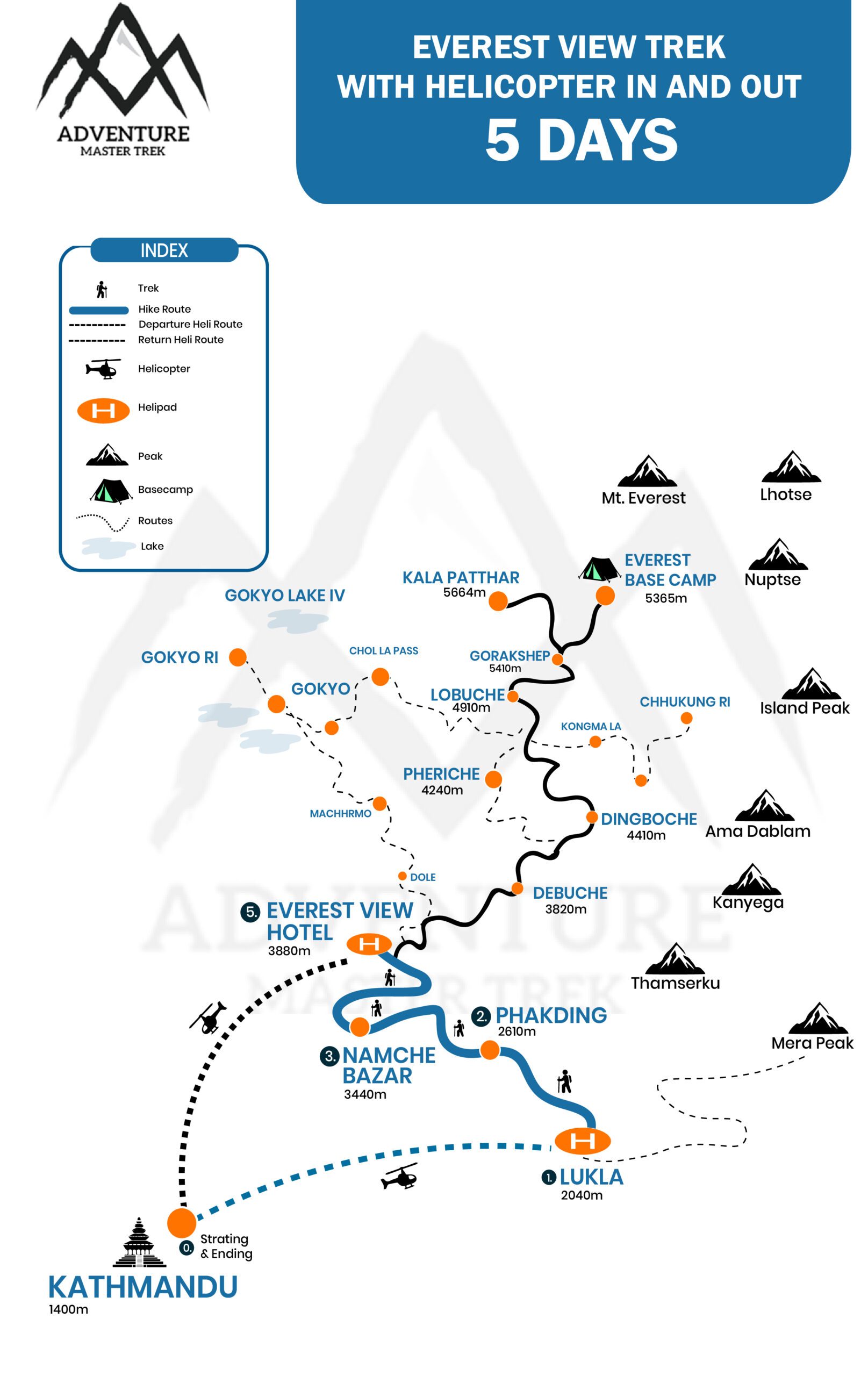
Helicopter flight to Lukla – Trek to Phakding (2,610m)
The day begins early with a thrilling helicopter ride from Lukla to Kathmandu. You’ll witness breathtaking vistas of the Kathmandu Valley, hills, and eventually the snow-capped Himalayan peaks as you take off. On reaching Lukla (2,860m), the gateway to the Makalu and the Everest region you will meet your porters and start your trek. After 3-4 hours’ trekking you will pass suspension bridges, Sherpa hamlets, and follow the beautiful Dudh Koshi River. You can hear the spinning prayer wheels as you pass tiny mani walls and chortens, and are surrounded by pine trees.
After hours of trekking, you will at last reach Phakding, a sleepy little hamlet high in the Khumbu region of Nepal, at an altitude of 2,610 meters (8,562 feet) above the sea-level. You will settle into the comfortable mountain lodge, eat a good meal, and soon retire for the night. Take care to rest and let your body start acclimatizing to the altitude today.
Stay overnight at the mountain lodge in Phakding.
Trek from Phakding to Namche Bazaar (3,440m)
An early breakfast in Phakding and you will start your trek to Namche Bazaar, the bustling centre of the Khumbu region. The trek winds through beautiful pine trees and charming Sherpa villages as it runs along the Dudh Koshi River. You will cross a number of suspension bridges on the way, including the famous Hillary Bridge, which is high above the river, from which there is a perfect view. After about two hours walking you reach the entrance to the Sagarmatha National Park, which is where your permits will be checked. The trail now becomes rougher as it gradually climbs up to Namche, presenting you with many opportunities to stop, rest and enjoy the views of the mountains. You might see Mount Everest for the first time on a clear day, right before you arrive in the settlement.
After trekking for 6 hours or so, you arrive in the lively Sherpa town of Namche Bazaar (3,440m). This place has many shops, bakeries, cafes, and colorful lodges. You’ll check into your mountain lodge and enjoy a warm meal and a well-deserved rest after trekking for hours.
Stay overnight at a lodge in Namche.
Hike to Everest View Hotel – Helicopter flight back to Kathmandu
Today will be the most thrilling and picturesque days of your journey as this will be your last day of trekking to the Everest View hotel. After an early breakfast in Namche, you’ll trek up to the Everest View Hotel (3,880m), one of the highest-located hotels in the world. The hike provides breathtaking panoramic views of the Himalayan giants, including Ama Dablam, Lhotse, and Mount Everest. There will be time for you to unwind on the hotel terrace, sip on a hot beverage, and take in the stunning surroundings. If you have the time and stamina, you can also hike a short distance to Khumjung village, a traditional Sherpa hamlet where Sir Edmund Hillary established a school and monastery.
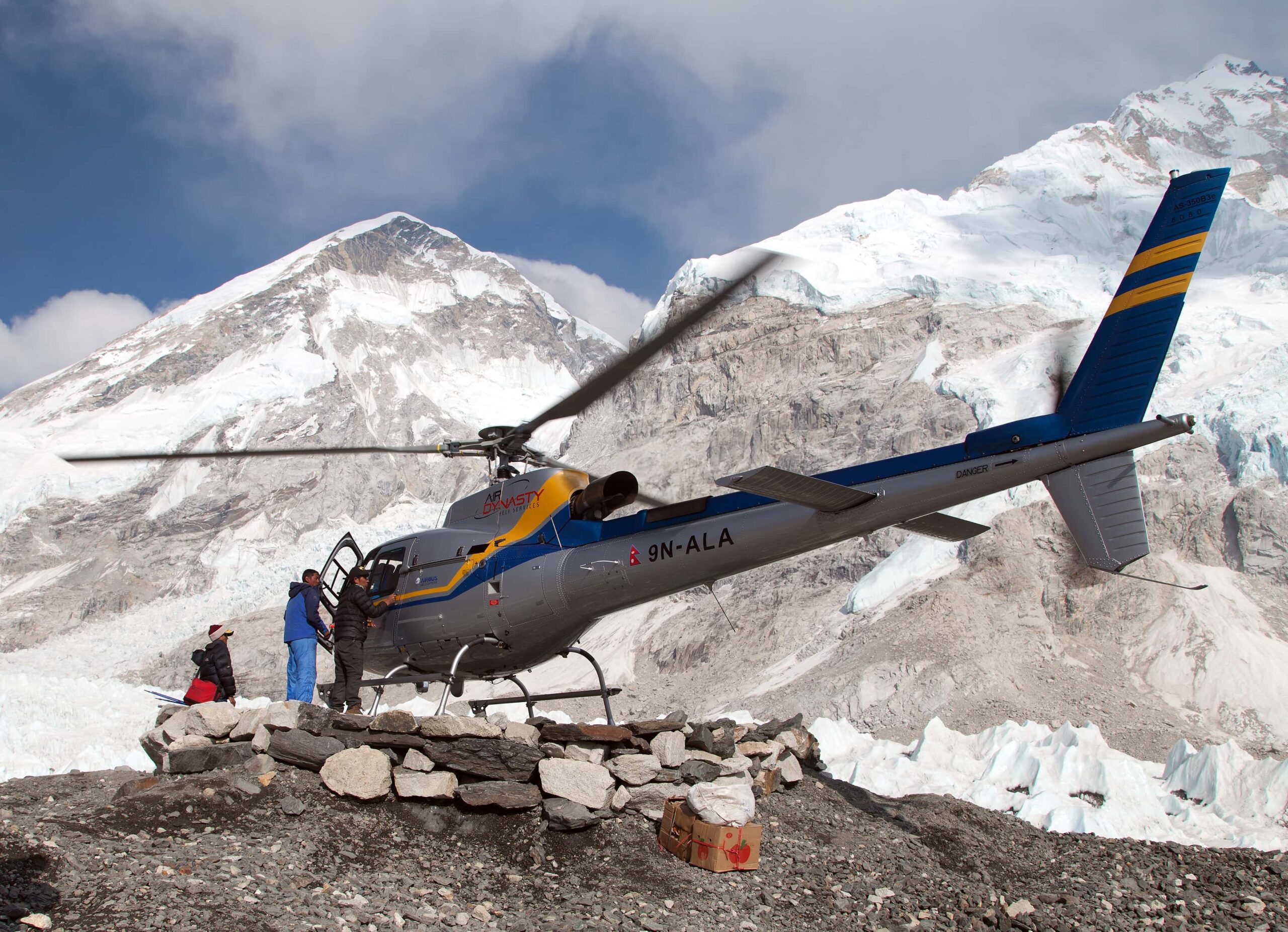
You will go to the Syangboche helipad, where you will be picked up by a helicopter for a breathtaking return journey to Kathmandu after the hike. Before descending into the valley, you will have one final, breathtaking look at the Himalayas as you pass over them.
After finishing such a wonderful journey, you will travel back to Kathmandu. You can have a restful night’s sleep and enjoy your relaxing time in Kathmandu.
Stay overnight at the hotel in Kathmandu.
Departure
Let’s get started with your trip to the Everest View Hotel, which might be the most picturesque day while trekking. The last day of the trek leads to the Everest View hotel. After breakfast in Namche, you make your ascent to the Everest View Hotel (3,880m), one of the highest situated hotels in the world. This is the last day of your trip to the Everest View Hotel. After breakfast we take you to the Tribhuvan International Airport for your trip home, depending on your flight itinerary.
Our staff will be in attendance during your departure to see that all is well. You will depart from Nepal with memories that are invaluable, leaving behind the people, the mountains and the wonderful views seen on this short but important trip. We are looking forward to seeing you again in the Himalaya Mountains!
Customize this trip with help from our local travel specialist that matches your Interests.
Customize This TripInclusions
What’s Covered in Your Adventure
- Helicopter flights (Kathmandu–Lukla and Syangboche–Kathmandu)
- All ground transfers in Kathmandu
- 2 nights' hotel in Kathmandu with breakfast (3-star or higher)
- 2 nights lodge accommodation in the mountains (twin-sharing)
- All meals (breakfast, lunch, dinner) during the trek
- English-speaking licensed trekking guide
- Sagarmatha National Park Permit and TIMS card
- Porter (optional, depending on group size)
- First aid kit
- Government taxes and service charges
- International airfare and Nepal visa
- Travel insurance (mandatory, with helicopter evacuation coverage)
- Tips for guides/porters
- Drinks and snacks are not included in meals
- Personal expenses (laundry, phone, Wi-Fi)
- Any additional nights in Kathmandu
- Emergency evacuation (unless covered by insurance)
Maps
Good to Know
Trek Difficulty of the 5-Days Everest View Trek with Helicopter In & Out
Overall Difficulty Rating: Moderate
Physical Demands
The 5-Day Everest View Trek is rated as moderate — suitable for reasonably fit individuals who do not need to be professional athletes or experienced mountaineers. Daily trekking distances range from 8 to 14 kilometers, with cumulative elevation gains reaching up to 700–900 meters on the most demanding days. The trail from Lukla to Namche Bazaar involves some steep ascents and rocky terrain, and the climb from Namche to the Everest View Hotel (3,880 m) is the most physically demanding section of the entire route. Trekkers should expect 4–6 hours of active hiking per day on the trail days. No technical climbing, ropes, or mountaineering experience is required at any point.
Altitude Considerations
Altitude is the most significant challenge on this trek. The highest point reached is the Everest View Hotel at approximately 3,880 meters above sea level. While this is well below the altitudes that require supplemental oxygen, Acute Mountain Sickness (AMS) is a real risk for those who ascend too quickly or do not stay well-hydrated. The itinerary includes a crucial acclimatization day in Namche Bazaar (3,440 m), during which trekkers make a short hike to a higher elevation before returning to sleep lower — following the golden rule of high-altitude trekking. Guides are trained to recognize AMS symptoms, and the helicopter-in format means trekkers begin at altitude immediately, making a disciplined acclimatization schedule especially important.
Trek Preparation for the 5-Days Everest View Trek with Helicopter In & Out
Proper preparation is key to a safe, enjoyable, and successful Everest View Trek experience.
Physical & Fitness Preparation
Begin your fitness preparation at least 6–8 weeks before departure. Focus on cardiovascular endurance through activities such as hiking, jogging, cycling, or stair climbing. Since this trek involves sustained uphill sections, it is especially important to train on inclines with a loaded daypack to replicate real conditions. Strength training for legs and core will help manage fatigue on longer trail days. If possible, include weekend hikes on hilly terrain to condition your joints and build confidence. You do not need to be in elite shape — but arriving fit and active will make every day on the trail significantly more enjoyable and reduces your risk of altitude-related issues.
Gear, Health & Documentation
Essential gear includes sturdy, broken-in hiking boots, moisture-wicking base layers, a warm insulating mid-layer, a windproof and waterproof outer shell, trekking poles, UV-protective sunglasses, and a comfortable daypack (25–30L). For health, consult your doctor about altitude sickness medication (Acetazolamide/Diamox) at least two weeks before the trek and carry a basic first-aid kit including blister treatments, analgesics, and rehydration salts. Required documentation includes a valid TIMS card (Trekkers’ Information Management System) and a Sagarmatha National Park entry permit — your operator will typically arrange these for you. Comprehensive travel insurance that covers helicopter evacuation is strongly recommended and, in some cases, mandatory for participation.
Accommodation on the 5-Days Everest View Trek
You will spend each night of the five-day Everest View Trek in comfortable, family-run mountain teahouses, which are simple lodges with twin beds, thin mattresses, communal bathrooms (usually squat-style), and a wood-fired common dining area. While some teahouses in larger villages like Lukla, Namche, or Phakding provide amenities like Wi-Fi (typically for a modest price), power for charging gadgets, and hot showers, the comforts decrease as you go higher; you should expect only cold showers and few services. The trek’s high point is spending a night at the luxurious Hotel Everest View (3,880m), where you may make use of solar-heated bathrooms, balconies with views of Everest, oxygen-enriched common areas, nicer beds, and even a helicopter for your fly-in and out.
Accommodation throughout the 5-Day Everest View Trek is provided at the prestigious Mountains Lodge — a 5-star property recognized as the finest hotel in the Everest region — with nights spent across two iconic locations: Phakding and Namche Bazaar. In Phakding, your first overnight stop after arriving by helicopter into Lukla, the Mountains Lodge offers a warm and luxurious welcome to the Khumbu, with world-class comfort that sets the standard for the nights ahead. From there, the trek continues up to Namche Bazaar, where the Mountains Lodge serves as your base for both your overnight stay and your all-important acclimatization day — combining unmatched hospitality with sweeping mountain views at 3,440 meters. Priced at $250 USD per room per night, these accommodations represent the very pinnacle of Everest-region lodging, offering trekkers a rare and indulgent contrast between the raw beauty of the Himalayas and the refined comfort of a 5-star mountain retreat.
Food and Drinking Water for the Everest View Trek with Helicopter trek
Most of the teahouses along the Everest View walk route serve wholesome, nutritious meals. The 5-day walk finishes with a helicopter in and out. For breakfast, the meals offered may include eggs, bread, oatmeal, and hot or cold liquids, such as tea or coffee. At lunch and dinner, there’s usually some local food, such as fried rice, noodles, momos or dumplings, and dal bhat, rice with lentils. Trekkers have many options for vegetarian food, which is recommended for good digestion and health. Some of the teahouses serve Western food such as pizza and pasta.
Staying at the Mountains Lodge — the Everest region’s premier 5-star property — means your dining experience is as exceptional as your surroundings, with world-class cuisine served at both the Phakding and Namche Bazaar lodges throughout your trek.
At Phakding, after your exhilarating helicopter arrival into Lukla and your first afternoon on the trail, you are welcomed with a superb dining experience that blends international culinary standards with the warmth of authentic Sherpa hospitality — a perfect and deeply satisfying end to your first day in the Khumbu. As you ascend to Namche Bazaar, the Mountains Lodge continues to deliver an extraordinary table, offering carefully crafted menus that feature both hearty, high-altitude-appropriate meals designed to fuel your trekking days and refined dishes that would not feel out of place in a top-tier city restaurant — all served with the breathtaking backdrop of the world’s highest peaks framed through panoramic lodge windows. Every meal at the Mountains Lodge is a celebration in itself — from energizing breakfasts that prepare you for the trail, to lavish dinners that reward the day’s effort — ensuring that trekkers on the Everest View Trek enjoy not just the finest beds in the Himalayas, but unquestionably the finest food.
Many trekkers feel the need for plenty of fluids to prevent dehydration and reduce the risk of altitude sickness. It is advisable that they drink from 3-4 litres of water daily. A good way to prevent dehydration is to drink plenty of water from teahouse refills or public sources after it has been treated with purification tablets or a SteriPen, which is a good chemical-free alternative. Bottled mineral water is also available, but it is not as economical and contributes to the problem of plastic litter. Alcoholic and acidic drinks, which dehydrate the body, should be avoided, and instead, the pilgrim should take drinks like herbal teas or soups to ease the ravages of cold in the Climate of the High Mountains.
Electricity and Internet Services on the 5-Days Everest View Trek
| Facility | Lukla | Phakding — Mountains Lodge | Namche Bazaar — Mountains Lodge |
| NTC SIM | Available (3G/4G) | Available (3G/4G) | Available (3G/4G) |
| Ncell SIM | Available (3G/4G) | Available (3G/4G) | Available (3G/4G) |
| WiFi | Available at most lodges | Available at Mountains Lodge | Available at Mountains Lodge |
| Everest Link | Available | Available | Available (Best Speed) |
| Internet Speed | Moderate | Moderate | Best on Route |
| Streaming / Video Calls | Limited | Limited | Possible |
| Messaging & Email | Reliable | Reliable | Reliable |
| Best Network | NTC | NTC | NTC |
| SIM Purchase | Limited & Expensive | Not Recommended | Available |
| Everest Link Card (20GB) | NPR 2,000 | NPR 2,000 | NPR 2,000 |
| Everest Link Card (30GB) | NPR 3,000 | NPR 3,000 | NPR 3,000 |
Tip: Always purchase and activate your NTC or Ncell SIM card in Kathmandu before departure for the best rates and guaranteed activation.
Most of the main points along the Everest View Trek with Helicopter In & Out will have available electricity and Internet service, especially the settled centres like Lukla, Phakding, and Namche Bazaar. These places’ facilities meet the basic needs of hikers, and electricity is typically supplied for charging gadgets like power banks, phones, and cameras. It’s a good idea to have a fully charged power bank with you because charging is often an additional fee at many lodges, usually paid per device or hour.
Trekkers in the Khumbu region often use the Everest Link system, a paid Wi-Fi service, or Wi-Fi to access the internet. The signal is reasonably dependable in locations like Namche Bazaar, although it could become weaker or slower in more isolated areas. You can buy data cards or access codes at the lodges. Although mobile network coverage is restricted, it is available in some places, especially if you have a Ncell or NTC SIM card. However, you should not rely solely on mobile data. All things considered, it is possible to stay connected when trekking, but it’s also a fantastic opportunity to disconnect and take in the scenery.
Why Adventure Master Trek?
- 99% of Travelers Recommend Us — Our reputation speaks louder than any brochure. With an overwhelming 99% traveler recommendation rate gathered across thousands of treks, tours, and expeditions, Adventure Master Trek has earned the trust and loyalty of adventurers from every corner of the globe. Our consistently glowing reviews reflect our unwavering commitment to safety, quality, and delivering experiences that exceed expectations — time and time again, our guests return home not just satisfied, but genuinely transformed by what they experienced with us.
- Fair Price & Absolutely No Hidden Costs — With Adventure Master Trek, the price you see is the price you pay — full stop. We believe that transparency is the foundation of trust, which is why every quote we provide is fully itemized, honest, and completely free of surprise charges, last-minute add-ons, or concealed fees. From permits and accommodation to guide fees and helicopter logistics, everything is laid out clearly from the very first conversation, allowing you to plan your adventure with complete financial confidence and total peace of mind.
- 15+ Years of Unmatched Experience — Over 15 years of operating in the Himalayas has given Adventure Master Trek a depth of knowledge, local expertise, and logistical precision that simply cannot be replicated overnight. Our seasoned team of certified guides, trek leaders, and mountain professionals have walked every trail, navigated every season, and managed every scenario the mountains can throw at a team — meaning that when you trek with us, you are backed by over a decade and a half of real, hard-won Himalayan expertise every step of the way.
- Committed to Eco-Tourism & Responsible Travel — Adventure Master Trek is deeply committed to protecting the very landscapes that make our treks so extraordinary. We operate under strict eco-tourism principles — minimizing waste on the trail, supporting local porters and Sherpa communities with fair wages and safe working conditions, sourcing meals and supplies from local producers wherever possible, and actively participating in trail clean-up initiatives throughout the Khumbu region. We believe that responsible travel is not optional — it is our obligation to the mountains, to the communities that call them home, and to the generations of trekkers who will follow in our footsteps.
Transportation for the Everest View Helicopter Trek
The entire transportation experience on the 5-Day Everest View Trek is designed to be seamless, scenic, and utterly thrilling from the very first moment. Your journey begins with an early morning helicopter departure from Kathmandu, lifting you swiftly above the Kathmandu Valley and sweeping you northward over rolling hills, terraced farmland, and the gradually rising Himalayan foothills before the first snow-capped giants begin to dominate the horizon. Within 45–55 minutes you touch down in Lukla (2,860 m), a journey that would otherwise take two grueling days by road — and the helicopter delivers it as one of the most breathtaking scenic flights you will ever experience. Each helicopter accommodates a maximum of 5 passengers, and the early morning slot is strongly recommended for the smoothest air, sharpest visibility, and the most spectacular golden-hour views of the mountains as you arrive into the Khumbu. For trekkers wishing to extend their adventure, optional helicopter add-ons from Namche Bazaar are available — including a flight to Everest Base Camp (5,364 m) with a maximum of 3 passengers per helicopter due to high-altitude weight restrictions, and a landing tour to the sacred Gokyo Lakes, a breathtaking 15–20 minute flight over the Ngozumpa Glacier with stunning views of Cho Oyu, Everest, Lhotse, and Makalu — priced at $800 USD per person with a minimum of 2 passengers required.
The return journey from Namche Bazaar back to Kathmandu by helicopter is the perfect grand finale to your Everest adventure — a sweeping, panoramic farewell flight that many trekkers describe as the single most spectacular 40–50 minutes of their entire journey. As the helicopter lifts from Namche and banks southward toward Kathmandu, the full grandeur of the Khumbu unfolds beneath you — Everest, Ama Dablam, Lhotse, the vast Khumbu glaciers, and the winding river valleys threading their way through the mountain foothills — a final, cinematic perspective of the Himalayas that no road or trail could ever replicate. With 4 passengers the cabin is open and supremely comfortable, with every seat commanding unobstructed panoramic views on both sides. On all helicopter flights throughout the trek, each passenger is permitted a maximum baggage allowance of 5 kg — excess luggage can be stored securely at your Kathmandu hotel — and passengers on high-altitude flights to Everest Base Camp and Gokyo Lake must adhere to a strict per-person weight limit of 80–90 kg, with a maximum combined total of 250 kg per flight from Namche, ensuring the highest standards of aviation safety at extreme altitude.
5 Days Everest Base Camp Helicopter Tour with Experienced Guide & Porter Support
The guides and porters of Adventure Master Trek are the beating heart of your entire Everest View Trek experience — without them, the journey simply would not be possible, and with them, it becomes something truly extraordinary. Every trek is led by a certified, English-speaking senior Sherpa guide with deep personal knowledge of the Khumbu Valley — someone who has walked these trails hundreds of times, knows every village, every teahouse, every viewpoint, and every cultural nuance of the region intimately. Our guides are trained in wilderness first aid, high-altitude medicine, and emergency helicopter evacuation procedures, meaning your safety is in the most capable and experienced hands at every stage of the journey. Beyond logistics and safety, your guide is your cultural interpreter, your storyteller, and your companion — sharing the legends of the mountains, introducing you to local families, explaining the significance of every monastery, mani wall, and prayer flag you encounter along the way, and ensuring that your experience goes far deeper than simply walking from one point to another. They set the pace with patience and sensitivity, monitor every member of the group for signs of altitude sickness, and make real-time decisions that prioritize your wellbeing and enjoyment above all else.
Our porters are equally indispensable — the unsung heroes of every Himalayan trek and among the most hardworking, resilient, and warmhearted people you will ever have the privilege of meeting on the trail. Adventure Master Trek operates under strict fair-employment principles, ensuring every porter receives a living wage, proper equipment including boots, clothing, and safety gear, adequate food and accommodation, and full insurance coverage for the duration of the trek. Each porter carries a maximum load within regulated safe limits, and their welfare is monitored and protected throughout the journey — because we believe that responsible trekking means caring as deeply for the people behind your adventure as for the experience itself. For trekkers, the presence of a dedicated porter means you carry nothing more than a light daypack on the trail — your camera, water, snacks, and a spare layer — freeing you to walk with ease, absorb the scenery fully, and arrive at each destination feeling energized rather than exhausted. Tipping your guide and porter at the end of the trek is warmly encouraged and deeply meaningful — a direct, personal way of honoring the extraordinary effort and care they invested in making your Himalayan dream a reality.
Group Size for the Everest View Trek with Helicopter In & Out
It is normally required to have a minimum of two clients to arrange the 5-Day Everest View Trek with Helicopter In & Out. This is more to do with keeping helicopter trips smooth and inexpensive. Smaller groups of 2-8 generally, are ideal for this trek. They, by virtue of their numbers, make it all a lot more fun and friendly. The smaller group is easier to alter pace in the group, also has flexibility en route and better communication with the guide. Most important of all it adds to the pleasure of the whole experience whether doing it with friends, family or a loved one.
If you are traveling alone and would like to take part you may possibly be able to join an existing group if they are going. However, while smaller groups present a tranquil, intimate atmosphere, especially when visiting villages nearby or admiring scenic beauty, larger groups can also be catered for if required. It adds to the assurance that all clients will feel at ease, supported and able to reap the full benefits of this short but thrilling trek through the Everest region.
| Group Size | Price Per Person | Helicopter Sharing |
| 2 Pax | $3,000 USD per person | Sharing up to 5 |
| 4 Pax | $2,500 USD per person | Sharing up to 5 |
| 8 Pax | $2,000 USD per person | Sharing up to 5 |
| 10 Pax | $1,800 USD per person | Sharing up to 5 |
Safety and Security for Everest View Trek with Helicopter In & Out
There is a very high standard of safety and security associated with the Everest View Trek with Heli In & Out. The local people are very friendly and hospitable and the trail is well travelled by hikers alike, being well-liked. Porters and guides are professional and ready to assist you at all times, thus keeping you on course and allowing for rapid reaction in the case of emergency. The lodges on the trip are assured to be of a very high standard, clean and good, and friendly with visitors.
As usual, it’s crucial to pay attention to your guide, drink plenty of water, and take your time getting used to the altitude. Since the trek begins and ends with helicopter flights, it reduces the hazards of stress and altitude-induced exhaustion that could occur from long descents, giving a little added safety. Climbing with a good, qualified group and listening to the needs of the body will enable the full enjoyment of the awe inspiring views of the Himalayas in safety and peace.
Altitude Sickness for the 5-days Everest View Trek with Heli In & Out
Altitude sickness can occur when the body has no adjustment time relative to the higher altitude. The highest altitude visited is Namche Bazaar, 3,440 m., and most people can stand this height with no trouble at all. Some climbers may experience slight symptoms, such as fatigue, headache, a loss of appetite, and have difficulty sleeping. These symptoms will usually pass by resting, drinking plenty of water and walking slowly but surely. A report will occasionally be made by the guide checking you up, and it is the natural course of the walk to give the body adjustment time.
You should always be careful however, to inform the guide when feeling ill that he may render assistance. The majority of people finish this walk successfully and without any accident if proper caution is exercised, that is to say, if they go slowly and drink plenty of water. The Everest View Trek with Heli In and Out is very moderate and offers a very slight chance of altitude sickness.
Permits for 5-days Everest Helicopter View Trek – Complete Permit Guide & Costs
In order to make the legal trip a pleasant one, it is necessary to have the proper permits for the Everest View Trek with Heli In. You can enter protected places like Sagarmatha National Park and the Khumbu region with these permits, and the money you pay goes toward supporting conservation efforts and local populations. Here are some permits required for the Everest View Trek with Helicopter In & Out:
- Khumbu Pasang Lhamu Rural Municipality Permit: To visit the Everest (Khumbu) region, you must have this permit. It is checked at the region’s entrance and aids in local development. You can obtain it immediately upon arriving at the permit check post in Lukla.
- Sagarmatha National Park Entry Permit: In order to access Sagarmatha National Park, which is home to Mount Everest, this permit is required. You can obtain it from the Nepal Tourism Board Office in Kathmandu or at the Monjo park gate (on the route to Namche).
Required Documents
- Passport (valid for at least 6 months)
- Passport-sized photos (2 copies)
- Copy of your passport
- Travel Insurance Details
- Flight Tickets (Domestic & International)
- Vaccination Certificate (if required by local rules)
Money Exchange
You should exchange your money in Kathmandu before the start of the view trek with Helicopter In & Out. Compared to the mountain regions, the city offers better rates on Nepali Rupees (NPR) at its numerous banks and money exchange locations. It becomes challenging to exchange money once you get to Lukla by plane, and any locations that do so can have weak exchange rates. It’s crucial to have enough Nepali cash on hand for personal costs because the majority of tea houses and stores along the trip do not take credit/debit cards or international currencies. Wi-Fi, hot showers, snacks, beverages, charging stations, and advice for porters and guides are all included in this. Additionally, since locals might not have enough change for large bills, it’s a good idea to bring smaller notes. Even though the majority of your travel expenses are often paid for in advance, having extra cash on hand will make your journey more comfortable and smooth.
Travel insurance for the 5-days Everest View Trek with Heli In & Out
Starting the 5-day Everest View Trek with helicopter evacuation is a once-in-a-lifetime experience that provides stunning Himalayan vistas. To guarantee your safety and peace of mind, you must have full travel insurance that covers certain features due to the trek’s high altitude. Here are some things you should cover in your insurance:
- High-Altitude Health Insurance: Make sure trekking up to 5,000 meters is covered by your coverage.
- Evacuation in an emergency: Verify that emergency medical evacuation, including helicopter rescues, is covered by your insurance.
- Cancellation and Interruptions of Trips: Select a plan that will pay you back if you have to cancel or postpone your trip because of illness, injury, bad weather, or political unrest.
- Protection of Gear: Choose insurance that will cover damage, theft, or loss of your hiking equipment.
Equipment and Gear List for the 5-days Helicopter Everest View trek
The aim of packing for the Everest View Trek is to be comfortable, warm, and prepared for the unpredictable weather of the mountains. Layering and essential items are important but there is no need for heavy camping equipment on this short but high-elevation trek with a helicopter in and out. Here is the packing list required for the Everest View trek with Helicopter:
General Gear
- Backpack (rain-covered, 60–70 L)
- 20–30 L daypack for daily hikes
- Duffel bag (usually provided/shared with the group)
- Sleeping bag (at least –15 to –20 °C rated)
- Liner for extra warmth and hygiene
- Extra batteries for the headlamp
- Folding trekking poles
- Water bottles plus purification (tablets or filter/SteriPen)
- Sunglasses (UV-protected, glacier-safe)
- Thermos (optional, great for hot drinks)
Dry bags or plastic bags for gear organization
Upper Body Clothing
- Base layers (1–2 moisture-wicking tops)
- Warm mid-layer (fleece/jacket)
- Heavy down jacket (for cold nights at altitude)
- Shell jacket (windproof/waterproof)
- Light wool/synthetic t-shirts (2–3)
- Long-sleeve trekking shirts (sun/cold protection)
Lower Body Clothing
- Thermal base layers (2 bottom pairs)
- Two trekking pants
- Waterproof pants
- Insulated trousers (for chilly nights)
- Lightweight shorts (optional for lower altitudes)
Torso & Accessories
- Warm hat (wool/beanie)
- Sun cap or wide-brim hat
- Buff or neck gaiter (protects from sun, wind, dust)
- Balaclava (optional for very cold days)
- Gloves: liner gloves + waterproof insulated pair
Footwear
- Waterproof, well-broken-in trekking boots
- Camp footwear (Crocs/sandals)
- Warm socks (4–5 pairs; mix of liner and thick)
- Gaiters (keep snow/mud/dust out)
Essentials & Toiletries
- Sunscreen (SPF 50+)
- Lip balm (with SPF)
- Wet wipes & tissues
- Quick-dry towel
- Toothbrush & toothpaste
- Hand sanitizer
- Toilet paper (important in teahouses!)
- Menstrual products (if needed)
- Small mirror & nail clippers
Medications & First Aid
- Personal prescriptions
- Diamox (altitude sickness – consult your doctor)
- Ibuprofen/paracetamol
- Antibiotics (for stomach or respiratory issues)
- Anti-diarrheal tablets (e.g., Imodium)
- Blister plasters (e.g., Compeed)
- Band-aids & antiseptic cream
- ORS (oral rehydration salts)
- Insect repellent (for lower altitude trails)
Optional Items
- Camera/GoPro + batteries
- Power bank or solar charger
- Lightweight book/journal
- Snacks (nuts, energy bars, chocolates)
- Earplugs & eye mask
- Lightweight travel cards/games
Booking Policy for Everest View Trek with Helicopter In & Out
1. Advance Payment & Booking Confirmation
For the 5-Day Everest View Trek with Helicopter In & Out, a 30% deposit of the total trip fee is required to reserve your spot on the trek. You can choose to pay the entire cost in advance if that is more convenient for you, or you can pay the remaining balance when you get to Kathmandu.
Please send us the following to confirm your reservation:
The payment of the deposit.
Your passport in a clear picture or scan.
Your emergency contact information and travel insurance data.
2. Payment Methods
We aim to facilitate your payments and to ensure that these may be done safely. Methods are listed below. Credit cards are the main mode of payment. Our website is secure and you may pay easily and safely.
- Credit/Debit cards may be used: The main cards are accepted e.g. Master card and Visa, and other major cards accepted (4% fee).
- Money Transfer to our bank account: Money may be sent to our bank, but note that bank charges are involved.
- Cash or cheque: may be used if in Kathmandu directly.
3. Final Payment
The balance of 70% must be paid before the commencement of the trek; this will be in Kathmandu by cash card or a bank transfer.
4. Booking Changes & Rescheduling
If you need to reschedule or change your dates, just let us know at least 30 days ahead. We’ll do our best to find new dates for you. Extra charges may apply depending on the changes.
5. Travel Insurance
You’ll need travel insurance for this trek. It should cover emergency helicopter evacuation, medical issues at high altitudes, lost or damaged luggage, and trip delays or cancellations.
6. Last-Minute Booking
We do accept last-minute bookings up to 48 hours before the trek starts, but during busy months (like spring or autumn), this might not be possible. So, it’s best to book early to make sure your place is secured, especially since helicopters and lodges can fill up fast.
Cancellation Policy for the 5-day Everest View Trek with Helicopter In & Out
1. No-cost cancellation
Up to 15 days before the commencement of the expedition, cancellations are free.
If you cancel during this time, you will receive a complete refund.
2. A portion of the refund
50% of your money will be returned if you cancel 7–14 days prior to the trek.
No refund if you cancel less than seven days before departure.
3. Last-minute changes are not refundable.
No-shows, last-minute cancellations, and early departures from the trek for personal reasons will not be qualified for refunds.
However, depending on availability and cost, we might help with rescheduling.
Note: In case of weather-related helicopter delays or cancellations, alternative arrangements will be discussed. Refunds will be provided for any services not used due to such events
FAQs
Your Questions, Answered
Do I need previous trekking experience for this trip?
This trek does not require any prior trekking knowledge. Even if it’s your first trip in the Himalayas, this journey is achievable and satisfying if you enjoy walking and are normally in good condition.
What is the highest altitude we’ll reach during the Everest View trek?
The Everest View trek’s highest altitude is about 3,880 meters (12,729 feet), which can be reached at Tengboche Monastery or the Everest View Hotel. Both of which have stunning views of the mountains.
How many hours will we walk each day?
You will walk for 4 to 5 hours per day. The walk is well-paced, allowing for rest periods, tea breaks, and taking in the scenery, which makes the trip less taxing and more pleasurable.
Where will we sleep during the trek?
Your accommodations will be traditional teahouses, which are straightforward mountain cabins with twin beds, blankets, and plain shared restrooms. They are an important part of the local trekking culture and are comfortable and well-maintained.
Will I be able to see Mount Everest on this trek?
Yes, you’ll get stunning views of Mount Everest, especially from Everest View Hotel and the surrounding ridges on the Everest View trek with a helicopter in & out. You’ll also see other famous peaks like Ama Dablam, Lhotse, and Thamserku.
How does the helicopter part of the Everest View trip with a helicopter in & out work?
You will start your trek by flying to Lukla in a small aircraft and, after completing the trek, you’ll take a scenic helicopter flight back to Kathmandu. The helicopter ride offers amazing aerial views of the Himalayas and is one of the highlights of the trip.
Is there a risk of altitude sickness on the Everest View trip?
Due to the Everest View trek’s elevation gain above 3,000 meters, there is a slight risk of altitude sickness. Most individuals only experience minor symptoms like exhaustion or a headache, and your guide will keep an eye on you the entire time to ensure your safety and well-being.
Is there a risk of altitude sickness on the Everest View trip?
Due to the Everest View trek’s elevation gain above 3,000 meters, there is a slight risk of altitude sickness. Most individuals only experience minor symptoms like exhaustion or a headache, and your guide will keep an eye on you the entire time to ensure your safety and well-being.
When is the best time to go on the Everest View trek?
The best times to do the Everest View trek are in the spring (March to May) and autumn (September to November), when the weather is generally clear, dry, and stable, offering the best mountain views and flight conditions.
Is a guide mandatory for the Everest View trek?
A guide is not an obligation but it is highly recommended to use one as one’s insurance and safety. In case a person gets sick or wants to turn back, someone needs to start a search, and that is only possible if one treks as a group.
Where do I book the Everest View Trek package?
One can either contact Trekking Agencies Association of Nepal (TAAN) or any of its associate trekking agents in Nepal, or they can go for travel websites.
What if I wish to see more of the Everest region?
This trek will help you see the same views as you would in other Everest trekking routes, allowing you to see all the same famous peaks in one trek since it is a linking route.
If the flight out to Lukla is canceled due to bad weather, what is the service provision?
In the case of such a situation, the flight can be rescheduled on the next available day.
Is it possible to ask our guide or porters to carry specially-labeled items?
The guides or porters would be familiar with the special labels and could distinguish them from each other.
Can I bring my pet?
The management of any travel package has a philosophy of not allowing any animals.
When do we come back from the trek?
You will return to Kathmandu after completing the trek.
Are hiking sticks available for rent?
Yes, but depending on the location, it is advisable to buy rather than rent ski poles.
Do we have hot showers in Namche?
In ancient times, Nunche was one of the most accommodative hotels housing their availability in hot showers.
What happens if the helicopter can’t fly due to bad weather?
If the helicopter can’t fly due to bad weather, we will either wait for the next safe weather window or modify the return itinerary, maybe involving an additional overnight stay or a regular flight from Lukla.
Can I do the Everest View trek solo, or do I need to join a group?
You can do the Everest View trek solo, and many solo travelers join. You’ll still be accompanied by a guide, and if you prefer, you can join a group to share the experience with others.
How much does the Lukla helicopter flight cost?
The Kathmandu to Lukla helicopter flight is fully included in your Adventure Master Trek package price with no additional charge.
How long is the helicopter flight to Lukla?
The helicopter flight from Kathmandu to Lukla takes approximately 45–55 minutes covering around 140 km.
How long is the helicopter flight from Namche to Kathmandu?
The return helicopter flight from Namche Bazaar to Kathmandu takes approximately 40–50 minutes covering around 130 km.
How long is the Everest Base Camp helicopter flight from Namche Bazaar?
The helicopter flight from Namche Bazaar to Everest Base Camp takes approximately 20–30 minutes with a maximum of 3 passengers per flight.
How much cash should I carry for the 4-day trek?
We recommend carrying $150–$250 USD worth of Nepalese Rupees in cash for personal expenses, tips, snacks, and shopping.
Where can I rent a sleeping bag and down jacket?
Sleeping bags and down jackets can be rented affordably at gear shops in Kathmandu’s Thamel district for $1–$3 USD per day.
What health conditions should I be aware of?
The primary concern is Acute Mountain Sickness (AMS) — stay hydrated, acclimatize properly, and consult your doctor about Diamox before departure.
How can I do this trek — what is the booking process?
Simply contact Adventure Master Trek via our website or email with your preferred dates and group size and we will handle everything from there.
How many litter bags do I need to carry?
One to two small zip-lock or dry bags are sufficient — we operate a strict leave-no-trace policy and all waste must be carried out from the trail.
How much does a water bottle cost on the trek?
Expect to pay NPR 100–250 ($0.75–$2.00 USD) per bottle depending on location — carrying a reusable bottle with purification tablets is strongly recommended.
When do Sherpa festivals happen?
The most celebrated festival is Mani Rimdu, held at Tengboche Monastery each October/November and at Thame Monastery each May.
What is Sherpa food?
Sherpa cuisine centers on Dal Bhat, Thukpa noodle soup, Tsampa, Sherpa stew, Tingmo steamed bread, and the iconic savory butter tea.
Where can I get original yak cheese?
The best authentic yak cheese is found at the community-run Khumjung Cheese Factory and at local market shops throughout Namche Bazaar

Reviews
What Our Travelers Say


Based on 5 ratings
5




A fantastic option for limited time in Nepal. Santosh and Shambhu were friendly, knowledgeable, and always helpful.
The helicopter flight was unforgettable and the Everest views were breathtaking. Special thanks to Raj and Naran for the wonderful support.
Well-organized trek with stunning scenery. Umesh and Santosh made everything easy and enjoyable. Highly recommend Adventure Master Trek!
View Our Similar Packages
Discover our top tours, loved by thousands of travelers annually. Choose the adventure that inspires you and embark on a journey tailored to your desires.

 Nepal
Nepal
 12 Days
Save 18%
Add Review
Reviewing for 5 Days Everest View Trek with Scenic Helicopter ReturnRequest a Callback - 5 Days Everest View Trek with Scenic Helicopter Return
Submit the form and we will be back to you shortly
Request a Callback - 5 Days Everest View Trek with Scenic Helicopter Return
Submit the form and we will be back to you shortly
Narayanhiti Palace Museum

Narayanhiti Palace Museum


