









Everest Base Camp vs. Summit of Everest: Everything You Need to Know
Everest Base Camp trek vs Mount Everest summit climb explained: altitude, difficulty, cost, risks, and what most trekkers experience in the Everest region.
-
 Adventure Master Trek
-
3 March, 2026
-
9 mins read
-
1803 Views
-
0 Comments


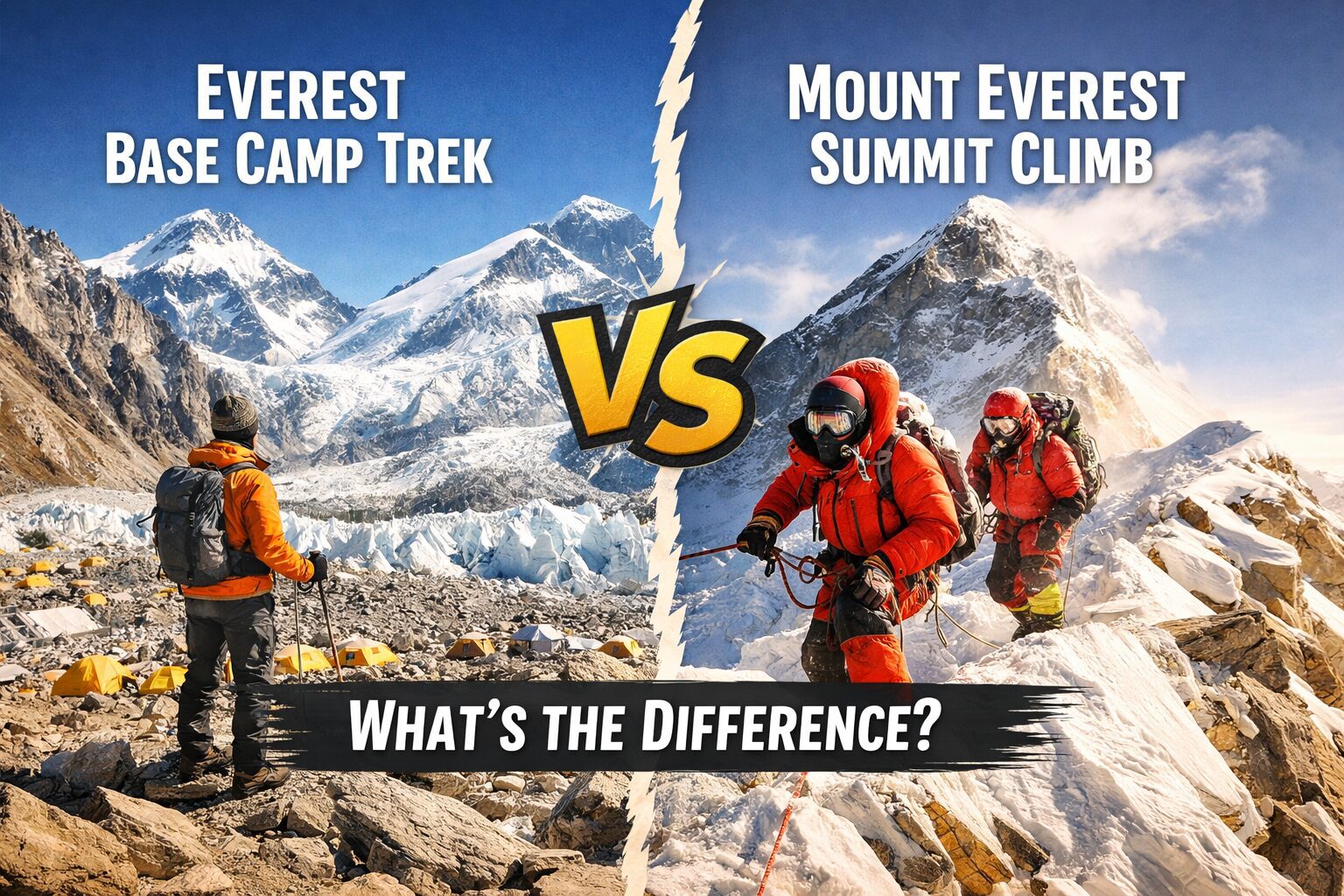
When people hear the word “Everest,” their minds tend to jump to dramatic images of frost-bitten mountaineers inching their way through a blizzard, queuing along a knife-edge ridge at 28,000 feet.
What many don’t realise is that the vast majority of people who travel to the Everest region never climb the mountain at all, they trek to Everest Base Camp, which is an entirely different experience. If you’ve ever wondered what separates a trek to Everest Base Camp from a full summit expedition, this guide breaks it all down, from altitude and difficulty to cost, risk, and the surprising answer to whether you can actually see the summit from base camp.
What Is Everest Base Camp — and Is It the Top of Everest?
Let’s clear up the most common misconception first: Everest Base Camp is not the top of Everest. Not even close.
The south (Nepal) Everest Base Camp sits at an altitude of 5,364 metres (17,598 feet) above sea level. The summit of Mount Everest stands at 8,848.86 metres (29,031.7 feet) — the highest point on Earth. That means the base camp is more than 3,400 vertical metres below the summit. If you stacked four Empire State Buildings on top of each other, that still wouldn’t bridge the gap.
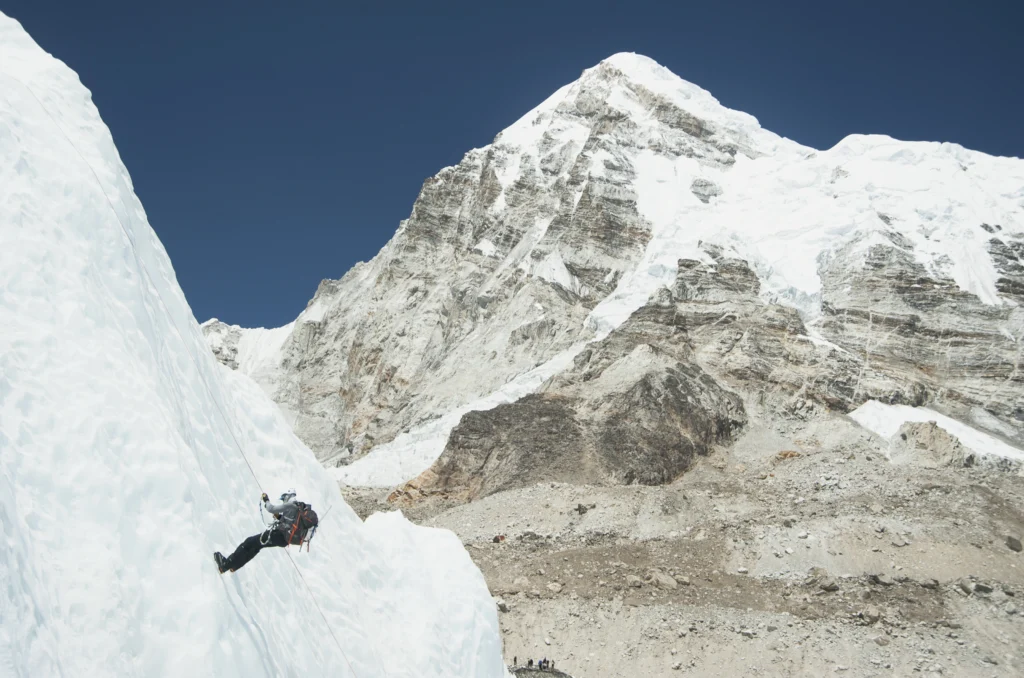
Base camp is exactly what the name suggests: the launching pad. It is a temporary city of tents erected each spring season by expedition teams preparing to attempt the summit. Professional mountaineers, Sherpa guides, logisticians, and support teams all converge here to acclimatise, load supplies, and plan their rotations up the mountain.
For trekkers, reaching Everest Base Camp means standing at the foot of the world’s most famous mountain and witnessing this incredible operational hub — an achievement that is enormously satisfying in its own right, but one that should not be confused with climbing Everest.
Can You See the Summit from Base Camp?
Here is another fact that surprises almost everyone: from the Nepal (south) Everest Base Camp, you cannot actually see the summit of Mount Everest. The massive bulk of the Khumbu Icefall and the surrounding ridgeline block the view entirely. You are too close to the mountain and at the wrong angle.
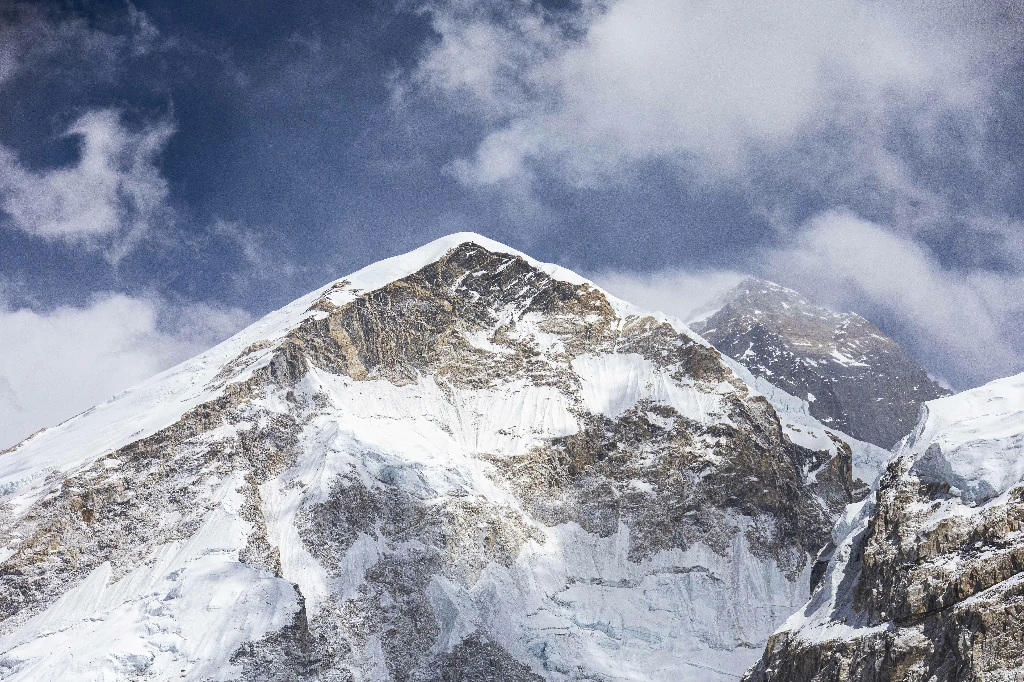
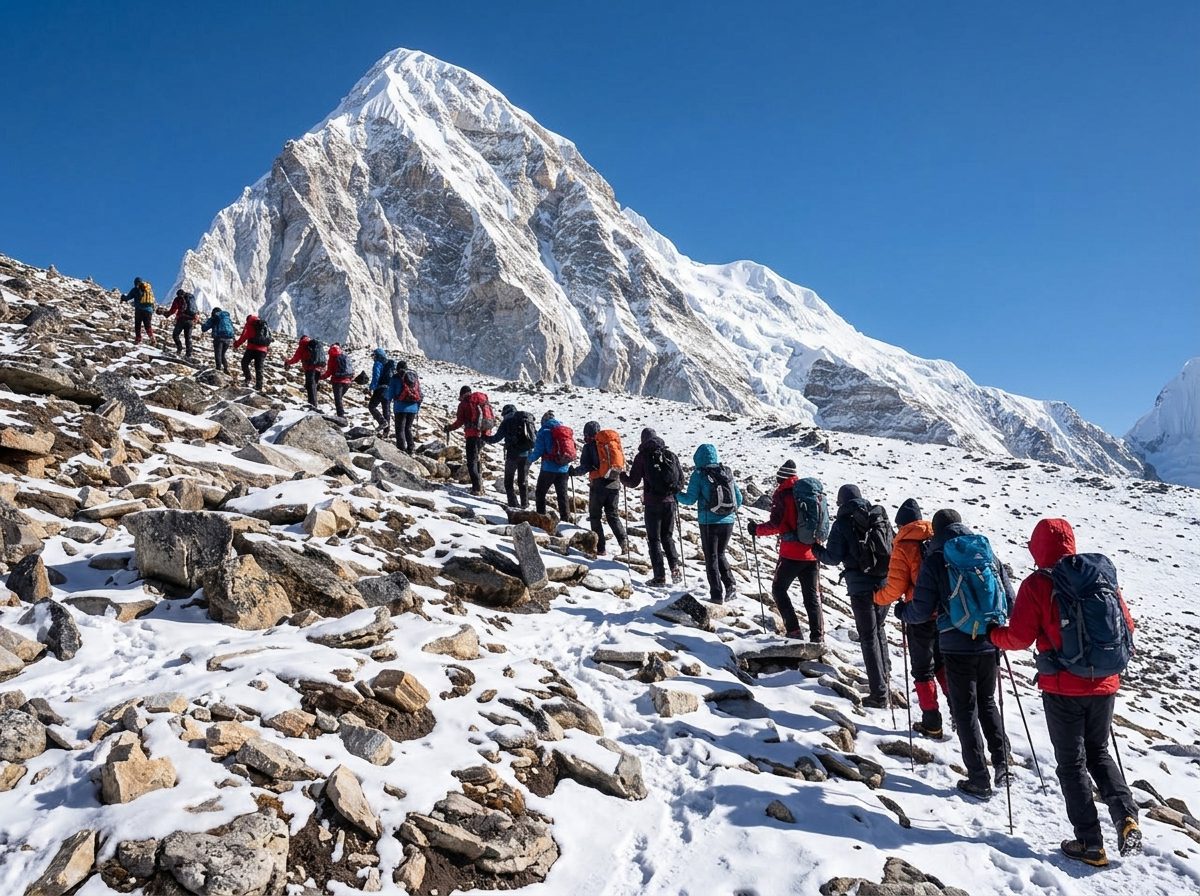
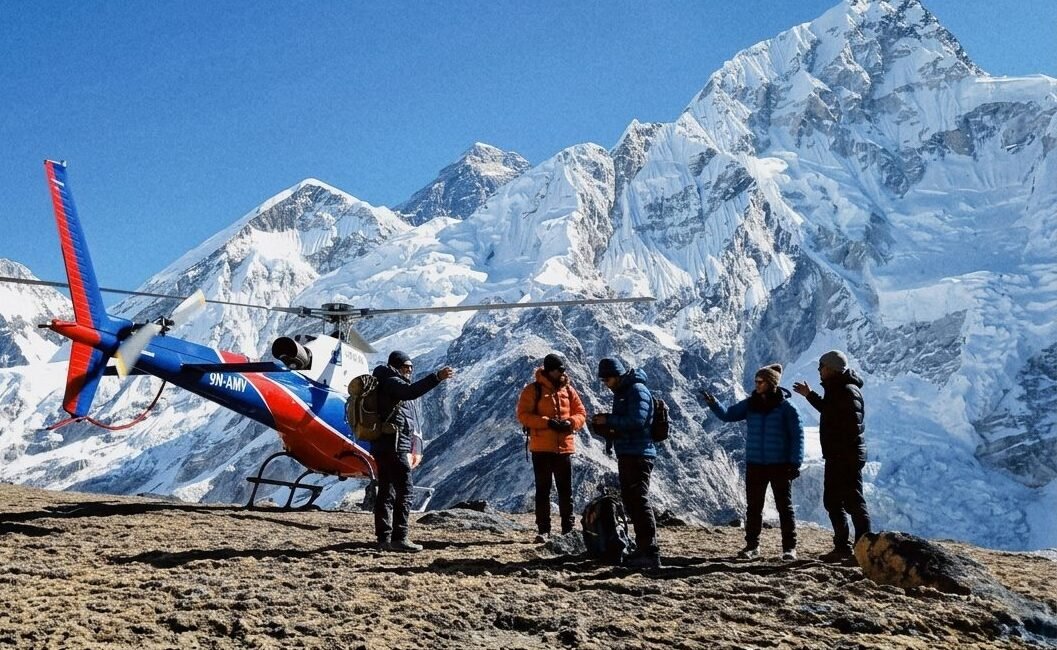
The best view of the Everest summit from the ground is obtained from Kala Patthar, a prominent hill that rises to 5,545 metres (18,192 feet) and sits just above the village of Gorak Shep.
Nearly all standard EBC trekking itineraries include a pre-dawn climb of Kala Patthar, where trekkers are rewarded with an unobstructed, jaw-dropping view of Everest’s iconic peak, with the summit’s characteristic plume of wind-driven snow streaming off the top.
From Kala Patthar you can also spot the tiny yellow expedition tents of base camp far below on the glacier — giving you a powerful sense of both scale and perspective.
If you trek to the Tibetan (north) side of Everest, the situation is quite different. The North Base Camp at around 5,200 metres offers a more direct, unobstructed view of the summit because the approach is along the northeast ridge rather than underneath a towering icefall.
That said, the Nepal EBC trek remains by far the most popular route in the world.
The Altitude Difference: Tea Houses vs. the Death Zone
The altitude gap between base camp and the summit is not just a number — it represents a fundamentally different physiological reality.
Trekkers heading to base camp ascend gradually over approximately 12 to 15 days, following a well-planned acclimatisation schedule that includes rest days and gradual elevation gains. The highest point most trekkers reach is Kala Patthar at 5,545 metres, and the oxygen levels there, while noticeably thin, are manageable with proper preparation and pacing.
Most trekkers experience mild symptoms of altitude sickness — headaches, fatigue, and poor sleep — but these are manageable and part of the experience.
Everest summit climbers, on the other hand, must contend with the Death Zone — any altitude above 8,000 metres where the human body simply cannot acclimatise. Above this threshold, oxygen levels drop to roughly one third of those at sea level, and without supplemental oxygen, the body begins to shut down.
Cognitive performance decays, muscles cease functioning efficiently, frostbite develops rapidly, and the risk of High-altitude pulmonary edema (HAPE) and High-altitude cerebral edema (HACE) becomes life-threatening.
The comparison between the headache at a tea house in Namche Bazaar and the fight to survive in the Death Zone at 8,800 metres perfectly explains why these two experiences fall into entirely different categories.
Difficulty: Strong Legs vs. Extreme Mountaineering
The EBC trek requires solid fitness, determination, and a willingness to put up with cold mornings and basic accommodation. You do not need any technical mountaineering skills whatsoever.
You will not use ropes, crampons, ice axes, or harnesses. The trail follows well-worn paths through Sherpa villages, past ancient monasteries, and across dramatic suspension bridges draped in colourful prayer flags.
You’ll walk an average of 10 to 14 kilometres per day on rocky but navigable terrain.
Most reasonably fit individuals who train consistently for a few months can complete the EBC trek. The trek has an approximate success rate of around 90%, and while altitude can affect even the fittest trekkers, the itinerary is designed to give your body time to adapt.
Summit climbing is on an entirely different plane of difficulty. To even attempt Everest, you need years of prior mountaineering experience, including successful ascents of other high-altitude peaks.
You must be proficient with ropes, ice climbing techniques, crevasse navigation, and jumar ascenders. You need to be able to move confidently across the Khumbu Icefall — a notoriously unstable, ever-shifting maze of ice towers and crevasses that has killed many experienced climbers.
Time Commitment: Two Weeks vs. Two Months
One of the most practical differences between the two experiences is the time required.
The standard EBC trek from Lukla to base camp and back takes approximately 12 to 15 days, including acclimatisation stops. Add travel to and from Kathmandu and you’re looking at a total trip of roughly three weeks — very manageable for most people with jobs and responsibilities.
A full Everest summit expedition, by contrast, requires a commitment of approximately two months, sometimes longer. This extended timeline is not optional; it is dictated by physiology.
Summit climbers must undertake multiple “rotation” climbs up and down the mountain before their final summit push, each time going a little higher and then descending to allow the body to build red blood cell capacity.
Weather windows also play a critical role; the main summit season is a narrow window in May before the summer monsoon arrives.
Price: Backpacking vs. 6 Figure Adventures
The difference between the two experiences in terms of finances is astounding.
A complete trek with a reputable operator will guide them up the EBC and back down, costing between $1000 and $3000, including round-trip flight tickets to Lukla, permits, accommodation in tea houses, meals, guide fees, and porter support.
Even when you factor in international flights to Kathmandu, personal gear, travel insurance, and spending money, most people can complete the entire journey for under $5,000 to $6,000.
Climbing to the summit of Mount Everest is a financial undertaking of an entirely different magnitude. The Nepal government’s climbing permit alone costs approximately $11,000 per person. Full guided expedition packages start at around $35,000 and can reach $100,000 or more, depending on the operator and the level of support.
Risk: Managed Adventure vs. Life-or-Death Commitment
Every high-altitude adventure carries some inherent risk, but the gap between EBC trekking and Everest summit climbing is vast.
Trekking to Everest Base Camp is widely considered safe when approached responsibly. The greatest dangers are altitude sickness and, to a lesser extent, undisclosed cardiovascular conditions exacerbated by high altitude.
Around 2 to 4 trekkers pass away on the EBC route each year out of approximately 30,000 who attempt it — an extremely low rate.
Summiting Mount Everest, however, is statistically dangerous in ways that cannot be minimised. The overall death rate sits at approximately 4% of all those who attempt it.
As of May 2024, 340 people have died on Everest, and over 200 bodies remain on the mountain, permanently frozen into the terrain.
Gear and Permits: Hiking Boots vs. a Full Arsenal
For the EBC trek, you need good quality layering, a warm sleeping bag rated to at least -10°C, a solid pair of broken-in hiking boots, trekking poles, and the usual kit of sun protection, a first aid kit, and a quality down jacket.
Two permits are required:
- Sagarmatha National Park Entry Permit
- Khumbu Pasang Lhamu Rural Municipality Permit
They cost $30 to $50 and are easily obtained in Kathmandu or along the route.
Summit climbers require an arsenal of technical equipment including double-plastic mountaineering boots, 12-point crampons, ice axes, harnesses, ascenders, expedition down suits, high-altitude sleeping bags, oxygen masks, and regulators.
The Cultural Experience: A Journey Through Living History
Both experiences offer unparalleled exposure to the culture of the Khumbu Sherpa people, but for EBC trekkers this cultural immersion is a central, daily thread of the journey.
Walking through Namche Bazaar, visiting Tengboche Monastery, passing through remote villages where yaks outnumber vehicles, and exchanging stories with Sherpa guides who have spent their lives in the shadow of these mountains all of this weaves together into an experience that is as rich and meaningful as the physical challenge.
For summit climbers, base camp itself becomes a temporary home for months, and the relationships forged with Sherpa teams are deep and profound.
The Bottom Line: Which Should You Choose?
If you are a regular person with a solid fitness foundation, a spirit of adventure, and two to three weeks to spare, the Everest Base Camp trek is one of the most extraordinary journeys you can take on this planet.
You will walk through some of the most dramatic scenery on Earth, sleep under a sky blazing with stars at altitude, stand at the foot of the world’s highest mountain, and come home with a story that will last a lifetime — and you don’t need a mountaineering resume or a six-figure budget to do it.
If you are an experienced, technically skilled mountaineer with years of high-altitude climbing under your belt, the financial means to fund a major expedition, and the physical conditioning of a serious endurance athlete, then the summit of Mount Everest represents the ultimate expression of human ambition and endurance.
The two experiences share a name and a geography. Beyond that, they are worlds apart.
Comments (0)
Write a comment- What Is Everest Base Camp — and Is It the Top of Everest?
- Can You See the Summit from Base Camp?
- The Altitude Difference: Tea Houses vs. the Death Zone
- Difficulty: Strong Legs vs. Extreme Mountaineering
- Time Commitment: Two Weeks vs. Two Months
- Price: Backpacking vs. 6 Figure Adventures
- Risk: Managed Adventure vs. Life-or-Death Commitment
- Gear and Permits: Hiking Boots vs. a Full Arsenal
- The Cultural Experience: A Journey Through Living History
- The Bottom Line: Which Should You Choose?
Read the latest Blogs & Insights
Explore our collection of articles and insights to gain in-depth travel knowledge, expert advice, and stay updated on the latest trends and tips.


No comments yet.