









Annapurna Base Camp Heli Tour vs Trek: Which One Is Right for You?
Compare Annapurna Base Camp heli tour vs trek by cost, time, difficulty, views, and experience to choose the best option for your trip.
-
 Adventure Master Trek
-
14 May, 2026
-
14 mins read
-
694 Views
-
0 Comments


The Annapurna region gets somewhere around 150,000 trekkers a year, and that number keeps climbing. It’s earned. Towering peaks, waterfalls dropping out of nowhere, old Gurung villages clinging to ridgelines, trails so thick with rhododendrons in March that you walk through tunnels of red and pink for hours at a stretch. And at the centre of all of it, Annapurna Base Camp: a wide-open bowl at 4,130 metres, ringed by some of the biggest mountains on the planet, including Annapurna I, the 10th highest in the world.
To get there, you have two options. Walk it, which means 7 to 12 days on the trail, teahouse beds, dal bhat twice a day, and a view you’ll have sweated hard to earn. Or fly it, which means a helicopter out of Pokhara, forty-something minutes in the air, half an hour on the ground at base camp, and you’re back before lunch.
Both work. Both are worth doing. But they’re not the same thing at all, and treating them as interchangeable versions of the same trip is a mistake. This guide covers the real differences so you can pick the one that actually suits your trip in 2026.
Overview of the Annapurna Base Camp Experience
Same destination, completely different journeys. One takes a week and a half and asks a lot of your legs. The other takes a morning and asks almost nothing. Here’s what you’re actually looking at with each.
What Is the Annapurna Base Camp Trek?
The ABC trek starts in Pokhara and works its way up through farmland, forest, and a string of villages before pushing into the high Annapurna Sanctuary. The route passes through Ghandruk, Chhomrong, and Sinuwa, climbing alongside the Modi Khola river until the valley opens up into the mountain amphitheatre. You pass Machhapuchhre Base Camp at 3,700 metres on the way up, with Annapurna Base Camp another hour or so beyond that.
Standard itineraries run 7 to 12 days. The shorter end is doable but rushed. Most people take 10 days and are glad they did. The trek sits in the moderate category, meaning no ropes or crampons required, but you need to be in reasonable shape and take the altitude seriously above 3,500 metres.
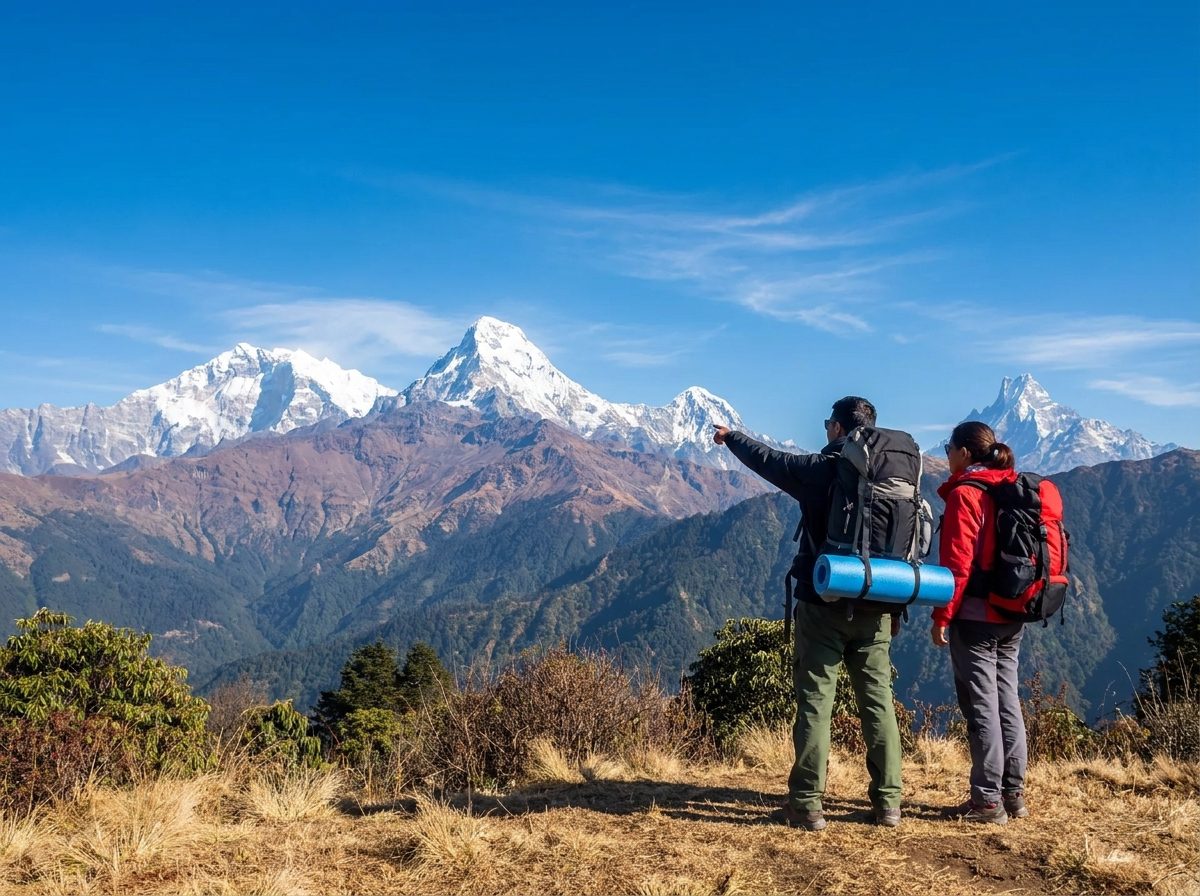
What people remember most isn’t the base camp itself. It’s the week of walking that gets them there: the suspension bridges over glacier rivers, the village guesthouses, the mornings when Fishtail Mountain is the first thing visible through the window before the clouds roll in.
What Is the Annapurna Base Camp Heli Tour?
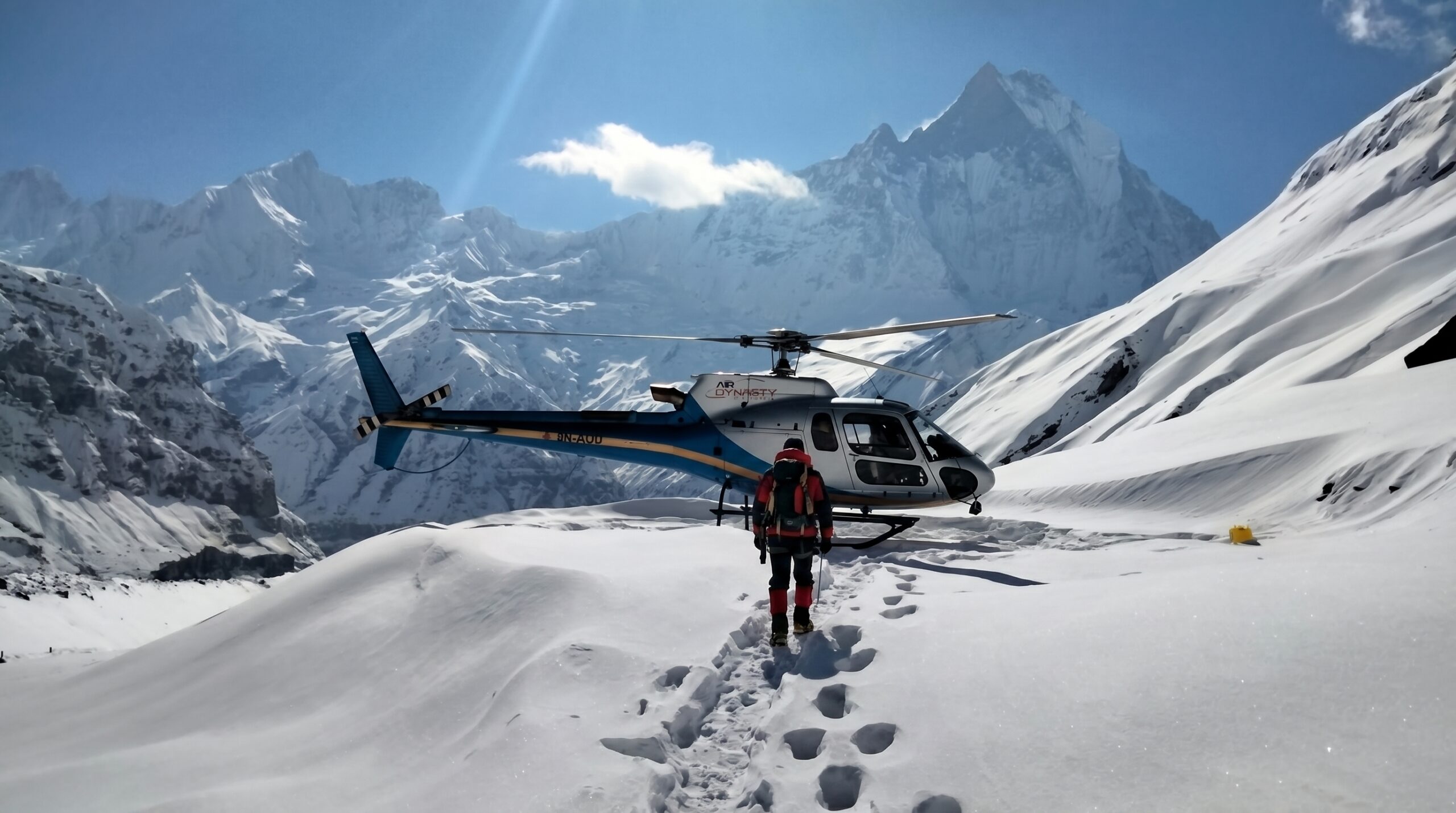
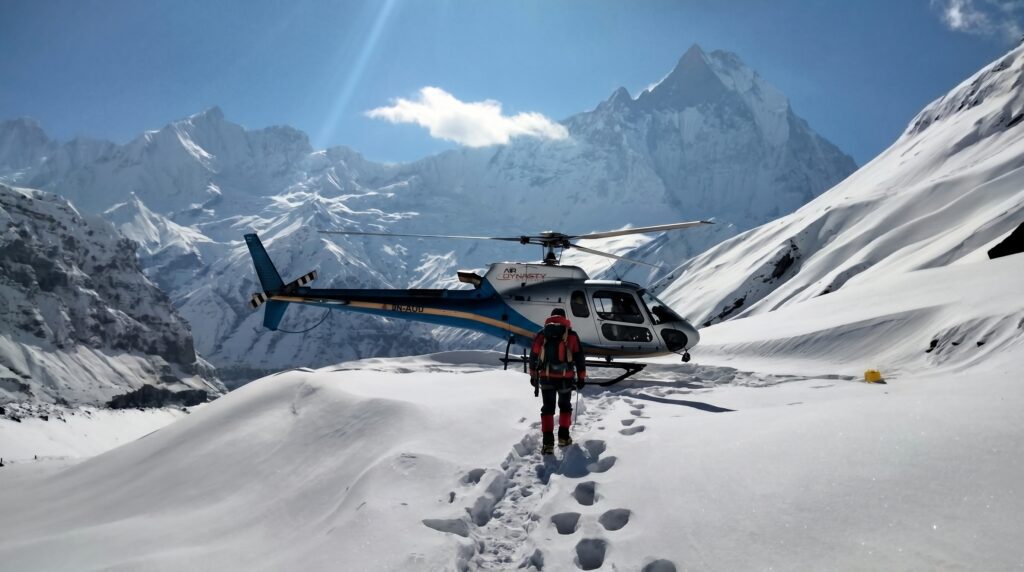
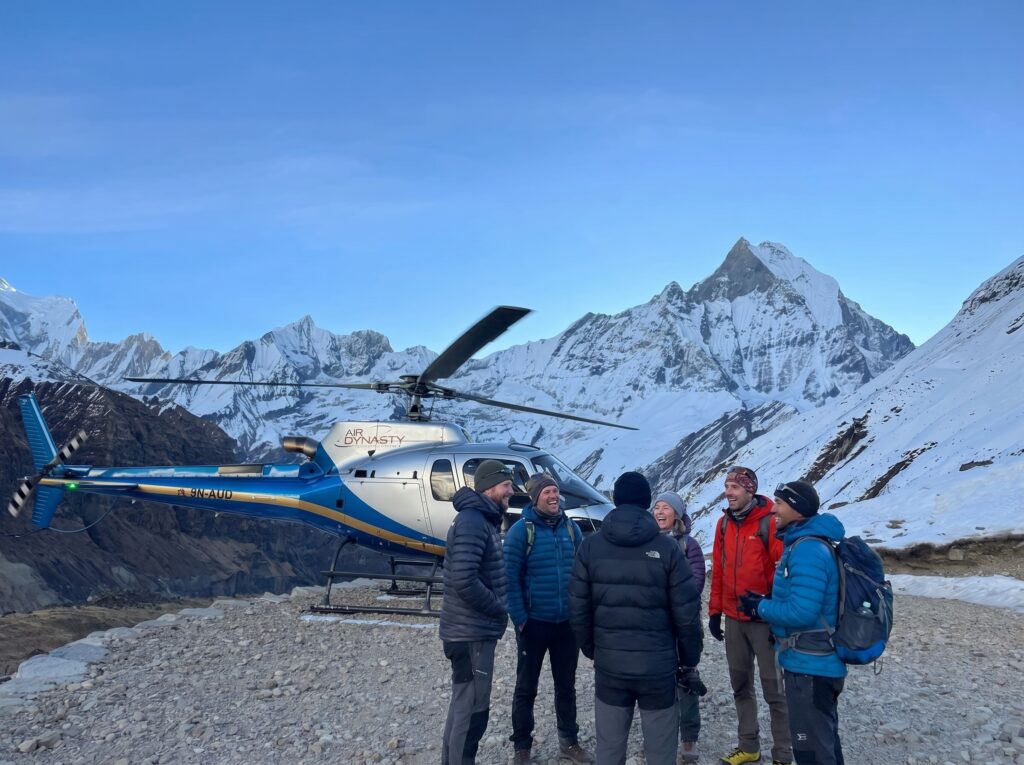
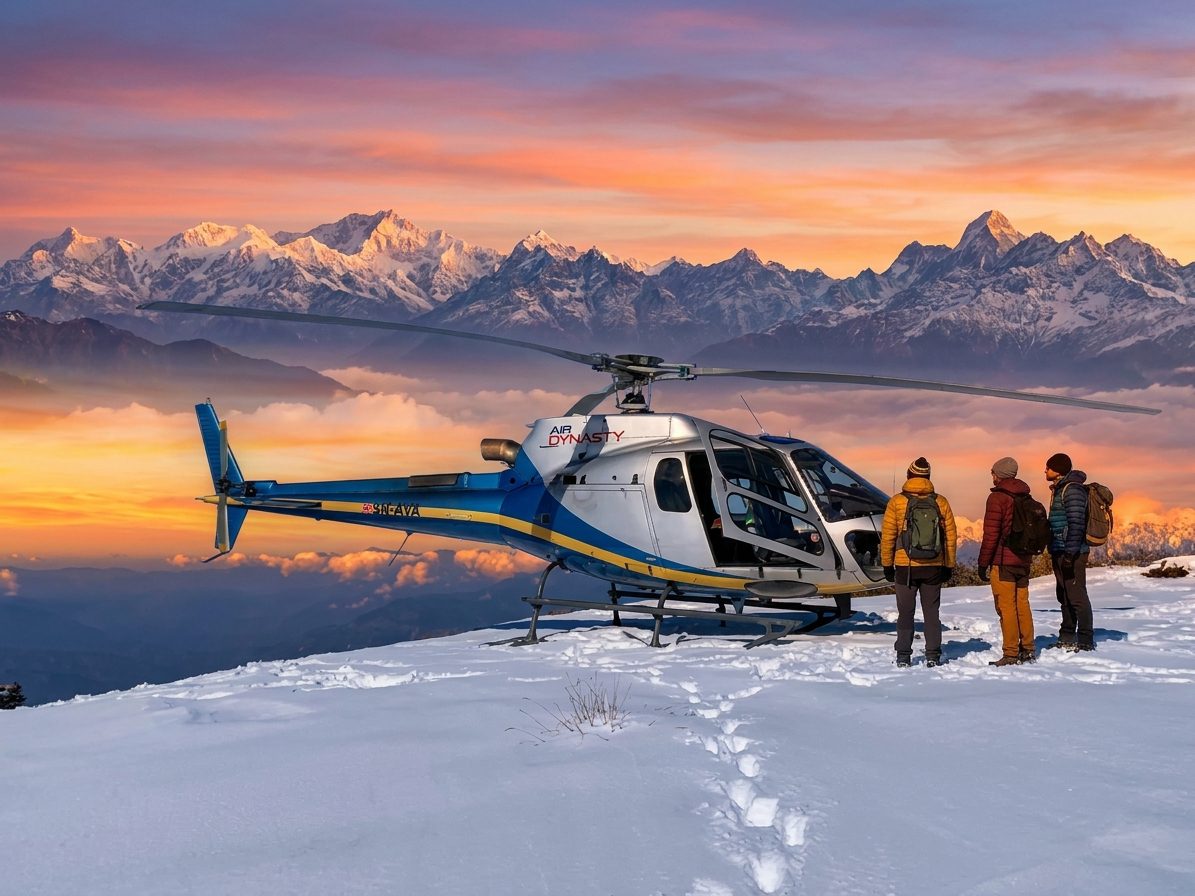
A helicopter leaves Pokhara, flies between Annapurna South and Machhapuchhre into the Sanctuary, and lands at base camp. The whole flight takes under an hour. You get 30 to 45 minutes on the ground, enough for photos and breakfast at one of the lodges up there. Then you fly back. Door to door from your Pokhara hotel, the whole thing wraps in 3 to 4 hours.
No fitness requirement. No acclimatisation days. No gear beyond a warm jacket. If you can get yourself to Pokhara, you can do this tour. That’s kind of the point.
Key Differences Between ABC Heli Tour and Trek
The gap between these two options runs deeper than just ‘one is faster.’ Time, money, how hard your body works, what you actually see along the way: all of it plays out differently. Here’s the breakdown.
Duration and Time Commitment
The trek needs a week minimum, and honestly, 7 days is tight. Most people doing it properly take 10 to 12 days, especially if they want to add the sunrise at Poon Hill or a soak at the Jhinu Danda hot springs. That’s before you count the days getting to Pokhara and back.
The heli tour needs a free morning. You can fly in the day after arriving in Pokhara, be back at your lakeside hotel by noon, and have the afternoon completely open. For anyone working a tight Nepal window into a bigger Asia trip, that’s not a small thing.
Cost Comparison
ABC Heli Tour: Group-joining packages from Pokhara start at around USD $575 per person in 2026. Private charters or packages departing from Kathmandu run higher, anywhere from $699 to $1,999 depending on the operator and what’s included. Breakfast at the base camp lodge is usually part of the deal.
ABC Trek: Budget packages start at roughly $450 to $700 for the basics. A properly organised trip with a licensed guide, porter, teahouse accommodation, and permits lands between $600 and $1,200. Luxury options with better lodges and a helicopter return on the way down can go up to $4,500.
The surprise is how close the bottom ends actually sit. A shared heli tour at $575 versus a budget trek at $500 is nearly the same money. The real question is what you want those dollars to buy you.
Extra trek costs are worth budgeting for: the ACAP permit runs about $25, guide and porter tips add $5 to $10 per day for guides and $3 to $7 for porters, and travel insurance that covers helicopter rescue above 4,000 metres usually runs $50 to $150. Don’t skip that last one.
Physical Effort and Difficulty
The trek involves 8 to 15 kilometres of walking per day, with real elevation gain and long sections of stone staircases that are hard on the knees. Above 3,500 metres, altitude becomes a factor. Headaches and fatigue are common; some people need an extra rest day, and a small number have to turn back. It happens.
That said, this isn’t a technical climb. No special gear, no mountaineering skills. Thousands of people who’ve never trekked before complete ABC every season, most of them handing their gear to a porter and just walking.
The heli tour involves sitting in a seat and looking out the window. The only physical consideration is that brief time at 4,130 metres, which is why operators keep oxygen on board. For anyone with health issues, age-related limitations, or young kids in tow, the helicopter removes every barrier the trek puts up.
Scenic Experience
Both are genuinely beautiful, but the beauty lands completely differently.
On the trek, the scenery builds over days. You start low, where it’s warm and smells like woodsmoke and damp soil. The forest changes as you climb: oak first, then rhododendron, then bamboo, then sparse alpine scrub. At Poon Hill you watch the sun come up behind a wall of Himalayan peaks stretching 200 kilometres across the horizon. You reach Chhomrong and look up for the first time at the white walls of the Sanctuary and realise how deep you’re about to go. By the time you reach base camp, you’ve earned every metre of that view.
From a helicopter, the scale hits you differently. Within minutes of leaving Pokhara, the foothills fall away and you’re flying between giants. Dhaulagiri, Annapurna I, Gangapurna, Fishtail. Glaciers pouring through the gaps. The Modi Khola far below, reduced to a silver thread. When you land, the silence at base camp is the first thing you notice.
These aren’t two versions of the same experience. They’re genuinely different things.
Comfort and Accessibility
Teahouses along the ABC route are basic: often shared rooms in peak season, limited hot water above a certain altitude, squat toilets at many lodges, and a menu that’s mostly dal bhat, noodles, soup, and porridge. Not miserable, but not a hotel.
With the heli tour, you sleep in your Pokhara hotel, fly in a well-maintained helicopter with an experienced mountain pilot, eat breakfast at the base camp lodge, and you’re back in town before the tourists are even out on the lake. It’s about as comfortable as mountain travel gets.
Pros and Cons of the Annapurna Base Camp Trek
The trek’s reputation is well-deserved. A lot of people call it one of the best things they’ve done in their lives. But that doesn’t mean it’s right for everyone, and going in with honest expectations matters.
Pros
• Cultural depth that the helicopter simply bypasses. Ghandruk and Chhomrong are real, living villages of Gurung and Magar communities. Eating in their guesthouses, walking through their lanes, hearing their stories: you can’t replicate that from the air.
• The scenery builds slowly in a way that sticks with you. You notice every shift in the landscape because you’re walking through it, not over it. The peaks reveal themselves gradually and the payoff at base camp feels earned.
• Reaching ABC on foot is one of those things that genuinely stays with people. It’s been a hard week. Standing there at the end of it means something.
• Better value over time. Per day, trekking is cheap by Himalayan standards, especially once you’re past the permit costs.
Cons
• It takes a real chunk of time. Seven days is the bare minimum, and most people need closer to ten. That’s a significant ask if Nepal isn’t your whole trip.
• Not everyone can do it. Health conditions, age, and fitness level are real barriers, and altitude adds another layer of uncertainty.
• More days on the trail means more exposure to whatever the weather decides to do. Cloud cover for a week is genuinely possible and will limit your mountain views.
Pros and Cons of the Annapurna Base Camp Heli Tour
People sometimes treat the heli tour like a consolation prize for those who couldn’t manage the trek. That’s not accurate. It’s a different kind of experience, with its own things it does better and its own genuine limitations.
Pros
• A half-day is all it takes, start to finish. That’s transformative for travellers with tight windows.
• Open to everyone. No fitness threshold, no age limit, no prior experience needed. Families with grandparents and small kids can do this together.
• The aerial view of the Annapurna Sanctuary is something trekkers never see. Rivers and valleys and glaciers laid out below you like a topographic map, all of it real.
Cons
• The upfront cost feels steep for a few hours, even when the per-day cost of the trek actually works out higher.
• You miss everything in between. The villages, the forests, the people, the slow accumulation of altitude and landscape: all of that gets skipped entirely.
• Helicopters get cancelled a lot. Mountain weather moves fast, and operators reschedule rather than refund. If your schedule is too tight to absorb a delay, that’s a genuine problem.
Which Option Is Better for You?
This comes down to your schedule, your body, and what you actually want from a Nepal trip. Neither option is the objectively correct choice.
Choose the Trek If:
• You have 7 to 12 days free in the Annapurna region
• You’re comfortable hiking and want a real physical challenge
• You care about spending time in the villages along the route and meeting the people who live there
• You want the full range of what this landscape looks like, from subtropical forest up to alpine snowfield
• Getting to base camp on your own two feet actually matters to you
• You’re watching your budget and want to stretch the value across more days
Choose the Heli Tour If:
• Your time in the region is limited to 2 to 4 days
• Physical limitations make the trek impractical, whether that’s health, age, or fitness
• You’re travelling with elderly relatives or young children
• You want aerial photography of the Himalaya and don’t mind paying for that specific access
• You’ve already done the trek and want to see base camp from a completely different angle
• Comfort matters more to you than endurance on this trip
Best Time for ABC Trek vs Heli Tour
Season has a bigger impact on both options than most people realise going in. The difference between a perfect week at Annapurna and a week of clouded-out views often comes down to when you show up.
Spring (March to May)
The rhododendrons are the story in spring. Between 2,000 and 3,500 metres, the forests go fully into bloom across the whole season, red and pink and white, sometimes so thick the trail runs through solid colour for kilometres at a stretch. More than 30 species flower at different altitudes, so there’s no single peak week: it just keeps going.
Mornings tend to be clear, which is when the mountain views come out. For heli tours, spring is a strong window for exactly this reason.
Autumn (September to November)
Most experienced Nepal hands will tell you autumn is the season. Once the monsoon is gone, the sky turns a high-altitude blue that genuinely doesn’t exist at other times of year. The views are sharper, the trails are busiest, the teahouses are fully stocked. Dashain and Tihar fall in this window, and if you’re moving through villages during festival time, that’s a memorable thing to stumble into.
Heli tours in autumn get the best visibility of the year. No haze, no ambiguity.
Winter (December to February)
Trekking in winter is possible but you need to know what you’re getting into. Above 3,500 metres things get genuinely cold and sections can be iced over. Some teahouses shut entirely. It’s manageable with the right gear and the right attitude, but it’s not the time for casual first-timers.
Heli tours can run on clear winter days, and the crowds are thinner than any other season. If you want base camp mostly to yourself, this is when to go.
Monsoon (June to August)
Skip it. Heavy rain, leeches on the lower trails, mountains hidden behind clouds for days at a stretch, landslide risk on the route. Neither the trek nor the heli tour is at its best here.
Safety Considerations
The Himalaya demands a basic level of respect no matter how you’re getting around in them. The risks look different depending on whether you’re trekking or flying, but both options have things worth knowing about in advance.
Altitude Awareness
Annapurna Base Camp is at 4,130 metres, well into the range where acute mountain sickness can hit. Trekkers deal with this by gaining altitude slowly and spending rest days at key points. A good guide tracks your symptoms and will tell you when to stop going up.
For heli tour passengers, the exposure time is so short that the risk is minimal. Operators carry supplemental oxygen and medical kits regardless, and the ground time at base camp is brief by design.
Travel insurance is non-negotiable for either option. For trekkers specifically, your policy must cover helicopter rescue above 4,000 metres. An evacuation without coverage can run into thousands of dollars.
Weather and Flight Risk
Helicopter cancellations happen far more often than first-time visitors expect. Mountain forecasts change fast, and operators err on the side of caution. They’ll reschedule, not refund, so build at least one extra day into your Pokhara plans.
Trekkers face weather risk spread over more days. A big snowfall above 3,000 metres can close sections of trail and pin you at a lower lodge until conditions improve.
Guide Recommendation
For the trek, a licensed registered guide is strongly worth having, and not just because they know the trail. Guides trained in wilderness first aid catch altitude sickness early and know when a situation is serious. Trekking solo is allowed, but the risk goes up considerably once you’re above Chhomrong.
Final Verdict: Trek vs Heli Tour
If your schedule can handle it, walk. The week or so you spend getting to base camp gives you something the helicopter can’t: you see the place as it unfolds, slowly, from the bottom up. You sleep in the villages. You get caught in the weather and wait it out at a teahouse over tea. You arrive at base camp tired and completely aware of how far you’ve come. That kind of trip tends to stick.
If your schedule can’t handle it, fly. Thirty minutes standing in that amphitheatre, ringed by peaks that size, is not nothing. A lot of people who take the helicopter come back saying it was one of the more striking things they’ve done. It’s a different kind of experience but it’s real.
And if you can swing it, do both. Trek in, fly back. You lose nothing from the walk and you gain the aerial view on the way out. In Nepal, sometimes you actually don’t have to pick.
Comments (0)
Write a comment- Overview of the Annapurna Base Camp Experience
- What Is the Annapurna Base Camp Trek?
- What Is the Annapurna Base Camp Heli Tour?
- Key Differences Between ABC Heli Tour and Trek
- Duration and Time Commitment
- Cost Comparison
- Physical Effort and Difficulty
- Scenic Experience
- Comfort and Accessibility
- Pros and Cons of the Annapurna Base Camp Trek
- Pros
- Cons
- Pros and Cons of the Annapurna Base Camp Heli Tour
- Pros
- Cons
- Which Option Is Better for You?
- Choose the Trek If:
- Choose the Heli Tour If:
- Best Time for ABC Trek vs Heli Tour
- Spring (March to May)
- Autumn (September to November)
- Winter (December to February)
- Monsoon (June to August)
- Safety Considerations
- Altitude Awareness
- Weather and Flight Risk
- Guide Recommendation
- Final Verdict: Trek vs Heli Tour
Read the latest Blogs & Insights
Explore our collection of articles and insights to gain in-depth travel knowledge, expert advice, and stay updated on the latest trends and tips.




No comments yet.