







Land Where the World Ends
There is no road to Kala Patthar. No cable car buried somewhere in the rock, no shortcut through the Khumbu Valley that shaves weeks off the journey. For most trekkers, reaching that windswept ridge at 5,644 metres means earning it step by step — through rhododendron forests below Namche, across the high plateau above Dingboche, […]
-
 SEO Sarash
-
21 May, 2026
-
14 mins read
-
880 Views
-
0 Comments


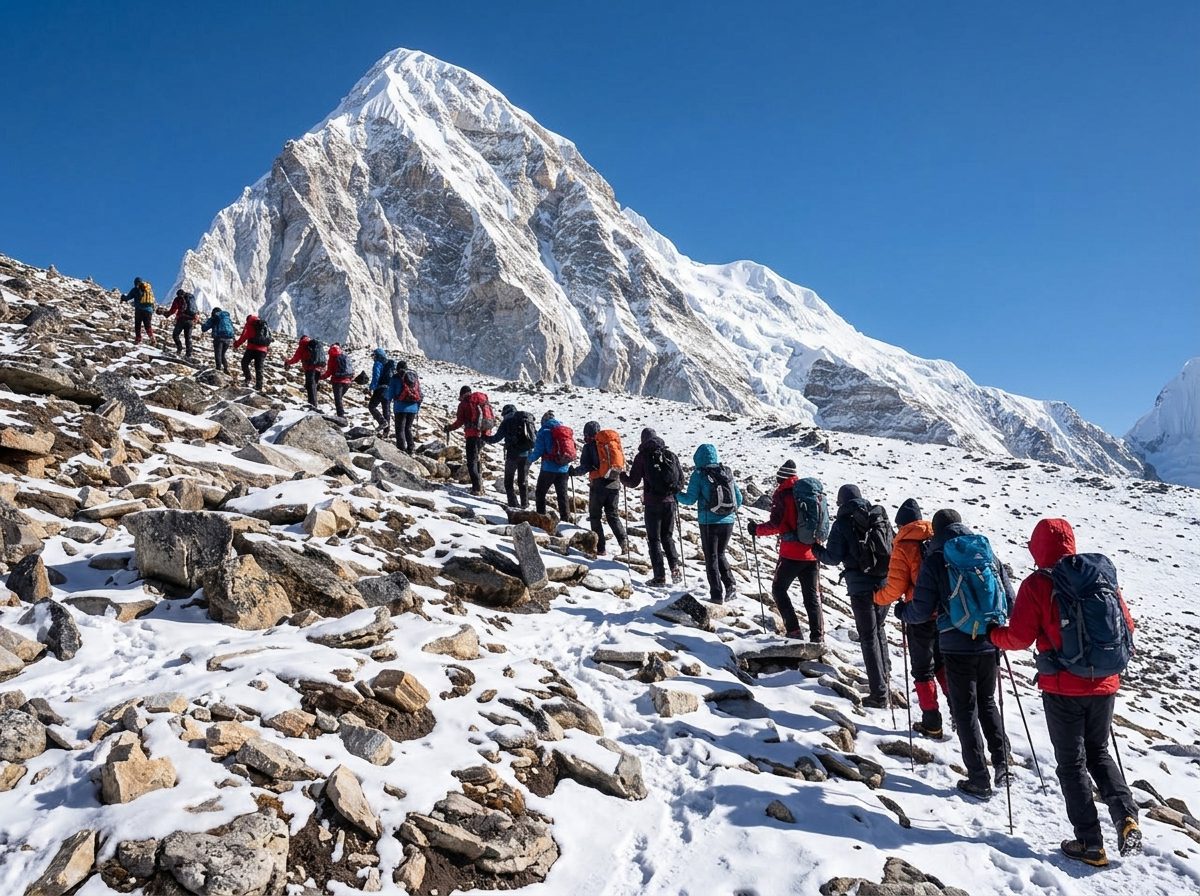
There is no road to Kala Patthar. No cable car buried somewhere in the rock, no shortcut through the Khumbu Valley that shaves weeks off the journey. For most trekkers, reaching that windswept ridge at 5,644 metres means earning it step by step — through rhododendron forests below Namche, across the high plateau above Dingboche, and finally up the loose scree that leads to one of the most famous viewpoints on earth.
But for those who know where to look, there is another way.
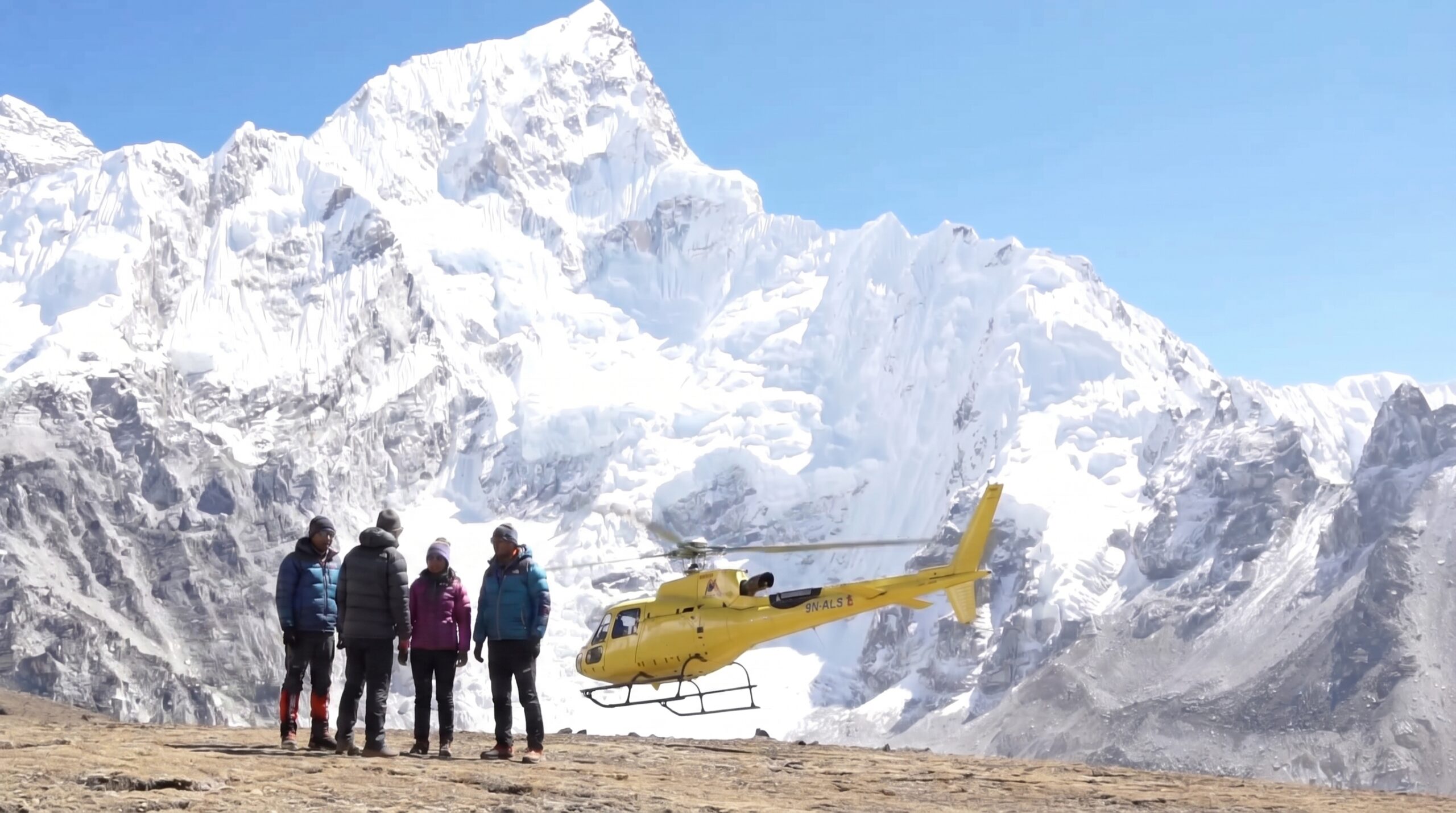
Since the end of April 2006, group sharing helicopter flights have been landing on Kala Patthar, quietly opening up one of the Himalaya’s greatest vantage points to travellers who might never have reached it otherwise. This is not a secret service for the ultra-wealthy — it is a structured, established operation that has been running for nearly two decades. And it is not the only landing available. From the turquoise shores of the Gokyo Lakes to the impossibly dramatic runway at Lukla, from a breakfast with Everest out the window to a snow landing inside the Western Cwm, the helicopter options in this part of Nepal are more varied — and more carefully managed — than most people realise.
This guide covers all of them: what each experience actually involves, what it costs, how the logistics work, and a few honest answers to questions people are sometimes afraid to ask.
Kala Patthar: The Flagship
Start here, because almost everyone does.
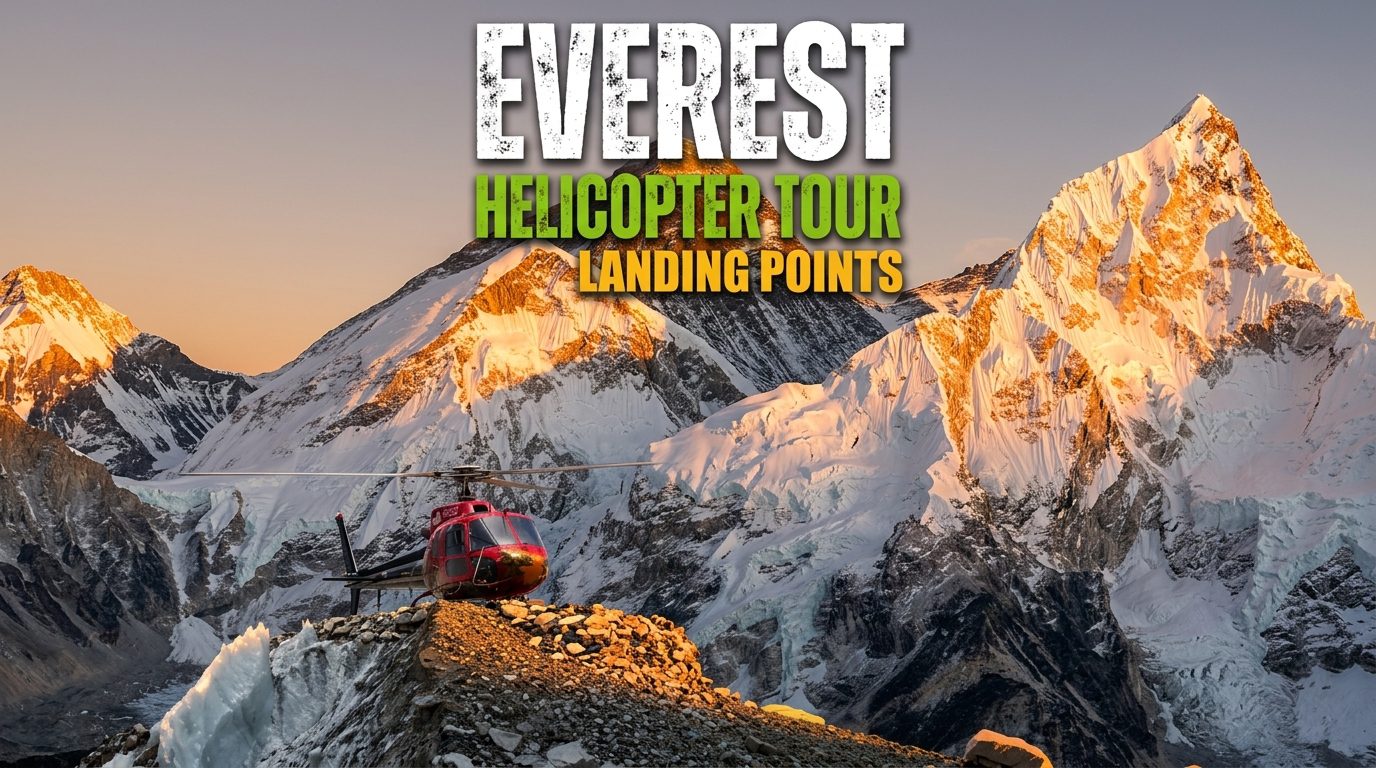
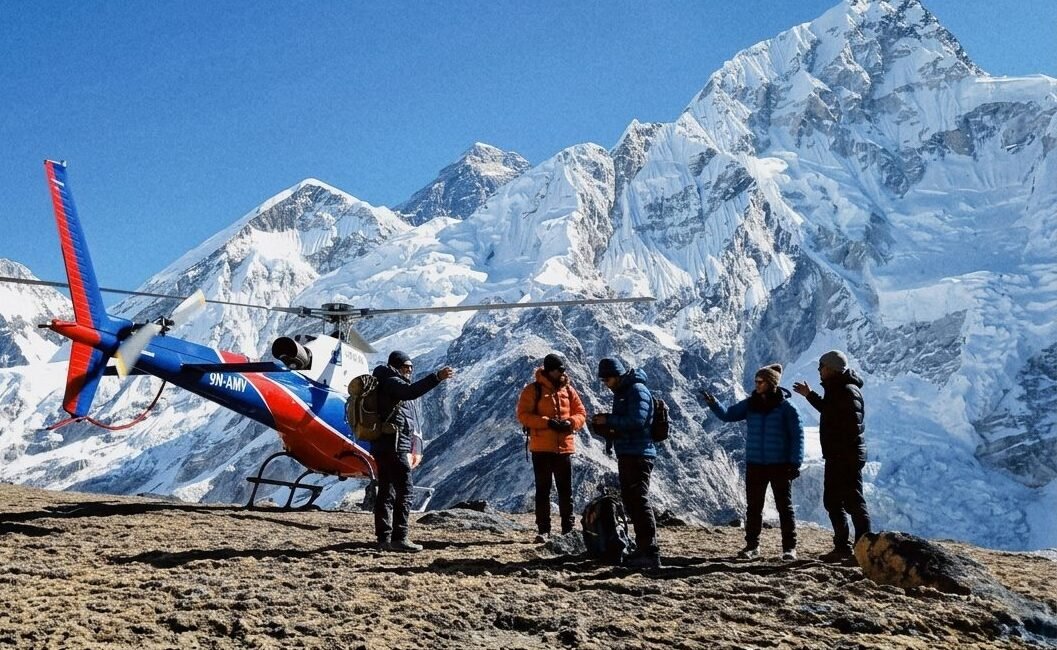
Kala Patthar, which translates roughly from Nepali as ‘black rock,’ sits at 5,644 metres on the southern shoulder of Pumori. What makes it extraordinary is its angle. From base camp itself, you cannot see the upper reaches of Everest — the mountain hides behind its own lower ridges. From Kala Patthar, you can. The South Face, the Khumbu Icefall, the long ridge leading to the summit — all of it opens up in front of you without obstruction, as if the mountain has agreed, just this once, to let itself be seen properly.
The helicopter departs from Pheriche, the sturdy little settlement at around 4,280 metres where teahouse lights still glow at five in the morning and yaks wander the dirt paths between stone walls. Pheriche sits far enough up the valley that the flight to Kala Patthar is meaningful without being unnecessarily long — the total flight time for the full excursion runs between five and six hours. On the ridge itself, you get a maximum of fifteen minutes.
Fifteen minutes sounds brief. At sea level it is. At 5,644 metres, in wind that can strip the warmth from your body within seconds of leaving the aircraft, fifteen minutes is often exactly the right amount. You step out, you find your footing on the rock, you look at the mountain. The Khumbu Icefall sprawls below you in its frozen chaos. Lhotse fills the horizon to the east. The silence, when the rotors slow, is the kind of silence you remember.
The cost is USD 1,600 per person on a group sharing basis. A maximum of two passengers land at one time, with a combined weight limit of 240 kilograms and a per-person limit of 50 kilograms. These are the numbers, and they are not negotiable.
The weight restrictions are worth explaining, because they sometimes catch people off guard. At extreme altitude, the air is considerably thinner than at sea level — roughly half the density you would encounter in Kathmandu. A helicopter’s rotors need air to generate lift, and with far less of it available at nearly 5,700 metres, the aircraft is working at the edge of its operational envelope. Every kilogram matters. All passengers are weighed before boarding; this is standard practice and no one takes offence.
Group sharing means exactly what it sounds like: your seat on the helicopter is shared with other travellers who have booked the same excursion. You are not chartering a private aircraft. You are joining a coordinated flight with other guests, which is what keeps the per-person price manageable. The model has worked smoothly since flights began in 2006, and the operational experience behind it shows.
The Question Everyone Asks: Can You Land at Everest Base Camp?
Not under normal conditions.
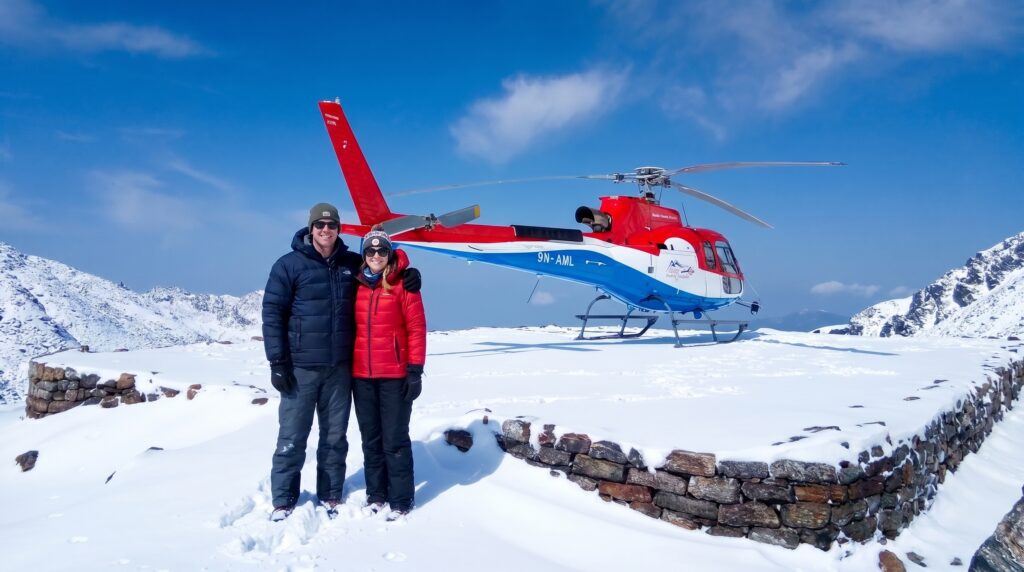
This comes up constantly, and the answer is often oversimplified. Helicopter landings at Everest Base Camp are generally not permitted as part of standard operations. This is not about timing, season, or operator choice. It is primarily due to safety, terrain instability, and strict aviation and environmental regulations.
During the climbing season, Everest Base Camp functions as an active mountaineering hub on the Khumbu Glacier. Climbers, guides, and support teams are acclimatizing, organizing gear, and preparing for summit pushes. A routine helicopter landing in this environment would be risky, disruptive, and operationally complex. This is why reputable operators do not include it as a standard feature.
However, there is an important exception.
In rare cases, landings can be conducted with special permission, provided all safety checks are cleared. This includes pilot assessment of altitude performance, payload limitations, weather stability, and surface conditions. These situations are highly controlled and not guaranteed, which is why they are not commonly advertised.
If your itinerary includes a landing at or near base camp or at Kala Patthar, it reflects a special arrangement rather than a standard offering.
For most travelers, the iconic experience comes from Kala Patthar, which offers a higher vantage point overlooking Everest Base Camp and delivers a far more expansive view of the surrounding peaks.
Off Season Flying: What It Costs and What It Means
The standard operating windows for helicopter flights in the Khumbu are spring — roughly March through May — and autumn, from late September through November. These align with the trekking seasons, when weather patterns are most predictable and visibility is typically at its best. The mountain turns in its most generous moods during these windows.
Flying outside these seasons is possible. The Himalaya does not close. But the weather becomes less reliable, the windows shorter, and the planning more complex. Off-season flights carry an additional surcharge of USD 500 per person above the standard rates — a reflection of the increased operational difficulty, not an arbitrary premium.
For some travellers, the off-season is actually preferable. The Khumbu in winter is a different place entirely: quieter, colder, stripped of the bustle that comes with peak trekking months. If you have the flexibility and the tolerance for uncertainty, there is something genuinely special about standing on Kala Patthar in January with no one else around for miles.
Gokyo Lakes: The Quieter Choice
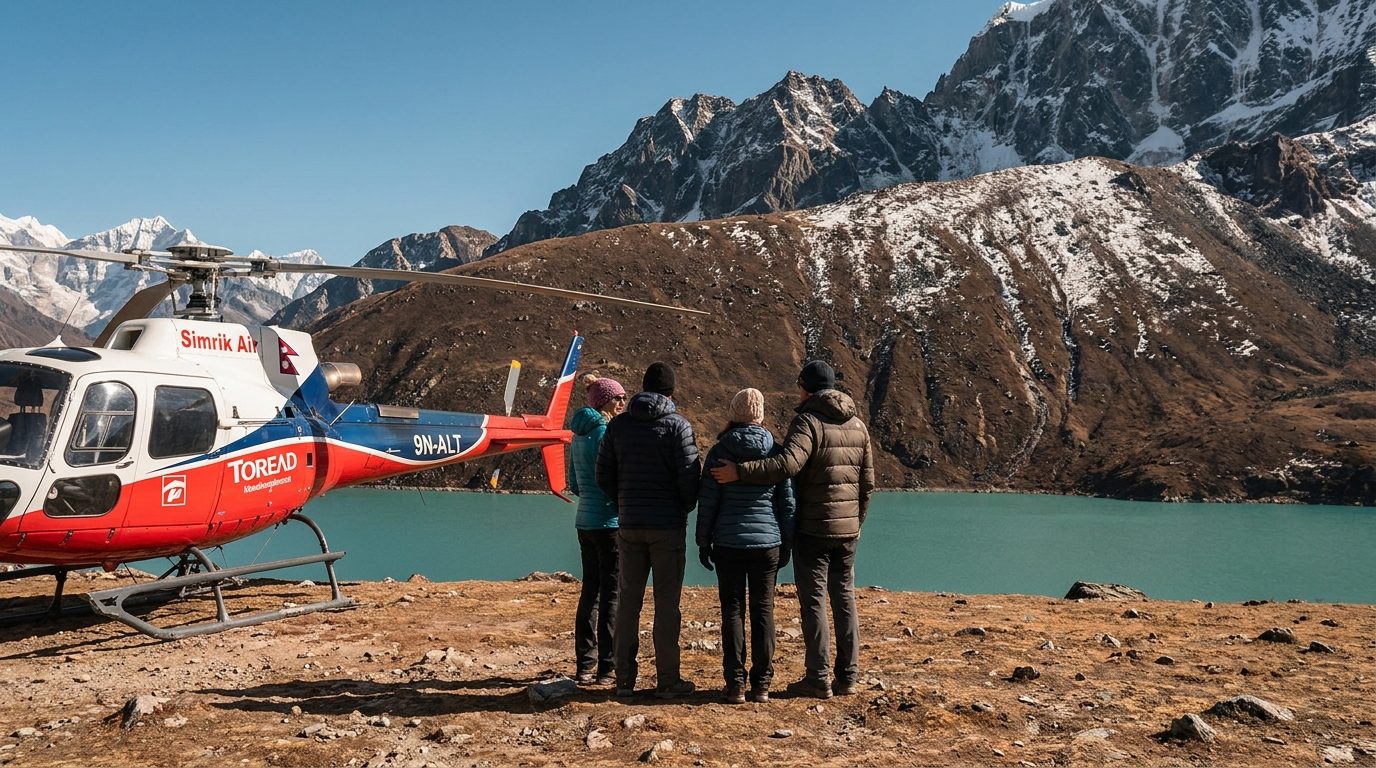
West of the main Everest corridor, the Gokyo valley holds a string of glacial lakes that most visitors to Nepal never see. The lakes sit between 4,700 and 5,000 metres, fed by snowmelt from the surrounding peaks and coloured a shade of turquoise that looks, on clear days, almost implausibly vivid against the grey moraines.
The landing here offers a longer window than Kala Patthar — between fifteen and twenty minutes on the ground — and can accommodate up to three passengers at one time, which makes it slightly more flexible for small groups or families. The cost is USD 700 per person.
What you are looking at from Gokyo is different from what you see at Kala Patthar. Cho Oyu, the world’s sixth highest mountain, dominates the western horizon. Gyachung Kang sits nearby. The Ngozumpa Glacier — the largest glacier in Nepal — sprawls down the valley below you, a vast river of ice studded with debris and meltwater pools. It is a wilder, less visited corner of the high Himalaya, and the light on the lakes in the early morning has a quality that is genuinely difficult to describe to someone who has not seen it.
For travellers who want the helicopter experience without the crowds that gather around the Everest approach, Gokyo is the answer.
Lukla: The Famous Runway
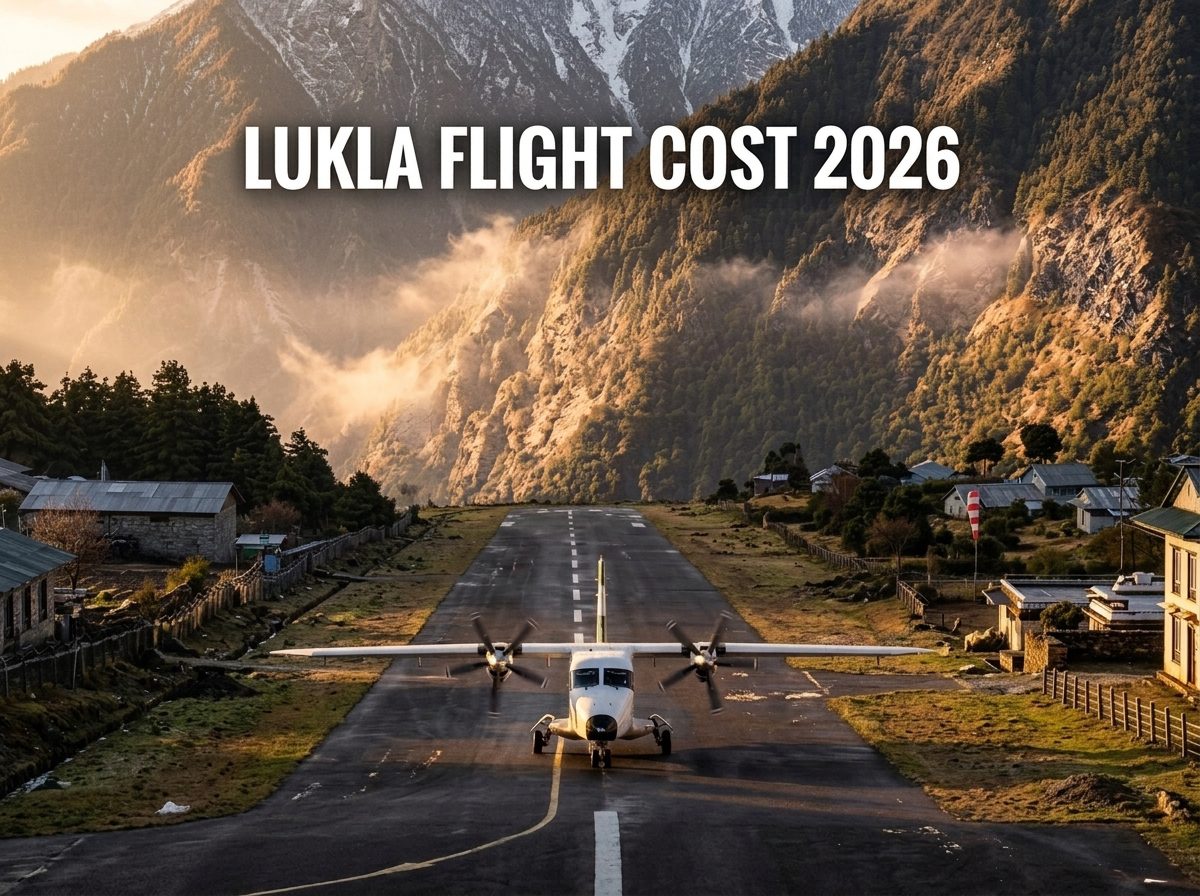
Tenzing-Hillary Airport at Lukla has been called many things over the years. The world’s most dangerous airport. The most thrilling landing in aviation. A controlled exercise in faith. All of these descriptions have some truth to them.
The runway is 527 metres long, which would be unremarkable except for two details: it tilts upward at a gradient of roughly twelve percent from the landing threshold, and it ends on one side in a cliff dropping away to the valley far below, while the other end meets a rock wall head-on. There is no overshoot area. There is no go-around option once committed. Pilots who land at Lukla do so with complete focus and considerable skill.
Landing here by helicopter is an experience that sits somewhere between thrilling and quietly cinematic. You approach through the valley, the Dudh Koshi River visible far below in its gorge, pine forests on the lower slopes, the white peaks beginning to appear above the ridgeline. The runway appears small and steep from above. You settle in. The rotors slow.
The flight from Kathmandu to Lukla takes approximately fifty minutes by helicopter, which is meaningfully different from the fixed-wing experience — you can see more of the terrain, you fly at lower altitude for portions of the approach, and the valley reveals itself gradually rather than arriving all at once. Maximum landing time at Lukla is twenty minutes.
The views from Lukla itself reward a few minutes of walking. Kongde Ri dominates the horizon to the west. The Khumbu valley stretches north toward Namche. If you have never been to this part of Nepal, the arrival at Lukla is a proper introduction — it announces immediately that you have arrived somewhere genuinely extraordinary.
Everest View Hotel: Breakfast at the Edge of the World
Not every remarkable experience needs to be physically demanding. This one is simply beautiful.
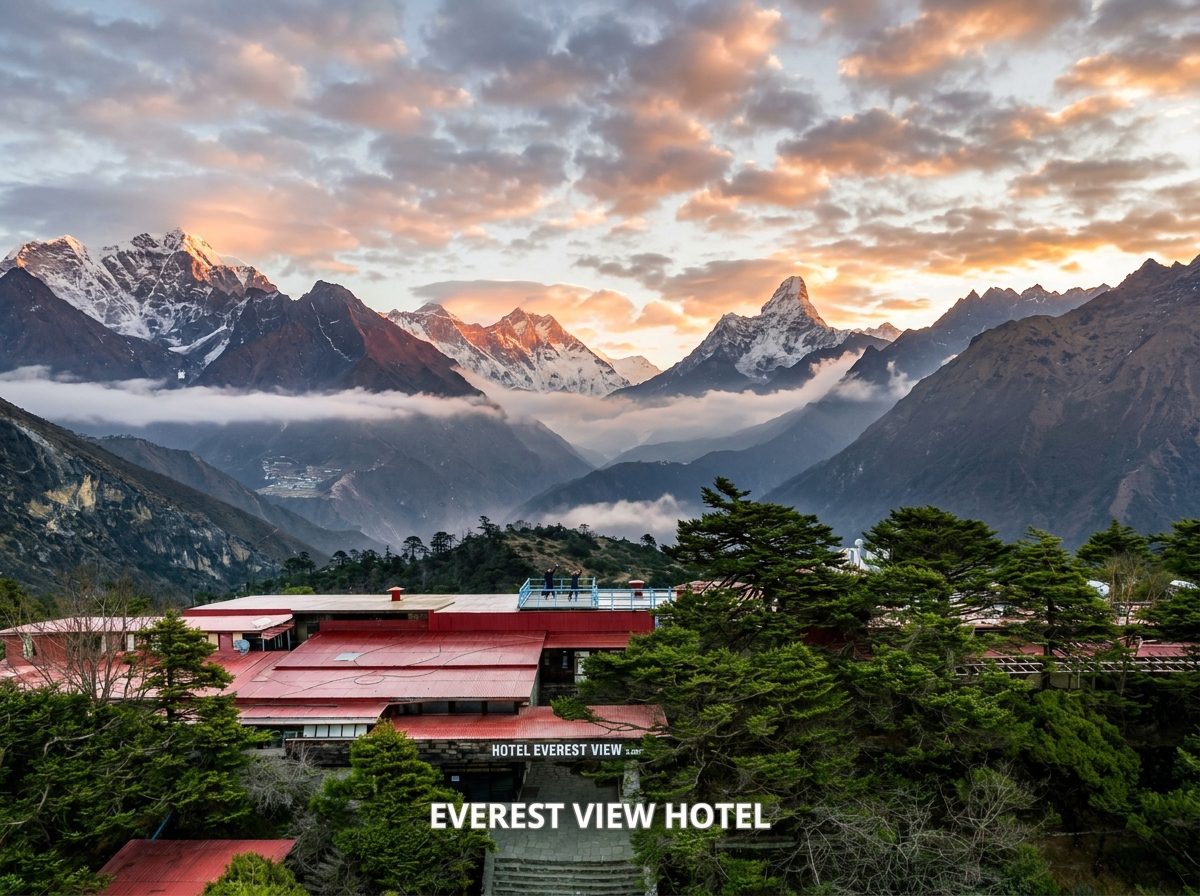
The Everest View Hotel sits at 3,880 metres on a ridge above Namche Bazaar, positioned with deliberate care to face north-east — directly toward Everest, Lhotse, Ama Dablam, and the full sweep of the Khumbu Himalaya. It has been there for decades, and the view has not changed.
The helicopter lands, you walk to the terrace, and you sit down for breakfast. Hot tea or coffee arrives. The mountains are right there in front of you, close enough that on a clear morning you can pick out individual features on the ridgelines — the South Col, the Yellow Band on Lhotse’s face, the elegant pyramid of Ama Dablam’s summit. You eat. You look. You take your time.
The maximum stay is one hour, which is enough. By the time you are done, the morning light will have shifted on the peaks, and the tea will have gone cold in the best possible way. It is one of those experiences that sounds almost too comfortable for the Himalayas — and then you arrive and understand why it works.
This landing is also one of the most accessible options for travellers with physical limitations or medical conditions that make high-altitude trekking inadvisable. At 3,880 metres there is some altitude to contend with, but nothing compared to the exertion required to reach it on foot.
Everest Camp I: The Deep Landing
This one is different in kind, not just degree.
Camp I sits above the Khumbu Icefall, on the edge of the Western Cwm — a vast glaciated valley enclosed on three sides by the south faces of Everest, Lhotse, and Nuptse. The altitude is approximately 6,100 metres. The Icefall below you is one of the most treacherous sections of the South Col route: a constantly moving jumble of seracs and crevasses that kills climbers every season. Above you, the Cwm stretches away toward the base of the Lhotse Face, white and silent and enormous.
A landing at Camp I is available on guest request. It carries a cost of USD 1,500 per person, accommodates a maximum of two passengers, and allows a maximum of ten minutes on the snow. The per-person weight limit of 50 kilograms applies strictly — at 6,100 metres, the physics of high-altitude flight are even less forgiving than at Kala Patthar.
What the Western Cwm shows you cannot be seen from any of the other landing points. You are inside the mountain, surrounded by it on three sides, standing in a place that most people on earth will never reach. The scale is disorienting in the most profound way — the walls of Nuptse to your right are so vast that they seem to occupy a different category of object than the mountains you know at home. The silence is absolute. The cold is immediate.
Ten minutes here feels like a long time.
A Note on Group Sharing Flights
Every landing described in this guide is operated on a group sharing model — the same model that has been running Kala Patthar flights since late April 2006. Understanding what this means in practice matters.
You are not chartering a private helicopter. Your seat is one of several sold on the same aircraft. Passengers are grouped based on booking dates, weights, and route compatibility. In practice, this works smoothly — the operations have been running long enough that the logistics are well understood, and the coordination between the landing points is managed carefully.
Group sharing is what makes these experiences available at prices that are ambitious but not inaccessible. A private charter to Kala Patthar would cost many times the per-person rate on a shared flight. The group model is not a compromise; it is what makes the experience viable.
One practical note: all passengers are weighed before boarding, at every landing. This is non-negotiable, done without ceremony, and entirely standard. If you are close to the weight limits, communicate clearly with your operator in advance — they will tell you honestly whether the landing is achievable.
Planning Your Visit
The best time for clear views is the spring window from March to May and the autumn window from late September to November. Morning flights are generally clearer than afternoon departures — cloud builds in the valleys through the day, and by early afternoon visibility at many of the high landing points can deteriorate quickly.
Weather in the Himalaya is not predictable in the way weather is predictable elsewhere. A clear forecast can change within hours. All helicopter operations in this region operate with appropriate flexibility — flights may be rescheduled, delays are common during unsettled spells, and no operator worth booking with will push a flight that the pilot is not comfortable with. This is not a place where corners get cut on weather decisions.
For most of the landings described here, no special trekking experience is required — you are in the aircraft for the journey, and on the ground for a short, managed stop. Camp I is the exception; while you do not need to be a technical climber to land there, your operator will discuss the physical requirements with you in advance.
Book early for the peak seasons, communicate your physical details honestly, and bring warmer layers than you think you need. The wind at 5,600 metres is a different proposition to what the forecast suggests at valley level.
Final Thought
The Himalayas have been open to serious mountaineers for a century and to trekkers for several decades. The helicopter operations described here represent something newer: a careful, considered expansion of access to places that most people would otherwise never reach.
There are those who feel this changes something essential about these landscapes — that part of their meaning comes from the difficulty of reaching them. That is a legitimate position, and worth holding alongside the other truth: that the mountains themselves are indifferent to how you arrive. What matters is whether you pay attention when you get there.
Kala Patthar does not care whether you walked for three weeks or flew in from Pheriche this morning. Everest is the same mountain from wherever you stand. What it asks of you, always, is simply that you look.
Comments (0)
Write a commentRead the latest Blogs & Insights
Explore our collection of articles and insights to gain in-depth travel knowledge, expert advice, and stay updated on the latest trends and tips.


No comments yet.