









Kathmandu to Lukla Helicopter Flight


Trip Overview


Overview of Kathmandu-Lukla Flight
It’s still dark when most people show up for this one. You’re at the domestic terminal in Kathmandu, ticket in hand, and out on the tarmac a helicopter is already running through its pre-flight checks, rotors turning slowly at first. In under an hour you’ll be on the ground at Lukla – the airstrip that opens the door to Everest.
For a lot of travelers this flight isn’t really the “experience” part of the trip. It’s the practical part. It’s how you get to the start of the Everest Base Camp trail without spending half a day bouncing along the road to Ramechhap, which is what a lot of fixed-wing passengers end up doing during busy months. But practical doesn’t mean forgettable. Ask anyone who’s done this flight and they’ll usually mention it before they mention the trek.
You’ll want to get to the airport with plenty of time to spare – about an hour and a half before your slot, generally. Nepal’s mountain flights almost all leave early in the morning, for a simple reason: the weather is calmest then. By 10 or 11am, heat rising off the valleys starts pushing cloud up against the hills, and visibility gets patchy. So you check in, your bags get weighed (and so do you, honestly – helicopters don’t have much margin for error on weight), and you go through the usual airport security.
Then you’re out on the apron and the helicopter looks smaller up close than you expected. That’s part of the appeal, actually. There’s no cabin crew walking an aisle, no seatback screens. Someone straps you in, hands you a headset, and the whole thing lifts off the ground within a couple of minutes of you climbing in.
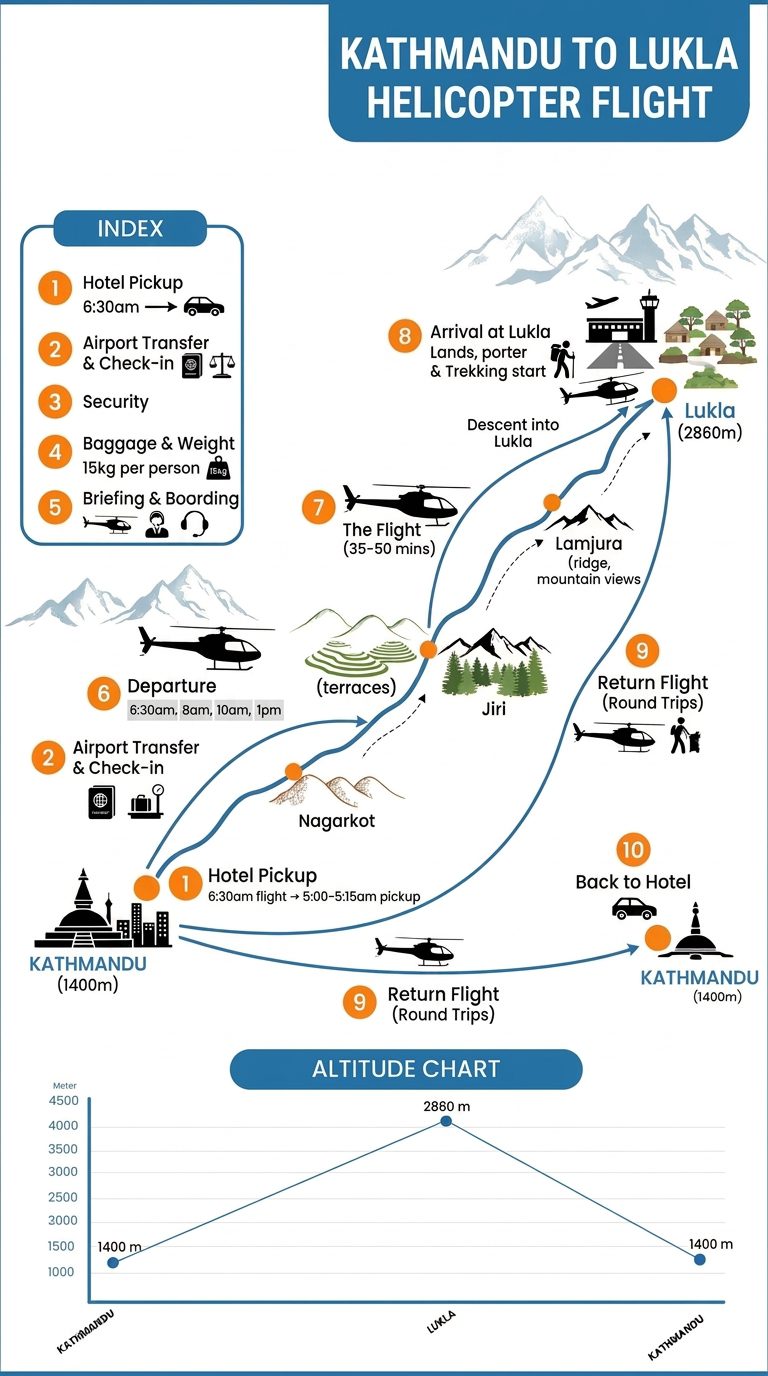
The first stretch is Kathmandu itself from above – rooftops, the haze that tends to sit over the valley in the mornings, the Bagmati winding through it. That fades pretty quickly into green hills around Nagarkot, and if it’s a clear day you might already catch a hint of snow further off. From there the terrain just keeps changing under you. Steeper hills, thicker forest, terraces cut into slopes that look too steep to actually farm – except people have been doing exactly that for generations.
You’ll pass more or less over Jiri along the way. It doesn’t look like much from the air, just another hillside town, but it used to be the starting point for the whole overland trek to Everest before Lukla had an airstrip. Hillary’s support teams walked that route. You’re covering the same ground in under a minute.
Past Jiri the land climbs harder. You cross the Lamjura ridge, one of the higher points on the route, and things get noticeably wilder-looking below – deep valleys, patches of forest, villages that only connect to each other by footpath. No roads at all in a lot of this country.
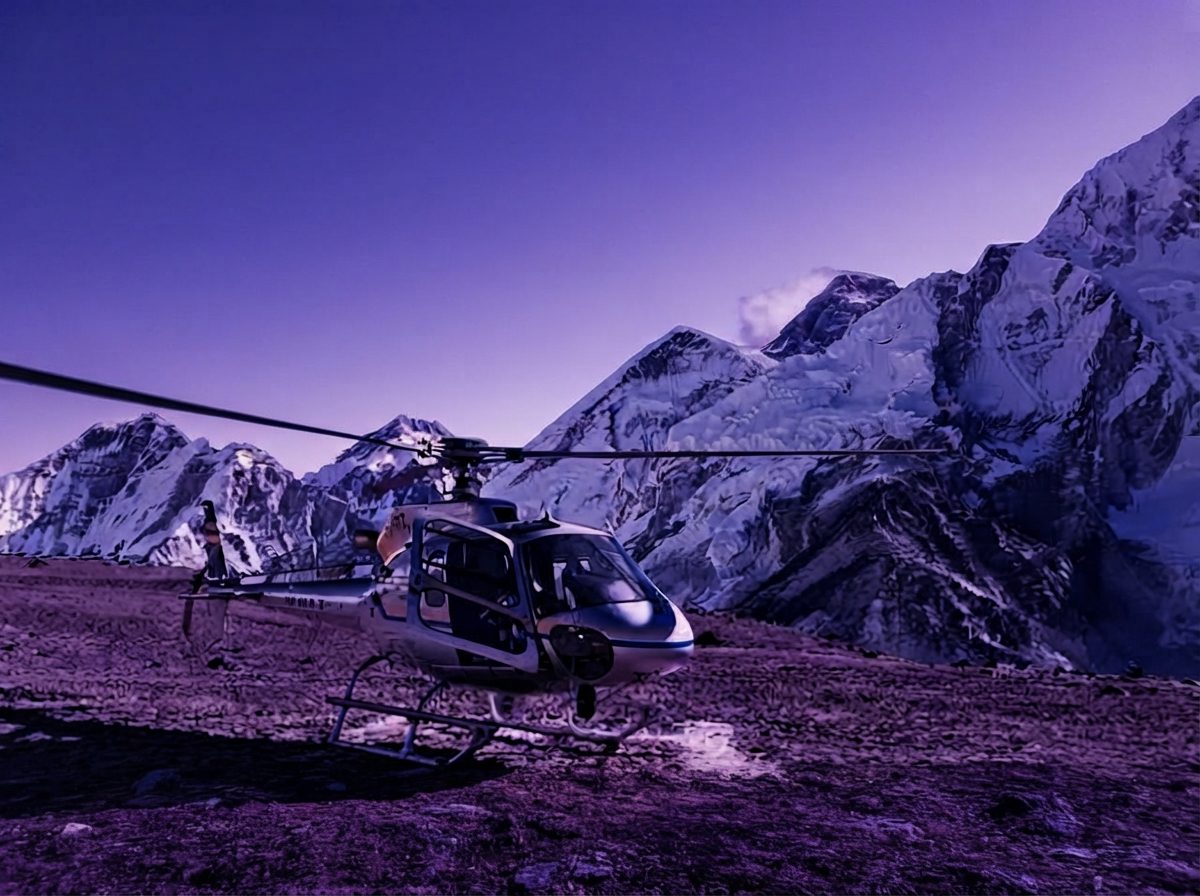
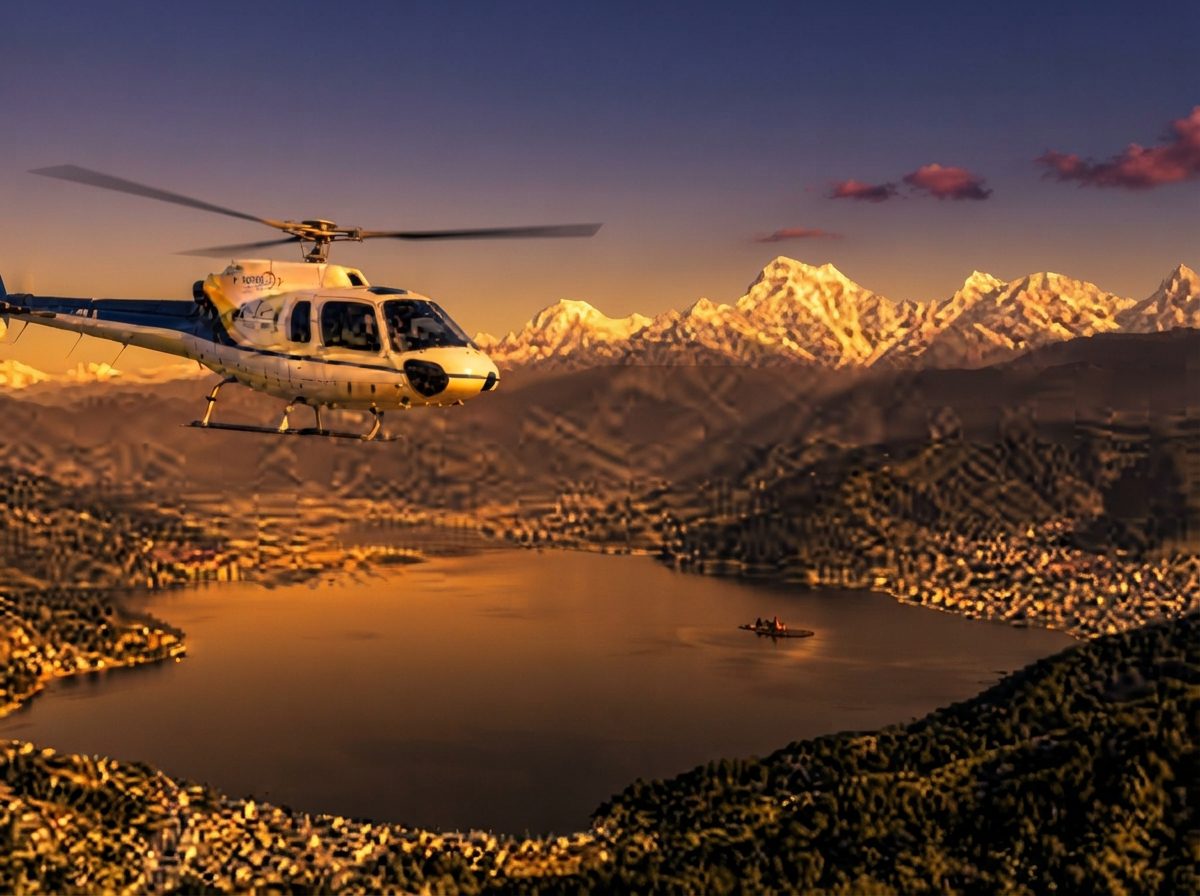
Then, if the day’s clear, the mountains show up properly. Maybe Langtang off to one side, and further ahead the wall of peaks that ring the Everest region. This is usually when conversation over the headset drops off. People just stop talking and start taking photos.
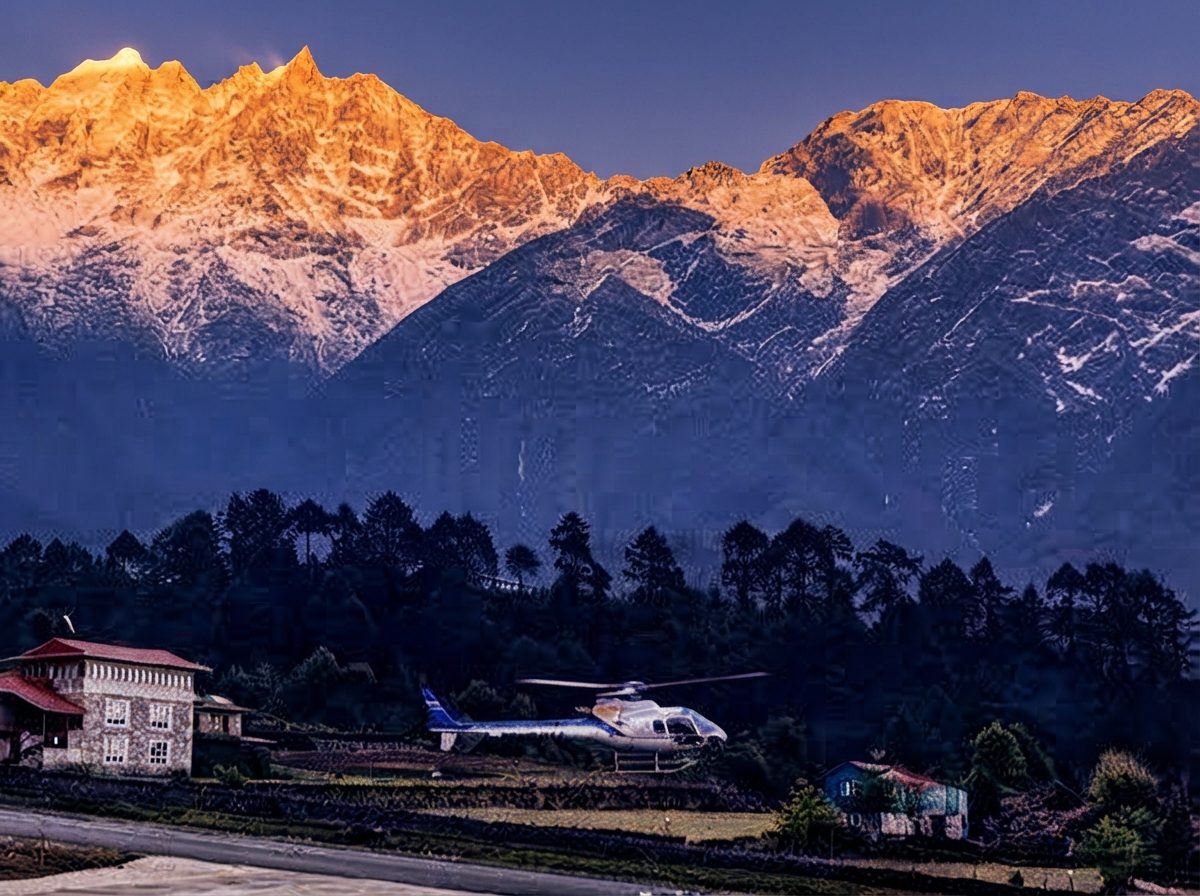
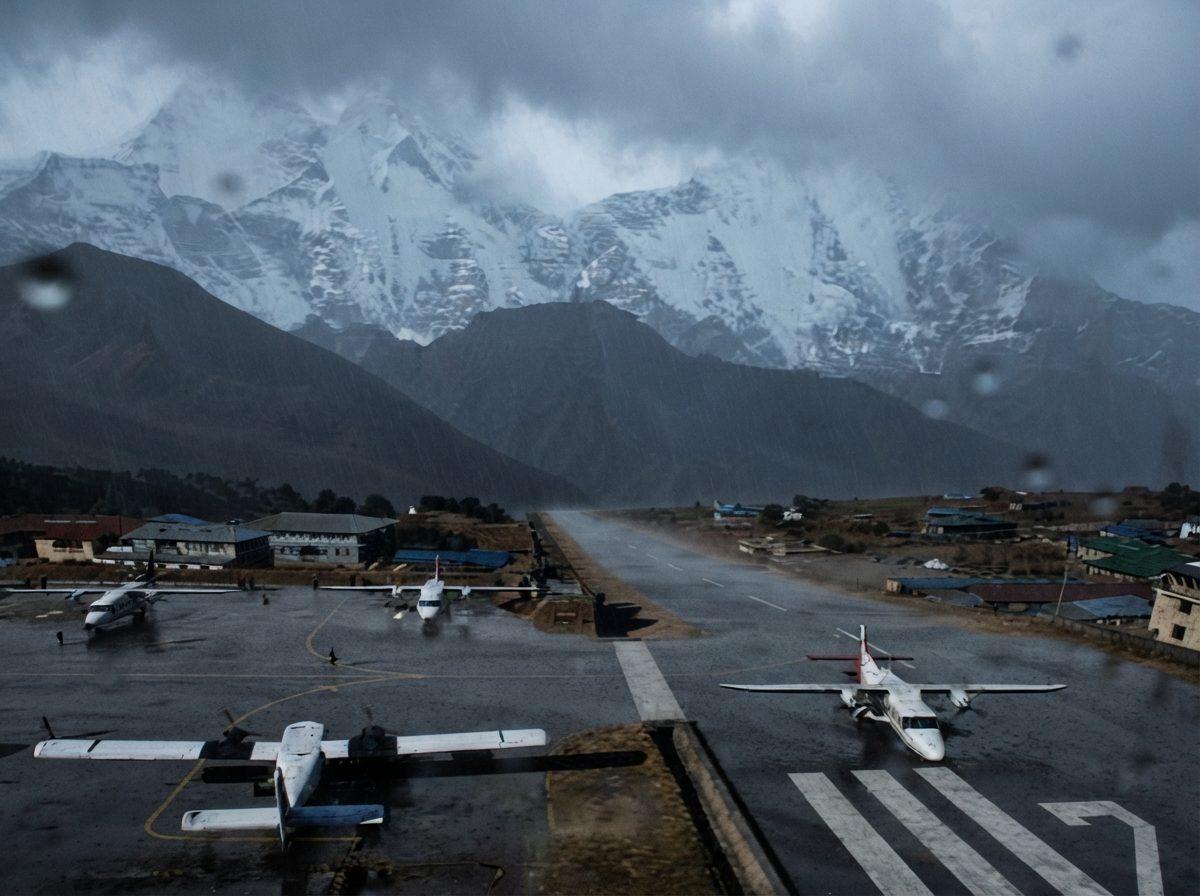
Coming into Lukla is the part everyone talks about afterward. Tenzing–Hillary Airport sits at close to 2,860 meters, built into the side of a mountain with a short runway that runs uphill toward a stone wall on one end and drops off toward a valley on the other. It’s famous for a reason. Helicopters have it a bit easier than the fixed-wing planes here, since they don’t need the full runway and can back off and try again if the wind’s being difficult. Your pilot’s done this landing more times than they’d probably bother counting, and it shows – they read the wind, line up the approach, and put it down without much drama.
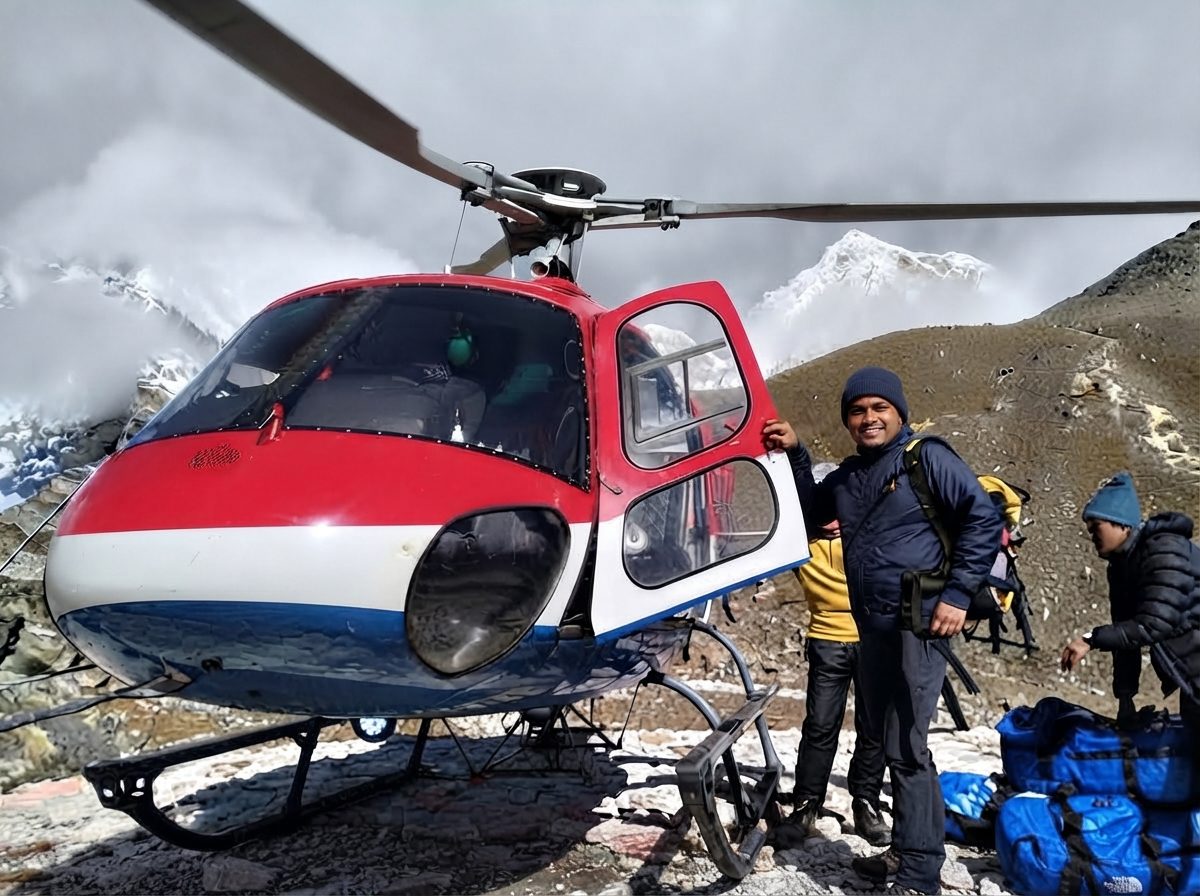
Rotors wind down, and suddenly you’re standing in thin mountain air with Lukla all around you: guesthouses, porters loading duffels, trekkers double-checking their boots before setting off toward Phakding. Some people are here to start a two-week trek. Others are just here for the flight and will turn around and head back to Kathmandu shortly. Either way, you’ve covered ground that used to take days on foot, in less time than it takes to watch a movie.
If you’re continuing on, your guide’s probably waiting right there. If you’re heading back, you’ll have a short window in Lukla before boarding again. The return flight follows more or less the same route in reverse, and it tends to feel calmer – you’ve seen what you came to see, or your trek’s already underway, and there’s less adrenaline in the cabin on the way home.
What makes this flight worth doing
- It skips the Ramechhap transfer that trips up a lot of fixed-wing passengers during peak season – a 4-5 hour drive in the middle of the night that nobody enjoys.
- You fly right over the old Jiri trekking route, the path used before Lukla existed.
- Landing at Tenzing–Hillary Airport is genuinely something – one of the more talked-about airstrips anywhere in the world.
- Helicopters have more room to work with weather-wise than fixed-wing planes. Not unlimited, but more.
- When fixed-wing flights are booked solid or grounded by weather, a helicopter is often the fallback that still gets you there on schedule.
- Private charters mean your group flies alone, no splitting across separate departures.
- You get a real look at how fast Nepal’s terrain changes – hazy valley, green terraces, forest, then bare mountain, all inside fifty minutes.
- Small groups. Five people max in a helicopter, so it never feels like a commercial flight.
- Pilots on this route generally have serious hours logged in mountain flying specifically, not just flying in general.
- It’s a memorable flight even if you strip away whatever trek comes after it.
Booking basics
- Reserve now, pay later. Put down a deposit to hold your date and settle up closer to departure – useful since good weather slots go fast in peak months.
- We respond quickly. Weather calls change fast in the mountains, and we try to get back to you the same day, including outside normal hours if something’s urgent.
- Weather delays get rescheduled, not charged again. If your flight can’t go, we move you to the next open slot at no extra flight cost.
- We only work with CAAN-certified operators who have an actual track record on this specific route.
- Pricing is stated upfront – shared seat, private charter, baggage limits, front-seat premiums, all quoted before you pay, not sprung on you at the airport.
- We fly a mix of trekkers and sightseers every season, from people heading to Base Camp to families just wanting the view.
Itinerary
Customize this trip with help from our local travel specialist that matches your Interests.
Customize This TripInclusions
What’s Covered in Your Adventure
- Check-in assistance at the domestic terminal
- The helicopter flight itself, one-way or round trip as booked
- 15kg baggage allowance per person
- Safety briefing and standard onboard equipment
- Government aviation charges where applicable
- Hotel pickup/drop-off (ask - sometimes bundled, sometimes not)
- Meals
- Nepal visa
- Extra baggage beyond 15kg
- Travel and medical insurance, including helicopter evacuation
- Trekking permits if you’re continuing past Lukla (Sagarmatha National Park entry, Khumbu municipality fee)
- Tips for pilots and crew
Maps
Navigate Your Journey
Good to Know
Your Journey, Step by Step
What you’ll actually see along the way
Setting aside where it takes you, this flight is worth doing for the views alone.
1. Kathmandu Valley from above
Rooftops, terraces around the valley rim, the morning haze thinning out as the sun climbs. Different world from what’s coming later.
2. Nagarkot ridgeline
Nagarkot’s a well-known sunrise spot on its own, and you get roughly that same view from the air, moving, with hints of the high Himalaya visible when it’s clear.
3. The old Jiri route
This is where the classic overland trek to Everest used to begin, before Lukla had an airstrip. Hillary’s expedition support crews walked this ground. You cross it in a few minutes.
4. Lamjura ridge
One of the higher points on the route. Forest thickens, the air visibly gets colder-looking, and in spring the rhododendrons color the hillsides even from this height.
5. River valleys and hill villages
A stretch of deep valleys and villages linked only by footpath – a good reminder of how much of rural Nepal still runs without road access.
6. First mountain views
Depending on the day, you might spot Langtang to the west, and further on the wall of Himalayan peaks that frames the Everest region starts to show itself.
7. The approach into Lukla
The last few minutes are the ones people remember. Terrain steepens fast, and the final descent onto that short, sloped runway at Tenzing-Hillary Airport is a highlight in its own right.
How hard is this flight?
Not hard at all. It’s a helicopter seat for under an hour.
Difficulty rating
1 out of 5 – very easy
No walking, no climbing. The only physical bit is stepping up and through a low doorway to board.
| Activity | Difficulty |
| Boarding/exiting | Very easy |
| Sitting during the flight | Very easy |
| Standing around at Lukla (round trip) | Very easy |
| Trekking onward from Lukla | Moderate to strenuous – separate matter entirely |
One thing worth being clear about
The flight is effortless. The trek that often follows it is not. If you’re using this flight to start an Everest Base Camp trip, don’t let the ease of the helicopter ride fool you into underestimating the days ahead.
Altitude
Lukla sits at roughly 2,860m, a real jump from Kathmandu’s elevation but one most people handle fine for a short visit. If you’re continuing on toward Base Camp (5,364m) or similar elevations, proper acclimatization on the trail matters a lot more than anything about the flight itself.
Who can fly
| Passenger | Suitability |
| Kids 5+ | Fine |
| Teens and adults | Fine |
| Seniors | Fine, general health permitting |
| Non-trekkers, scenic flight only | Ideal |
| Mild heart conditions | Check with a doctor first |
| Pregnant travelers | Not recommended |
| Serious respiratory issues | Doctor’s approval needed |
Best time of year
Weather along this route swings a lot by season, and that affects both the views and whether you’ll actually fly on schedule.
Spring (March-May)
One of the two busy seasons, for good reason. Kathmandu’s pleasant, low-to-mid 20s°C, while Lukla and the surrounding hills run cooler, often 10-15°C in the day and colder at night. Visibility’s generally solid early, though afternoon cloud builds up as the season goes on – another reason morning flights are the standard. Rhododendrons are in bloom along the route, which adds some color to the scenery. Also peak trekking season, so book early.
Autumn (September-November)
Generally considered the best window of the year. Comes right after monsoon, and the air is about as clear as it gets. Kathmandu stays comfortable, Lukla runs cold and crisp in the mornings, and visibility along the whole route can be excellent. Also the busiest season, so the same booking-early advice applies.
Winter (December-February)
Cold and dry, with some genuinely clear days. Temperatures at Lukla can drop well below freezing, especially early morning, and occasional snow can mess with runway conditions. Fewer crowds though, which some travelers prefer. Just build in flexibility.
Summer/monsoon (June-August)
The hardest season for this route. Heavy cloud, rain, reduced visibility, more delays and cancellations than any other time of year. You can still fly, but don’t expect much of a view even when you do.
| Season | Months | Kathmandu day temp | Lukla day temp | Weather | Verdict |
| Spring | Mar-May | 20-25°C | 10-15°C | Clear mornings, some afternoon cloud | Highly recommended |
| Autumn | Sep-Nov | 20-24°C | 8-13°C | Clearest skies of the year | Best season |
| Winter | Dec-Feb | 12-18°C | -5 to 5°C | Cold but clear, occasional snow | Recommended, stay flexible |
| Monsoon | Jun-Aug | 25-29°C | 12-18°C | Frequent cloud and rain | Not recommended |
Shared or private?
Shared
Book a seat, not the whole aircraft. You may be flying alongside other passengers booked separately.
Why go this route
- Much cheaper per person than a private charter
- Fixed departure windows so you know roughly when you’re flying
- No need to coordinate group size with anyone else
Details
- Slots: 6:30am, 8am, 10am, sometimes 1pm
- Flight time: 35-50 minutes
- Baggage: 15kg
Private charter
The whole helicopter, your group only.
Why go this route
- You control the timing, within safe operating hours
- No coordinating with strangers
- Room to adjust routing slightly for photos, weather permitting
- Good for families or small trekking groups who want reliability
- Everyone effectively gets a good view given the small group
Details
- Departure: flexible within standard hours
- Flight time: 35-50 minutes
- Capacity: up to 5, weight dependent
- Cost: roughly $2,800-3,200 per helicopter, one way, depending on operator and load
The aircraft of Kathmandu - Lukla Flight
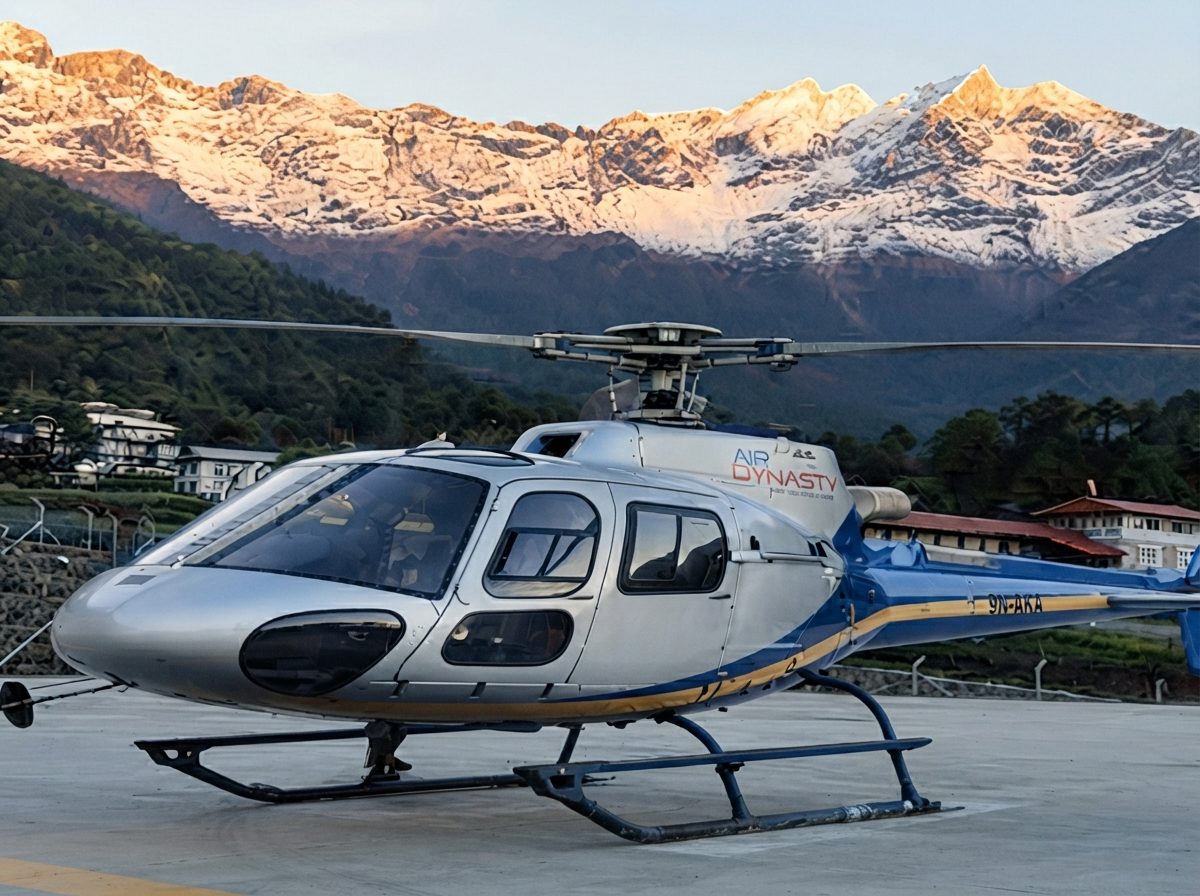
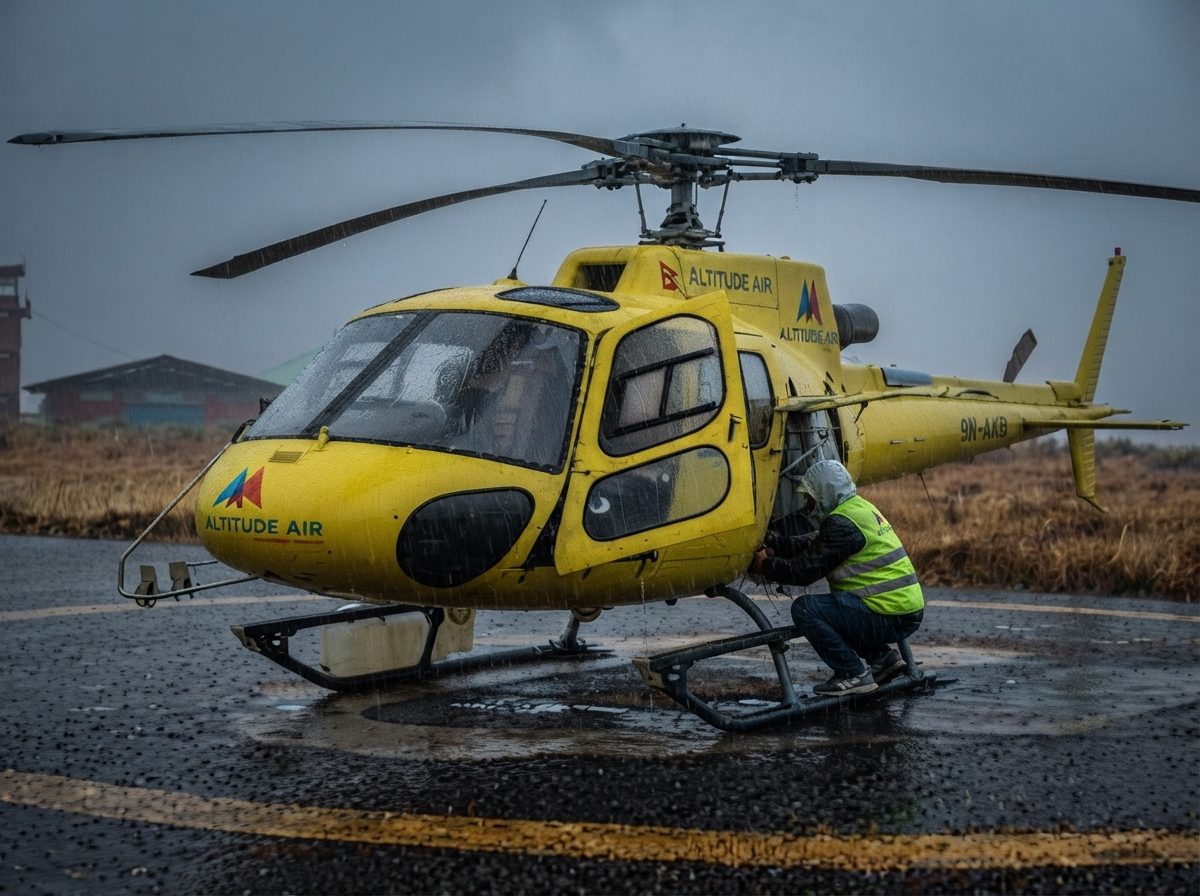
Usually an Airbus AS350 B3 or B3e Écureuil, or something comparable.
- <li”list-style-type: none;”>
- <li”list-style-type: none;”>
- <li”list-style-type: none;”>
- <li”list-style-type: none;”>
- <li”list-style-type: none;”>
- <li”list-style-type: none;”>
- <li”list-style-type: none;”>
- <li”list-style-type: none;”>
- <li”list-style-type: none;”>
- <li”list-style-type: none;”>
- <li”list-style-type: none;”>
- <li”list-style-type: none;”>
- <li”list-style-type: none;”>
- <li”list-style-type: none;”>
- <li”list-style-type: none;”>
- <li”list-style-type: none;”>
- <li”list-style-type: none;”>
- <li”list-style-type: none;”>
- <li”list-style-type: none;”>
- <li”list-style-type: none;”>
- Built for high-altitude mountain work
- Plenty of altitude margin above anything on this route
- Up to 5 passengers, weight and fuel dependent
- Big windows, good for photos
- Standard emergency and communication gear onboard
Rough pricing for 2026
| Group size | Private total | Private per person | Shared per person |
| 1 | $2,800-3,200 | $2,800-3,200 | $500-600 |
| 2 | $2,800-3,200 | $1,400-1,600 | $500-600 |
| 3 | $2,850-3,210 | $950-1,070 | $500-600 |
| 4-5 | $2,800-4,000 | $560-800 | $500-600 |
Front seat upgrade on shared flights: around $700, subject to availability.
Prices move with fuel costs, season, and demand. Confirm the actual number for your date directly with your operator – don’t book off a number you saw months ago.
Baggage and weight forKathmandu - Lukla Flight
Fifteen kilos per person, checked and carry-on together. Helicopters don’t have much room to spare on payload, so this gets enforced.
- Excess baggage should be stored in Kathmandu or sent separately – most hotels and agencies handle this
- Both passenger and bag weight get recorded before takeoff for load calculations – standard procedure, not a judgment call
- Tell your operator ahead of time if weight is a concern for anyone in your group, so the numbers work out properly
- Trekkers often underestimate this – a full duffel for a multi-week trek rarely fits in 15kg, so plan on forwarding gear or renting some of it in Kathmandu or Namche
Why Choose Helicopter and Who Should Choose It?
Why Choose the Helicopter to Lukla?
The direct answer: reliability and time. The helicopter skips the Ramechhap problem entirely, gives your group more scheduling control, and delivers one of the more memorable short flights in Nepal along the way. If you’re on a fixed itinerary where a one-day delay to Lukla would cascade into missed trail days, missed onward flights, or a shortened trek — the helicopter is the insurance policy that’s worth paying for.
Who Should Book the Helicopter
| Traveler Type | Why Helicopter Makes Sense |
| Time-pressed travelers | Schedule is locked — no buffer for a Ramechhap day or a multi-day weather hold |
| Luxury and comfort travelers | Private cabin, no strangers, flexible timing, the most seamless gateway into the Everest region |
| Families with children | No 4am Ramechhap drive. Shorter, calmer boarding process. Kids handle helicopter flights well from age 5+ |
| Small private groups (2–5 people) | Private charter cost splits well and everyone flies together with no splitting across departures |
| Senior travelers | Avoids the physical strain of an overnight road transfer. Boarding is simple, flight is short |
| Travelers with medical conditions | Less physical stress than road transport; medical clearance still required for altitude |
| Photographers and experience-seekers | 45–60 minutes over the Jiri route and mid-Himalayan terrain that fixed-wing passengers don’t see at all |
| Peak season travelers | When fixed-wing seats disappear and Ramechhap kicks in, helicopter is often the only way to fly on your planned date |
Who Fixed-Wing Makes More Sense For
- Solo budget travelers
- 200–250 price matters more than schedule certainty
- Large groups where per-seat fixed-wing pricing is more economical
- Travelers with flexible itineraries who can absorb a one-day delay without consequence
Weather & Cancellation of Kathmandu - Lukla Flight
Weather and Cancellation: What to Realistically Expect
Mountain weather in Nepal is not predictable the way urban weather is. Conditions along the Kathmandu–Lukla route can change in under an hour, and the pilot — not the schedule — makes the final call on every departure.
What causes delays and cancellations:
- Low cloud sitting over the Kathmandu Valley at departure time
- Reduced visibility anywhere along the route — Nagarkot, the Jiri corridor, or Lukla itself
- Strong or gusty crosswind on final approach into Tenzing-Hillary Airport
- Sudden storm development over the Lamjura ridge
- Traffic congestion at Lukla during busy morning windows
- Snow or ice on the Lukla helipad in winter
Realistic cancellation chances by season:
| Season | Cancellation Risk | What Usually Happens |
| Spring (Mar–May) | Low–Moderate | Mornings mostly clear. Afternoon cloud builds. Fly early and you’re usually fine |
| Autumn (Sep–Nov) | Very Low | Post-monsoon air is the clearest of the year. Best odds of flying on your booked date |
| Winter (Dec–Feb) | Moderate | Clear days outnumber bad ones, but cold snaps and snow can close the helipad with little warning |
| Monsoon (Jun–Aug) | High | Heavy cloud, rain, and poor visibility make this the most disrupted season. Expect delays |
What happens when your flight can’t go: Your flight gets rescheduled to the next available weather window — no extra flight charge. If delays stretch across multiple days and rescheduling doesn’t work for you, a full refund is issued (minus a small ground transport fee of around $20–25 if our vehicle picked you up). Weather cancellations are never penalised.
The one thing worth building into your plan: Treat your flight date as the target, not a guarantee. A one or two day buffer at the start of a long trek costs very little and removes an enormous amount of stress. Travelers who book with zero flex and fixed onward connections have the hardest time with Himalayan delays — because the delays are real and they happen to everyone at some point.
A note for trekkers
If you’re booking this to start an Everest Base Camp trek or similar, build in a spare day or two somewhere in your schedule. Weather up here can turn quickly, and treating your flight date as completely fixed is one of the more common planning mistakes. A buffer near the start of your trip – and ideally near the end too – takes a lot of the stress out of a delay.
Permits for onward trekking
The flight itself needs nothing beyond a passport and Nepal visa. If you’re walking beyond Lukla, though, a couple of permits apply separately from the flight:
| Permit | Who needs it | Cost | Notes |
| Sagarmatha National Park entry | All trekkers entering the park | NPR 3,000 (foreign nationals) | Checked at Monjo |
| Khumbu Pasang Lhamu municipality fee | All trekkers in the Khumbu | NPR 2,000 | Separate from the park permit |
| TIMS card | Independent trekkers, in some cases | Varies | Confirm current rules with your agency – this has changed before |
If you’re on a guided trek, your agency usually sorts this. Independent trekkers can arrange these in Kathmandu or at checkpoints along the trail.
Time Breakdown for Kathmandu - Lukla Flight
Standard route from Kathmandu
| Segment | Time |
|---|---|
| Hotel to airport | 20-30 min |
| Check-in, security, weigh-in | 45-60 min |
| Briefing and boarding | 10-15 min |
| Flight to Lukla | 35-50 min |
| Time at Lukla (round trip) | 15-30 min |
| Flight back (round trip) | 35-50 min |
| Airport to hotel (round trip) | 20-30 min |
| Total, one-way to start trekking | ~2-2.5 hours |
| Total, round trip | ~3.5-4.5 hours |
What changes the numbers
- Weather can add 5-15 minutes each way if the pilot has to route around wind or cloud
- Heavier loads mean slightly different fuel planning
- Wind direction alone can shift flight time a few minutes
- Air traffic at Lukla during busy mornings can cause short holds before landing or takeoff
How Difficult Is Landing at Lukla Airport?
Tenzing-Hillary Airport sits at 2,860m on the edge of a Himalayan hillside. The runway is 527 metres long, slopes uphill at a 12% gradient, ends on one side at a stone retaining wall, and drops into a valley on the other. It consistently ranks among the most challenging commercial airstrips in the world — but the experience differs significantly depending on how you arrive.
| Fixed-Wing (Twin Otter / Dornier) | Helicopter (AS350 B3) | |
| Runway use | Full runway required — must commit to landing on approach, no go-around option once too low | Does not use the runway — lands on a separate helipad beside the terminal |
| Approach | Single shot. Pilots line up through a narrow mountain valley, descend steeply, and touch down in the uphill direction. Overshooting or going around is not possible below a certain point | Can abort approach at any stage, circle, reposition, and try again. Far more flexibility |
| Wind sensitivity | High. Crosswind and downdraft on final approach are the main cause of fixed-wing delays and cancellations at Lukla | Still weather-dependent, but helicopters read and respond to wind far better. Pilots can hover, adjust heading, and choose the exact moment to put down |
| Weight and runway length | Fixed-wing aircraft must calculate weight, fuel, and runway performance precisely. Fully loaded flights are sometimes held until conditions improve | Weight still matters for payload and fuel, but there’s no runway performance calculation — the helipad is short by design |
| What passengers feel | Steep, fast descent through terrain, braking hard on touchdown, the wall ahead passing quickly. Genuinely intense for first-timers | A controlled hover descent, quieter than expected, settling onto the pad. Most passengers describe it as smooth |
| Pilot experience required | Special mountain flying certification and extensive route-specific hours. This approach is not taught in standard commercial training | CAAN mountain certification required. Pilots on this route typically have thousands of hours of Himalayan flying specifically |
| Cancellation rate | Higher — full runway conditions must be met | Lower — more ability to work around marginal weather |
The short version: Fixed-wing landings at Lukla are technically demanding and genuinely exciting for passengers. Helicopter landings are controlled and smooth by comparison — the pilot has more options at every stage of the approach. Either way, the people doing it have done it hundreds of times.
Everest Region Helicopter Flight Costs 2026
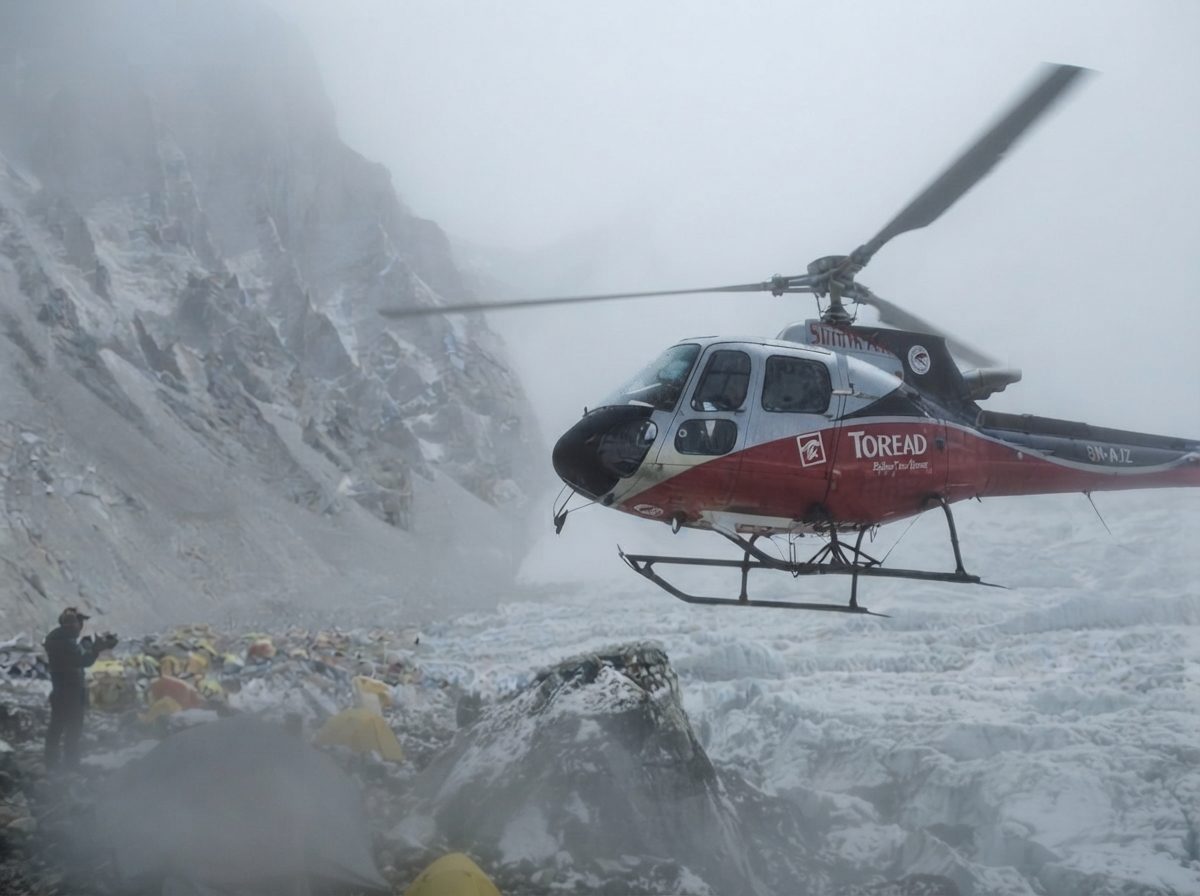
If your trek is already underway and you need to fly out — due to altitude sickness, injury, a schedule change, or simply skipping the walk back down — helicopters can pick up from several points along the Everest trail. Prices below are per person on a shared basis. Private charters are priced per helicopter (up to 5 passengers).
| Pickup Point | Altitude | To Lukla (per person) | To Kathmandu (per person) |
| Namche Bazaar | 3,440 m | $500 | — |
| Tengboche | 3,860 m | $600 | — |
| Dingboche | 4,410 m | $600 | — |
| Lobuche | 4,940 m | $700 | $1,300 |
| Gorak Shep | 5,164 m | $700 | $1,300 |
| Gokyo | 4,790 m | $700 | — |
Note: Prices are indicative for 2026 and vary by operator, season, and group size. Emergency evacuation costs are separate and handled through your travel insurance — confirm your policy covers helicopter evacuation before the trek starts. Direct Kathmandu flights from high altitude require fuel stops and may be weather-dependent.
Beyond the flight - Everest region options for 2026
Most people booking this flight are heading somewhere further. Quick rundown of the common options.
1. Everest Base Camp trek
The classic: fly to Lukla, then walk about 12-14 days round trip through Phakding, Namche, Tengboche, Dingboche, and Lobuche to reach Base Camp (5,364m) and usually Kala Patthar (5,545m) for the best Everest views.
2. EBC trek with a helicopter return
Trek in the standard way, then fly straight out from near Base Camp instead of walking back down – saves several days while keeping the full trek experience on the way up.
3. Gokyo Lakes trek
A different valley, leading to a chain of turquoise glacial lakes and Gokyo Ri (5,357m), with arguably better panoramic views than the standard Base Camp route. Also starts from Lukla.
4. Everest Three Passes
Longer and tougher – combines Base Camp, Gokyo, and three high passes (Kongma La, Cho La, Renjo La) into an 18-21 day loop through the Khumbu. Also via Lukla.
5. Short helicopter-only tours
For people with very little time, some operators run same-day helicopter tours that fly over the Everest region and land briefly at a high viewpoint before heading back – different product entirely from the Kathmandu-Lukla transport flight, but worth asking about if you’re not trekking.
Altitude and general safety notes
Lukla’s around 2,860m, which most people handle without any trouble on a short visit. A few things worth knowing anyway:
- Spend a day or two in Kathmandu beforehand if you can, just to give your body a small head start
- Drink more water than usual, before and after
- Skip alcohol the night before an early flight
- If you’re continuing to trek higher, remember the helicopter doesn’t replace proper acclimatization further up the trail – that’s a separate risk from the flight itself
- History of altitude sickness, heart issues, lung issues, high blood pressure, or pregnancy – talk to a doctor before booking and let your operator know
- If you feel off at Lukla, say something to your guide or the ground crew right away
Health and safety guidelines
Tell your operator in advance about any of the following: heart conditions, uncontrolled high blood pressure, lung disease, severe anxiety around flying, recent major surgery, ear or sinus problems, past severe altitude sickness, or pregnancy. None of this automatically rules you out, but it may mean getting a doctor’s sign-off first.
Everyone gets a safety briefing before boarding – seatbelts, boarding procedure, headset use, emergency steps. Flight decisions are made on weather and safety alone, never to keep a schedule.
If you wake up feeling sick on flight day, say so – rescheduling for genuine illness is usually possible without penalty, and it’s a better call than pushing through.
Get travel insurance that covers helicopter evacuation, medical treatment in Nepal, and delays or cancellations. It’s a small cost for a lot of peace of mind.
Safety on the Kathmandu–Lukla Helicopter Route
1.Aircraft and airworthiness
Flights on this route use aircraft built specifically for high-altitude mountain operations — typically the Airbus AS350 B3 or B3e Écureuil. These are single-engine turbine helicopters designed for performance at altitude, certified to operate well above anything on this route. Every aircraft operating commercially in Nepal requires an Airworthiness Certificate issued by the Civil Aviation Authority of Nepal (CAAN) and undergoes mandatory scheduled maintenance checks. Operators running regular Lukla services maintain their aircraft to a higher standard than CAAN minimums — their reputation and operating licence depend on it.
2.Pilots
Every pilot flying this route holds a CAAN Commercial Pilot Licence with specific mountain flying qualifications. The Himalayan environment requires endorsements that standard commercial training does not cover — approach procedures, high-altitude performance management, and mountain weather reading are all separately certified. Pilots working the Kathmandu–Lukla corridor typically have thousands of hours of Himalayan flying logged, not just total flight hours. This route is flown dozens of times a week during peak season by the same pilots repeatedly — the approach into Tenzing-Hillary Airport is not unfamiliar territory for them.
3.How decisions get made
The pilot has unconditional final authority over every departure and landing. No commercial pressure, no schedule, and no passenger preference overrides that authority. If conditions aren’t safe, the flight doesn’t go. This applies to departure from Kathmandu, en-route conditions, and the approach into Lukla — the decision can be reversed at any point.
4.Onboard equipment
Every aircraft carries standard emergency equipment including first aid kit, fire extinguisher, emergency locator transmitter (ELT), and communication systems. Pilots maintain radio contact with both Tribhuvan International Airport and Tenzing-Hillary Airport throughout the flight.
5.What safety doesn’t mean
No reputable operator will tell you this flight is 100% safe. Mountain flying carries inherent risks that don’t exist at lower elevations — weather changes faster, terrain is unforgiving, and altitude reduces mechanical margins. The safety record on this specific corridor is strong and the pilots are genuinely expert. But anyone who guarantees you a risk-free Himalayan flight is not being straight with you. The honest position is: certified aircraft, expert pilots, strict weather standards, and an environment that still demands respect.
What If You Can't Fly Same Day?
What Happens If Your Flight Can’t Go?
Weather delays at Kathmandu, Lukla, or anywhere along the route are a normal part of mountain flying. Here’s exactly what to expect if your departure day doesn’t go to plan.
If weather prevents departure from Kathmandu: You won’t be left standing at the airport. Your operator contacts you — usually the night before or early morning — if conditions look unflyable. Your flight moves to the next open weather window, no charge. Most delays resolve within 24–48 hours, particularly in spring and autumn.
If you’ve boarded and the pilot turns back en-route: Rare, but it happens. The pilot reads conditions continuously throughout the flight. If weather deteriorates between Kathmandu and Lukla, the aircraft returns to base. You’ll be rescheduled and the flight cost carries over.
If you’re already in Lukla and can’t fly back: This is the more common scenario for round-trip passengers. Lukla weather can close independently of Kathmandu. You’ll wait at a teahouse (several options near the helipad), your operator stays in contact, and you fly as soon as the window opens. Most people are out within a day. Longer holds are unusual but do happen — keep a day’s cash on hand for food and accommodation.
Practical steps to protect yourself:
- Build buffer days into your schedule — one day at the start, one near the end of your trip. This single step removes most of the stress from a weather delay
- Don’t book tight onward connections — international flights out of Kathmandu the day after your planned Lukla return are a real risk
- Get travel insurance that covers delays — costs for extra nights in Kathmandu or Lukla, missed connections, and rebooked flights can add up quickly without cover
- Stay contactable — keep your Nepal SIM active and your operator’s number saved. Communication during delays is fast if your phone works
What to pack forKathmandu - Lukla Flight
Essentials
- Passport and visa
- Booking confirmation, and permits if you’re trekking on
- A small daypack for the flight – camera, documents, anything you want on hand
Clothing
- A warm mid-layer – Lukla and the hills are colder than Kathmandu, especially early morning
- A windproof or waterproof shell
- Trekking trousers if you’re continuing on
- A warm hat and gloves for early departures
- Sunglasses – the light at altitude is intense even on a short flight
- Broken-in footwear, especially for trekkers
Practical items
- Sunscreen and lip balm
- A refillable water bottle
- Camera or phone with storage cleared – you’ll want it
- A little cash in rupees for tips or small purchases at Lukla
- Any medication you need, in original packaging, enough for your whole trip
If you’re trekking on from Lukla
- A duffel or trekking pack that fits your allowance, or arrange separate transport for it
- Full trekking kit for the season – sleeping bag, insulation, proper boots – check with your agency for specifics.
Booking policy of Kathmandu Lukla Flight
1. Deposit
Most bookings need a deposit to confirm – usually 30–50% of the total. The rest is generally payable in Kathmandu before departure, cash or card.
2. What we need from you
- Deposit
- A clear passport copy
- Accurate weight for everyone and all bags
- Emergency contact and, if you have it, insurance details
3. Payment
Online payment, bank transfer, and major cards all work. Card payments usually carry a processing fee, typically around 3-4%.
4. Changing your date
Tell us as early as you can. Changes well ahead of your date are usually free or close to it; last-minute changes depend on availability and may cost extra.
5. Insurance
Strongly recommended given the nature of mountain flying and, for a lot of travelers, the trek that follows. Cover medical treatment, evacuation, and cancellation/delay.
6. Booking late
Sometimes possible with 24-48 hours’ notice, if there’s space. During peak months, that window shrinks fast – book early if you can.
Cancellation policy of Kathmandu - Lukla Flight
1. If you cancel
- 15+ days out: full refund, minus any transaction fees
- 7-14 days out: 50% refund
- Under 7 days: generally non-refundable, though rescheduling may still be an option
- No-shows: no refund
2. If we cancel
Rare, but if it happens for reasons on our end, you get a full refund or a rebooked flight at no extra cost.
3. Weather
Handled separately from the above and never penalized. Weather delays get rescheduled at no extra flight cost. If that genuinely doesn’t work out after repeated attempts, you get a full refund, possibly minus a small ground transport fee (usually $20-30).
4. Events outside anyone’s control
Natural disasters, government restrictions, airspace closures – fully refunded or rebooked, no extra charge.
FAQs
Your Questions, Answered
Why helicopter over the regular plane?
Mainly directness and flexibility. Fixed-wing flights often run out of Ramechhap in peak season, adding hours of driving. The helicopter skips that entirely and tends to be more adaptable when weather is borderline.
Is it safe?
It’s mountain flying with certified pilots and proper aircraft, but nobody should call any Himalayan flight “100% safe.” The pilot always has final say on whether it flies.
What is Baggage allowance?
15kg per person, checked and carry-on combined.
What is Standard departure times?
6:30am, 8am, 10am, occasionally 1pm depending on demand and weather.
Cost of a shared seat?
Around $500-600 per person currently, though this shifts by operator and season.
What is the best time to visit?
Roughly $2,800-3,200 per helicopter, up to 5 passengers.
Can I get a window seat?
Private charters give you flexibility on seating. On shared flights, a front seat is available for a fee, around $700.
What if the flight is delayed for weather?
You get rescheduled to the next open window at no extra flight charge. If it genuinely can’t happen, you get a refund.
Do I need permits for this flight?
<span”font-weight: 400;”>Not for the flight itself – just passport and visa. Trekking beyond Lukla needs separate permits.
How high is Lukla?
About 2,860 meters.
Is hotel pickup included?
Depends on the package – confirm with your operator.
What’s the route?
Roughly Kathmandu, Nagarkot, Jiri, Lamjura, Lukla, though it varies a bit by day.
Can I book one-way?
Yes, common for people starting a trek in Lukla and returning some other way.
What is minimum group size?
None for shared flights – solo travelers book individual seats. Private charters make more sense financially from about 3 people up.
Is it suitable for kids?
Generally yes from age 5 up. Younger kids can find the noise and intensity a lot.
What documents do I need?
Passport and Nepal visa. Trekking permits separately if continuing on foot.
What should I wear?
Warm layers – it’s colder up there than Kathmandu even for a short visit. Windproof shell, hat, gloves for early departures.
Can I bring trekking gear?
Within the 15kg limit – most trekkers forward the rest separately or rent gear locally.
How early should I book?
As early as you can in peak season. Off-peak, 24-48 hours can sometimes work.
Can I change my dates?
Yes, tell us early and it’s usually easy. Last-minute changes can cost more or depend on availability.
Do I need travel insurance?
Not legally, but strongly recommended, and often required by trekking agencies for onward treks.
What’s the cancellation policy?
Full refund 15+ days out, 50% at 7-14 days, mostly non-refundable under 7 days. Weather cancellations are always handled separately.
Why does the route change sometimes?
Pilots adjust for local weather, wind, or air traffic, which can shift flight time a bit either way.
Can I take photos?
Absolutely, and most people do a lot of it. Bring spare battery and clear your storage beforehand.
What about traffic at Lukla itself?
During busy mornings, several aircraft may be working the single runway/helipad, which can cause short delays even in good weather.
Is Ramechhap ever a factor for helicopters?
No – that’s specifically a fixed-wing issue in peak season. It’s one of the main reasons people choose the helicopter instead.
What if I have a medical condition?
Tell your operator when booking. Some conditions may need a doctor’s clearance first.
Can I fly pregnant?
Generally not recommended, given the vibration and altitude. Talk to your doctor if you have questions.
Are meals included?
Not on standard flights. Some private charters can arrange this on request.


View Our Similar Packages
Discover our top tours, loved by thousands of travelers annually. Choose the adventure that inspires you and embark on a journey tailored to your desires.

 Nepal
 4 Days
Add Review
Reviewing for Kathmandu to Lukla Helicopter FlightRequest a Callback - Kathmandu to Lukla Helicopter Flight
Submit the form and we will be back to you shortly
Request a Callback - Kathmandu to Lukla Helicopter Flight
Submit the form and we will be back to you shortly
Narayanhiti Palace Museum

Narayanhiti Palace Museum


