









Everest Base Camp Helicopter Tour in Autumn: Complete 2026 Guide
Autumn is the peak season for an Everest Base Camp helicopter tour, offering crystal-clear skies, stable weather, and spectacular Himalayan views. This 2026 guide covers costs, flight conditions, the best time to fly, landing experiences, and practical tips to help you plan your Everest helicopter adventure.
-
 Adventure Master Trek
-
9 July, 2026
-
12 mins read
-
373 Views
-
0 Comments


Not everyone has two weeks to spend walking to Everest Base Camp, and not everyone needs to. For travelers short on time, unable to handle multi-day high-altitude trekking, or simply looking for the most efficient way to see Everest up close, the Everest Base Camp helicopter tour has become one of Nepal’s most popular Himalayan experiences. And if you’re weighing up when to go, autumn (September to November) is widely considered one of the two best windows of the year to do it, alongside spring.
This guide covers everything you need to know about doing the Everest Base Camp helicopter tour, specifically in autumn: what the itinerary looks like, what the weather and views are actually like this time of year, how much it costs, what’s included, and how to decide if it’s the right choice for your trip to Nepal.
What Is the Everest Base Camp Helicopter Tour?
The Everest Base Camp helicopter tour is a one-day aerial excursion that takes travelers from Kathmandu, over the foothills of the Khumbu region, past Lukla, and up toward Everest Base Camp and Kala Patthar — all without walking a single step of the trail. Instead of the 12 to 16 days a trekking itinerary requires, the entire experience is typically completed in around 4 to 5 hours, including a landing and breakfast stop at a high-altitude hotel with Everest views.
It’s essentially a compressed, aerial version of the full trekking experience: you still get close-up views of Everest, Lhotse, Nuptse, and Ama Dablam, you still get to stand at extreme altitude near Kala Patthar or the Everest View Hotel, and you still get a genuine sense of the scale of the Khumbu — just in a single morning instead of two weeks.
Why Autumn Is One of the Best Times to Fly
Autumn in Nepal runs roughly from September through November, and it’s one of the two peak seasons — alongside spring — for both trekking and helicopter tours in the Everest region. There are a few specific reasons autumn stands out for a helicopter tour:
- Post-monsoon clarity. The monsoon rains that run through the summer months wash dust and haze out of the atmosphere, and by late September the skies over the Khumbu are typically at their clearest and sharpest of the entire year. October in particular is often singled out as delivering the best mountain visibility of any month, which matters enormously for a tour that’s built entirely around aerial views.
- Stable flying conditions. Autumn mornings tend to bring calm, settled weather with minimal cloud buildup before midday, which is exactly the window helicopter tours are scheduled around. Nearly all EBC helicopter tours depart in the early morning specifically to take advantage of this pre-noon stability, before afternoon winds and cloud cover typically move in.
- Comfortable temperatures. Daytime temperatures in the Everest region during autumn generally sit in a mild range, dropping toward freezing or below at night and at altitude. It’s cold at Kala Patthar and the Everest View Hotel regardless of season, but autumn avoids both the summer rain and the harsher sub-zero mornings of deep winter.
- A lively, scenic Khumbu. Autumn is also peak trekking season, so the villages you fly over and the Everest View Hotel itself tend to be busier and more atmospheric than in the quieter winter months, without the crowding pressure that spring’s Everest climbing season sometimes brings to the base camp area itself.
The trade-off is that autumn is also one of the two busiest booking periods of the year, alongside spring, so seats on shared group departures can sell out ahead of the peak weeks in October, and advance booking is genuinely worth doing if you have specific dates in mind.

A Typical Autumn Helicopter Tour Itinerary
While exact itineraries vary slightly between operators, a standard Everest Base Camp helicopter tour with landing follows roughly this structure:
- Early hotel pickup in Kathmandu (typically between 5:30 and 6:30 AM), transferred to the domestic terminal of Tribhuvan International Airport for check-in and paperwork.
- Takeoff from Kathmandu, flying over the hills and settlements of the Kathmandu Valley toward the Everest region.
- First stop in Lukla for refueling, since the helicopter can’t carry a full fuel load and reach the highest points of the route in one leg. This stop usually takes 15–20 minutes.
- Flight onward toward Everest Base Camp, passing over Namche Bazaar and the increasingly dramatic terrain of the upper Khumbu, with views of the Khumbu Glacier and icefall.
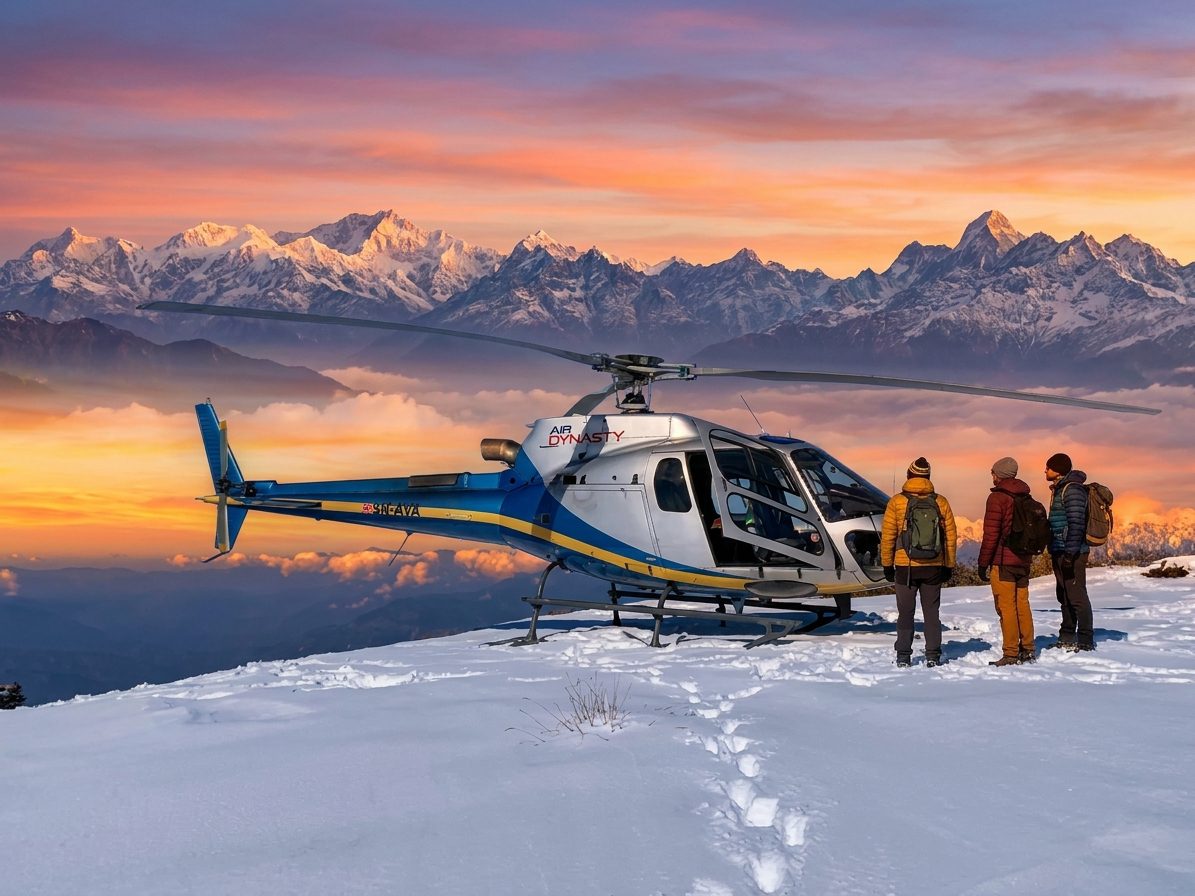
- Approach to Kala Patthar or a viewpoint near Everest Base Camp itself, where most tours land for several minutes, giving passengers a chance to step out at extreme altitude and take in an unobstructed view of Everest, Nuptse, Lhotse, Pumori, and Ama Dablam. Because Everest Base Camp’s own terrain sits on an active, shifting glacier without a proper helipad, most operators land near Kala Patthar or fly a close overpass of base camp itself rather than touching down directly on it, weather and regulations permitting.
- Breakfast stop at the Everest View Hotel (around 3,880m) in Syangboche, widely regarded as one of the highlights of the tour — a hot breakfast served with a direct, unobstructed view of Everest from the dining room or terrace.
- Return flight via Lukla for a second refueling stop, then back to Kathmandu, typically arriving mid-to-late morning.
The whole experience — door to door from your Kathmandu hotel — usually wraps up in around 4 to 5 hours, making it entirely feasible as a single morning activity, with the rest of your day free.
What Will You Actually See in Autumn?
This is where autumn genuinely earns its reputation. On a clear autumn morning, passengers typically get sharp, unobstructed views of:
- Mount Everest (8,849m) and its distinctive summit plume
- Lhotse, Nuptse, and Pumori, the peaks that frame the Khumbu Glacier and base camp area
- Ama Dablam, often cited as one of the most photogenic peaks in the entire Himalayan range
- The Khumbu Icefall and Glacier, the dramatic, crevassed terrain that climbers must cross en route to Everest’s summit
- Namche Bazaar and the terraced Sherpa villages of the lower Khumbu, seen from above
- Kathmandu Valley and the Himalayan foothills, especially striking in the clear morning light typical of autumn
Because autumn follows directly on from the monsoon, the lower valleys are also unusually green and lush at the start of the season (September into early October), gradually turning drier and more golden-brown through November — giving early and late autumn flights a noticeably different look and feel from one another.
How Much Does the Autumn Helicopter Tour Cost?
Pricing for the Everest Base Camp helicopter tour is fairly consistent year-round, since operating costs (fuel, maintenance, permits) don’t change much with the season — what does change is how far in advance you need to book to guarantee a seat during autumn’s high demand.
- Shared group tour (with landing at Kala Patthar or Everest View Hotel): Roughly USD 1,200 to 1,500 per person, based on a shared helicopter with other travelers, typically up to 5 passengers per aircraft.
- Private charter: Roughly USD 5,800 to 6,500 per helicopter, split among however many passengers you bring (up to the aircraft’s weight limit), which can work out cheaper per person for a full group and gives you a flexible, custom-timed departure.
- Everest mountain flight only (no landing, fixed-wing aircraft, not helicopter): A separate and considerably cheaper option, generally a few hundred dollars per person, for those who want an aerial view without a helicopter landing.
Most quoted prices include hotel pickup and drop-off in Kathmandu, the helicopter flight itself, and the breakfast stop at the Everest View Hotel, though breakfast itself is sometimes billed as a small separate charge (typically around USD 30–35) depending on the operator. It’s worth asking specifically what’s included before booking, since “starting from” prices sometimes exclude the breakfast or don’t include a landing at all — some cheaper packages are flyover-only, circling Everest and Kala Patthar without actually touching down.
Weight Limits and Landing Restrictions
One practical detail that catches some travelers off guard: helicopters operating at extreme altitude have strict weight limits, and this directly affects group logistics. At elevations above roughly 4,000 meters, the maximum safe passenger load per aircraft drops significantly compared to lower altitudes, which is why many operators split larger groups, landing first at a lower village like Pheriche to redistribute weight before continuing up to Kala Patthar or the base camp area with a lighter load.
You should also expect a strict carry-on baggage limit — often just a few kilograms per person — with no large backpacks or rolling luggage allowed onboard. Leave anything non-essential at your hotel in Kathmandu and bring only a light daypack with a camera, phone, spare batteries (cold drains them fast at altitude), and warm layers.
Is a Landing at Everest Base Camp Itself Possible?
This is a common point of confusion. Because Everest Base Camp sits directly on the moving, crevassed terrain of the Khumbu Glacier, there is no fixed, safe helipad at the base camp site itself, and routine landings there are generally not offered by standard tour packages. Most operators instead land at Kala Patthar (5,545m) — widely regarded as the best viewpoint in the entire region, arguably better than base camp itself for photography — or at Everest View Hotel / Syangboche (3,880m) for breakfast, with a close flyover of base camp itself rather than a touchdown. Some operators offer special, weather-dependent private charters that land closer to base camp during peak climbing season, but this is the exception rather than the standard package, and it comes with a considerable cost premium.
Altitude Sickness: Is It a Concern on a Helicopter Tour?
Altitude sickness is a significantly smaller risk on a helicopter tour than on a multi-day trek, for a simple reason: you’re not sleeping at altitude, and your total time at extreme elevation is measured in minutes rather than days. Most healthy travelers tolerate the brief stops at Kala Patthar and the Everest View Hotel without any issue. That said, extreme altitude can still cause lightheadedness or shortness of breath in some people even for a short visit, especially if you’re arriving in Nepal directly from sea level with no prior acclimatization. Moving slowly during the ground stops, staying hydrated in the days before your flight, and mentioning any relevant heart or lung conditions to your operator in advance are all sensible precautions.
Booking Tips for an Autumn Departure
- Book several weeks ahead if possible. Autumn, alongside spring, is peak season for both trekking and helicopter tours, and shared group seats can fill up quickly during the busiest weeks of October.
- Build in a flexible day or two around your planned flight date. Even in the generally stable autumn weather window, mountain weather can change quickly, and reputable operators will delay or reschedule rather than fly in unsafe conditions — a guaranteed full refund or rebooking policy for weather cancellations is standard with most established companies.
- Fly early in your Nepal trip if you can, not on your last possible day, so a weather delay doesn’t put your flight home at risk.
- Confirm exactly what’s included — landing versus flyover-only, breakfast inclusion, and whether the quoted price is per person on a shared flight or the total for a private charter — before paying a deposit.
- Choose a licensed, Nepal Tourism Board-registered operator with a clear safety record, since this is genuinely one of the more technically demanding aviation environments in the world, and not all operators are equal in terms of maintenance and pilot experience.
Helicopter Tour vs. Trekking in Autumn: Which Should You Choose?
Autumn is one of the best times of year to see Everest either on foot or by air — so the choice mostly comes down to time, budget, and what kind of experience you want.
A helicopter tour is the right choice if you have limited time in Nepal, physical limitations that make multi-day high-altitude trekking impractical, or simply want the most efficient possible way to see Everest up close without committing one to two weeks of your trip.
A trek is the right choice if the journey itself — the villages, the Sherpa culture, the gradual reveal of the mountains, the physical challenge — is as much the point as the destination. Many trekkers also combine the two: walking in and taking a helicopter back out from Gorak Shep, getting the full trekking experience without the multi-day descent.
Final Thoughts
If your goal is to see Everest up close without committing weeks to a high-altitude trek, autumn is genuinely one of the best times of year to take the Everest Base Camp helicopter tour. The combination of post-monsoon clarity, stable morning flying conditions, and comfortable temperatures makes September through November — and October in particular — one of the two peak windows for aerial views of the Khumbu, alongside spring. Book ahead, build in some flexibility around weather, choose a licensed operator, and you’ll get one of the most efficient, genuinely spectacular ways to experience the world’s highest mountain in a single unforgettable morning.
Frequently Asked Questions
Is autumn or spring better for the EBC helicopter tour? Both are excellent, and the choice often comes down to personal preference. Autumn, particularly October, is frequently cited as offering the clearest, sharpest mountain visibility of the year following the monsoon. Spring adds the extra draw of visible expedition activity at Everest Base Camp during climbing season.
How long does the Everest Base Camp helicopter tour take? Door to door from your Kathmandu hotel, the full experience typically takes around 4 to 5 hours, including the breakfast stop at the Everest View Hotel.
Does the helicopter actually land at Everest Base Camp? Not usually. Because base camp itself sits on shifting glacial terrain with no fixed helipad, most tours land at Kala Patthar or the Everest View Hotel instead, with a close flyover of base camp.
Is the helicopter tour safe? Reputable, licensed operators maintain strong safety records, and pilots have full authority to alter or abort a flight if weather conditions deteriorate, with passenger safety taking priority over completing the full itinerary. Choosing an established, Nepal Tourism Board-registered company matters more than choosing the cheapest option.
Can weather cancel my autumn helicopter tour? Yes, although autumn is one of the more weather-stable seasons. Flights can still be delayed or rescheduled if visibility or wind conditions are unsafe, which is why most operators offer a full refund or free rescheduling for weather-related cancellations, and why building a flexible day or two into your trip is a smart precaution.
Comments (0)
Write a comment- What Is the Everest Base Camp Helicopter Tour?
- Why Autumn Is One of the Best Times to Fly
- A Typical Autumn Helicopter Tour Itinerary
- What Will You Actually See in Autumn?
- How Much Does the Autumn Helicopter Tour Cost?
- Weight Limits and Landing Restrictions
- Is a Landing at Everest Base Camp Itself Possible?
- Altitude Sickness: Is It a Concern on a Helicopter Tour?
- Booking Tips for an Autumn Departure
- Helicopter Tour vs. Trekking in Autumn: Which Should You Choose?
- Final Thoughts
- Frequently Asked Questions
Read the latest Blogs & Insights
Explore our collection of articles and insights to gain in-depth travel knowledge, expert advice, and stay updated on the latest trends and tips.




No comments yet.