









Helicopter vs Plane to Lukla: Which Is Safer?
Planning a flight to Lukla for your Everest Base Camp trek? Compare helicopters and fixed-wing planes based on safety, weather conditions, flight experience, reliability, and cost. Understand the risks and differences before choosing your journey to the Everest region.
-
 Adventure Master Trek
-
19 November, 2026
-
10 mins read
-
2 Views
-
0 Comments


Both are safe when operated by experienced crews in acceptable weather. But if you are comparing the two directly, helicopters have a slight operational safety advantage on the Lukla route — not because the aircraft is inherently safer, but because helicopters are not forced to commit to Lukla’s terrifying one-way runway approach. A helicopter can slow down, hover, and abort at any point. A plane on final approach to Lukla cannot.
That said, the overwhelming majority of incidents on this route — for both aircraft types — are caused by weather, not mechanical failure. The machine you sit in matters far less than the conditions you fly in.
Here is exactly how the two options compare on safety, altitude, weather flexibility, and the specific risks you should actually worry about.
The Case for Helicopters
The Approach Advantage
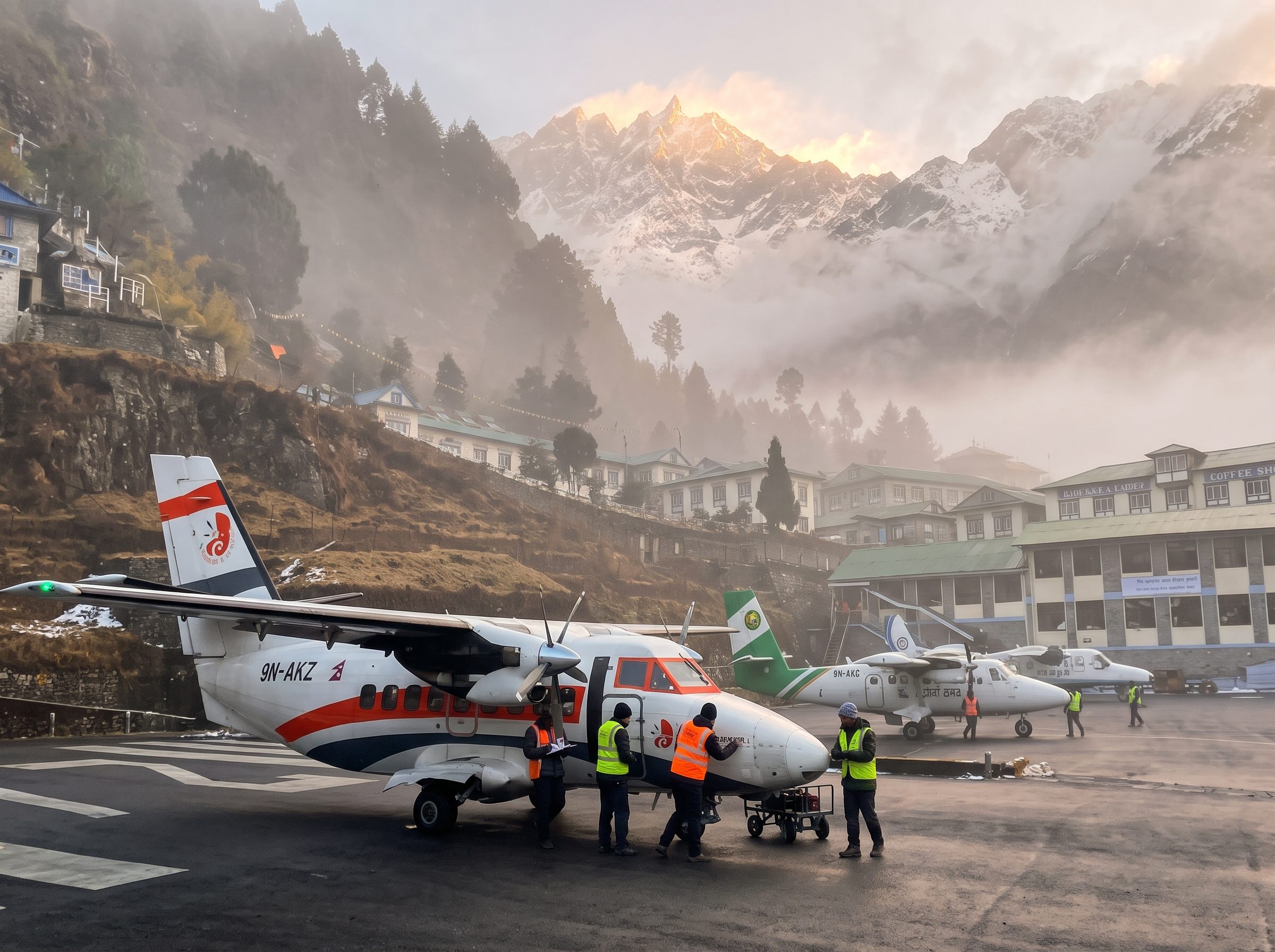
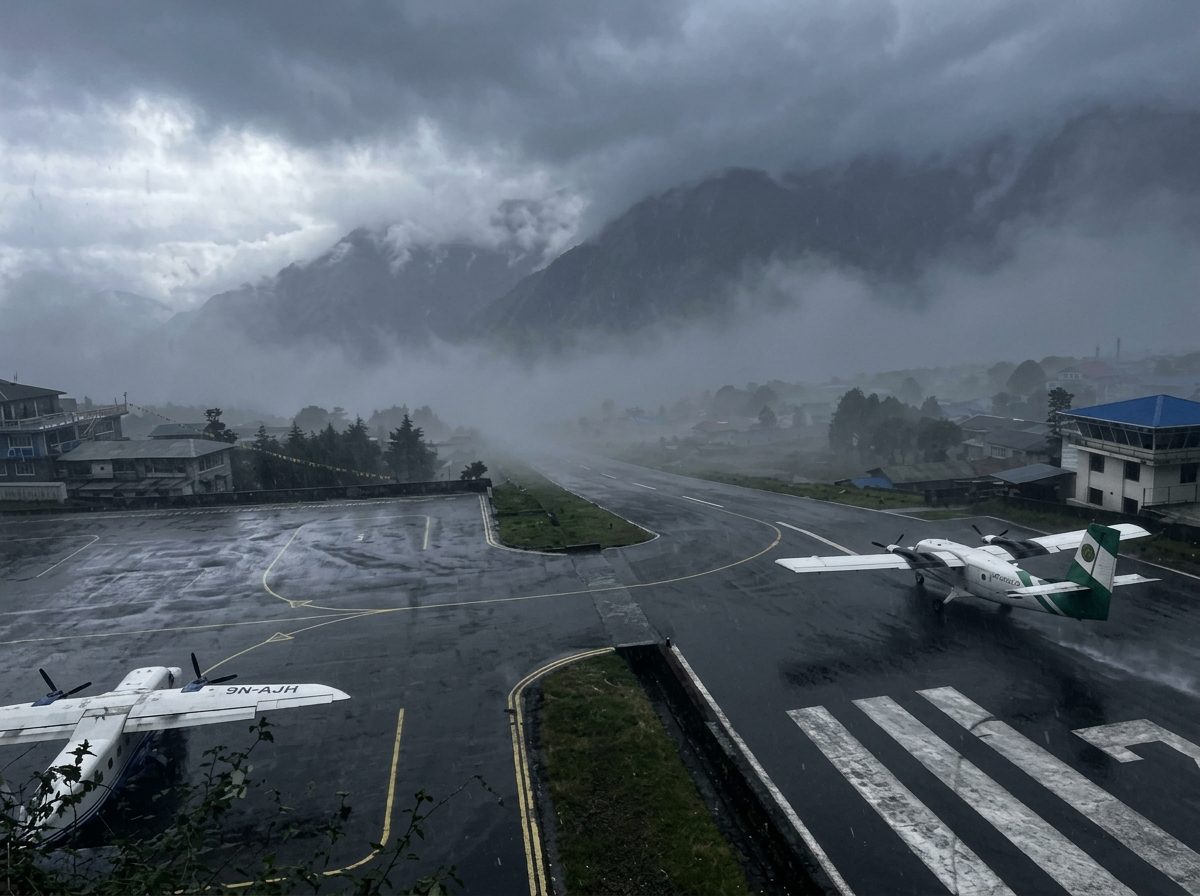
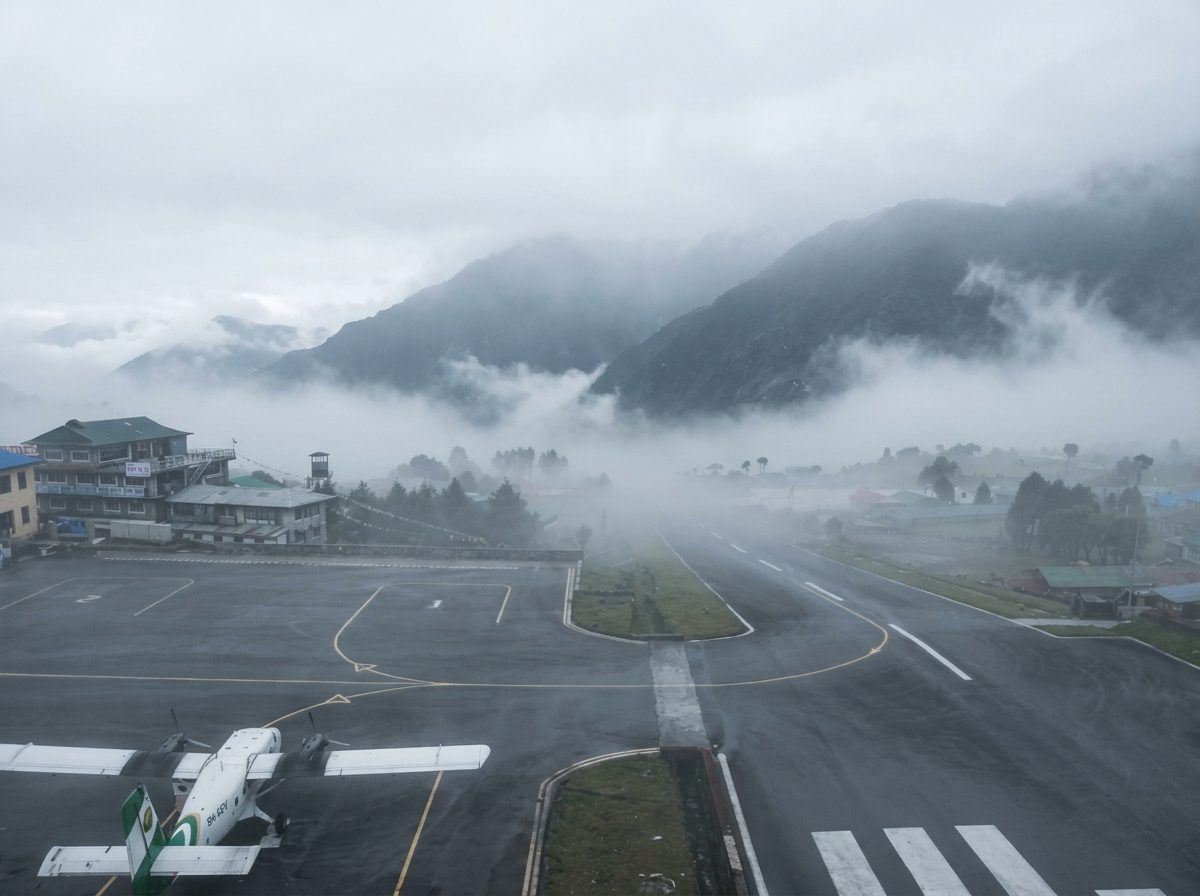
The single biggest safety factor on the Lukla route is the landing. Lukla’s runway is 527 meters long, slopes uphill at 12%, and ends in a stone wall. Fixed-wing aircraft must approach from one specific direction, maintain a committed descent angle, and touch down with zero option to go around. Once the pilot lines up the approach, there is no abort.
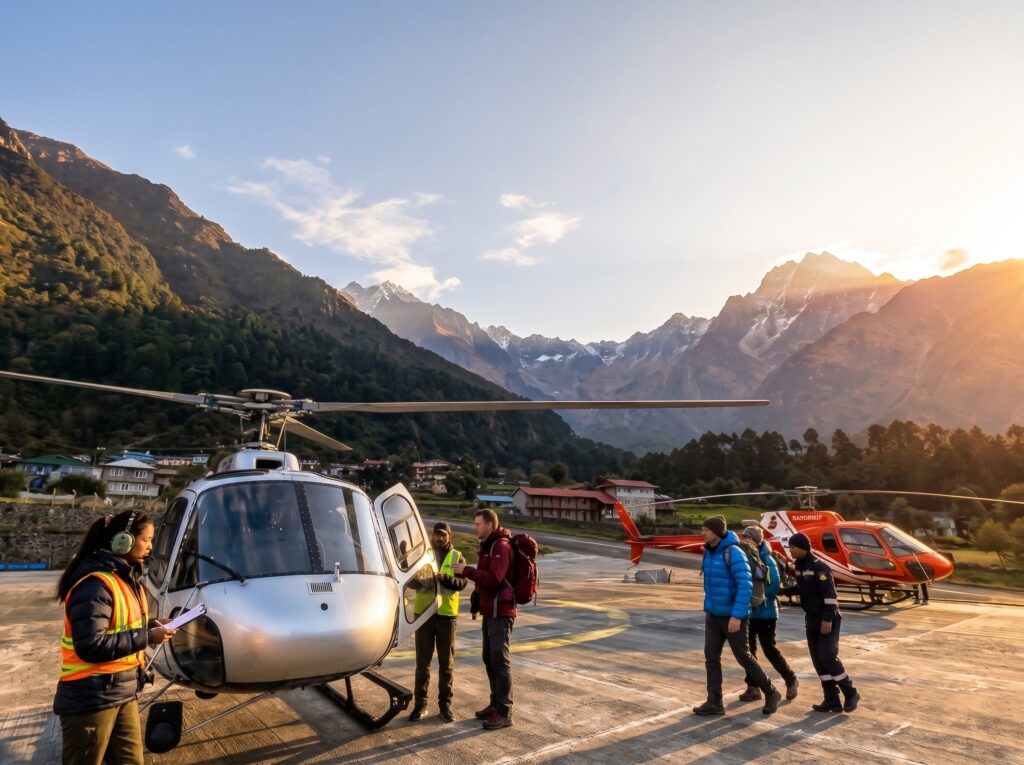
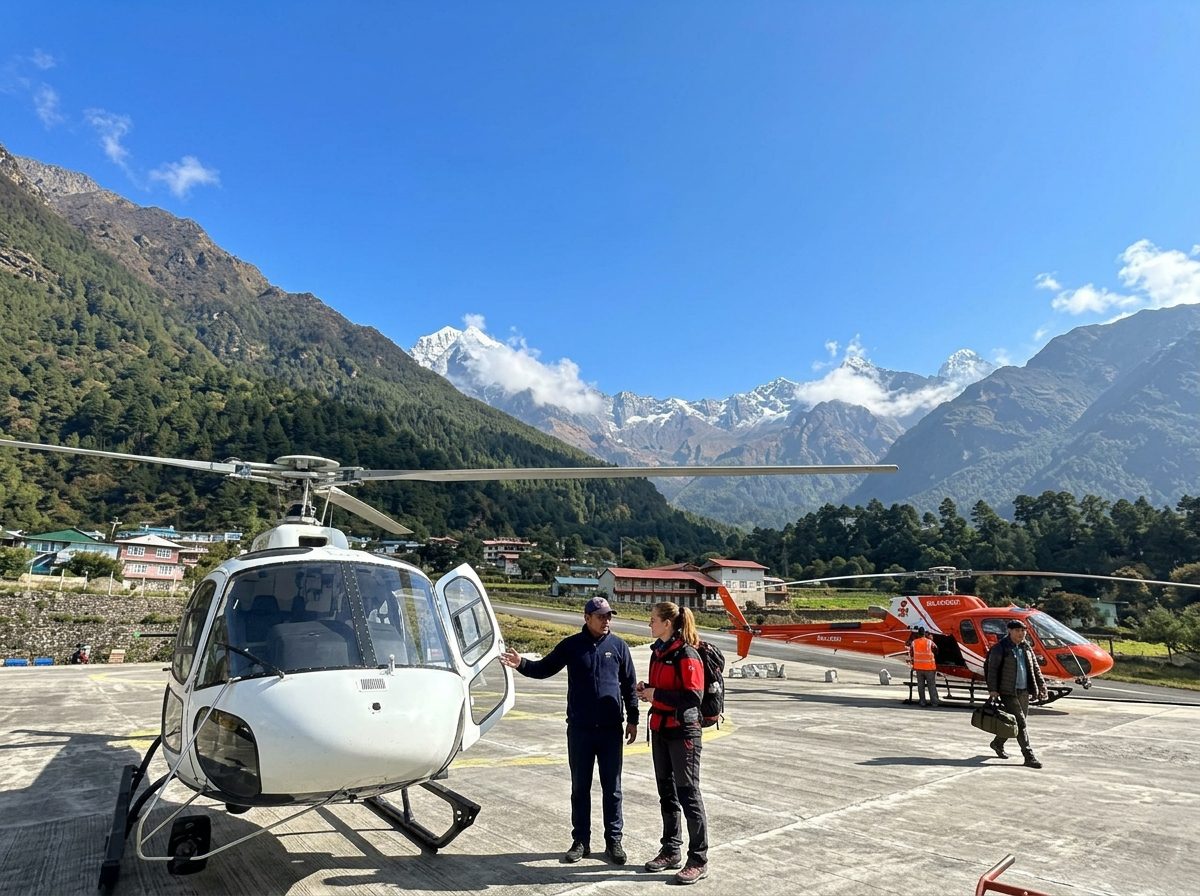
A helicopter doesn’t play by those rules. Helicopters land on a separate helipad adjacent to the terminal. They can approach from multiple angles, hover stationary in the air while the pilot assesses conditions, and fly away at any point if something doesn’t look right. There is no commitment to a narrow corridor, no minimum speed requirement, and no “point of no return.”
This approach flexibility is the primary reason why helicopter operations can sometimes continue when fixed-wing flights are grounded. If the cloud ceiling drops to a level where a Twin Otter pilot cannot see the runway threshold from the required distance, the flight is cancelled. A helicopter pilot, flying slower and lower, may still have enough visual reference to navigate the valley and set down safely on the helipad.
The Operational Record
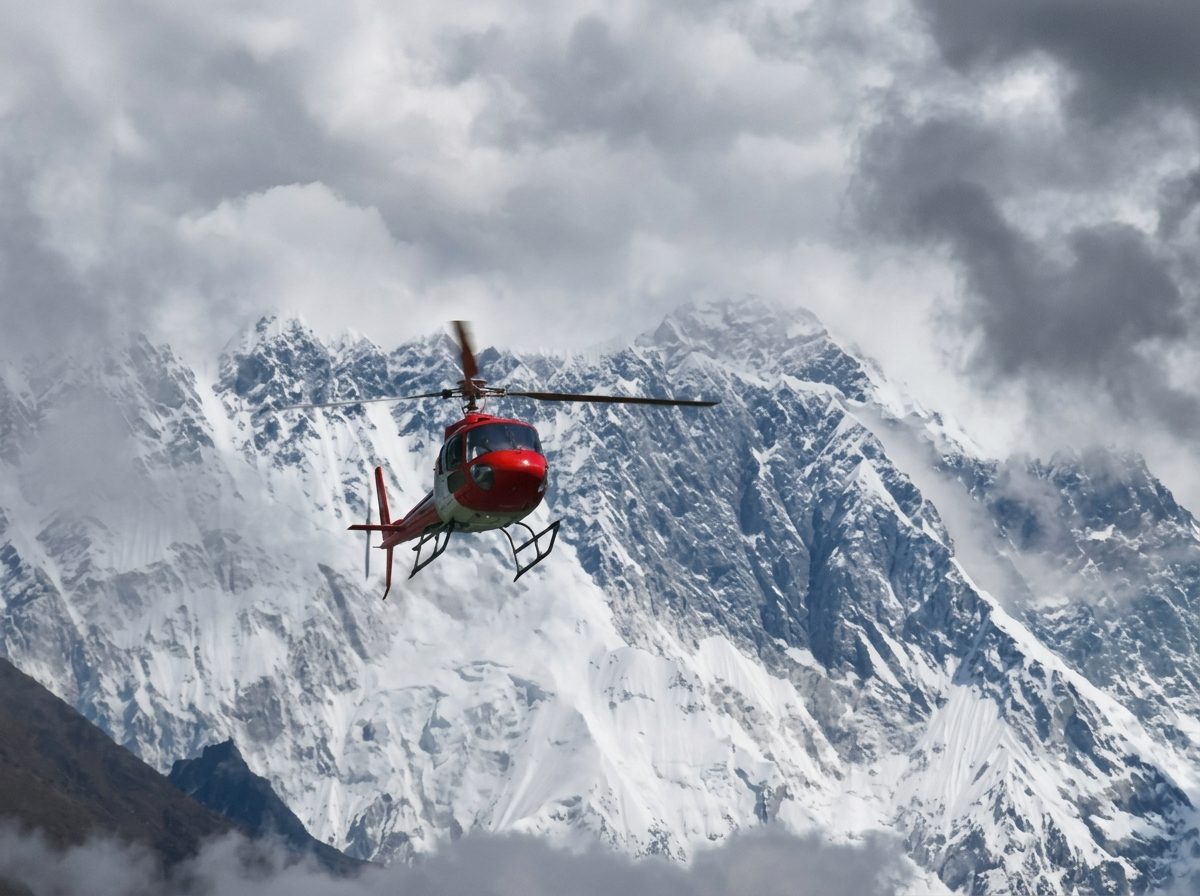
Commercial helicopter operators flying the Khumbu route use the Airbus AS350 (also called the H125). This is one of the most proven high-altitude helicopters in the world. It was specifically designed for mountain operations — thin air, high winds, short landing zones. The Nepali military, the Indian Air Force, and rescue services across the Alps, Rockies, and Andes all rely on this exact airframe.
The AS350’s operational ceiling is above 7,000 meters. Flying to Lukla at 2,846 meters is well within its comfortable performance envelope. The aircraft is not straining at its limits on this route.
The Schedule Flexibility
When you charter a helicopter, you are not locked into a rigid airline schedule. If the weather is marginal at 6:00 AM, the pilot can wait an hour for conditions to improve without losing your slot to another flight. Fixed-wing flights operate on a tight sequential schedule — if your 6:15 AM departure doesn’t happen, you go to the back of the queue behind dozens of other delayed flights.
The Case for Planes
The Statistical Argument
Despite Lukla’s terrifying reputation, the fixed-wing safety record on this route is overwhelmingly positive. Thousands of flights operate every single trekking season without incident. The pilots who fly Twin Otters and Dornier Do 228s into Lukla are among the most experienced short-runway operators in the world. Many of them have logged over 10,000 landings on this specific strip.
The aircraft themselves are built for exactly this kind of mission. The De Havilland DHC-6 Twin Otter has been flying into remote mountain strips since the 1960s. It was engineered for short takeoffs and landings on unpaved, high-altitude airfields. Lukla is extreme, but it is not beyond what the aircraft was designed to handle.
The Redundancy of Twin Engines
Both the Twin Otter and the Dornier Do 228 are twin-engine aircraft. If one engine fails during the approach or takeoff, the second engine provides enough power to maintain flight and execute an emergency procedure. The AS350 helicopter, by contrast, is a single-engine aircraft. While its engine reliability is exceptional and the aircraft can perform an autorotation (a controlled, unpowered descent) in the event of engine failure, the twin-engine redundancy of the fixed-wing planes is a legitimate structural safety advantage.
The Cost of Experience
Because fixed-wing Lukla flights are the default transport for the entire Everest trekking industry, the infrastructure around them is highly developed. CAAN enforces strict pilot certification requirements for the Lukla route. Pilots must complete a specific number of supervised flights before they are cleared to operate independently. The institutional knowledge base — how to read the valley weather, when to abort, where the turbulence pockets are — has been built over decades of daily operations.
The Direct Comparison
| Safety Factor | Fixed-Wing Plane | Helicopter |
| Landing Approach | Committed. One direction. No go-around. | Flexible. Can hover, abort, adjust. |
| Engine Configuration | Twin-engine (redundancy) | Single-engine (autorotation backup) |
| Weather Tolerance | Lower. Needs clear visual of full runway. | Higher. Can operate in lower ceilings. |
| Pilot Experience (Lukla) | Decades of institutional experience | Growing rapidly; fewer total flights logged |
| Turbulence Handling | Fixed wings ride through moderate turbulence | Helicopters feel turbulence more intensely |
| Passenger Capacity | 15–19 passengers | 5 passengers max |
| Accident History (Lukla) | Several incidents over decades | Very few recorded incidents |
| Overall Safety Rating | High | High (slight edge on approach flexibility) |
How High Does the Helicopter Fly? Do You Need Oxygen?
This question comes up constantly, and the answer is straightforward.
On the Kathmandu to Lukla route, a helicopter cruises at approximately 3,500 to 4,500 meters (11,500 to 14,800 feet) above sea level. The aircraft is pressurized by the simple fact that it flies with the doors sealed, but it is not a pressurized cabin in the way a commercial jet is. You are breathing ambient air at altitude.
At 4,500 meters, the air holds roughly 60% of the oxygen available at sea level. You will not feel this during a 45 to 60–minute flight. Your body doesn’t react to altitude in under an hour the way it does after sleeping at high elevation for days. You might feel a slight ear pressure change.
You might yawn more. But you will not experience altitude sickness, headaches, or breathing difficulty from the flight alone.
You do not need a supplemental oxygen tank for the Lukla helicopter flight.
Every commercial helicopter on this route does carry supplemental oxygen on board as a standard safety measure — but it is there for medical emergencies, not for routine passenger use. If a passenger has a severe pre-existing respiratory condition and reacts poorly to the brief altitude exposure, the pilot can administer oxygen immediately.
Local Tip: The altitude conversation becomes relevant if you are flying a helicopter beyond Lukla — for example, directly to Gorakshep (5,164m) or Kala Patthar (5,545m) on an Everest Base Camp helicopter tour. At those altitudes, supplemental oxygen is provided during the ground stop because you are standing in air with roughly 50% less oxygen than sea level. But for the standard Kathmandu-to-Lukla transfer? Your lungs won’t notice.
The Risks You Should Actually Worry About
Forget the dramatic YouTube videos of windy Lukla landings. The actual risks on this route are far more mundane and far more manageable.
- Weather Cancellations (Not Crashes) The number one risk is not that your plane crashes. It is that your plane doesn’t fly at all. During peak season, Lukla flights get cancelled for 2 to 3 consecutive days roughly once or twice per month. When this happens, hundreds of trekkers stack up at the airport waiting for the backlog to clear. Your carefully planned itinerary collapses. This is the real, statistically common problem — and it is solved by building buffer days into your schedule.
- Flying With an Unregulated Operator Nepal has a mix of highly professional airlines and operators that cut corners. The safety gap between the best and worst is significant. Always fly with CAAN-certified operators. If an agency offers you a suspiciously cheap helicopter charter, ask why. The discount usually comes from somewhere — deferred maintenance, an inexperienced pilot, or an aircraft that should have been grounded.
- Ignoring Weight Limits This applies specifically to helicopters. At Lukla’s altitude, helicopter performance is directly tied to payload. If passengers lie about their body weight or overload their luggage, the aircraft may not have enough lift margin to safely hover or abort a landing. When the operator asks for your weight, tell the truth. Your honesty is a safety input, not a personal question.
Why Choose a Helicopter Over a Plane?
If both options are safe, why would you pay more for a helicopter? Here is when it makes practical sense:
- Your fixed-wing flight has been cancelled for 2+ days. This is the most common reason. The helicopter becomes an extraction tool, not a luxury.
- You are in a group of 4–5 people. The per-person cost of a helicopter charter drops to within USD 100–200 of a fixed-wing ticket. At that point, the added flexibility is almost free.
- You are flying during marginal weather. If the forecast shows borderline conditions, a helicopter has a wider operational window than a plane.
- You want to depart from Kathmandu, not Ramechhap. During peak season, many fixed-wing flights shift to Ramechhap Airport — a brutal 4 to 5-hour night drive from Kathmandu. Helicopters always depart from Kathmandu.
- Early morning departures work best. If you can get on the first helicopter flight of the day — 6:00 to 6:30 AM — you are flying in the calmest, clearest conditions. The earlier you fly, the smoother the ride.
Frequently Asked Questions
Has a helicopter ever crashed on the Lukla route?
There have been very few helicopter incidents on the standard Kathmandu-to-Lukla transfer route. The vast majority of helicopter accidents in Nepal’s mountain aviation have occurred during high-altitude rescue missions or flights to remote, unprepared landing zones — not on the established Lukla corridor.
Can a helicopter fly to Lukla in the monsoon?
It can, but operations are severely limited. During the monsoon (June to August), the valleys fill with thick, persistent cloud cover. Even helicopters need some visual reference to navigate safely. Monsoon flights are possible on days with temporary weather breaks, but cancellation rates are extremely high.
Should nervous flyers choose the helicopter or the plane?
Counterintuitively, most nervous flyers feel better in the plane. The Twin Otter feels more like a conventional aircraft — you are seated in rows, there is a defined aisle, and the flight feels familiar. Helicopters are louder, vibrate more, and the bubble windshield gives you an uncomfortably clear view of the terrain rushing past beneath your feet. If your fear is about the landing specifically, the helicopter is objectively less dramatic — a gentle hover and set-down versus the aggressive, committed runway approach.
The Bottom Line
Stop asking which aircraft is safer. Start asking which operator is safer.
Both helicopter and plane flights to Lukla are well within acceptable safety margins when operated by certified, experienced crews in appropriate weather. The helicopter offers more flexibility. The plane offers more redundancy. Neither is going to kill you if you fly with a reputable operator and don’t force a departure in bad weather.
The real safety decision you make is not at the airport. It is weeks before your trip, when you choose which agency to trust with your logistics. Fly with operators who cancel flights when conditions are marginal — not the ones who push departures to keep their schedule on track. If you need help identifying vetted, safety-first operators for your Lukla transfer, check our [Everest Region Trek Packages] and we will match you with the right team.
Comments (0)
Write a comment- The Case for Helicopters
- The Approach Advantage
- The Operational Record
- The Schedule Flexibility
- The Case for Planes
- The Statistical Argument
- The Redundancy of Twin Engines
- The Cost of Experience
- The Direct Comparison
- How High Does the Helicopter Fly? Do You Need Oxygen?
- The Risks You Should Actually Worry About
- Why Choose a Helicopter Over a Plane?
- Frequently Asked Questions
- The Bottom Line
Read the latest Blogs & Insights
Explore our collection of articles and insights to gain in-depth travel knowledge, expert advice, and stay updated on the latest trends and tips.



No comments yet.