









Kathmandu to Lukla Helicopter Ride: Real Costs, Prices, and How It Actually Works (2026/2027)
Discover the real Kathmandu to Lukla helicopter ride cost for 2026/2027, including shared flights, private charters, ticket prices, flight duration, booking procedures, and what to expect on this scenic journey to the Everest region.
-
 Adventure Master Trek
-
12 November, 2026
-
11 mins read
-
3 Views
-
0 Comments


Every spring and autumn, the domestic terminal at Kathmandu’s Tribhuvan International Airport turns into a pressure cooker.
A wall of cloud rolls in over the Lamjura Pass, the radar screens turn red, and the announcement horn crackles: All fixed-wing flights to Lukla are suspended.
Within twelve seconds, ninety trekkers with heavy duffel bags pull out their phones and swarm the nearest ticket counters. They all want the exact same thing: a helicopter seat to Lukla before their entire two-week Everest Base Camp itinerary collapses.
I’ve managed those emergency transfers for over a decade. Some people pay fair market rates; others panic and hand over $750 in cash to predatory middlemen lurking near the baggage scanners.
If you are planning an Everest region trek, understanding how helicopter flights to Lukla operate — what they cost, how pricing shifts during bad weather, and whether you should book shared or private — is the single most valuable piece of logistics advice you will get. Here is the honest breakdown.
Kathmandu to Lukla Helicopter Cost — At a Glance (2026/2027)
| Flight Type | Average Price (USD) | Passenger Capacity | Baggage Allowance | Departure Point |
| Shared Seat (Group-Joining) | $450 – $600 per person | 4 to 5 passengers | 10–15 kg per person | Kathmandu (TIA Domestic) |
| Private Charter | $2,500 – $3,200 per flight | Up to 5 passengers (max 400–450kg total payload) | Up to 80–100 kg combined | Kathmandu (TIA Domestic) |
| Shared from Ramechhap (Manthali) | $300 – $400 per person | 4 to 5 passengers | 10–15 kg per person | Manthali Airport |
| Lukla to Kathmandu (Return Shared) | $400 – $550 per person | 4 to 5 passengers | 10–15 kg per person | Tenzing-Hillary Airport |
| Regular Plane Ticket (Fixed-Wing) | $217 per person (Foreigners) | 14 to 18 passengers | 15 kg strictly checked | Usually diverted to Ramechhap |
Shared vs. Private Helicopter to Lukla: Which Should You Book?
Choosing between a group-joining shared flight and a private charter comes down to party size, budget, and how much schedule control you need.
| Group Size / Traveler Profile | Recommended Option | Estimated Cost | Why It Makes Sense |
| 1 to 3 Trekkers (Solo or couples) | Shared Helicopter Seat | $450 – $600 per person | Lowest out-of-pocket cost; your agency pairs you with other travelers |
| 4 to 5 Trekkers (Friends or families) | Private Charter | $2,500 – 3,000total(~500–$600/person) | Same per-person cost as shared, but with instant departure and private cabin |
| Tight International Connection | Private Charter | $2,500 – $3,200 total | Priority flight clearance the second mountain weather opens up |
| Flexible Schedule & Budget-Minded | Shared Helicopter Seat | $450 – $600 per person | Best balance of speed and price if you don’t mind waiting for a full manifest |
Option 1: Shared Helicopter Seat ($450 – $600 per person)
A shared seat is the default choice for solo trekkers, couples, and small groups of three.
Your trekking agency or helicopter broker groups you with other independent travelers until the aircraft reaches its operational payload (typically 4 or 5 passengers).
- The Advantage: You pay roughly one-fifth of the charter cost while skipping the overland detour to Ramechhap.
- The Trade-off: Departure times are fluid. You might be told your flight leaves at 7:00 AM, but if one passenger is late or the agency is still waiting to fill the 5th seat, you sit in the domestic lounge until the manifest is complete.
- When rates hit $600+: When regular Twin Otter planes have been grounded for two or three consecutive days due to cloud cover, thousands of stranded trekkers compete for limited helicopter slots. During those weather logjams, shared seat prices jump toward the $600–$700 marks due to supply and demand.
Option 2: Private Helicopter Charter ($2,500 – $3,200 per flight)
A private charter means you rent the entire aircraft and crew for a dedicated flight slot.
- The Math for Groups: If you are a party of four or five friends, booking a private charter is a no-brainer. At $2,600 total split five ways, you are paying $520 per person — roughly the exact same price as a shared seat, but with zero waiting for strangers and complete flexibility on departure timing.
- Direct Clearance: Private charters get priority handling when weather windows crack open over the mountains. The pilot launches as soon as air traffic control gives clearance.
- VIP Flexibility: If your international flight lands in Kathmandu at 6:30 AM, a pre-arranged private charter can pick you up from immigration, transfer you directly to the domestic apron, and have you sipping butter tea in Lukla by 9:30 AM.
Why Pay for a Helicopter Instead of a Regular Plane?
A standard Twin Otter or Dornier plane ticket from Kathmandu/Ramechhap to Lukla costs roughly $217 one-way for foreign passport holders. A shared helicopter costs more than double.
So why do thousands of trekkers willingly pay the difference every season?
There are two major reasons:
1. The “Ramechhap Diversion” Reality
To relieve heavy runway congestion at Kathmandu’s international airport during peak trekking months (October, November, March, April, and May), the Civil Aviation Authority of Nepal (CAAN) redirects almost all commercial fixed-wing flights to Manthali Airport in Ramechhap.
Here is what taking a regular plane to Lukla actually looks like during peak season:
- Your alarm rings at 1:00 AM in your Kathmandu hotel.
- You load into a shared minivan for a bone-rattling 4.5 to 5-hour drive across 135 kilometers of winding, unpaved mountain roads through the BP Highway and Tamakoshi valley.
- You arrive at the tiny, crowded Manthali airstrip around 6:00 AM covered in dust.
- You wait in a crowded shed hoping the mountain weather holds so your 20-minute flight can take off.
Helicopters, by contrast, are permitted to take off directly from Kathmandu’s domestic terminal year-round.
You wake up at 6:00 AM in your comfortable Thamel hotel, take a 20-minute taxi to Tribhuvan International Airport, board your chopper, and land at Lukla 42 minutes later. For anyone with tight vacation time or back problems, avoiding that midnight Ramechhap drive is worth every single dollar.
2. Weather Resilience and Flying Capabilities
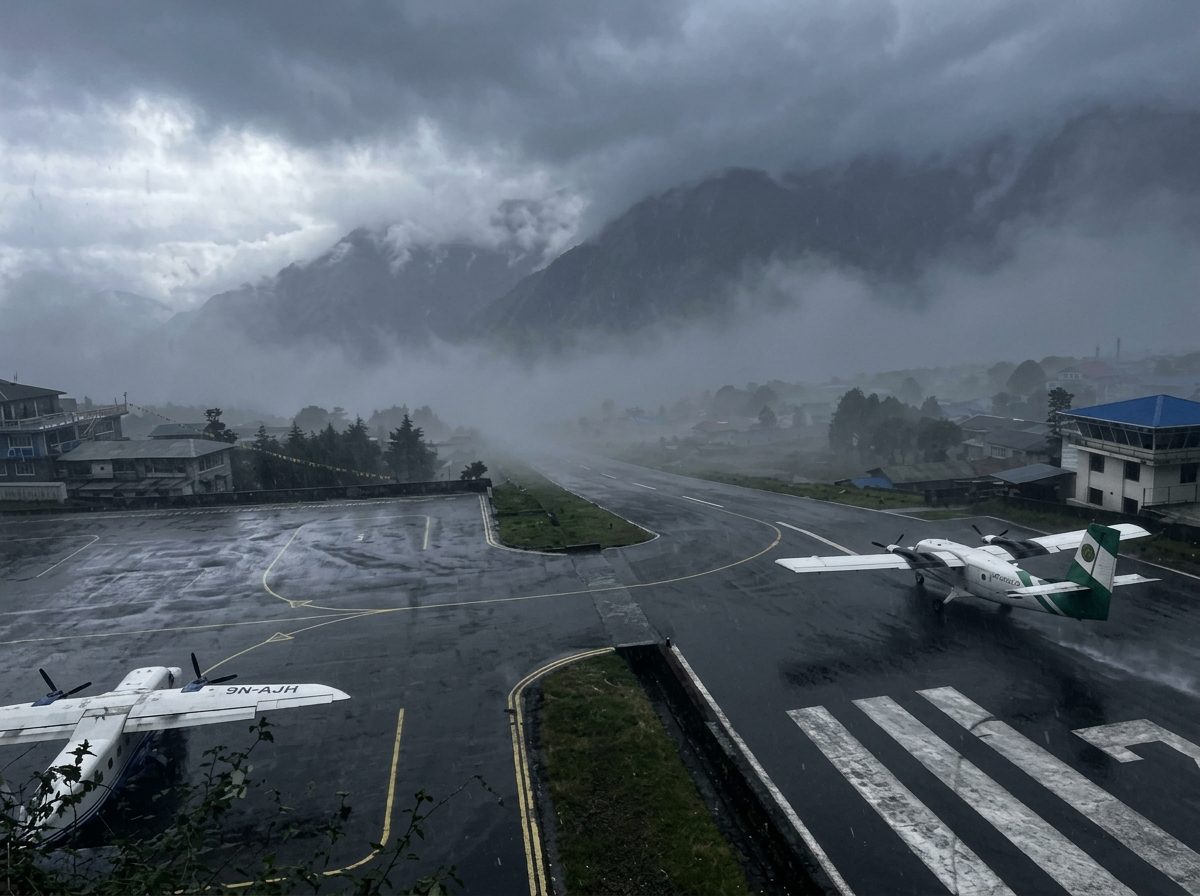
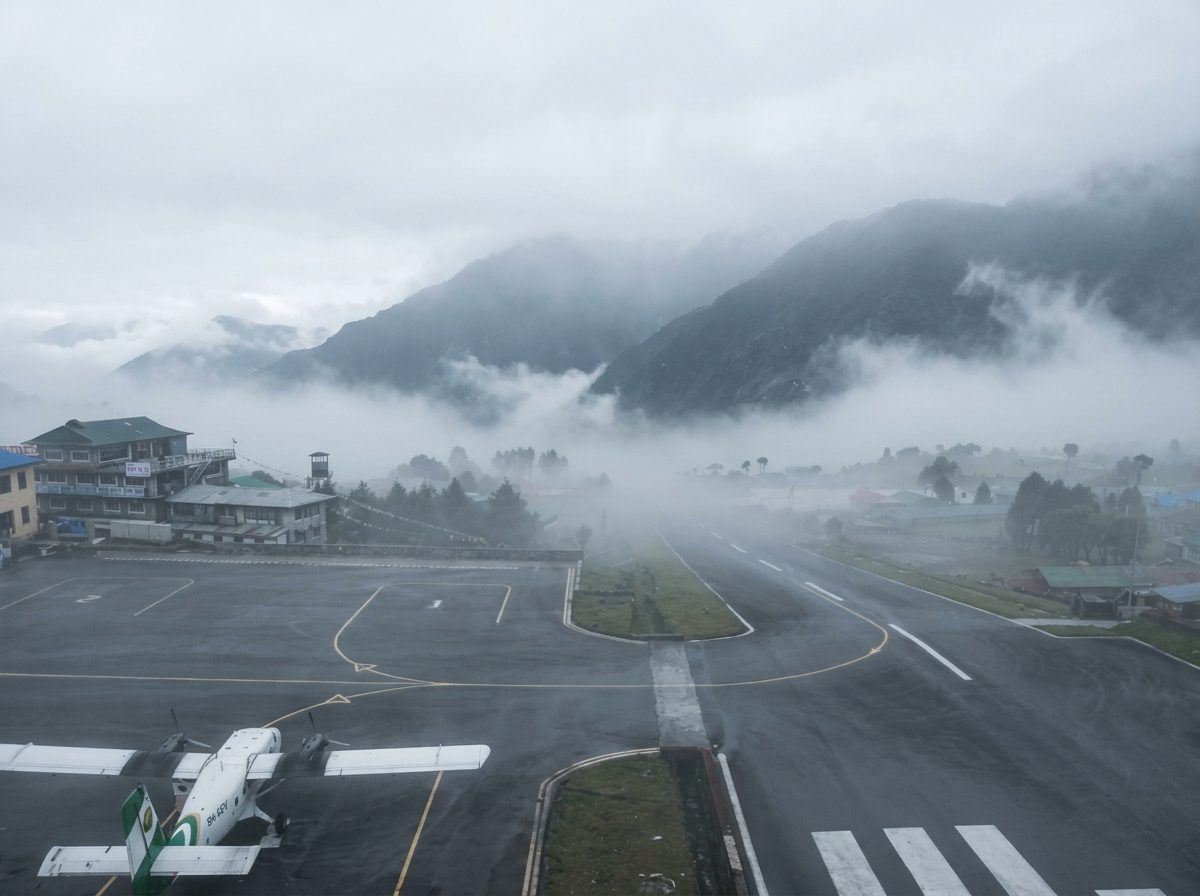
Fixed-wing propeller planes require strict visual flight rules (VFR) with clear line-of-sight minimums along the entire flight corridor and over the Lukla runway. If there is a stubborn cloud sitting over the ridge at Chaurikharka, planes cannot land.
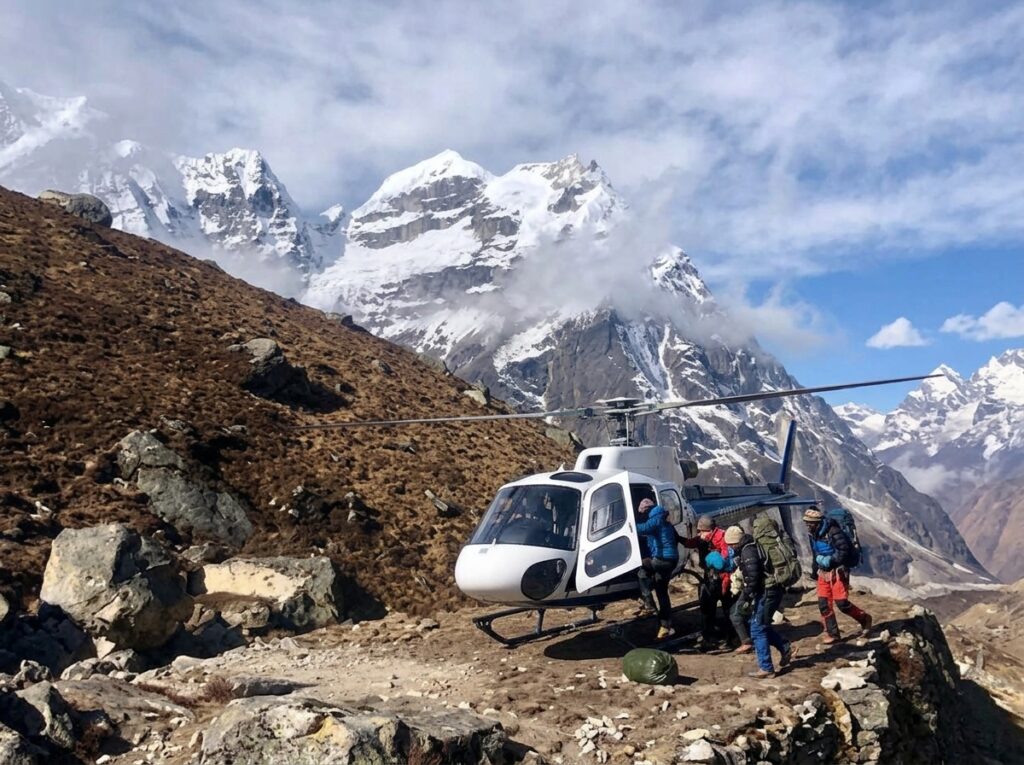
Helicopters fly lower, navigate through tight river gorges (following the Dudh Koshi valley floor below cloud ceilings), and can land on tiny helipads even when the main tarmac runway is officially closed to fixed-wing aircraft. When planes are grounded for two straight days, helicopters often continue operating throughout the morning hours.
The Physics of Helicopter Flights: Payload and Weight Limits
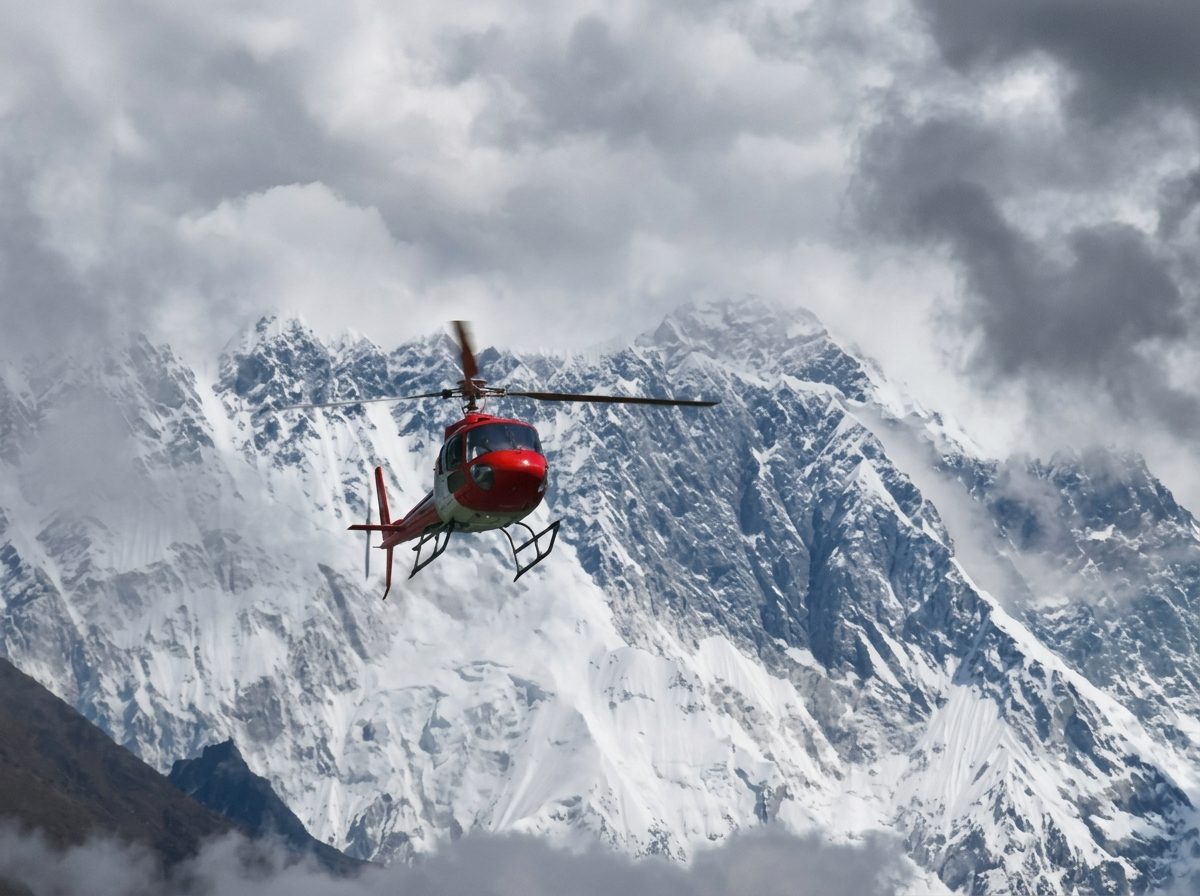
High-altitude helicopter operations in Nepal rely almost exclusively on the Airbus H125 (formerly the Eurocopter AS350 B3e). It is one of the few production helicopters on Earth capable of landing at extreme altitudes — it holds the world record for landing on the summit of Mount Everest.
However, hot air and high altitude create thin air (low density altitude), which dramatically reduces the helicopter’s aerodynamic lift.
| Location & Elevation | Air Density Level | Maximum Usable Payload | Operational Reality |
| Kathmandu (1,400m) | Moderate density | ~1,000 kg | Helicopter easily lifts pilot, 5 passengers, full baggage, and full fuel |
| Lukla Airport (2,845m) | Thin mountain air | ~400–450 kg | Pilot + 4–5 passengers max + strictly 10–15 kg bags each; fuel is strictly calculated |
Here is how that affects your flight and your wallet:
- Passenger Weight Check: Before boarding, every single passenger and their daypack is placed on an industrial scale at the domestic gate.
- Maximum Combined Payload: At Lukla’s altitude (2,845 meters / 9,334 feet), the safe landing payload for an H125 is capped between 400 kg and 450 kg (including passengers and all luggage).
- Luggage Allowance: Standard baggage allowance on a shared helicopter is strictly 10 to 15 kg (22 to 33 lbs) per person. If your duffel bag weighs 25 kg, you will either be forced to leave gear behind in Kathmandu or pay an excess baggage penalty ($5 to $10 per kg) — assuming the aircraft has payload to spare.
- Weight Redistribution: If a group consists of four very heavy passengers (over 90 kg each), the pilot cannot legally take a fifth passenger or full fuel. Respect the pilot’s decision when they adjust passenger manifests; high-altitude aerodynamics do not forgive ego or bad math.
Step-by-Step: What to Expect on Flight Day
If you have never flown in a high-altitude helicopter in Nepal, here is the exact chronological sequence of how departure morning unfolds:
- Airport Arrival (05:45 AM – 06:15 AM): Arrive at Kathmandu Airport’s Domestic Terminal. Pass through the primary security gate (battery packs and pocket knives must be declared).
- Weigh-In and Manifest Verification (06:30 AM): Present your passport to your agency representative or helicopter counter. Step on the floor scale with your backpack. Your boarding slip will show your seat cluster and assigned tail number (e.g., 9N-ANA).
- Apron Transfer (07:00 AM): A shuttle bus drives you across the tarmac past parked ATR-72s to the dedicated helicopter stands along the southern apron.
- Safety Briefing: Ground crew will instruct you: Never approach the tail rotor under any circumstance. Always enter and exit the aircraft from the downhill side in the pilot’s direct line of sight. Duck low when walking under the spinning main rotor.
- The Flight (40 to 45 Minutes): You lift off over Kathmandu’s brick valley, bank east over the Nagarkot ridge, and follow the Sun Koshi and Dudh Koshi river valleys. On a clear morning, the Langtang, Rolwaling, and Everest ranges form a jagged white wall along your left window.
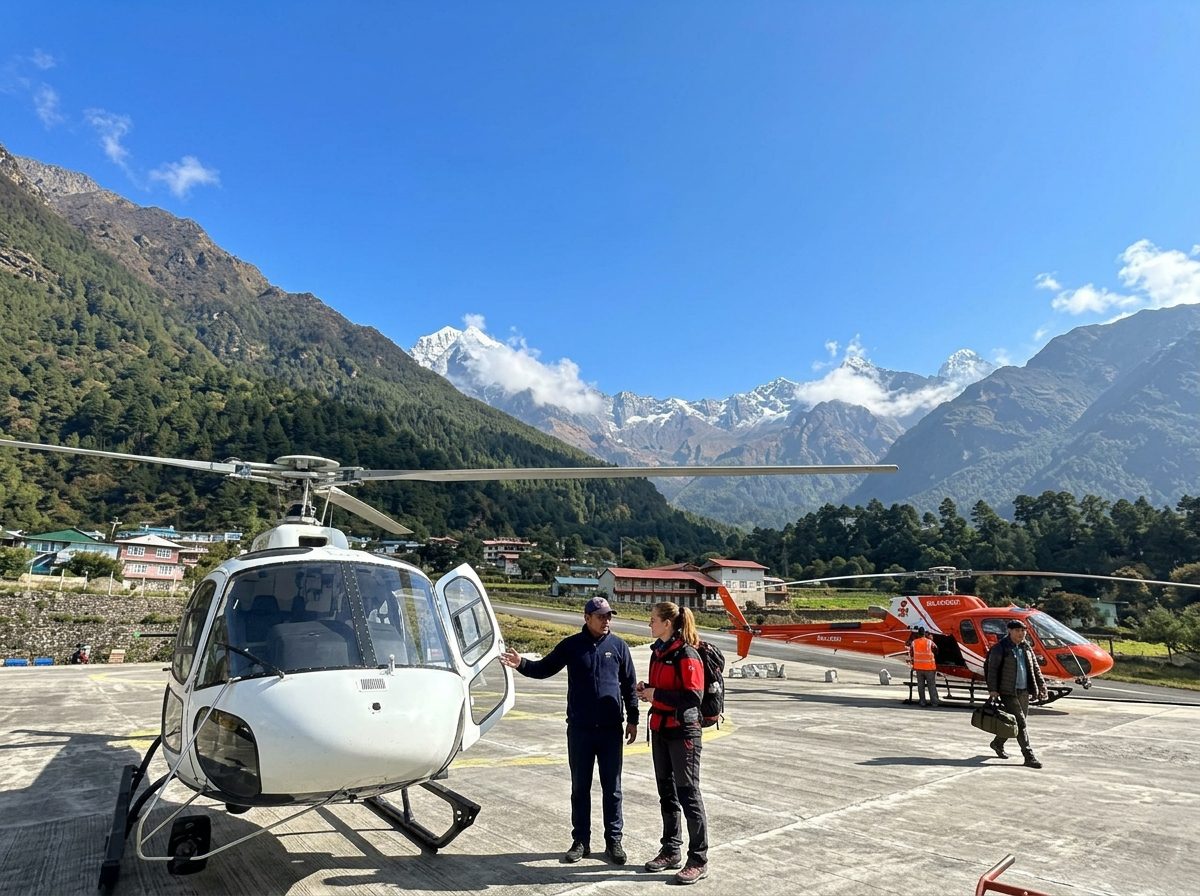
- Landing at Lukla (2,845m): The helicopter dips sharply into the Dudh Koshi gorge and touches down on the sloped asphalt helipad just below the main runway. You step out into crisp, sub-zero pine-scented air. Your Everest trek has officially begun.
4 Costly Mistakes Trekkers Make With Lukla Helicopters
Over the years, we have seen trekkers lose thousands of dollars on poorly planned helicopter logistics. Avoid these four common traps:
1. Booking with Unofficial Airport “Touts”
When flights get cancelled, men wearing fake agency lanyards wander the terminal offering “guaranteed helicopter seats in 30 minutes” for $600 cash. Half of them do not hold confirmed slots; they take your money and try to barter with registered operators. Always book directly through a licensed trekking agency or directly at an authorized operator counter (such as Air Dynasty, Simrik Air, Prabhu Heli, Altitude Air, or Kailash Heli).
2. Not Checking Travel Insurance Helicopter Clauses
Most travel insurance policies cover helicopter evacuation for medical emergencies (acute mountain sickness). Almost none cover helicopter flights booked due to weather delays or commercial flight cancellations. You will pay for this flight out-of-pocket. Ensure you have access to credit cards or cash reserves (500–600) before heading to the airport.
3. Forgetting the Return Flight Bottleneck
Getting to Lukla is only half the battle. If an autumn storm traps hundreds of returning trekkers in Lukla at the end of their trek, helicopter prices for the Lukla-to-Kathmandu leg can spike dramatically. If you have an unmovable international flight home from Kathmandu, book a flexible buffer day at the end of your itinerary.
4. Overpacking Your Duffel Bag
If you bring a 25-kilogram duffel bag designed for a four-week mountaineering expedition, you will cause a logistical headache on a 5-passenger helicopter. Pack light. Keep your trek essentials to 12–14 kg, and leave your city clothes, extra laptops, and hard suitcases in free storage at your Kathmandu hotel.
Frequently Asked Questions
How much does a helicopter ride from Kathmandu to Lukla cost?
A shared helicopter seat from Kathmandu to Lukla costs between $450 and $600 per person one-way in 2026 and 2027. A private helicopter charter costs $2,500 to $3,200 total, seating up to five passengers depending on total body and luggage weight. Prices fluctuate based on season, demand, and weather delays.
How long does the helicopter flight take from Kathmandu to Lukla?
The direct helicopter flight from Kathmandu (Tribhuvan International Airport) to Lukla (Tenzing-Hillary Airport) takes 40 to 45 minutes. This is significantly faster than taking a regular plane during peak season, which requires a 5-hour drive to Ramechhap followed by a 20-minute flight.
Does the helicopter fly directly from Kathmandu to Lukla?
Yes. While commercial fixed-wing planes are frequently redirected to fly out of Ramechhap (Manthali Airport) during peak trekking months, helicopters are permitted to take off directly from Kathmandu’s domestic airport terminal year-round, weather permitting.
What is the baggage weight limit on a Lukla helicopter?
The standard baggage allowance on a shared helicopter to Lukla is 10 to 15 kg (22 to 33 lbs) per passenger. Due to high-altitude payload restrictions at Lukla (2,845m), total aircraft weight is strictly enforced. Excess luggage may incur fees or must be transported on a separate flight.
Can helicopters fly to Lukla when planes are cancelled?
Yes, in many cases. Helicopters operate under lower visual weather minimums than fixed-wing aircraft and can navigate beneath low cloud ceilings along river valleys. However, helicopters cannot fly through dense zero-visibility fog, severe thunderstorms, or extreme gale-force mountain winds.
What happens if my helicopter flight is cancelled due to weather?
If your flight is cancelled due to bad weather, registered operators will either reschedule you for the earliest weather window the following morning or issue a full refund minus a minimal administrative processing fee (typically 10–20). Always reconfirm cancellation terms with your agency prior to payment.
Need to arrange a reliable shared seat or private helicopter charter to Lukla without terminal chaos or inflated broker markups? Our flight desk at Adventure Master Treks coordinates daily morning charters with Nepal’s top aviation fleets. [Contact our Kathmandu operations team] for real-time seat availability and confirmed departure slots.
Comments (0)
Write a comment- Kathmandu to Lukla Helicopter Cost — At a Glance (2026/2027)
- Shared vs. Private Helicopter to Lukla: Which Should You Book?
- Option 1: Shared Helicopter Seat ($450 – $600 per person)
- Option 2: Private Helicopter Charter ($2,500 – $3,200 per flight)
- Why Pay for a Helicopter Instead of a Regular Plane?
- 1. The “Ramechhap Diversion” Reality
- 2. Weather Resilience and Flying Capabilities
- The Physics of Helicopter Flights: Payload and Weight Limits
- Step-by-Step: What to Expect on Flight Day
- 4 Costly Mistakes Trekkers Make With Lukla Helicopters
- 1. Booking with Unofficial Airport “Touts”
- 2. Not Checking Travel Insurance Helicopter Clauses
- 3. Forgetting the Return Flight Bottleneck
- 4. Overpacking Your Duffel Bag
- Frequently Asked Questions
- How much does a helicopter ride from Kathmandu to Lukla cost?
- How long does the helicopter flight take from Kathmandu to Lukla?
- Does the helicopter fly directly from Kathmandu to Lukla?
- What is the baggage weight limit on a Lukla helicopter?
- Can helicopters fly to Lukla when planes are cancelled?
- What happens if my helicopter flight is cancelled due to weather?
Read the latest Blogs & Insights
Explore our collection of articles and insights to gain in-depth travel knowledge, expert advice, and stay updated on the latest trends and tips.


No comments yet.