









Badal Danda vs High Camp: Where Should You Actually Sleep on the Mardi Himal Trek?
When planning the 5-day Mardi Himal trek, almost every commercial agency itinerary tells you to hike directly from Forest Camp or Low Camp straight up to High Camp (3,580m), sleep there, and wake up at 4:00 AM for the summit push to Mardi Base Camp. What those standard itineraries don’t tell you is that High […]
-
 Adventure Master Trek
-
27 November, 2026
-
11 mins read
-
1 Views
-
0 Comments


When planning the 5-day Mardi Himal trek, almost every commercial agency itinerary tells you to hike directly from Forest Camp or Low Camp straight up to High Camp (3,580m), sleep there, and wake up at 4:00 AM for the summit push to Mardi Base Camp.
What those standard itineraries don’t tell you is that High Camp sits on an exposed, razor-thin ridge where night temperatures routinely plunge below -10°C, rooms are uninsulated plywood boxes, water pipes freeze solid after dark, and the thin air causes many hikers to toss and turn with altitude headaches.
Meanwhile, just 370 vertical meters below sits Badal Danda (3,210m) — literally translated as “Cloud Ridge.”
Badal Danda offers warmer dining rooms, thicker air, significantly better 360-degree sunset panoramas above the cloud deck, and far less competition for beds during peak season.
So where should you actually book your room?
The immediate answer depends on a single trade-off: sleep quality and comfort versus the length of your morning sunrise hike.
If you want a short, 2-hour pre-dawn walk to the Upper Viewpoint, sleep at High Camp. But if you value deep sleep, warm rooms, and having sunset vistas over Annapurna South completely to yourself, sleep at Badal Danda.
Below is the honest guide’s breakdown of how the two camps compare across altitude, lodging conditions, sunrise timing, and trail safety.
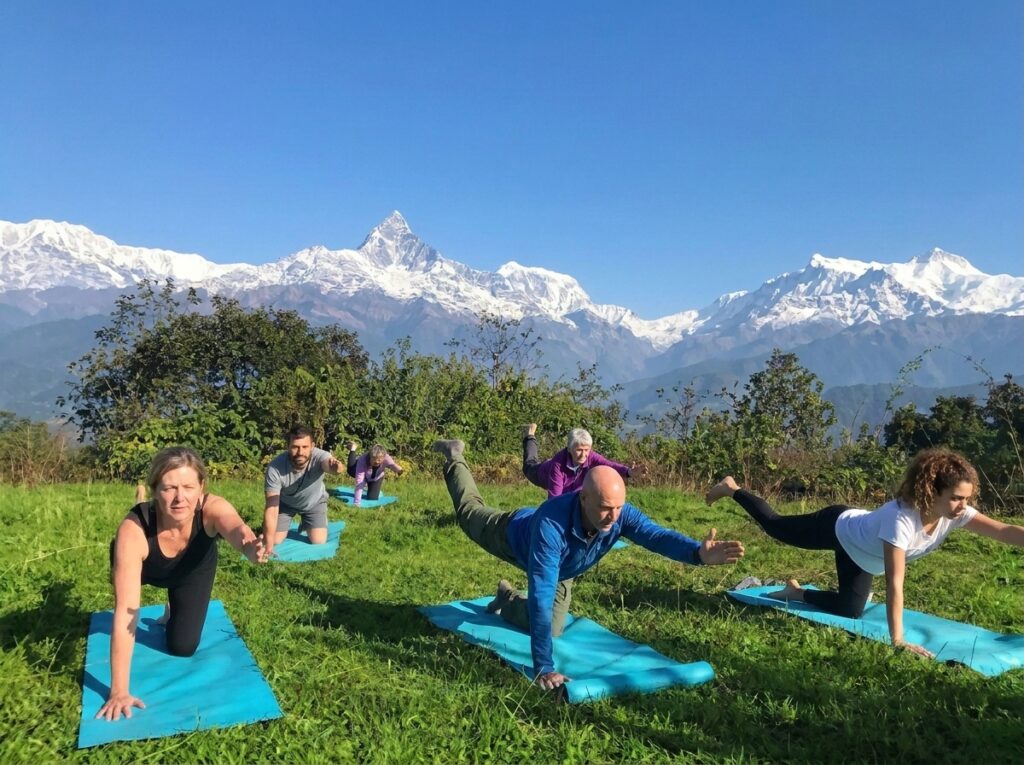
Badal Danda vs. High Camp at a Glance
| Factor | Badal Danda (Cloud Ridge) | High Camp | The Verdict |
| Elevation | 3,210 meters (10,531 ft) | 3,580 meters (11,745 ft) | Badal Danda is 370m lower — significantly less hypoxic strain. |
| Typical Night Temperatures (Oct/Nov) | 0°C to -4°C | -6°C to -12°C | Badal Danda is much warmer and less exposed to howling ridge gales. |
| Pre-Dawn Walk to Upper Viewpoint (4,200m) | 3.5 to 4 hours | 2 to 2.5 hours | High Camp saves 1.5 hours of walking in freezing darkness. |
| Pre-Dawn Walk to Mardi Base Camp (4,500m) | 5 to 5.5 hours | 3.5 to 4 hours | High Camp is much closer for hikers reaching the full 4,500m base camp. |
| Teahouse Space & Bed Availability | 2 to 3 spacious lodges; fewer crowds | 4 to 5 small lodges; severely crowded in peak season | Badal Danda is quieter; High Camp regularly overbooks in October. |
| Water Supply & Bathroom Realities | Flowing spring water; operational solar showers | Frozen pipes after dark; squat bucket toilets only | Badal Danda has far better plumbing and cleaner sanitation. |
| Sunset & Sunrise Panorama Quality | 360° unobstructed ridge view above the cloud inversion | Great views of Machhapuchhre, but blocked toward the south | Badal Danda has the superior sunset; High Camp has better morning proximity. |
1. The Altitude and Sleep Quality Reality
The difference between sleeping at 3,210 meters and 3,580 meters sounds minor on paper. In high-altitude physiology, those 370 vertical meters represent a major biological threshold.
Sleeping at High Camp (3,580m): The Restless Night
At 3,580 meters, your body is operating at roughly 67% of sea-level atmospheric oxygen.
- Many trekkers ascending quickly from Pokhara (820m) or Forest Camp (2,550m) experience Cheyne-Stokes breathing at High Camp — an irregular breathing pattern during sleep where your brain alternates between hyperventilation and brief breath-holding spells.
- You wake up repeatedly gasping for air, feeling dehydrated, and struggling with a throbbing frontal tension headache.
- Because temperatures inside the unheated plywood rooms drop well below freezing, getting out of your sleeping bag to walk down a freezing hallway to a shared squat toilet is an ordeal.
By 3:30 AM when your alarm rings for the sunrise hike, you are often already exhausted, groggy, and physically drained before you even put on your boots.
Sleeping at Badal Danda (3,210m): Deep Recovery
At 3,210 meters, oxygen saturation is noticeably higher, and the human body adapts far more smoothly.
- Trekkers almost universally report falling into a deeper, more restorative sleep at Badal Danda.
- Nighttime temperatures rarely drop below -3°C during peak autumn, meaning dining rooms stay warmer and bedrooms feel significantly less drafty.
- You wake up at 3:00 AM feeling genuinely rested, alert, and physiologically ready for a steep uphill climb.
If you are prone to mild altitude headaches, struggle to sleep in sub-zero cold, or have never slept above 3,000 meters before, staying at Badal Danda is the single best insurance policy against developing Acute Mountain Sickness (AMS) on the Mardi ridge.
2. The Sunrise Push: How Much Harder Is It from Badal Danda?
The primary argument for sleeping at High Camp is trail proximity: you are 370 meters closer to the viewpoints when the morning push begins.
Let’s look at the actual trail time and physical demands from each staging point:
The Morning Push from High Camp (3,580m)
- Wake-up time: 3:30 AM to 4:00 AM.
- Hike to Lower Viewpoint (3,800m): 45 minutes to 1 hour over a rocky, switchbacked trail.
- Hike to Upper Viewpoint (4,200m): 2 to 2.5 hours total moving time. You arrive just as the first golden rays illuminate the eastern face of Annapurna South and Machhapuchhre.
- Optional push to Mardi Base Camp (4,500m): Another 1.5 to 2 hours along the narrow ridge moraine.
Hikers who sleep at High Camp can comfortably reach the Upper Viewpoint for sunrise, walk to Base Camp, and be back at High Camp eating hot noodles by 10:30 AM.
The Morning Push from Badal Danda (3,210m)
- Wake-up time: 2:30 AM to 3:00 AM.
- Hike to High Camp (3,580m): 1 to 1.5 hours of steady uphill hiking in the dark along the open grassy ridge.
- Hike to Upper Viewpoint (4,200m): 3.5 to 4 hours total moving time from Badal Danda.
Starting from Badal Danda requires walking for an extra 90 minutes in the pitch-black cold. Your headlamp batteries need to be fresh, your gloves must be warm, and you will burn more energy before the sun even rises.
However, many hikers who sleep at Badal Danda choose a smarter alternative: instead of hiking all the way to 4,200 meters in the freezing dark, they hike 1.5 hours up to High Camp or the Lower Viewpoint (3,800m) for sunrise, enjoy the golden hour with hot tea, and continue upward only if their legs feel fresh.
3. The Sunset Experience: Why Badal Danda Wins
Most trekkers focus entirely on the sunrise. But on the Mardi Himal ridge, the sunset is often twice as dramatic.
Because Badal Danda sits at the exact elevation where afternoon valley cloud inversions settle, you are perched directly above a rolling sea of white clouds that fills both the Modi Khola valley on your left and the Mardi Khola valley on your right.
Between 5:00 PM and 5:45 PM in autumn, the sun sinks into the cloud deck to the southwest, lighting up the entire south face of Annapurna South, Hiunchuli, and the jagged knife-edge of Machhapuchhre in brilliant shades of pink, orange, and purple.
At High Camp, the mountain views are dramatic, but you are tucked tighter against the flank of the ridge, and the southern horizon is partially obscured. Furthermore, because High Camp is so cold by 5:00 PM, most hikers are forced to retreat inside the crowded dining room, missing the light show entirely. At Badal Danda, you can sit comfortably outside with a hot ginger tea and watch the sun set over the clouds.
4. Teahouses and Crowds: The Space Problem at High Camp
The geographic ridge at High Camp is narrow, rocky, and constrained. There are only four or five operating lodges, and they have very limited bed capacity.
During peak trekking windows (October to mid-November, and early April):
- High Camp lodges sell out weeks in advance to commercial tour agencies.
- Independent trekkers or small groups arriving after 2:00 PM without confirmed telephone reservations frequently find zero private rooms available.
- Lodge operators routinely pack late-arriving trekkers into communal dining halls on wooden benches, or cram three people into tiny twin rooms with foam pads on the floor.
- Because water must be hauled or piped from seasonal springs far below the ridge, water pressure dies in the afternoon, and pipes freeze by 7:00 PM. Hot showers at High Camp are essentially nonexistent during peak cold spells.
Badal Danda has larger lodge footprints, more spacious grounds, and fewer total overnight guests. Lodges like the Hotel Cloud View and surrounding teahouses have better insulated dining rooms, working solar hot water systems during daytime, and a noticeably calmer, more relaxed atmosphere.
The Strategy: How to Structure Your Itinerary
After guiding hundreds of clients up the Mardi ridge, here are the three tested strategies we recommend based on your hiking profile:
Option A: The Sunset & Deep Sleep Strategy (Stay at Badal Danda)
- Best for: Couples, photographers, beginners, anyone worried about altitude sickness, and hikers who prioritize a warm, quiet room.
- Day 3: Hike from Forest Camp or Low Camp to Badal Danda (3 to 4 hours). Check in by 1:00 PM. Spend the afternoon taking photos, watching the sunset above the clouds, and eating a warm dinner.
- Day 4: Wake up at 3:00 AM. Hike with headlamps to High Camp for tea, push to the Upper Viewpoint (4,200m) for sunrise, and descend back down to Low Camp or Siding to sleep.
Option B: The Base Camp Purist Strategy (Stay at High Camp)
- Best for: Strong hikers whose primary goal is touching the actual 4,500m Mardi Himal Base Camp sign and returning early.
- Day 3: Push all the way from Forest Camp through Badal Danda to High Camp (3,580m). Arrive before 2:00 PM to secure a bed. Rest, drink plenty of hot garlic soup, and sleep in your thermal layers.
- Day 4: Wake up at 4:00 AM. Hike 2 hours to Upper Viewpoint, push another 1.5 hours to Base Camp (4,500m), return to High Camp for lunch, and hike down to Siding.
Option C: The Hybrid Acclimatization Compromise
If you have an extra day in your schedule, do not choose between them — use both:
- Day 3: Sleep at Badal Danda (3,210m). Enjoy the sunset and sleep in thick air.
- Day 4: Wake up late, enjoy breakfast in the sunshine, and take a gentle 1.5-hour morning walk up to High Camp (3,580m). Spend the afternoon resting, acclimatizing, and drinking tea at High Camp.
- Day 5: Wake up at 4:00 AM at High Camp for a relaxed, short summit push to Base Camp, and descend to Siding.
Frequently Asked Questions
Can you see Machhapuchhre from Badal Danda?
Yes, you have an extraordinary, unobstructed view of Machhapuchhre (Fishtail) from Badal Danda. Because Badal Danda sits on an open ridge crest above the treeline, you have 360-degree panoramas of Machhapuchhre, Annapurna South, and Hiunchuli. High Camp is closer in linear distance, but Badal Danda provides a wider, more photogenic perspective.
How cold does it get at High Camp compared to Badal Danda?
High Camp is typically 4°C to 8°C colder than Badal Danda at night. During peak autumn (October and November), temperatures at High Camp drop between -6°C and -12°C, with strong winds sweeping over the exposed ridge. Badal Danda sits lower and more sheltered, with night temperatures rarely dropping below -2°C to -4°C.
Is there running water and electricity at High Camp?
Electricity at High Camp is solar-powered and limited; lodges charge small fees ($2 to $3 USD) to charge phones and power banks in the dining room. Running water is very basic. Because surface pipes freeze solid as soon as the sun sets, teahouses store water in plastic barrels indoors for bucket flushing. Hot showers are rarely functional at High Camp; take your hot shower lower down at Low Camp or Badal Danda.
Do I need to book High Camp teahouses in advance?
Yes, booking your lodge at High Camp in advance is strongly recommended if you trek during the peak autumn (October–November) or spring (April) seasons. Because the ridge has only four or five operating lodges with limited rooms, unreserved hikers regularly end up sleeping on dining room benches or floors during busy weekends.
Can you reach Mardi Base Camp if you sleep at Badal Danda?
Yes, you can reach Mardi Himal Base Camp (4,500m) starting from Badal Danda, but it requires an early 2:30 AM or 3:00 AM start and strong physical endurance. Total round-trip hiking time from Badal Danda to Base Camp and back down is approximately 8 to 10 hours. Hikers sleeping at Badal Danda who want a shorter day usually turn around at the Upper Viewpoint (4,200m).
Are there leeches between Badal Danda and High Camp?
No, there are zero leeches between Badal Danda and High Camp at any time of year. Leeches live only in damp subtropical forest below 2,800 meters. Badal Danda (3,210m) sits above the treeline in an open alpine grass zone where dry air and cold temperatures prevent leeches from surviving.
Which camp is better for preventing altitude sickness?
Badal Danda is vastly better for preventing altitude sickness. Sleeping at 3,210 meters allows your respiratory system to adapt much more smoothly than jumping directly to 3,580 meters at High Camp. Hikers sleeping at Badal Danda experience significantly fewer altitude headaches, better oxygen saturation, and far more restorative sleep.
Planning your Mardi Himal trek and want the perfect balance of mountain views, comfortable lodges, and safe acclimatization? When you book with us, our local guides pre-book the best rooms along the ridge, monitor your altitude health, and pace your sunrise push perfectly. Contact our team to plan your seamless Annapurna trek.
Comments (0)
Write a comment- Badal Danda vs. High Camp at a Glance
- 1. The Altitude and Sleep Quality Reality
- Sleeping at High Camp (3,580m): The Restless Night
- Sleeping at Badal Danda (3,210m): Deep Recovery
- 2. The Sunrise Push: How Much Harder Is It from Badal Danda?
- The Morning Push from High Camp (3,580m)
- The Morning Push from Badal Danda (3,210m)
- 3. The Sunset Experience: Why Badal Danda Wins
- 4. Teahouses and Crowds: The Space Problem at High Camp
- The Strategy: How to Structure Your Itinerary
- Option A: The Sunset & Deep Sleep Strategy (Stay at Badal Danda)
- Option B: The Base Camp Purist Strategy (Stay at High Camp)
- Option C: The Hybrid Acclimatization Compromise
- Frequently Asked Questions
- Can you see Machhapuchhre from Badal Danda?
- How cold does it get at High Camp compared to Badal Danda?
- Is there running water and electricity at High Camp?
- Do I need to book High Camp teahouses in advance?
- Can you reach Mardi Base Camp if you sleep at Badal Danda?
- Are there leeches between Badal Danda and High Camp?
- Which camp is better for preventing altitude sickness?
Read the latest Blogs & Insights
Explore our collection of articles and insights to gain in-depth travel knowledge, expert advice, and stay updated on the latest trends and tips.


No comments yet.