









Kathmandu to Lukla Flight Time & Schedule
Find out how long the Kathmandu to Lukla flight takes, when flights depart, and what to expect when flying to Lukla for your Everest Base Camp trek.
-
 Adventure Master Trek
-
6 November, 2026
-
10 mins read
-
6 Views
-
0 Comments


The Kathmandu to Lukla flight takes 30 to 35 minutes by fixed-wing plane and 45 to 60 minutes by helicopter. All flights depart in the early morning — typically between 6:00 AM and 10:00 AM — because afternoon weather in the Khumbu makes landing at Lukla too dangerous. You need to report to the airport 1.5 to 2 hours before your scheduled departure.
That is the clean, simple version. But if you have actually flown this route, you know there is nothing simple about it. The Kathmandu to Lukla flight is one of the most operationally complex short-haul routes in commercial aviation. Here is everything that happens between your 4:00 AM alarm and the moment your boots hit the tarmac at one of the world’s most notorious airports.
What the Flight Actually Looks Like
Most travel blogs describe the Lukla flight as “scenic.” That is technically accurate and wildly inadequate.
The Plane Route
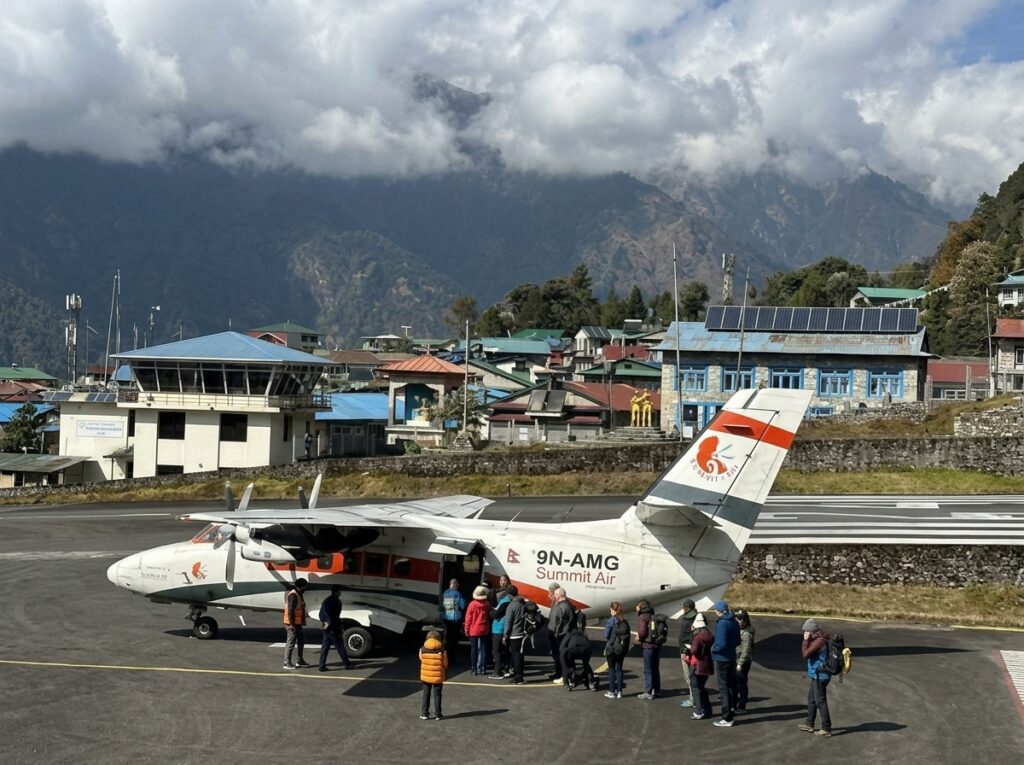
You take off from either Tribhuvan International Airport in Kathmandu or — during peak season — from Ramechhap Airport, a smaller strip about 4 to 5 hours east of the capital by road. The aircraft is small. A De Havilland Twin Otter or a Dornier Do 228. These hold 15 to 19 passengers. There is no beverage service. There is no overhead bin big enough for a real bag. You sit with your knees pressed against the seat in front of you.
Once airborne, the plane climbs northeast out of the Kathmandu Valley. Within 10 minutes, the green foothills give way to the first serious mountain ridges. On a clear day, the panorama from your window includes:
- The Langtang Range to the north
- Gaurishankar (7,134m) dead ahead
- The Rolwaling Himal stretching east
- The deep river valleys of the Solu-Khumbu district below
At roughly the 25-minute mark, the pilot begins the approach. The plane drops below the ridgeline, threads through a narrow river valley, and the runway appears directly ahead — short, uphill, and ending in a stone wall.
The Helicopter Route
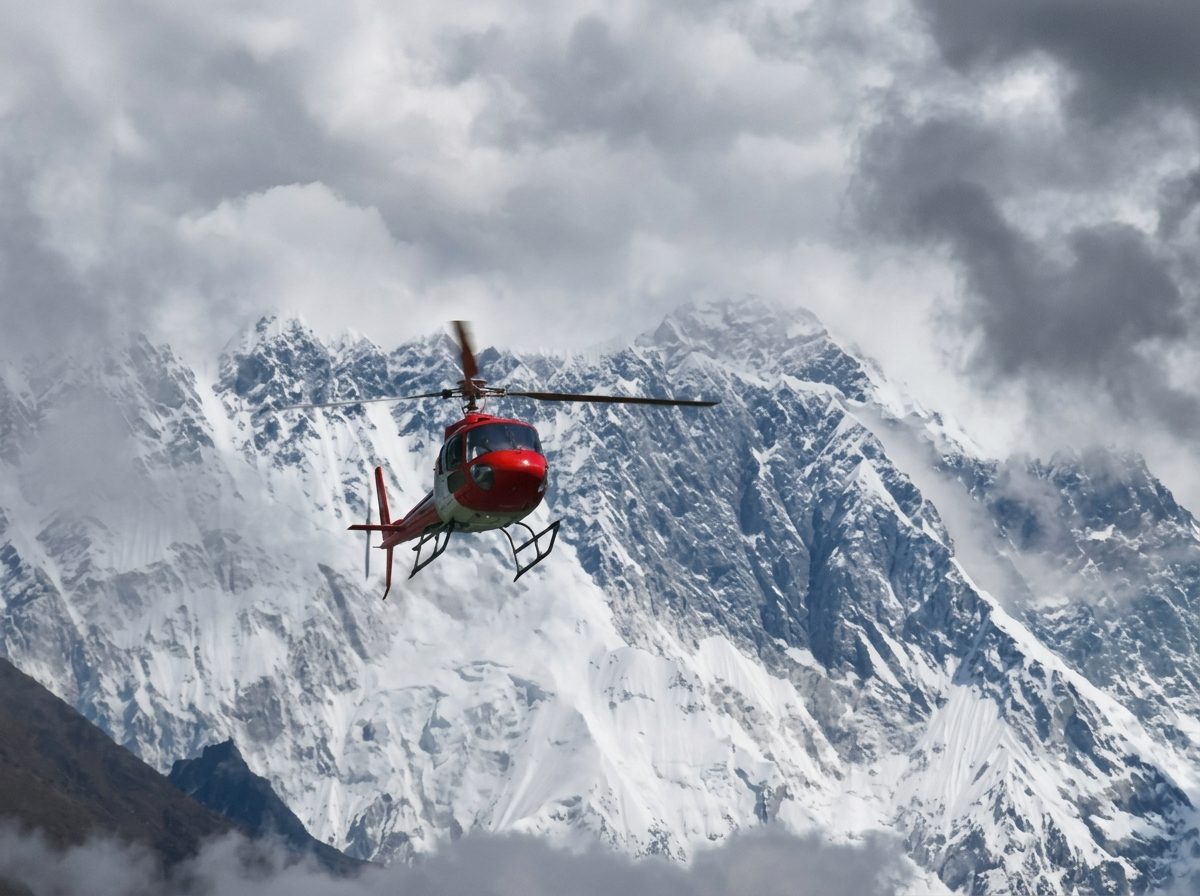
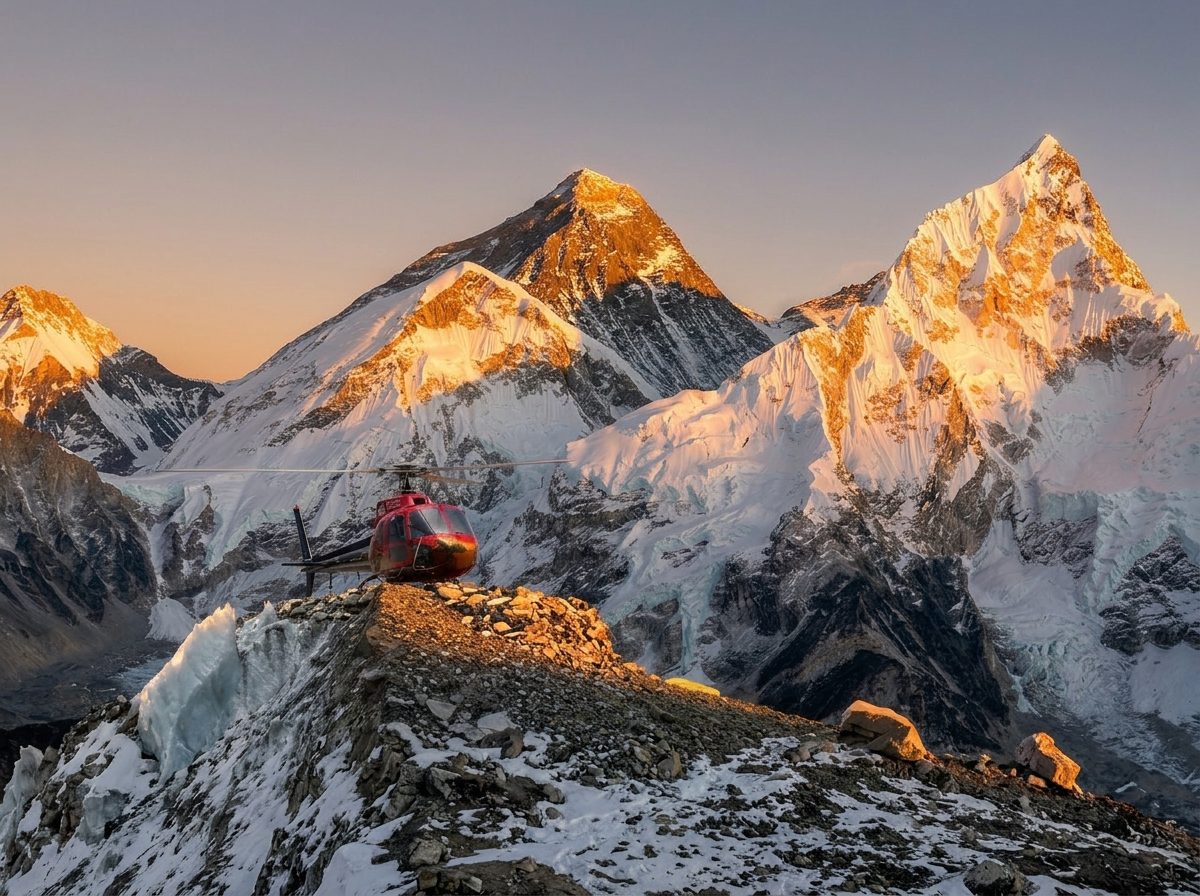
Helicopters take a slightly different, more direct line and fly at a lower altitude. The flight takes 45 to 60 minutes because helicopters cruise at roughly 220 km/h compared to a Twin Otter’s 280 km/h. The trade-off is that you get a significantly better view — the helicopter flies closer to the terrain, and there are no wings blocking your sightline.
Helicopters always depart from Kathmandu, never Ramechhap. That alone saves you the brutal 1:00 AM jeep ride.
The Departure Schedule
Every Lukla flight — plane or helicopter — operates on an early-morning schedule. This is not a preference. It is a hard operational requirement dictated by the mountain weather cycle.
| Detail | Fixed-Wing Plane | Helicopter |
| First Departure | 6:00 AM | 6:00 AM (flexible) |
| Main Window | 6:00 AM – 10:00 AM | 6:00 AM – 11:00 AM |
| Afternoon Flights | Almost never. Too dangerous. | Rare. Only in emergencies. |
| Departure Airport | Kathmandu or Ramechhap | Kathmandu (always) |
| Reporting Time | 1.5–2 hours before departure | 45 min–1 hour before departure |
| Flight Frequency (Peak) | 15–20 flights per morning | On-demand charter basis |
| Flight Frequency (Off-Peak) | 3–5 flights per morning | On-demand only |
Why No Afternoon Flights?
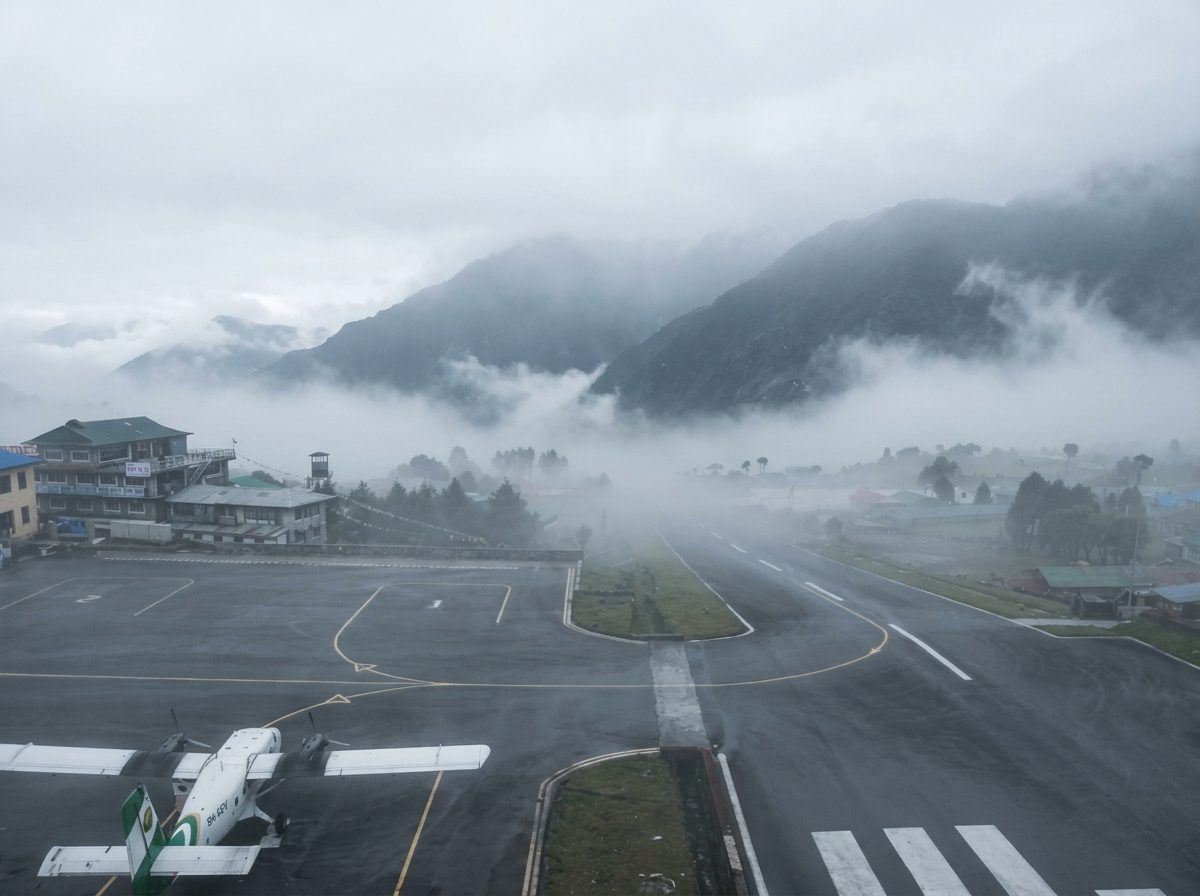
By 10:00 to 11:00 AM, the sun heats the valley floors surrounding Lukla. Warm air rises, generating thick cloud cover and unpredictable thermal winds in the narrow approach corridor.
The Lukla runway has no instrument landing system — pilots fly entirely by visual reference. If they cannot physically see the runway threshold from the approach valley, they turn around.
This is why every single trekker heading to Everest wakes up in the dark. The calm, clear window between sunrise and mid-morning is the only reliable opportunity to land.
Airport Tax and Reporting
Reporting Time
For fixed-wing flights, you need to be at the airport counter 1.5 to 2 hours before your scheduled departure. This sounds excessive for a 30-minute flight, but the Lukla check-in process involves manual bag weighing, security screening, and a boarding manifest that the airline physically hands to the pilot. It is not a digital system. If you show up 45 minutes before departure, you will miss your flight and lose your seat to the next person on the standby list.
For helicopter charters, reporting is faster — 45 minutes to 1 hour before departure. Because you have already provided passenger weights and passport details during booking, the ground handling is simpler.
Airport Tax
Nepal’s domestic airport departure tax is built into your ticket price for fixed-wing flights. You do not pay anything extra at the counter. For helicopter charters, airport handling fees are similarly bundled into the quoted charter price by the operator. There is no surprise fee at the gate.
Local Tip: If you are departing from Ramechhap, arrive at the airport even earlier than the 2-hour guideline. Ramechhap is a tiny, chaotic airstrip with no waiting lounge, no café, and a single check-in desk processing hundreds of anxious trekkers. Getting there early secures your place in line.
Lukla Airport: The Runway That Terrifies Pilots
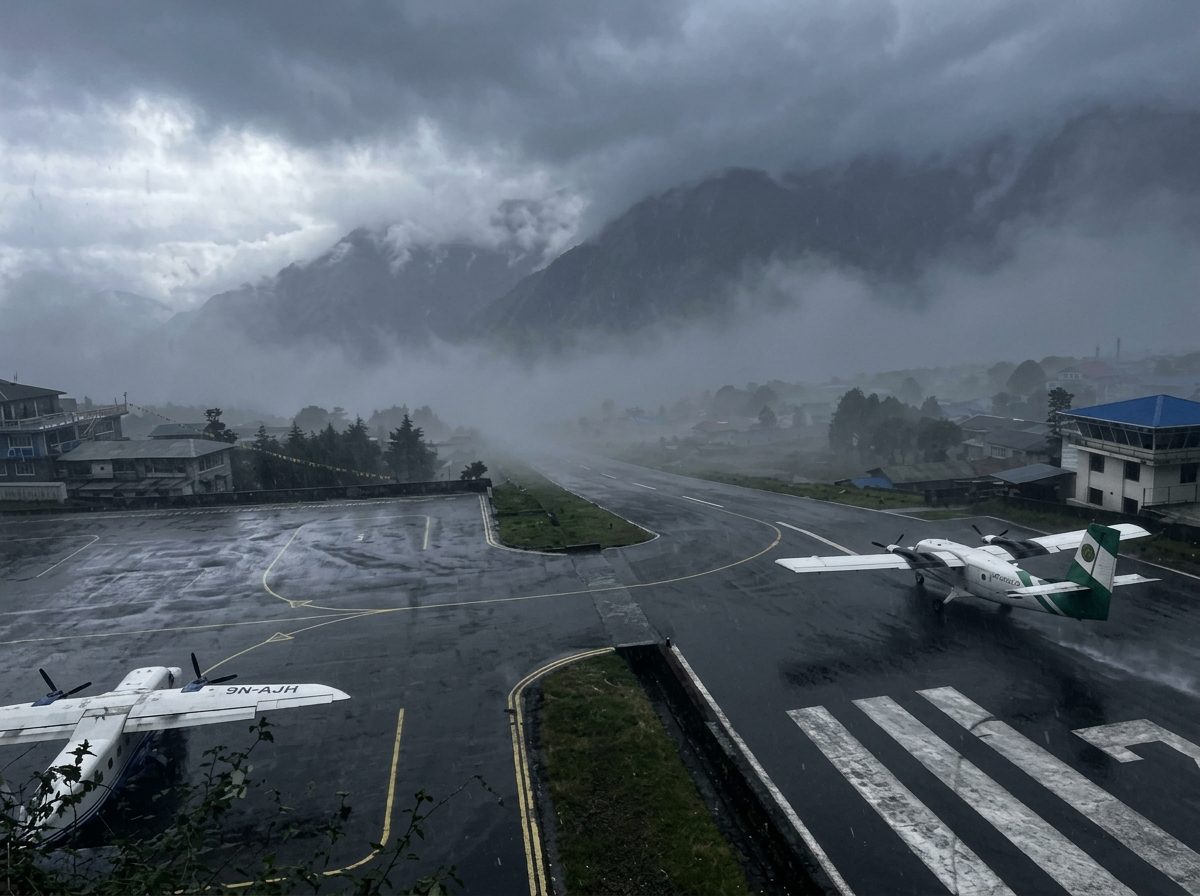
Tenzing-Hillary Airport at Lukla is consistently ranked among the most dangerous airports in the world. Not because the planes are unsafe, but because the physical geography leaves zero margin for error.
Here are the raw numbers:
- Runway length: 527 meters (1,729 feet). For context, a standard commercial runway is 2,500 to 3,000 meters. Lukla’s runway is roughly one-fifth of that.
- Runway width: 20 meters (65 feet).
- Elevation: 2,846 meters (9,337 feet) above sea level.
- Gradient: 12% uphill slope from south to north.
- Surface: Asphalt.
- Approach: One-way only. Aircraft land uphill (south to north) and take off downhill (north to south).
That 12% uphill gradient is the key engineering feature. When a plane lands at Lukla, it doesn’t rely on brakes to stop — it relies on gravity. The runway slopes sharply upward, so the aircraft is essentially landing on a ramp. The incline scrubs speed faster than any braking system could.
At the top of the runway sits a solid stone wall and the mountain face. There is no overshoot area. You stop on the runway, or you stop against the mountain.
Taking off is the reverse. The plane rolls downhill, accelerating with gravity, and launches off the southern threshold of the runway. Beyond that threshold is a 600-meter vertical drop into the
Dudh Kosi river valley below. There is no go-around. Once the pilot commits to the takeoff roll, the plane is leaving the ground whether it has enough speed or not.
Why this matters to you as a passenger: It doesn’t, practically speaking. The pilots who fly this route do it multiple times per day, every day, for years. They know this runway better than you know the road to your office. But understanding the physics of the runway helps you understand why weather delays are non-negotiable. If visibility drops below the minimum threshold, there is no instrument approach to fall back on. The pilot either sees the runway or the flight doesn’t happen.
How Helicopters Land at Lukla
Helicopters do not use the main runway at Lukla. They have a dedicated helipad located adjacent to the terminal building, separate from the fixed-wing traffic pattern.
The helicopter approach is fundamentally different from the plane approach. A fixed-wing aircraft must commit to a single approach corridor — a narrow valley lined with ridges on both sides — and maintain forward momentum the entire time. A helicopter can slow down, hover, adjust laterally, and land vertically. This gives helicopter pilots significantly more flexibility in marginal weather conditions.
That said, helicopters are not immune to Lukla’s weather. Heavy fog and high crosswinds still ground helicopter operations. The difference is that helicopters can sometimes operate in conditions where fixed-wing aircraft cannot — meaning if your plane gets cancelled due to low cloud cover, a helicopter charter might still be able to get you in.
The landing itself is smooth and anticlimactic. The pilot approaches from the valley side, hovers over the helipad for a few seconds, and sets down. You step out, grab your bag from the cargo basket, and walk 50 meters to the terminal. The entire process from touchdown to standing on the tarmac takes about 2 minutes.
What You See During the Flight
Even if you are a nervous flyer, force yourself to look out the window. The 30-minute corridor between Kathmandu and Lukla crosses some of the most dramatic terrain on the planet.
- Minutes 1–10: The Kathmandu Valley falls away behind you. Terraced rice paddies cover the hillsides below. The sprawl of the city gives way almost immediately to deep green ridges.
- Minutes 10–20: The first snow-capped peaks appear on the horizon. Gaurishankar (7,134m) dominates the view directly ahead. Below you, the rivers cut through increasingly steep gorges. The settlements shrink to tiny clusters of tin roofs clinging to impossibly steep slopes.
- Minutes 20–30: The plane drops lower, threading between ridgelines. The vegetation shifts from subtropical to alpine. You catch your first glimpse of the Khumbu icefall region in the far distance. Then the valley narrows, the pilot banks, and the tiny, tilted strip of asphalt at Lukla appears directly in front of the windshield.
- Minutes 30–35: The approach, the touchdown, and the abrupt stop against the uphill gradient. Your Everest trek has officially started.
Frequently Asked Questions
Can I choose a window seat on the Lukla flight?
Seating on Twin Otters and Dornier aircraft is not pre-assigned. You board and sit wherever is available. However, the planes are so narrow (usually 2 seats on each side of a tiny aisle) that every seat is essentially a window seat. You will have a view regardless.
What if my flight departs from Ramechhap instead of Kathmandu?
Your trekking agency or airline will notify you 24 to 48 hours before departure. If you are departing from Ramechhap, you need to leave Kathmandu by road at approximately 1:00 to 2:00 AM to arrive in time for the early morning flight. Most agencies arrange a shared jeep transfer. It is a rough, uncomfortable ride on a winding highway, but it is the price you pay for peak-season Lukla access.
Is the Lukla flight included in my trek package price?
It depends entirely on your operator. Some agencies bundle the round-trip Lukla flight into the total trek cost. Others list it as a separate line item. Always confirm before signing your contract. If the flights are listed as “excluded,” budget an additional USD 440 to 500 for the round-trip plane tickets.
How early should I wake up for a 6:00 AM departure?
If departing from Kathmandu, set your alarm for 3:30 to 4:00 AM. You need time to get dressed, grab your pre-packed bag, and reach the domestic terminal by 4:30 AM. If departing from Ramechhap, you won’t sleep at all — the jeep leaves Kathmandu around 1:00 AM.
The Bottom Line
The Kathmandu to Lukla flight time is absurdly short — half an hour by plane, under an hour by helicopter. But every minute of that flight is dictated by weather, physics, and one of the most challenging runways ever built.
Don’t obsess over the flight itself. Obsess over the logistics around it. Report early. Pack light. Build a buffer day into your itinerary in case the weather shuts everything down. And if you are staring at a cancelled departure board for the second morning in a row, know that a helicopter charter to Lukla can get you back on schedule before the afternoon clouds roll in.
Comments (0)
Write a comment- What the Flight Actually Looks Like
- The Plane Route
- The Helicopter Route
- The Departure Schedule
- Why No Afternoon Flights?
- Airport Tax and Reporting
- Reporting Time
- Airport Tax
- Lukla Airport: The Runway That Terrifies Pilots
- How Helicopters Land at Lukla
- What You See During the Flight
- Frequently Asked Questions
- The Bottom Line
Read the latest Blogs & Insights
Explore our collection of articles and insights to gain in-depth travel knowledge, expert advice, and stay updated on the latest trends and tips.


No comments yet.