









Annapurna Base Camp Helicopter Tour — Price, Best Time, and How to Book It at the Most Affordable Cost
If you’ve come to Nepal with limited time but want to stand inside the Annapurna Sanctuary — surrounded by the giants that trekkers spend 7 to 10 days walking to reach — the ABC helicopter tour is one of the most efficient and genuinely extraordinary experiences available anywhere in the Himalayas. This guide covers everything: […]
-
 Adventure Master Trek
-
11 June, 2026
-
12 mins read
-
759 Views
-
0 Comments


If you’ve come to Nepal with limited time but want to stand inside the Annapurna Sanctuary — surrounded by the giants that trekkers spend 7 to 10 days walking to reach — the ABC helicopter tour is one of the most efficient and genuinely extraordinary experiences available anywhere in the Himalayas. This guide covers everything: what the tour actually is, what it costs in 2025 and 2026 broken down by every booking option, how to get the most affordable price, the best time to go, and what to expect from the moment you lift off from Pokhara airport to the moment you land back with a breakfast at 4,130 meters still sitting warm in your memory.
What the Annapurna Base Camp Helicopter Tour Actually Is
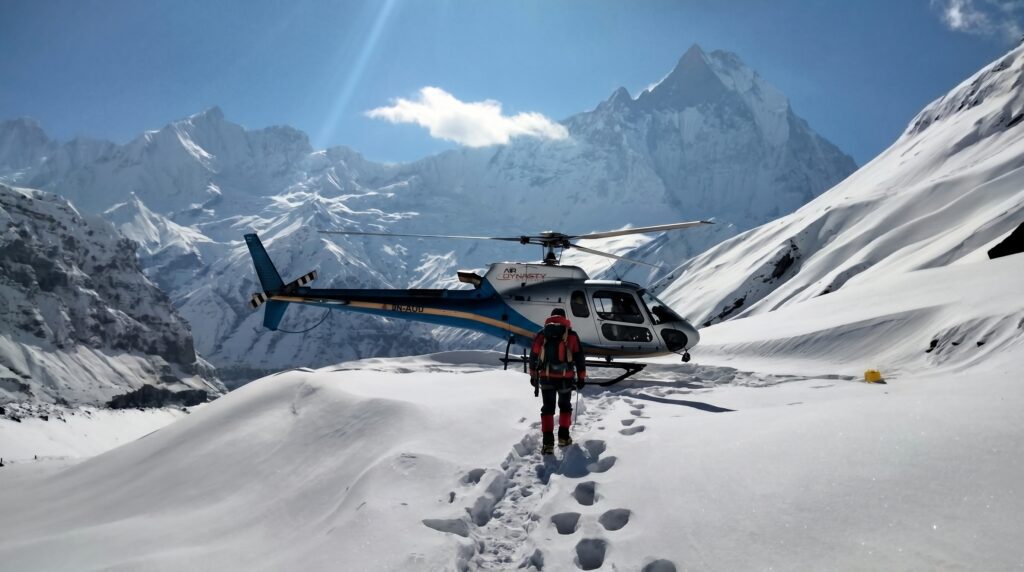
The tour departs from Pokhara Airport in the early morning — typically between 6:00 and 7:00 AM — and flies north into the Annapurna Conservation Area. The flight itself takes roughly 20 minutes from Pokhara to the base camp, covering terrain that would take a trekker anywhere from four to seven days on foot depending on their pace and fitness.
From the air, the route passes over the Pokhara Valley and Fewa Lake first, then the green terraced hills of the Gurung village country, then the deep gorge of the Modi Khola river, then the upper sanctuary where the valley narrows and the walls of ice and rock close in on either side. By the time you land, you are sitting at 4,130 meters inside an amphitheater of peaks that includes Annapurna I at 8,091 meters — the tenth highest mountain in the world — Annapurna South, Hiunchuli, Gangapurna, and directly ahead of you the iconic Fish Tail summit of Machhapuchare, which is considered sacred and has never been legally summited.
You typically land for 20 to 45 minutes depending on weather conditions and the operator you book with. During this time you can walk around the base camp area, photograph the peaks from inside the sanctuary, and have breakfast at the teahouse. Then you board again and fly back to Pokhara. The entire experience from hotel pickup to hotel drop-off runs about three to four hours total.
The helicopter used for most ABC tours is the Airbus AS350 B3e, also known as the H125 — the same aircraft used on the Everest heli tours. It’s internationally recognized as one of the most capable high-altitude helicopters in operation, with a maximum capacity of five passengers plus the pilot.
Annapurna Base Camp Helicopter Tour Price — Complete 2025/2026 Breakdown
The price of the ABC helicopter tour depends on one primary variable: whether you book a group joining (sharing) flight or a private charter. These are two entirely different products at very different price points.
Group Joining — The Most Affordable Option
Group joining means you and up to four other travelers share a single helicopter. The total cost of the helicopter charter is divided equally among everyone on board. This is by far the most common way to book the tour and the most affordable per-person price available.
The current group joining price per person from Pokhara in 2025 ranges from USD 425 to USD 595 per person, with the majority of reputable operators pricing between USD 490 and USD 550. The variation comes from the operator, the season, and what’s included in the package. Some operators advertise lower headline prices and then charge separately for the breakfast at base camp, the airport transfer, and the ACAP permit. Others include everything. Always confirm exactly what is included before you pay.
The most competitive and transparent group joining rate currently available on the market sits at around USD 425 to USD 450 per person when booked directly with local operators in Pokhara outside of peak season.
Private Charter from Pokhara — Full Helicopter for Your Group
A private charter means you book the entire helicopter for your group alone. You don’t share with strangers, you don’t wait for the operator to fill the remaining seats, and you can often negotiate your own schedule flexibility. The private charter price from Pokhara currently runs from USD 1,700 to USD 2,300 for the full helicopter depending on the operator and season. With five passengers, this breaks down to between USD 340 and USD 460 per person — which can actually be cheaper than the standard group joining rate if your party is full.
Private Charter from Kathmandu — Higher Cost, Longer Flight
If you’re flying from Kathmandu rather than Pokhara, the charter costs significantly more because the flight distance is greater. A private charter from Kathmandu to ABC and back currently runs approximately USD 3,390 to USD 4,000 for the full helicopter. Per person with five passengers this comes to USD 680 to USD 800. The total journey from Kathmandu takes roughly four hours including the flight time, the base camp landing, and the return.
Price Summary Table — 2025/2026
Group Joining from Pokhara: USD 425 to USD 595 per person Private Charter from Pokhara: USD 1,700 to USD 2,300 total (USD 340 to USD 460 per person with 5 people) Private Charter from Kathmandu: USD 3,390 to USD 4,000 total (USD 680 to USD 800 per person with 5 people)
How to Get the Most Affordable Price — Practical Tips
Book directly with a Pokhara-based operator rather than through an international travel aggregator or a Kathmandu-based agency. Pokhara operators have lower overhead and the base camp is accessible directly from Pokhara without the added cost of flying from Kathmandu first. The price difference between a direct Pokhara booking and an international booking for the same flight can be USD 100 or more per person.
Go in the shoulder season. October and November are the most popular months, which means the highest prices. March and April are the second peak. If you fly in late September, early December, late February, or early March, you’re in shoulder season where operators have more available slots and more incentive to offer better rates.
Ask about last-minute group joining seats. If an operator has a helicopter with two or three passengers already booked for the following morning and needs to fill the remaining seats, they will often offer a reduced rate to fill the flight rather than run a partially empty helicopter. If you’re already in Pokhara and flexible on timing, walk into two or three operators on Lakeside Road and ask directly what’s available tomorrow. This approach has gotten travelers significantly below the listed rate.
Travel as a group of five. If you have five people in your party, a private charter from Pokhara at USD 1,700 to USD 2,000 divided five ways becomes USD 340 to USD 400 per person — the single lowest per-person price available for this tour. You get the entire helicopter to yourselves, complete schedule flexibility, and a rate that beats the standard group joining price by a meaningful margin.
Compare what’s included before comparing the headline number. Some operators include hotel pickup and drop-off, the ACAP permit, a guide on the flight, and breakfast at base camp in their stated price. Others advertise a lower number and charge each of these separately. USD 425 with everything included is better value than USD 400 with permits, breakfast, and transfers all additional. Always ask for the all-in price and get it in writing.
What’s Included — What to Confirm Before You Book
Most reputable operators include the following in their package price: helicopter flight from and back to Pokhara airport, 20 to 30 minutes landing time at Annapurna Base Camp, hotel pickup and drop from Lakeside, ACAP (Annapurna Conservation Area Permit), and basic breakfast or tea at the base camp teahouse. Some include a GoPro photo and video package. Some include a guide. Some do not include the breakfast separately and the base camp teahouse will charge you directly.
What is almost never included: personal travel insurance, tips for the pilot and ground crew, and any additional time at base camp beyond what’s scheduled. Confirm the following before you hand over any money: Is hotel pickup included? Is the ACAP permit included? Is breakfast included or charged separately at base camp? What is the weather cancellation and rescheduling policy? What happens if the flight is cancelled due to cloud — do you get a full refund or a reschedule?
Best Time to Book the Annapurna Base Camp Helicopter Tour
The Annapurna Sanctuary is weather-dependent in a way that matters very directly to this tour. The base camp sits inside a glacial amphitheater where cloud builds up rapidly in the afternoon, and the entire valley can close in with mist within an hour of a clear morning. All flights depart early morning specifically to take advantage of the pre-cloud window. By 10:00 or 11:00 AM, conditions at base camp are often deteriorating. This is not an afternoon activity.
The best months in order of reliability are October, November, March, April, and May. These are the driest, clearest windows in the Himalayan calendar. October and November sit in the post-monsoon period when the air has been washed clean and the mountain views are at their sharpest. March and April are pre-monsoon spring when the rhododendrons are blooming and the morning skies are generally excellent. May is increasingly variable toward the end as pre-monsoon cloud builds.
December, January, and February are the coldest months. The tour does run in winter and can offer extraordinary clear-sky days, but the cold at base camp is serious — minus ten to minus fifteen degrees Celsius is possible — and the frequency of clear mornings is lower than in the peak seasons. Some operators reduce their group joining schedules in winter due to lower demand, which can make seat availability more difficult to arrange quickly.
June, July, August, and September are the monsoon months. The tour is technically available during monsoon but cloud cover makes a clear base camp landing much less reliable. September is the tail end of monsoon and conditions improve noticeably through the month — late September can offer some surprisingly good flights when a clear window opens between monsoon retreating and pre-monsoon cloud beginning.
The single most important thing to understand about timing: this tour is weather-dependent on the morning of your flight, not on your booking date. You can book the perfect season and still get a cloudy day. A good operator will reschedule or refund you if the weather is unflyable. This is the most critical thing to confirm before you book.
The Experience Itself — What Happens Hour by Hour
5:30 to 6:00 AM — Your hotel pickup arrives. This is early on purpose. The drive to Pokhara Airport is short from Lakeside, usually ten to fifteen minutes.
6:00 to 6:30 AM — Airport formalities. You check in at the operator’s desk, receive your boarding pass, and wait in the small departure lounge. You’ll meet the other passengers on your group joining the flight at this point. The pilots do their pre-flight checks and the ground crew loads luggage.
6:30 to 7:00 AM — Takeoff from Pokhara. The helicopter lifts off and heads north. In the first few minutes you see Fewa Lake below and the Pokhara Valley spreading out behind you. The mountains ahead build in size fast.
7:00 to 7:20 AM — The flight to base camp. The helicopter follows the Modi Khola river gorge upward, passing over the trail and the villages of Ghandruk, Chhomrong, and Deurali from the air. Trekkers walking the trail below will look up at you. The gorge narrows significantly above Deurali as the helicopter enters the sanctuary. The walls of ice and rock on either side close in. The base camp plateau appears ahead.
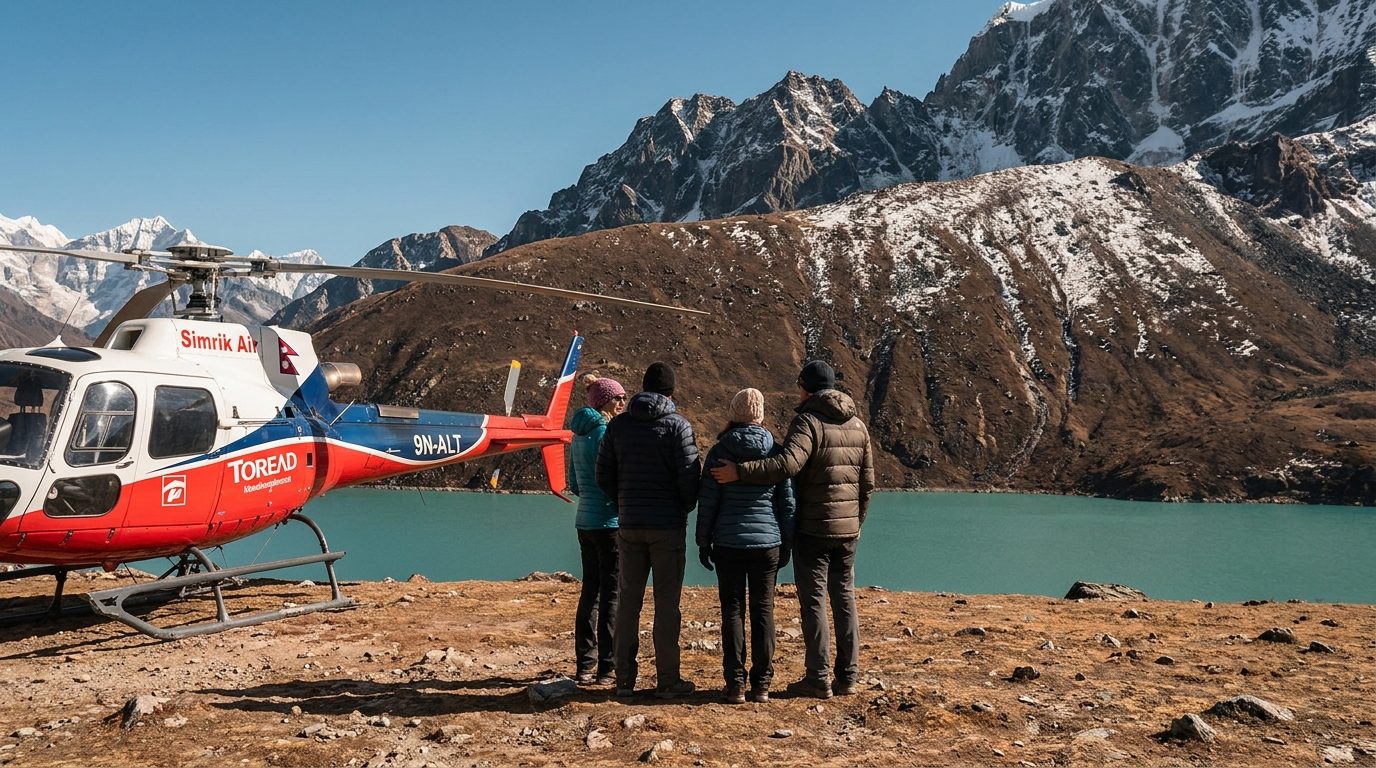
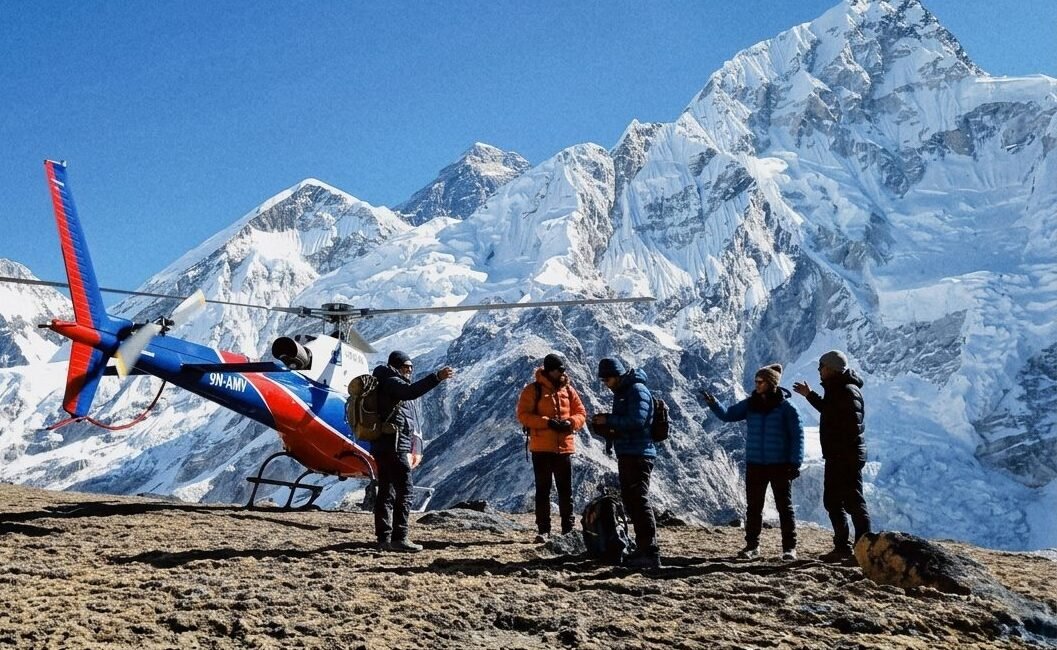
7:20 AM — Landing at Annapurna Base Camp, 4,130 meters. The helicopter sets down on the flat glacier moraine. You step out into air that is thin, cold, and clean. The peaks surrounding you are not in photographs here — they are directly above you, immediate and enormous in every direction. Annapurna I fills the northern sky. Machhapuchare is directly ahead to the east. The silence between the rotor spin-down and whatever you say next is genuine and brief.
7:20 to 8:00 AM — Your 30 to 45 minutes at base camp. Walk to the small viewpoint ridge for the best angle on the Annapurna range. Photograph everything. Breathe slowly — the altitude is real even for 30 minutes. At the small teahouse operating during trekking season, breakfast is available: eggs, toast, tea, noodles. At 4,130 meters with Annapurna I directly above the window, this is the best breakfast table in Nepal by some distance.
8:00 to 8:20 AM — Flight back to Pokhara. The return passes the same terrain in reverse. Seats are often rotated so everyone gets a window view at some point in the journey.
8:30 to 9:00 AM — Back at Pokhara Airport. Transfer to your hotel. The rest of the day is yours, and it will feel different from the day before.
What to Wear and Bring
The temperature at base camp in the morning is roughly 0 to 10 degrees Celsius in peak season and can drop significantly lower in winter. A down jacket is non-negotiable. Thin layers underneath and one good thermal base layer. Gloves and a beanie for the time outside the helicopter. Sunglasses because the UV at 4,130 meters on a clear morning is intense and immediate. Sunscreen on any exposed skin. A camera with a charged battery — cold kills batteries fast and you will want every shot.
What you do not need: a sleeping bag, trekking boots, altitude medication for 30 minutes at 4,130 meters, or any special technical gear. You are landing for less than an hour. The experience is accessible to almost anyone who can walk a short distance on uneven ground.
Who This Tour Is For
The ABC helicopter tour is for travelers who are short on time — those with three to five days in Pokhara who want the Annapurna experience without two weeks of trekking. It’s for older travelers or those with physical conditions that make the 7 to 10 day trek not feasible. It’s for families with children who want a Himalayan experience that’s accessible. And it’s for anyone who has done the ABC trek before and wants to return to the base camp from a completely different and genuinely extraordinary angle.
It is not a substitute for the trek in terms of what the trek teaches you. But as a standalone experience — as a single morning that puts you inside one of the most dramatic high-altitude landscapes on earth — it earns its price completely.
Comments (0)
Write a commentRead the latest Blogs & Insights
Explore our collection of articles and insights to gain in-depth travel knowledge, expert advice, and stay updated on the latest trends and tips.



No comments yet.