







Lukla to Kala Patthar and Gokyo Lake Landing Helicopter Tour: Itinerary, Views, and Discounted Group Pricing
There’s a moment, somewhere past Namche Bazaar, when the helicopter banks slightly and the entire Khumbu unfolds beneath the skids — glacier moraine, prayer flags strung across a ridge, a yak trail cut into the hillside like a thread. Most people who fly this route say the same thing afterward: photographs don’t do it justice. […]
-
 Adventure Master Trek
-
19 June, 2026
-
11 mins read
-
717 Views
-
0 Comments


There’s a moment, somewhere past Namche Bazaar, when the helicopter banks slightly and the entire Khumbu unfolds beneath the skids — glacier moraine, prayer flags strung across a ridge, a yak trail cut into the hillside like a thread. Most people who fly this route say the same thing afterward: photographs don’t do it justice. The Lukla to Kala Patthar and Gokyo Lake landing helicopter tour packs the single best view in the Everest region — and one of its most underrated lakes — into a single, unforgettable morning, without the two weeks of trekking that usually come attached to it.
If you’ve been searching for a way to stand near Everest without spending fourteen days on the trail, this is the route trekking operators in Kathmandu get asked about more than almost any other. Here’s what actually happens on the flight, what it tends to cost, and how group bookings can bring that price down considerably.
What the Lukla–Kala Patthar–Gokyo Route Actually Involves
This isn’t a simple there-and-back flyover. The route stitches together three of the most photographed locations in the Everest region into one continuous loop: Lukla, the gateway airstrip every EBC trekker knows by name; Kala Patthar, the rocky outcrop above Gorak Shep that delivers the classic, unobstructed view of Everest’s summit pyramid; and Gokyo, a chain of glacial lakes tucked into a side valley that most helicopter passengers never even hear about, let alone see.
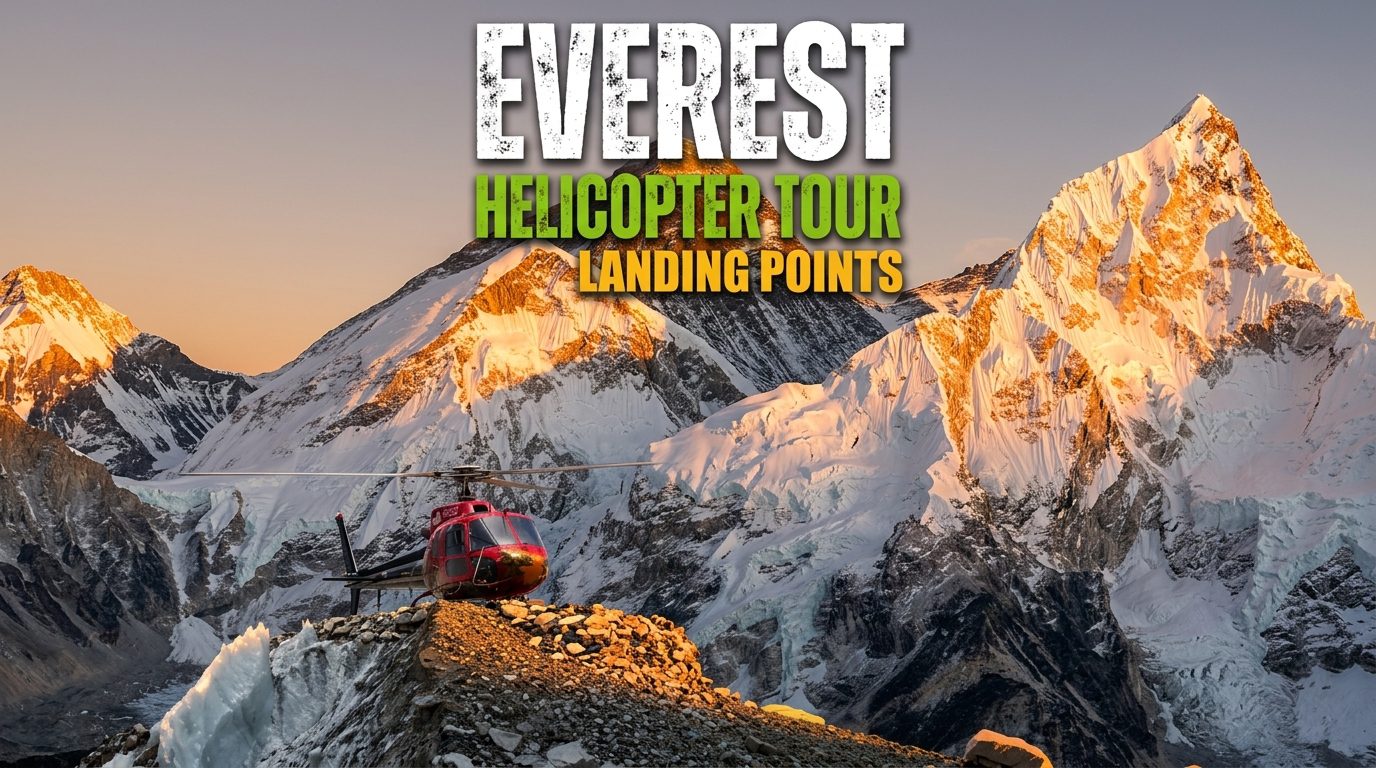
Flying from Lukla rather than direct from Kathmandu also changes the character of the trip. Because the helicopter refuels at Lukla before pushing higher into the mountains, it can carry passengers further into the high valleys with a landing at Kala Patthar itself, rather than just circling above it. That landing — ten to twenty minutes standing at roughly 5,545 meters with Everest, Nuptse, and Lhotse filling the skyline — is the part nearly every traveler mentions first when they get home.
How the Day Unfolds, Hour by Hour
The day starts early, usually with a 6:00 or 7:00 AM check-in at the helipad in Kathmandu, where staff weigh both passengers and luggage — altitude flying runs on strict weight limits, so this part isn’t optional. After a short safety briefing on how to board, exit, and handle the doors, the helicopter lifts off and heads northeast.
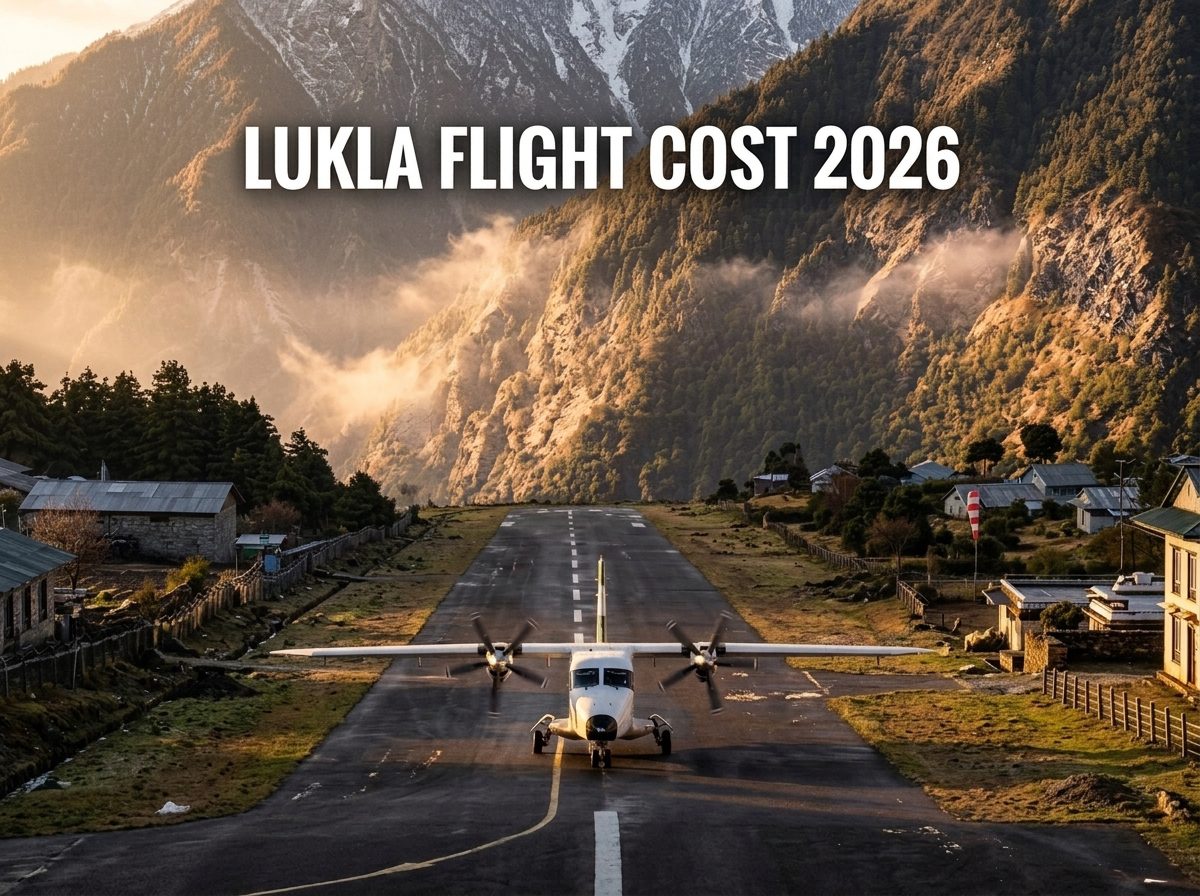
The first leg to Lukla’s Tenzing-Hillary Airport takes around 40 to 45 minutes. On a clear morning you’ll catch Ganesh Himal and the Rolwaling peaks off to the west before the helicopter threads through the Lamjura ridge, where Everest and Lhotse make their first, brief appearance in the distance. Landing at Lukla — at 2,860 meters, on one of the most famous short runways in the world — is a moment in itself, and the ground crew uses the stop to refuel for fifteen to twenty minutes while passengers stretch their legs and watch the smaller fixed-wing planes come and go.
From Lukla, the helicopter follows the Dudh Koshi valley upward, passing over the lodges of Phakding and the switchbacks leading into Namche Bazaar. This is where the scenery shifts from forest to true high-mountain terrain — Khumjung and Phortse appear off to one side, Cho Oyu rises on the other, and Ama Dablam’s distinctive hanging glacier comes into full view as the route passes near Tengboche. Groups carrying more than roughly 250 kilograms of combined passenger weight are sometimes split here, with the helicopter shuttling back and forth between Pheriche and the upper valley to stay within safe operating limits at altitude.
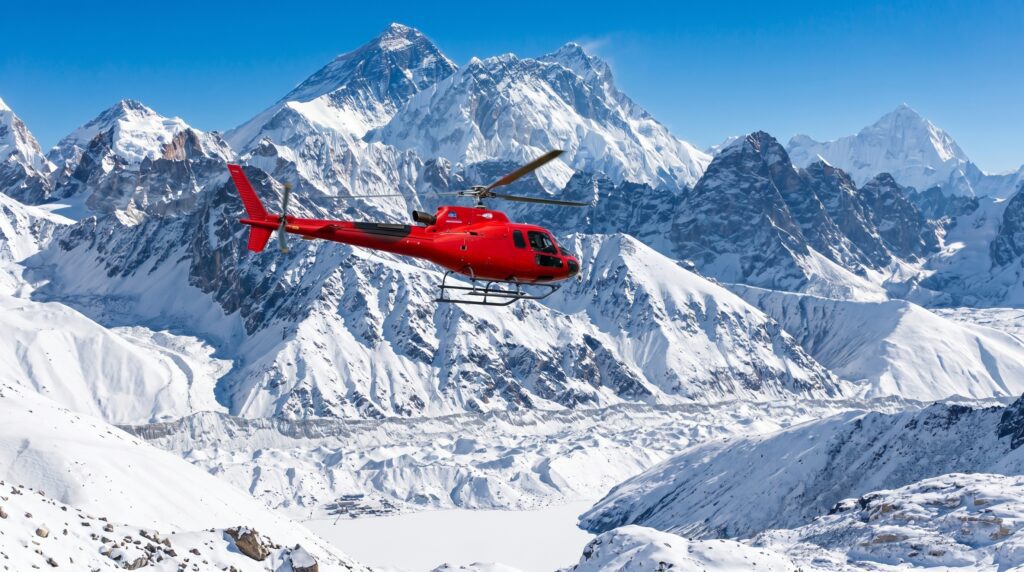
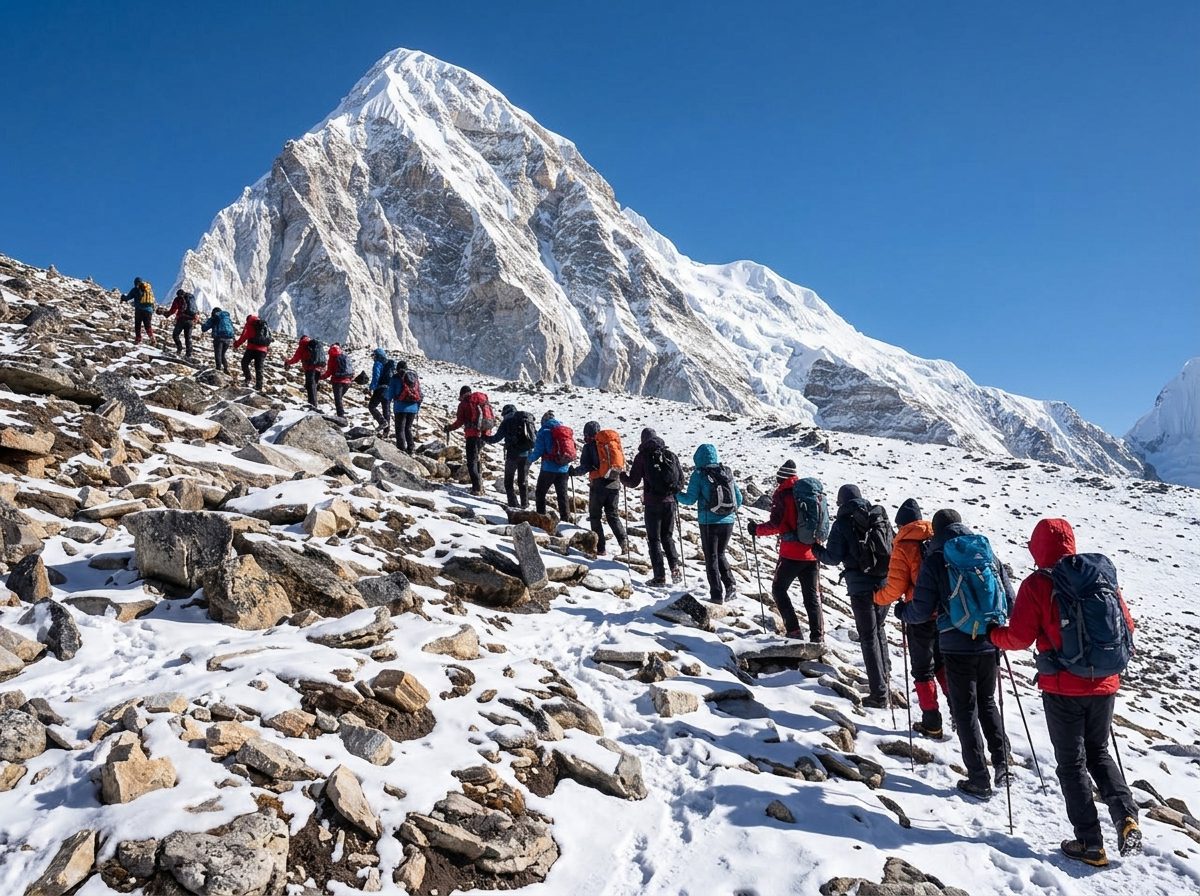
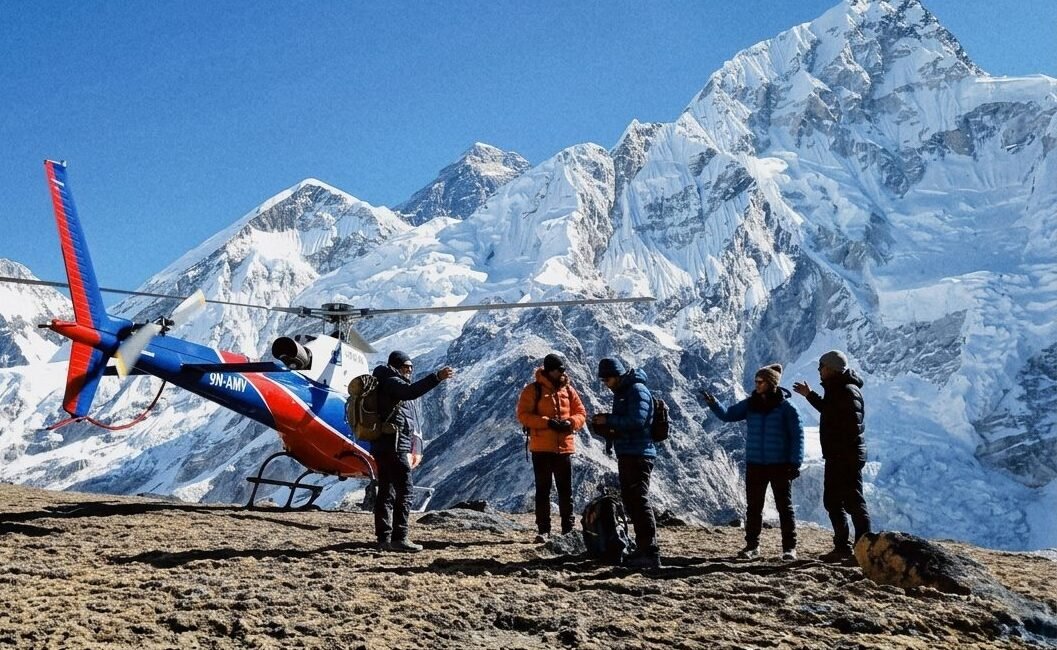
The highlight comes next. The helicopter climbs past Lobuche and the Khumbu Glacier toward Kala Patthar, and depending on conditions and operator, this is where it sets down. Standing on that ridge with Everest’s summit directly ahead, Nuptse to the right, and the tents of Everest Base Camp visible far below in the glacier basin, is genuinely one of the more disorienting kinds of beautiful — it doesn’t quite register that you got here in under two hours.
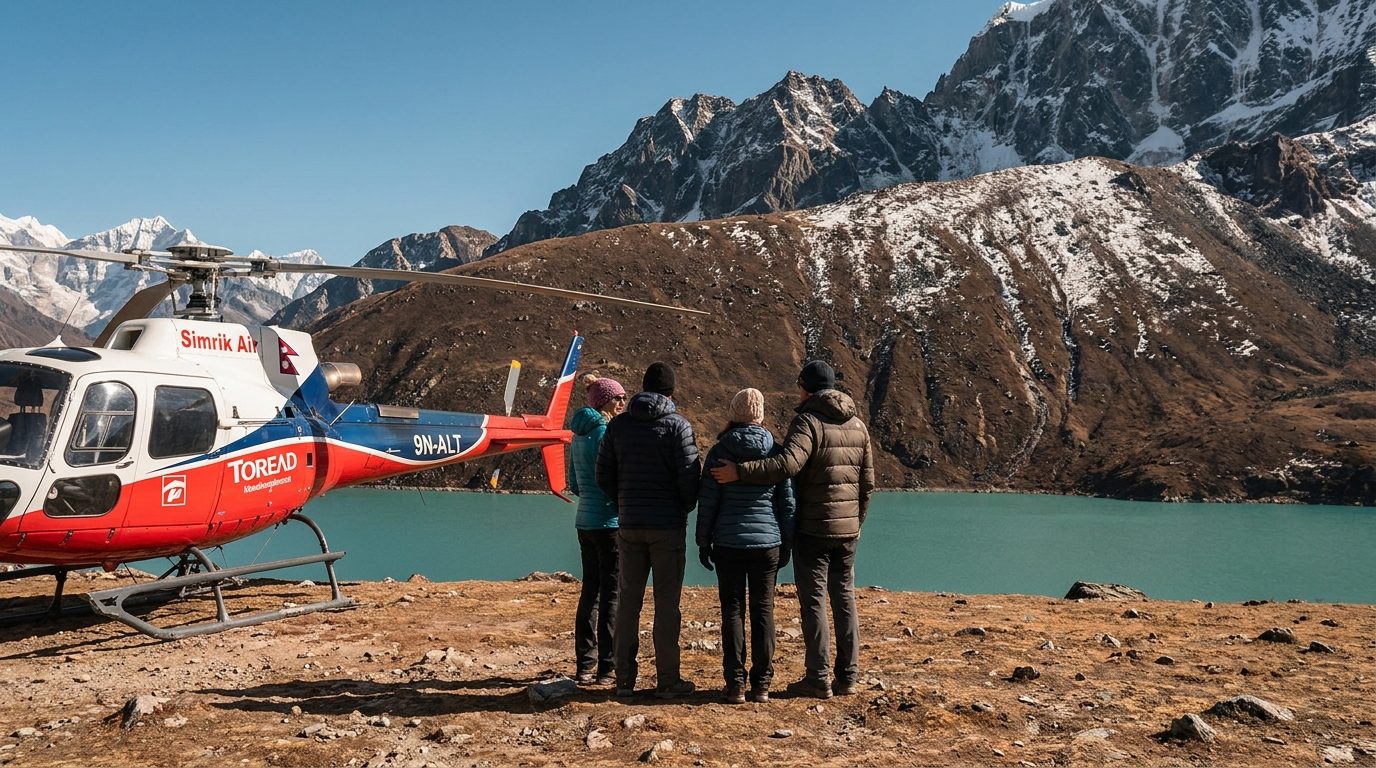
After Kala Patthar, the flight turns toward Gokyo. The valley opens into a series of turquoise, glacier-fed lakes sitting between 4,700 and 5,000 meters, with Gokyo Ri rising sharply at 5,357 meters behind them. The helicopter lands right beside the lake, and passengers usually get ten to fifteen minutes to walk to the shoreline, take photos, and simply take in how still the water is at that altitude.
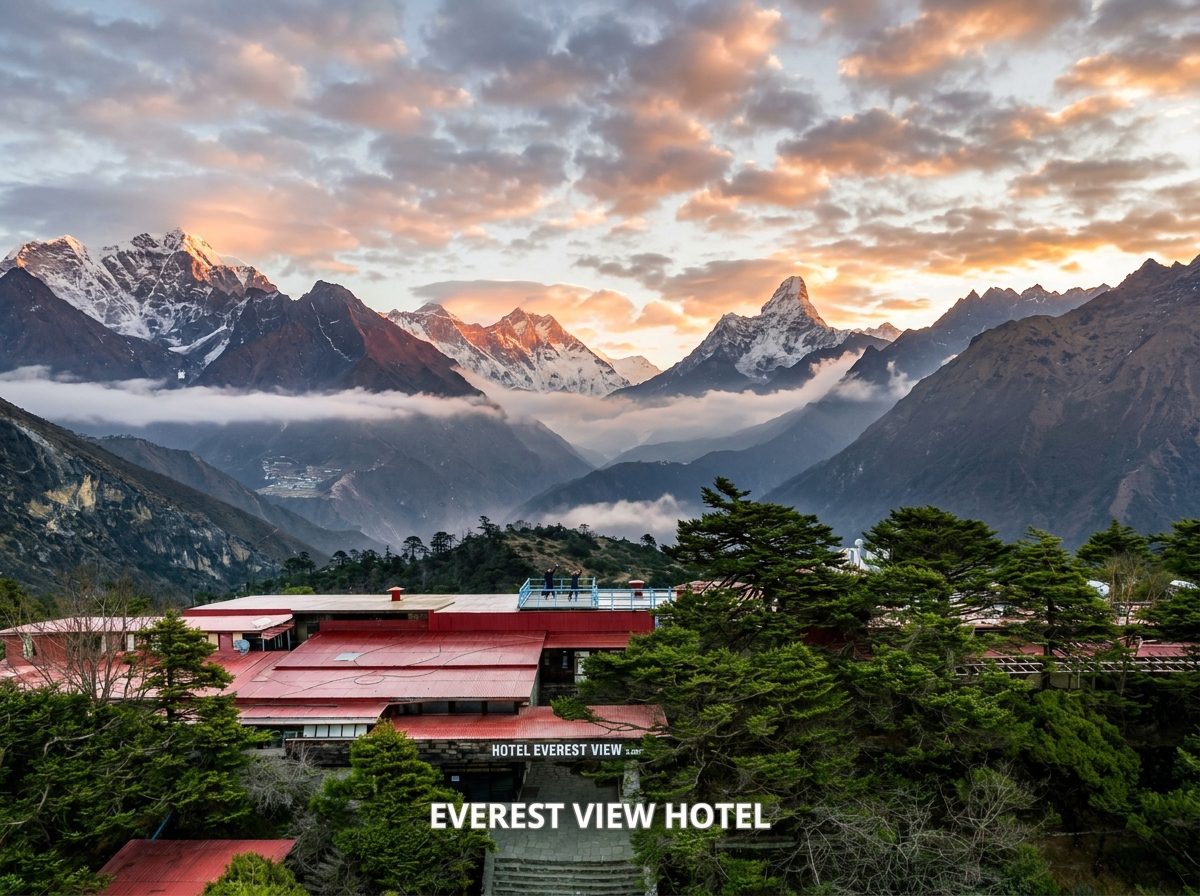
The last stop before heading home is breakfast — at the Everest View Hotel in Syangboche, often cited as one of the highest-altitude hotels anywhere in the world. Sitting on its terrace with a hot meal in front of you and Everest, Lhotse, and Ama Dablam framed in the window is, for a lot of travelers, the part that finally makes the whole morning feel real. From there, it’s a short hop back to Lukla to refuel, then the final leg to Kathmandu, usually wrapping up by early afternoon.
What You’re Actually Looking At
Beyond the headline peaks, the route passes a surprising amount of cultural and natural texture. Tengboche Monastery, the largest in the Khumbu region, sits squarely along the flight path. Sherpa villages with their stone-walled fields and prayer-flag-draped rooftops are visible nearly the entire way up. The Khumbu Glacier itself, with its crevasses and ice towers, looks completely different from above than it does from any trekking trail. And the contrast between the green, terraced lower valleys and the stark white-and-grey high country above 5,000 meters is something most photographs of Everest simply don’t capture, because trekkers on foot rarely see both extremes in the same hour.
Best Months to Fly This Route
Mountain flying depends entirely on visibility and wind, so timing matters more here than on most trips. March through May and again from late September through November are generally the most reliable windows, with stable morning air and the clearest skies of the year. Within those months, flights almost always depart early — by mid-morning, rising heat can build cloud cover around the high peaks and ground operations for the day. Winter flying is possible and often delivers exceptionally crisp views, though it’s colder at altitude and operators tend to build in extra buffer days. Monsoon season, from June through early September, is the least predictable time to book, since cloud cover can ground flights for days at a stretch.
Cost Breakdown: Discounted Rates and Group Pricing
Pricing on this route depends on three things: how many people are flying together, whether you’re booking a shared seat or chartering the whole helicopter, and the season. A helicopter typically carries a maximum of five paying passengers besides the pilot, and weight limits at altitude mean larger groups are sometimes split into two shuttles rather than one — which is part of why per-person pricing drops noticeably as group size increases.
The figures below reflect the kind of discounted and group pricing structure commonly offered on this route. Treat them as a planning guide rather than a locked-in quote — always confirm the exact rate, fuel surcharge, and any seasonal adjustment with your operator before booking.
| Group Size | Standard Rate (Per Person) | Discounted Cost (Per Person) | Group Discounted Price (Total) |
| 2 Passengers | USD 1,950 | USD 1,750 | USD 3,500 |
| 3 Passengers | USD 1,800 | USD 1,600 | USD 4,800 |
| 4 Passengers | USD 1,650 | USD 1,450 | USD 5,800 |
| 5 Passengers (Private Charter) | USD 1,550 | USD 1,350 | USD 6,750 |
A few things worth knowing about how this pricing actually works in practice. Solo travelers are usually placed into a shared group departure, which is the only way to bring the per-person cost down to something close to the discounted rate above — chartering a helicopter alone is considerably more expensive. Families or friend groups of four or five booking together tend to get the best value overall, since the fixed costs of fuel, permits, and the helicopter itself are split across more people. National park entry fees and the rural municipality tax are almost always charged separately, in cash, and aren’t included in the headline price. And if breakfast at the Everest View Hotel is an add-on rather than a built-in inclusion with your chosen operator, it’s worth asking about that cost upfront rather than discovering it on the day.
What’s Typically Included and What Isn’t
- Included: round-trip helicopter transport, hotel pickup and drop-off within Kathmandu, the Kala Patthar and Gokyo landings, and in most packages a loaner warm jacket if you don’t have your own.
- Usually included, sometimes an add-on: breakfast or refreshments at the Everest View Hotel.
- Not included: Sagarmatha National Park entry permit and local municipality fees (paid in cash, in the mountains), personal travel insurance, tips for the ground crew and pilot, and any personal expenses along the way.
Who This Trip Actually Suits
This route tends to attract a specific kind of traveler: people who want to stand somewhere near Everest Base Camp but don’t have two to three weeks free, older travelers or those with physical limitations who couldn’t manage the trek itself, and trekkers who’ve already done part of the Everest Base Camp trail on foot and want to fly back rather than walk down. It’s also become popular with photographers chasing a single, efficient morning of high-altitude shots, and with couples or small groups celebrating something specific who want the experience without the blisters.
It’s worth being honest that this isn’t a substitute for the trekking experience in every sense — you don’t get the week of acclimatization, the tea-house conversations, or the slow build toward that first sight of Everest. What you do get is the view, the landing, and the lake, compressed into a few unforgettable hours.
Practical Tips Before You Fly
Dress in dark, comfortable layers — bright colors tend to reflect off the helicopter’s plexiglass windows and show up as glare in photos, while darker clothing keeps the glass clear. Bring sunglasses and sunscreen even if the morning feels cool, since UV exposure climbs fast above 4,500 meters. Pack light: weight limits are strictly enforced, and you’ll be weighed along with your bags before boarding. A small day bag with water, a snack, your passport, and any personal medication is usually all you need, since the heavier kit gets left behind for a day trip like this.
Motion sensitivity is worth planning for if it’s ever affected you before — the climbs and descents happen quickly, and most operators carry sickness bags and a portable oxygen supply as a precaution, though serious discomfort is uncommon on a flight this short. And because the whole tour depends on a clear weather window, it’s smart to build one or two flexible days into your Kathmandu schedule rather than booking it for your very last morning in the country.
Frequently Asked Questions
Does the helicopter actually land at Kala Patthar, or just fly past it? On this specific itinerary, yes — the helicopter sets down at Kala Patthar for roughly ten to twenty minutes, rather than only circling above it, which is the main feature that distinguishes this route from the cheaper flyover-only tours.
How long does the entire trip take? Door to door, including the Kathmandu drive to and from the helipad, the full loop usually runs around five to six hours.
Is the price per person the same whether I book alone or with a group? No — booking with a group of three to five people sharing a single helicopter brings the per-person cost down significantly compared to flying solo, since the fixed costs are split across more passengers.
What happens if the weather doesn’t cooperate? Reputable operators will reschedule you to the next available clear-weather slot rather than fly in unsafe conditions, which is why building flexibility into your travel dates matters more on this trip than on most.
Can children or older travelers join this tour? Most operators accept children above a minimum age (commonly around three years old) and have no strict upper age limit, though anyone with serious heart, lung, or blood pressure conditions should check with a doctor before flying to altitudes above 5,000 meters.
Final Thoughts
The Lukla to Kala Patthar and Gokyo Lake landing helicopter tour exists for a simple reason: not everyone who wants to see Everest up close has three weeks to walk there. What you trade in trail time, you get back in concentrated, hard-to-believe scenery — a landing on Kala Patthar’s ridge, a quiet half-hour beside one of the highest lake systems on the planet, and breakfast with Everest in the window, all before lunch. If your trip to Nepal is short, or your knees have a different opinion about multi-week trekking than your heart does, this is about as close as a single morning gets to standing inside a postcard of the Himalayas.
Comments (0)
Write a comment- What the Lukla–Kala Patthar–Gokyo Route Actually Involves
- How the Day Unfolds, Hour by Hour
- What You’re Actually Looking At
- Best Months to Fly This Route
- Cost Breakdown: Discounted Rates and Group Pricing
- What’s Typically Included and What Isn’t
- Who This Trip Actually Suits
- Practical Tips Before You Fly
- Frequently Asked Questions
- Final Thoughts
Read the latest Blogs & Insights
Explore our collection of articles and insights to gain in-depth travel knowledge, expert advice, and stay updated on the latest trends and tips.


No comments yet.