









Private vs Shared Helicopter Ride Prices in Nepal: Which One Actually Saves You Money?
Not sure whether to book a private or shared helicopter ride in Nepal? This guide compares costs, group pricing, scheduling flexibility, comfort, and the best use cases for each option, helping you choose the most cost-effective helicopter experience.
-
 Adventure Master Trek
-
25 July, 2026
-
12 mins read
-
288 Views
-
0 Comments


Almost every helicopter tour operator in Nepal, whether they’re flying you to Everest Base Camp, Muktinath, or Annapurna, gives you the same two options at checkout: join a shared group flight, or charter the whole helicopter privately. The price difference between the two looks enormous at first glance. A private Everest charter can run five times what a single shared seat costs. But that comparison, taken on its own, is a little misleading, and it’s the reason so many travelers end up either overpaying for privacy they didn’t need, or underpaying by joining a group when a private flight would have worked out roughly the same per person.
This piece breaks down how shared and private helicopter pricing actually works in Nepal, where the real breakeven point sits for each major route, and which option makes sense depending on who you’re traveling with.
The Basic Difference Between Shared and Private
A shared flight, usually called a “group joining” tour, splits the total cost of chartering the helicopter across the passengers on board, typically up to five people. You’re not renting the aircraft, you’re buying a seat on it. Operators run these on fixed morning departures, usually timed for the clearest flying weather, and they’ll only confirm the flight once enough seats are filled (or they’ll combine your booking with other travelers who’ve booked separately).
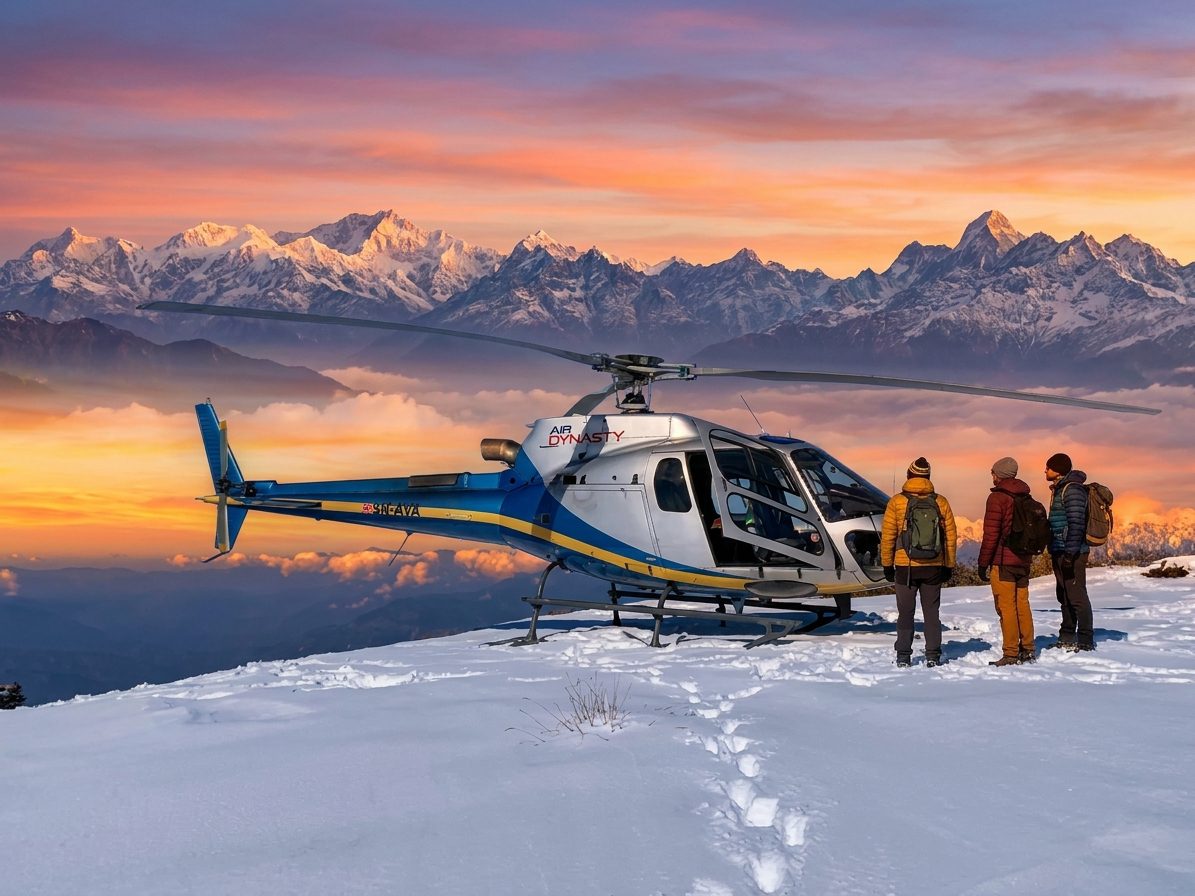
A private charter means you, or your group, are paying for the entire helicopter regardless of how many seats are actually occupied. If you book a private Everest tour for two people, you’re still paying the same total charter cost as a group of five would split five ways among themselves. The upside is that you control the schedule, the pace, and in some cases the exact route.
Neither option is “cheaper” in the abstract. Which one is cheaper depends entirely on how many people you’re traveling with, and that’s really the whole point of this article.
Everest Base Camp: Shared vs. Private
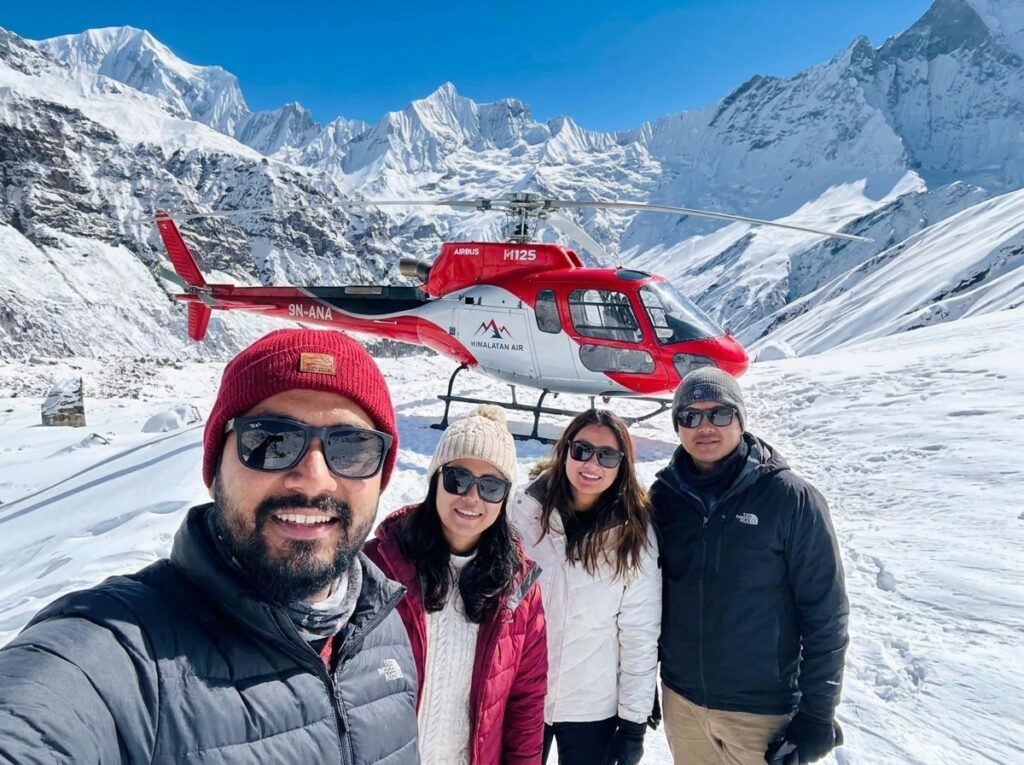
Everest is the most requested helicopter route in Nepal, and also the one with the biggest gap between shared and private pricing.
A shared seat on a group-joining Everest flight generally runs around USD 1,395 per person, with other operators pricing it anywhere from roughly USD 1,200 to 1,500 depending on season and whether the route includes time near Kalapatthar. A full private charter for up to five passengers typically costs USD 5,000 to 6,000 for the whole aircraft.
Do the math on that, and something interesting shows up. If you split a USD 5,500 private charter five ways, you land at roughly USD 1,100 per person, which is actually cheaper than the standard shared rate. Even splitting it four ways puts you around USD 1,375, right in line with group pricing. The private option only becomes meaningfully more expensive per person once your group drops to two or three passengers, where the per-person share climbs to somewhere between USD 1,800 and 2,750.
So for Everest specifically, a group of four or five friends or family members is almost always better off chartering privately. You get the same route, the same landing points, and full control over your schedule, for roughly the same money you’d pay joining strangers on a fixed departure.
Muktinath: Where Departure City Changes the Whole Equation
Muktinath pricing works a little differently because your starting point (Kathmandu or Pokhara) affects the base charter cost so heavily.
From Pokhara, a shared group flight runs roughly USD 799 per person, while a private charter for the whole helicopter costs around USD 3,000. Split five ways, that’s about USD 600 per person, which is actually below the shared group rate. Split four ways, it lands closer to USD 750, still competitive with the standard shared price.
From Kathmandu, shared flights run closer to USD 1,200 per person, with private charters costing around USD 5,500 total. A full group of five splitting that charter pays roughly USD 1,100 each, again undercutting the shared rate slightly.
The pattern holds across both departure cities: once you’ve got four or five people traveling together, private charter almost always comes out even or ahead of shared pricing, while giving you a flexible departure time rather than a fixed morning slot set by the operator.
Annapurna Base Camp: The Closest Race Between the Two
Annapurna Base Camp tours from Pokhara show the smallest gap between shared and private pricing of the three major routes, which makes the decision here mostly about flexibility rather than cost.
Shared group flights typically run USD 450 to 500 per person, while private charters for up to five passengers land somewhere around USD 2,000 to 2,500 for the whole aircraft. Split five ways, a USD 2,500 charter works out to USD 500 per person, essentially identical to the shared rate. Split four ways, it’s about USD 625, a modest premium over group pricing but still far closer than what you’d see on the Everest route.
Because the gap is so narrow here, a group of three or four doing Annapurna Base Camp often finds it barely costs more to charter privately and get a flexible flight time, guaranteed base camp landing, and no strangers on board. If you’ve got the numbers, it’s hard to justify the shared option purely for the small savings.
Why This Math Works Out the Way It Does
The reason private charters become competitive with shared pricing once you hit four or five passengers is simple: shared pricing is really just the private charter cost divided among the group, plus a small service margin the operator adds for organizing and coordinating the shared departure. Some operators are transparent about this; the Muktinath group-joining price, for instance, is often calculated by adding a flat per-person service charge on top of the base charter cost divided by passenger count.
So a “shared” flight and a “private” flight for a full group of five are, in a real sense, pricing the same helicopter trip, just with a small markup baked into the shared version to account for the operator’s job of matching strangers into a group and running a fixed schedule.
When Shared Actually Wins
None of this means private is always the better choice. Shared flights make clear sense in a few situations:
Solo travelers and couples. If there are only one or two of you, chartering privately means paying for three or four empty seats. A shared seat is almost always dramatically cheaper here, even accounting for the service charge built into group pricing.
Flexible schedules. If you don’t need a specific departure time and you’re comfortable flying whenever the operator has a group ready, shared flights are simpler to book and usually available with less advance notice during peak season.
First-time flyers on a budget. If the goal is simply to experience an Everest or Muktinath flight without spending on the full charter, shared is the natural entry point.
When Private Is Worth It Even at a Premium
There are also situations where paying more for a private charter makes sense even if the per-person math doesn’t quite break even:
Special occasions. Proposals, anniversaries, honeymoon flights, and milestone birthdays come up constantly as reasons travelers choose private even solo or as a couple, since the flexibility and privacy matter more than the price gap.
Elderly travelers or those with mobility concerns. A private charter means you’re not on anyone else’s schedule if someone needs extra time boarding, adjusting to altitude, or simply moving at a slower pace during ground time.
Photographers. Extra time hovering near a specific angle, or requesting the pilot circle a particular peak, is really only possible on a private flight. Group departures follow a fixed route with no room for individual requests.
Pilgrims traveling for religious purposes. For a Muktinath Darshan trip especially, some travelers prefer private charters so they aren’t rushed through prayer and ritual time by a group schedule.
What People Ask Before Choosing Between the Two
“If I have four people, should I just go private?” On Everest and Muktinath routes, yes, almost always. The per-person cost typically lands at or below the shared rate, and you get full control of your day. On Annapurna, the gap is small enough that it’s worth doing regardless.
“Can I combine my private charter with strangers to fill empty seats?” Some operators allow this if you’re short one or two people, effectively turning a “private” booking into a slightly larger shared group at a lower per-person cost. It’s worth asking directly, since not every operator advertises this option.
“Is the safety standard different between shared and private flights?” No. Same aircraft, same pilots, same maintenance and inspection standards regardless of which pricing tier you book. The only difference is who else is on board and who controls the schedule.
“Why is the private charter price sometimes not exactly five times the shared price?” Because shared pricing includes a coordination fee on top of the divided charter cost, while private pricing is closer to the operator’s actual base rate for the aircraft and route. That’s also why splitting a private charter among a full group can come out cheaper than booking shared seats individually.
“What happens if my group is three people and Team private doesn’t quite break even?” It’s still worth comparing directly rather than assuming shared is cheaper. On Everest, three-way private splits often land somewhere between the group rate and a meaningful premium, so getting an exact quote before deciding is worth the five minutes it takes.
How Season Affects the Shared vs. Private Decision
Timing matters more here than people expect, and it changes which option makes practical sense, not just which one is cheaper.
During peak season (spring, roughly March through May, and autumn, September through November), shared group flights are easy to fill. Operators run daily departures, and demand is high enough that seats sell out fast on popular routes like Everest and Muktinath. This is actually a point in favor of shared flights during peak months, since you’re not waiting around for a group to form, and prices tend to stay closer to standard rates because operators aren’t discounting to attract customers.
Outside peak season, the picture flips. Shared departures become harder to guarantee simply because there aren’t always enough travelers booked on a given day to fill a helicopter. Some operators will still run the flight with two or three passengers rather than a full five, effectively giving you a semi-private experience at the shared price, but this isn’t something you can count on in advance. If you’re traveling in a quieter month and want a guaranteed departure date, a private charter removes that uncertainty entirely, since you’re not depending on strangers to book the same day.
Monsoon season (June through August) adds another layer, since cloud cover and unpredictable weather lead to more delays and cancellations regardless of which option you book. Neither shared nor private flights are immune to weather holds, but private charters tend to offer easier rescheduling since you’re not trying to coordinate a new date around other passengers’ plans too.
Negotiating and Getting the Best Rate
A few practical habits make a real difference in what you end up paying, on either side of the shared-private divide.
Get quotes from more than one operator. Prices for the same route can vary by USD 100–300 between agencies, especially on private charters where there’s more room for operators to set their own margin. A quick round of WhatsApp or email inquiries before booking is worth the ten minutes it takes.
Ask about last-minute shared seats. Operators sometimes have one or two open seats on an already-scheduled group flight, priced at a discount to fill the aircraft. This isn’t advertised on most websites, so it’s worth asking directly if your dates are flexible.
Mention your group size upfront. If you’re traveling with three or four people, tell the operator that directly when requesting a quote rather than asking for shared and private prices separately. Some agencies will offer a blended rate for a near-full private group that beats their standard published pricing.
Don’t assume the first quote is final. Especially for private charters, agencies often have some flexibility on price if you’re booking during a slower period or bundling multiple services (hotel transfers, an additional stop, a longer ground stay) into one package.
| Route | Shared (per person) | Private Charter (total) | Breakeven Group Size |
| Everest Base Camp | ~USD 1,200–1,500 | ~USD 5,000–6,000 | 4–5 people |
| Muktinath (Pokhara) | ~USD 650–800 | ~USD 3,000 | 4–5 people |
| Muktinath (Kathmandu) | ~USD 1,000–1,200 | ~USD 5,000–5,500 | 4–5 people |
| Annapurna Base Camp (Pokhara) | ~USD 450–550 | ~USD 2,000–2,500 | 4–5 people |
The Bottom Line
The shared-versus-private decision in Nepal really comes down to one number: how many people are in your travel party. Solo travelers and couples will almost always pay less joining a shared group flight, and that’s true across every major route. But once you’ve got three, four, or five people traveling together, the math flips, and private charter pricing often lands at or below what you’d pay for the equivalent number of shared seats, while also handing you full control over departure time, route flexibility, and ground time at your destination.
Before booking either option, it’s worth asking your operator for an exact quote on both, since prices shift with season, aircraft type, and route inclusions. A five-minute comparison can be the difference between paying a premium for privacy you didn’t need, or getting a fully private Himalayan flight for close to the price of a shared seat.
Comments (0)
Write a comment- The Basic Difference Between Shared and Private
- Everest Base Camp: Shared vs. Private
- Muktinath: Where Departure City Changes the Whole Equation
- Annapurna Base Camp: The Closest Race Between the Two
- Why This Math Works Out the Way It Does
- When Shared Actually Wins
- When Private Is Worth It Even at a Premium
- What People Ask Before Choosing Between the Two
- How Season Affects the Shared vs. Private Decision
- Negotiating and Getting the Best Rate
- The Bottom Line
Read the latest Blogs & Insights
Explore our collection of articles and insights to gain in-depth travel knowledge, expert advice, and stay updated on the latest trends and tips.




No comments yet.