









Gorak Shep to Lukla Helicopter Cost: Price, Booking & Flight Guide (2026)
Looking for a helicopter from Gorak Shep to Lukla? This 2026 guide covers the latest prices, shared and private flight options, booking advice, baggage policies, flight times, and practical tips to help you book the most convenient and cost-effective helicopter transfer after your Everest Base Camp trek.
-
 Adventure Master Trek
-
31 July, 2026
-
11 mins read
-
370 Views
-
0 Comments


There’s a moment that happens to almost everyone on the way down from Kala Patthar or Everest Base Camp. You’re standing at Gorakshep, legs sore, lungs still adjusting to thinner air, and someone in your group says it out loud: “Do we really have to walk all the way back to Lukla again?”
It’s a fair question. You’ve already covered that ground once, and the idea of retracing three or four more days of the same trail — just in reverse — doesn’t have quite the same appeal as the climb up did. This is exactly why the Gorakshep to Lukla helicopter transfer has become such a popular add-on for Everest Base Camp trekkers. It’s fast, it’s scenic, and for a lot of people, it’s simply the smarter way to end the trip.
If you’re weighing whether to book one, here’s what you actually need to know — the real costs, how the booking process works, what the flight is like, and a few things nobody mentions until you’re already standing on the helipad.
Why People Choose to Fly Instead of Walk
Gorakshep sits at around 5,164 meters, and it’s about as basic as mountain villages get — a handful of lodges, no more, packed with trekkers every single night during peak season. By the time most people reach it, they’ve already pushed through altitude headaches, cold nights, and long days of walking. The idea of doing another three or four days back down the same valley, even though it’s downhill, just doesn’t sound appealing to a lot of travelers, and honestly, it shouldn’t have to be the only option.
The reasons trekkers give for choosing the flight are pretty consistent. Time is the big one — flying out saves two to three full days compared to walking back to Lukla. For anyone with a flight home booked soon after the trek, or a job they need to get back to, that’s not a small thing. Then there’s the physical side of it. Altitude sickness, exhaustion, a twisted ankle, a stomach bug picked up somewhere along the trail — none of these necessarily require a full medical evacuation, but they’re good enough reasons to want out of the mountains sooner rather than later. And then, for some people, it’s simply about wanting a different kind of experience. Walking up and flying down means you get to see the whole route twice, once on foot and once from the air, and those two perspectives really don’t feel like the same trip at all.
What the Flight Actually Looks Like
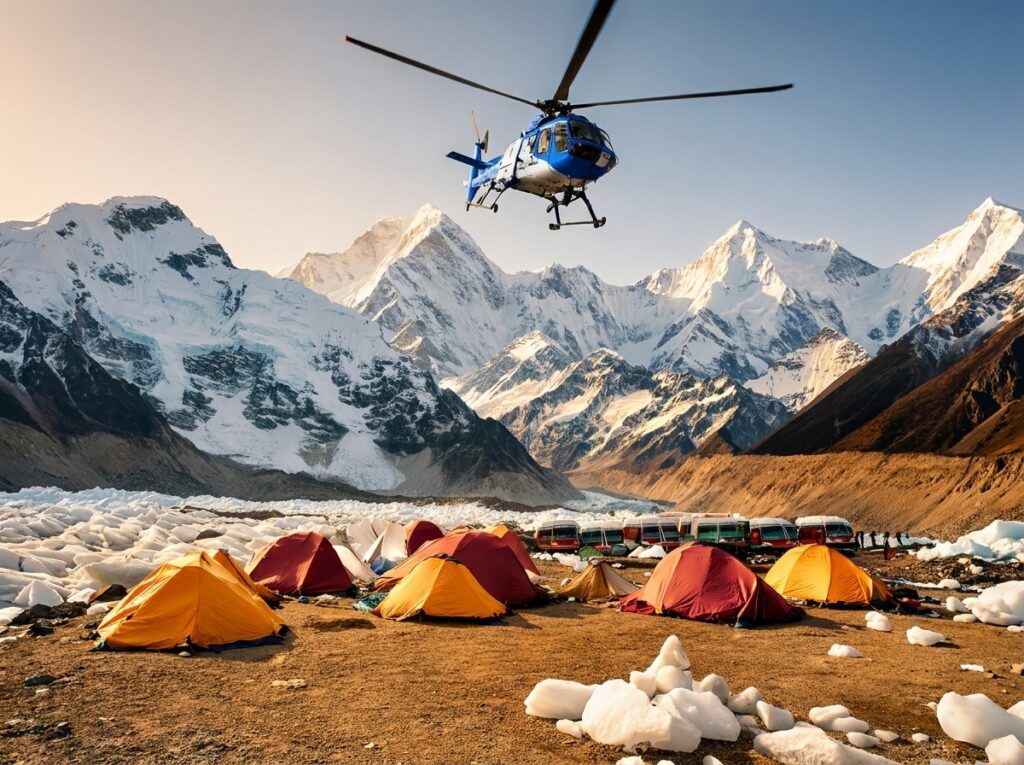
The helicopter more or less follows the same corridor you walked coming up — over the Khumbu glacier, past the string of villages, with the big peaks visible the entire way. It’s a strange feeling, seeing in a few minutes what took you days to cross on foot.
In terms of actual flying time, it’s short. Most operators quote somewhere between 15 and 20 minutes in the air for the Gorakshep to Lukla leg. That said, don’t assume the whole process wraps up in twenty minutes flat. Boarding takes time, weather can cause delays, and if you’re in a larger group, there’s a good chance you won’t be flying straight through — which brings up something worth understanding before you book.
The Weight Limit Problem (And Why Your Group Might Get Split Up)
This part surprises a lot of people, so it’s worth explaining clearly. At Gorakshep’s altitude, the air is thin enough that helicopters can’t lift the same payload they would at sea level. Most of the aircraft used on this route are rated to carry five passengers, but in reality, they can usually only lift about three people plus luggage in one go from that elevation.
So what happens if you’re traveling in a group of four or five? The helicopter runs what’s basically a shuttle. It picks up the first two or three passengers in Gorakshep and flies them down to a lower point — often Pheriche, which sits around 4,500 meters — where the air is denser and lifting weight is less of an issue. Then it goes back up to Gorakshep, picks up the remaining passengers, and brings them down to that same lower point. Once everyone’s together, the helicopter takes the whole group onward to Lukla.
It sounds complicated written out like this, but in practice it’s routine. Operators do this constantly and it doesn’t really add much time to the overall transfer. It’s just something to know ahead of time so you’re not surprised if your group gets split into two short hops instead of one straight flight.
So, How Much Does This Actually Cost?
This is where things get a little messy, because prices vary a lot depending on who you ask, what season it is, and how many people are splitting the cost. Based on current quotes from a range of operators working the Everest region, here’s roughly what you’re looking at.
If you’re booking a shared seat — meaning you’re one of several passengers splitting a helicopter that’s already going that direction — expect somewhere in the range of 500 to 750 dollars per person. During particularly busy stretches of the trekking season, some operators push shared rates up toward 1,000 dollars per person, mostly because demand for helicopters is high and seats fill fast.
If you’d rather charter the whole aircraft privately, either because you want flexibility on timing or you just don’t want to wait around for other passengers to fill the seats, you’re looking at something closer to 1,500 to 3,500 dollars total, depending on the operator and how many people are in your own group. Smaller private groups — say two or three people — will end up paying more per head than a full group of five splitting the same charter.
A few things push these numbers up or down. Season matters a lot — spring and autumn are peak trekking months in the Khumbu, and prices tend to rise along with demand. Group size matters too, since a fuller helicopter means the cost gets divided more ways. Weather plays a role as well; flights only go out when visibility and wind conditions are considered safe, and delays or cancellations can shuffle prices and availability around. And weight limits, as mentioned above, can affect how many people and how much gear actually fit per lift, which sometimes factors into the quote you’re given.
For a bit of context, a standard scheduled flight between Lukla and Kathmandu costs somewhere around 170 to 200 dollars one-way. So the Gorakshep-to-Lukla helicopter segment is clearly not a budget option — it’s a premium convenience, and it’s priced that way.
How to Actually Book One
There are two realistic paths here. The first is booking ahead of time as part of your full itinerary. A lot of trekking agencies now offer a package built specifically around this — you do the standard trek up to Everest Base Camp and Kala Patthar, and instead of walking back down, you fly out from Gorakshep. It’s marketed under names like “EBC Trek with Helicopter Return,” and it’s become common enough that most agencies in Kathmandu will know exactly what you’re asking for.
The second path is deciding on the ground, once you’re already at Gorakshep or nearby. This is more spontaneous, and honestly, it’s how a lot of people end up doing it — you get to base camp, your legs are done, and you or your guide start asking around about helicopter availability. If you’re hoping to share a flight and split the cost with other trekkers, this route requires a bit more patience, since you might need to wait a day for enough people to fill a shared seat. Guides and lodge owners in the area tend to know operators well and can usually help sort this out quickly.
Either way, get pricing confirmed in writing before you commit, and clarify exactly what’s included — some quotes cover just the flight, others fold in extras like a short detour over Everest Base Camp itself for better photos.
What The Day Itself Is Like
Mornings are generally the best time to fly. Winds tend to be calmer earlier in the day, and visibility is usually better before afternoon clouds start rolling in, which is a pattern that holds true across most of the Everest region, not just this specific route. Don’t be shocked if your flight gets pushed back a few hours, or even to the next day — this is standard practice in mountain flying, not a sign that anything’s gone wrong. Patience really is part of the deal here.
Luggage limits are strict, more strict than you’d expect if you haven’t flown in this kind of terrain before. Confirm your weight allowance ahead of time and pack accordingly — this isn’t the moment to bring back three extra kilos of souvenirs from Namche.
As for the flight itself, the views are genuinely the whole point. You’ll get close passes over the Khumbu glacier, and depending on the exact route and weather, sightings of Everest, Lhotse, Nuptse, and Ama Dablam from an angle you simply don’t get on foot. A lot of trekkers say afterward that the flight ended up being one of the most memorable parts of the whole trip, which says something given everything else that happens on an EBC trek.
Other Routes Worth Knowing About
If Lukla isn’t your final stop, some operators run direct Gorakshep to Kathmandu flights instead, usually taking around 55 minutes to an hour and costing considerably more given the extra distance and altitude range covered — often several thousand dollars split across a group. There are also similar transfers available from villages like Pheriche, Dingboche, and Lobuche, generally priced a bit lower than starting from Gorakshep itself, simply because those points sit at a lower, easier-to-lift altitude.
A Few Questions People Ask Before Booking
Is it safe? This is usually the first thing people want to know, and it’s a reasonable thing to ask given how remote and high-altitude the whole area is. The honest answer is that operators flying this route do it constantly, often multiple times a day during peak season, and the pilots working here are specifically experienced in high-altitude mountain flying, which is a different skill set from flying at lower elevations. Helicopters used on this route are also generally fitted out for these conditions, including things like oxygen masks on board. That said, no one flies if the weather doesn’t cooperate — pilots would rather delay a flight by a day than push through poor visibility, and that’s exactly the attitude you want from them.
What if the weather doesn’t cooperate at all and the flight keeps getting pushed back? It happens, more often than people expect. If you’re on a tight schedule, it’s worth building at least one buffer day into your itinerary around the point where you plan to fly out, just in case. Agencies dealing with this route regularly will usually tell you the same thing upfront.
Can you combine this with other parts of your trip, like flying out over Everest Base Camp itself for photos before continuing on to Lukla? Often, yes — some operators will add a short detour over base camp for an extra fee, which isn’t a huge amount on top of the base price and gives you one more angle on the mountain before you head down. Worth asking about specifically when you’re getting quotes, since it’s not always mentioned unless you bring it up.
Is It Actually Worth Booking?
Honestly, it depends on what you’re optimizing for. If your priority is getting home on time, or your body’s telling you it’s had enough, the helicopter transfer solves both problems at once, and for most people, the cost feels justified the second the helicopter lifts off and the whole Khumbu valley opens up below them. If you’re working with a tighter budget, though, walking back down remains free beyond the usual cost of food and lodging, and it gives you a slower, second look at villages you may have rushed through on the way up.
Whichever way you go, book through an operator with a solid local reputation, get your pricing in writing, and leave some flexibility in your schedule. Weather doesn’t negotiate, and if there’s one thing that’s true of every helicopter flight in the Everest region, it’s that patience tends to pay off more than frustration ever does.
Comments (0)
Write a comment- Why People Choose to Fly Instead of Walk
- What the Flight Actually Looks Like
- The Weight Limit Problem (And Why Your Group Might Get Split Up)
- So, How Much Does This Actually Cost?
- How to Actually Book One
- What The Day Itself Is Like
- Other Routes Worth Knowing About
- A Few Questions People Ask Before Booking
- Is It Actually Worth Booking?
Read the latest Blogs & Insights
Explore our collection of articles and insights to gain in-depth travel knowledge, expert advice, and stay updated on the latest trends and tips.


No comments yet.