









Do You Need a Permit for the Annapurna Base Camp Trek? ACAP, TIMS and Costs
Planning the Annapurna Base Camp Trek? Find out which permits you need, including the Annapurna Conservation Area Permit (ACAP) and TIMS card, along with current costs, requirements and how to obtain them before your trek.
-
 Adventure Master Trek
-
25 September, 2026
-
11 mins read
-
23 Views
-
0 Comments


Yes — you need a permit for the Annapurna Base Camp trek, and as of 2026 you also need a licensed guide, which wasn’t always the case. The two documents that matter are the Annapurna Conservation Area Permit (ACAP) and the TIMS (Trekkers’ Information Management System) card, together costing roughly NPR 5,000, or about US$38–40 per person. On top of that, a rule introduced in April 2023 and now firmly enforced means independent, guideless trekking is no longer legally possible in the Annapurna Conservation Area. Here’s exactly what each permit covers, what it costs in 2026, where to get it, and what’s changed recently.
Quick Answer: What You Actually Need
For the standard Annapurna Base Camp route, you need:
- ACAP (Annapurna Conservation Area Permit) — mandatory, no exceptions, checked at multiple checkpoints
- TIMS card — technically required, though enforcement has become inconsistent at trail checkpoints in 2026 (more on this below)
- A licensed guide booked through a registered trekking agency — mandatory since April 2023, with no solo-trekking exception left for foreign nationals
That’s it. Unlike some restricted areas of Nepal (Upper Mustang, Nar Phu, Manaslu), the ABC route doesn’t require a special Restricted Area Permit or a minimum group size. It’s one of the more straightforward permit processes in the country, provided you understand the guide requirement going in.
ACAP: The Permit That Actually Matters
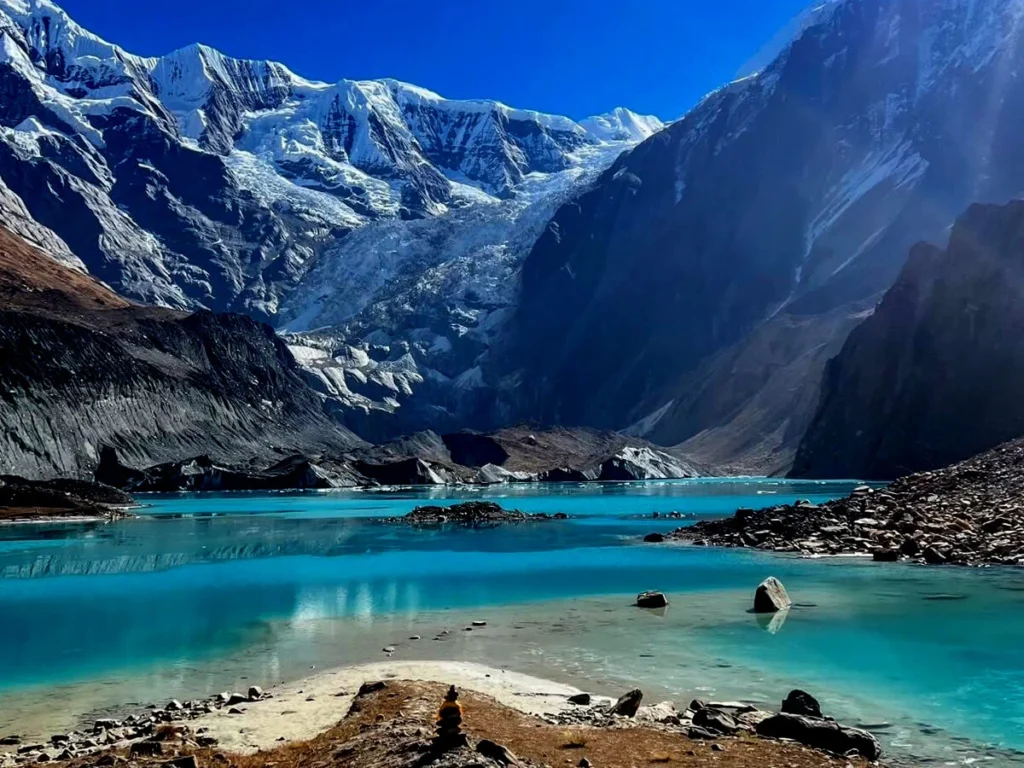
The Annapurna Conservation Area Permit is the core, non-negotiable document for this trek. It’s issued by the National Trust for Nature Conservation (NTNC) and grants entry into the Annapurna Conservation Area, Nepal’s largest protected area and the one that encompasses the entire Annapurna Sanctuary, including Base Camp itself.
Cost in 2026:
- Foreign nationals (non-SAARC): NPR 3,000, roughly US$22–25
- SAARC nationals (India, Bangladesh, Bhutan, Maldives, Pakistan, Sri Lanka, and Afghan nationals with valid travel documents): NPR 1,000, roughly US$8
- Children under 10: free, though documentation is still required
- Nepali citizens: a separate, minimal fee managed by NTNC
It’s worth knowing that this fee isn’t static. ACAP jumped from NPR 2,000 to NPR 3,000 for foreign nationals in September 2024, so if you’re working from an older blog post or a friend’s trip report from a few years back, expect the number to be higher now. The fee also doesn’t scale with how long your trek is — whether you’re doing a 4-day Poon Hill loop or a 12-day Sanctuary trek, the ACAP cost is the same flat fee.
TIMS Card: Required on Paper, Inconsistent in Practice
The TIMS card is where the current rules get genuinely confusing, and it’s worth addressing head-on rather than pretending the situation is simpler than it is.
TIMS was originally designed as a safety-tracking system, logging who’s on the trail so authorities can locate trekkers in an emergency. For years it existed in two forms: a green card for independent trekkers and a blue card for those trekking with an agency. Since the 2023 guide mandate effectively ended independent trekking in conservation areas, the old green independent-trekker TIMS has been phased out, and the system is shifting toward a model where TIMS is issued only through a registered agency alongside your guide booking.
Cost when issued (2026): roughly NPR 2,000 (about US$15-17) for an individual trekker, or NPR 1,000 per person when issued through a group booking.
The confusing part: multiple current sources describe TIMS as “technically required but not actively enforced” at many Annapurna checkpoints in 2026, with checkpoint staff focusing almost entirely on verifying the ACAP permit and guide credentials instead. Practically speaking, this means:
- If you book through a trekking agency, they’ll almost certainly arrange TIMS for you as a matter of course, whether or not it gets checked on the trail.
- If you’re piecing together your own logistics (with your mandatory guide arranged separately), it’s worth asking your guide or agency directly whether TIMS is being issued for your specific route and dates, since the rules have been in flux.
- Don’t assume you can skip it just because enforcement seems patchy — regulations in Nepal’s trekking regions have changed direction before, and being the one trekker without a required document at the wrong checkpoint is not a risk worth taking to save $15.
The Guide Requirement: The Real Change Since 2023
If you last researched this trek before 2023, the single biggest thing that’s changed isn’t the permit fee — it’s the fact that trekking the Annapurna Base Camp route without a licensed guide is no longer a legal option for foreign nationals.
On April 1, 2023, the Nepal Tourism Board and the Trekking Agencies’ Association of Nepal (TAAN) jointly introduced a rule requiring every foreign trekker to be accompanied by a licensed guide or porter-guide hired through a government-registered agency, across virtually all national parks, conservation areas, and restricted zones. The stated reasons were trekker safety (reducing the number of missing or stranded hikers each year) and formalizing employment for local guides and porters, many of whom had previously worked informally.
As of 2026, this rule is firmly and consistently enforced on Annapurna routes specifically:
- Checkpoints along the Annapurna Circuit and Base Camp trails now verify guide credentials, and some report QR-code-based verification of guide licenses.
- Trekkers arriving without a licensed guide are turned back at permit counters rather than waved through with a warning.
- Penalties for attempting to trek without a licensed guide can include fines (figures cited range from roughly NPR 12,000 up to NPR 50,000 depending on the source and region), forced evacuation from the trail at the trekker’s own expense, and potential complications with travel insurance claims if an incident occurs while out of compliance.
A practical nuance worth knowing: this guide mandate is stricter and more consistently enforced in the Annapurna region and Langtang than it currently is in the Everest/Khumbu region, where local rules and enforcement have been described as more variable. If you’re planning both an Annapurna and an Everest region trek, don’t assume the rules are identical between the two — Annapurna is the stricter of the two in 2026.
Guide costs aren’t part of the “permit” fee technically, but they’re now a non-optional line item in your budget: expect to pay roughly US$25–35 per day for a standard licensed guide, more for a senior or specialized guide, typically bundled into an all-inclusive package price if you book through an agency rather than hired independently.
Full Cost Breakdown for 2026
| Item | Foreign Nationals | SAARC Nationals |
| ACAP Permit | NPR 3,000 (~US$22–25) | NPR 1,000 (~US$8) |
| TIMS Card | NPR 2,000 individual / NPR 1,000 group (~US$15–17) | Same tiered structure |
| Licensed guide | Not a permit fee — budget US$25–35/day separately | Same |
| Total permit cost | ~NPR 5,000 (~US$38–40) | ~NPR 2,000–3,000 (~US$15–23) |
For comparison, this is meaningfully cheaper than permits for restricted areas like Upper Mustang, where a daily Restricted Area Permit fee (recently set at US$50/day for the area itself, on top of ACAP and TIMS) can push total permit costs for a 10-day trip well past US$500. The standard ABC route remains one of the more affordable permit packages in Nepal precisely because it isn’t a restricted area, just a conservation area with a flat entry fee.
Where to Get Your Permits
You have three practical options, and which one makes sense depends on how you’re organizing the rest of your trip.
Option 1: Through a trekking agency (most common in 2026). Since a licensed guide is mandatory anyway, most trekkers now book a package or a guide-plus-logistics arrangement through a registered agency, which handles ACAP and TIMS paperwork as part of the booking. This is the simplest route and the one that guarantees your documents match current requirements, since agencies deal with permit offices daily and track rule changes as they happen.
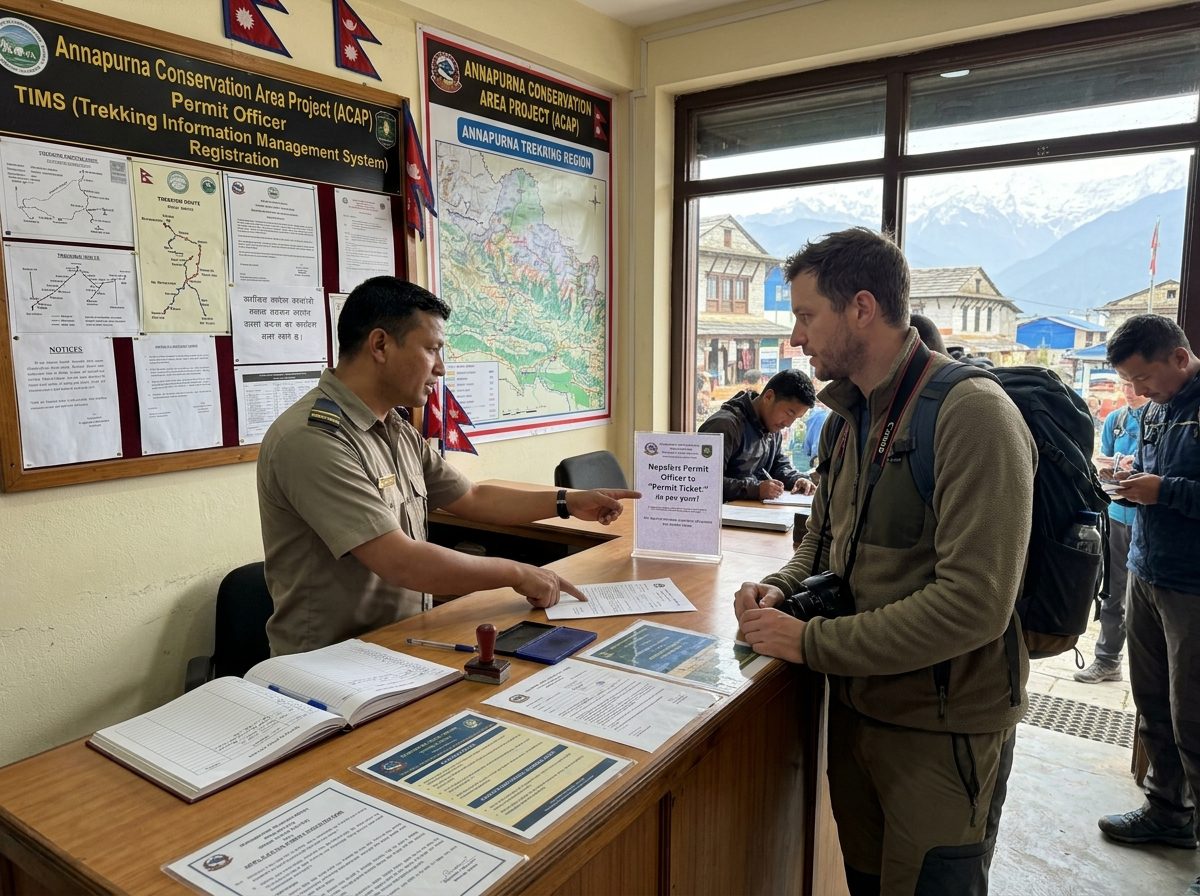
Option 2: In person in Kathmandu. The Nepal Tourism Board’s Tourist Service Centre at Bhrikutimandap, near Thamel, issues both ACAP and TIMS. It’s open Sunday through Friday, roughly 9am to 5pm, closed Saturdays and public holidays.
Option 3: In person in Pokhara. Since most ABC treks start from the Pokhara side, many trekkers prefer picking up permits here instead. The Nepal Tourism Board office at Damside (Pardi) handles both permits, and the separate ACAP counter at Damside is specifically set up for Annapurna-bound trekkers; the TAAN office at Lakeside can also process agency-issued permits. Same hours as Kathmandu, generally.
What to bring, wherever you go:
- Your original passport, valid for at least six months beyond your trip
- A photocopy of your passport bio page and Nepal visa
- Two to four passport-sized photos (34x45mm or 35x45mm; bring physical printed photos, not just digital copies)
- Cash in Nepali rupees — permit counters do not accept cards
- Basic trip details: rough itinerary, entry and exit points, and your guide’s details if you’ve already arranged one
Processing is generally fast if your documents are in order — most trekkers report getting both permits within 20 minutes to an hour.
A note on going online: ACAP has an e-permit option through NTNC’s online portal, and TIMS has historically had a similar digital application route. In practice, most independent travelers still find it faster and more reliable to apply in person or let their agency handle it, since the digital systems have had a mixed track record with international payments and document uploads. If you do go the online route, print a hard copy anyway — trail checkpoints in mountainous parts of the Annapurna region don’t reliably have signal for you to pull up a digital version.
What Happens If You Skip a Permit?
This isn’t a theoretical question — the ABC trail has multiple staffed checkpoints (including at the entrance near Birethanti/Ghandruk and further up the valley), and permits are physically checked, not just requested on the honor system. Trekking without ACAP, or without a guide when required, can result in being turned back at the checkpoint, fines, and in some described cases a permanent black mark against future permit applications. It’s also worth considering the insurance angle: if you need a medical evacuation or your travel insurer investigates a claim, being out of compliance with Nepal’s permit and guide requirements at the time of the incident is the kind of detail that can complicate or void a claim.
None of this is meant to be alarmist — the overwhelming majority of ABC trekkers comply without issue, and the process itself is quick and low-friction once you know what’s required. The main risk is outdated information: guidebooks, old blog posts, and even some currently-published articles still describe a pre-2023 world where solo trekking with just an ACAP permit was routine. That world no longer exists for this route.
The Bottom Line
Getting permitted for Annapurna Base Camp in 2026 comes down to two things: paying roughly US$38–40 for ACAP and TIMS combined, and accepting that a licensed guide is now a legal requirement, not a nice-to-have. The paperwork itself is genuinely simple compared to Nepal’s restricted-area treks — no daily fees, no minimum group size, no complicated application windows. The part that trips people up is outdated expectations about solo trekking, so go in knowing that the guide requirement is real, consistently enforced on this specific route, and worth budgeting for from the start rather than discovering at a checkpoint partway up the trail.
Planning Your Annapurna Base Camp Trek?
Adventure Master Treks can handle your ACAP and TIMS paperwork, arrange a licensed guide, and build an Annapurna Base Camp itinerary around your fitness level and travel dates. Get in touch with Adventure Master Treks to start planning your trek.
Frequently Asked Questions
- Can I still trek Annapurna Base Camp without a guide?
No, not legally, as of 2026. The April 2023 guide mandate applies to the Annapurna Conservation Area with no remaining exception for solo foreign trekkers. If you want a highly independent experience, hiring a guide through an agency and setting your own pace with just the two of you is the closest legal equivalent to solo trekking on this route.
- Do children need a permit?
Children under 10 are generally exempt from ACAP and TIMS fees, though it’s worth carrying identification and checking current rules with your agency, since documentation requirements can still apply even when the fee is waived.
- Does the permit cost change based on trek length?
No. ACAP is a flat single-entry fee regardless of whether your itinerary is 4 days or 14 days.
- Can I get the permit at the trailhead instead of Kathmandu or Pokhara?
It’s best not to count on this. While some entry points historically allowed permit purchase at trailhead checkpoints, the safer and more standard approach in 2026 is to secure both ACAP and TIMS in Kathmandu or Pokhara — or through your agency — before you start walking.
- Is ACAP the same as a TIMS card?
No, they’re two different documents serving different purposes. ACAP is your conservation-area entry permit and the one checkpoints scrutinize most closely. TIMS is a trekker-registration and safety-tracking system, currently issued mainly through agencies and less consistently checked on the trail, though it remains part of the formal requirement.
- How long does it take to get both permits?
If you have your documents ready (passport, photos, cash), expect 20 minutes to an hour at either the Kathmandu or Pokhara office. Agencies handling it on your behalf typically fold this into your pre-trek preparation day without you needing to visit an office at all.
Comments (0)
Write a comment- Quick Answer: What You Actually Need
- ACAP: The Permit That Actually Matters
- TIMS Card: Required on Paper, Inconsistent in Practice
- The Guide Requirement: The Real Change Since 2023
- Full Cost Breakdown for 2026
- Where to Get Your Permits
- What Happens If You Skip a Permit?
- The Bottom Line
- Frequently Asked Questions
Read the latest Blogs & Insights
Explore our collection of articles and insights to gain in-depth travel knowledge, expert advice, and stay updated on the latest trends and tips.



No comments yet.