









Everest Helicopter Tour for Honeymoon Couples: A Romantic Himalayan Experience
Celebrate your honeymoon with an unforgettable Everest helicopter tour. Enjoy breathtaking views of Mount Everest, private helicopter flights, scenic landings, luxury breakfast options, and a once-in-a-lifetime romantic experience above the Himalayas.
-
 Adventure Master Trek
-
6 August, 2026
-
9 mins read
-
469 Views
-
0 Comments


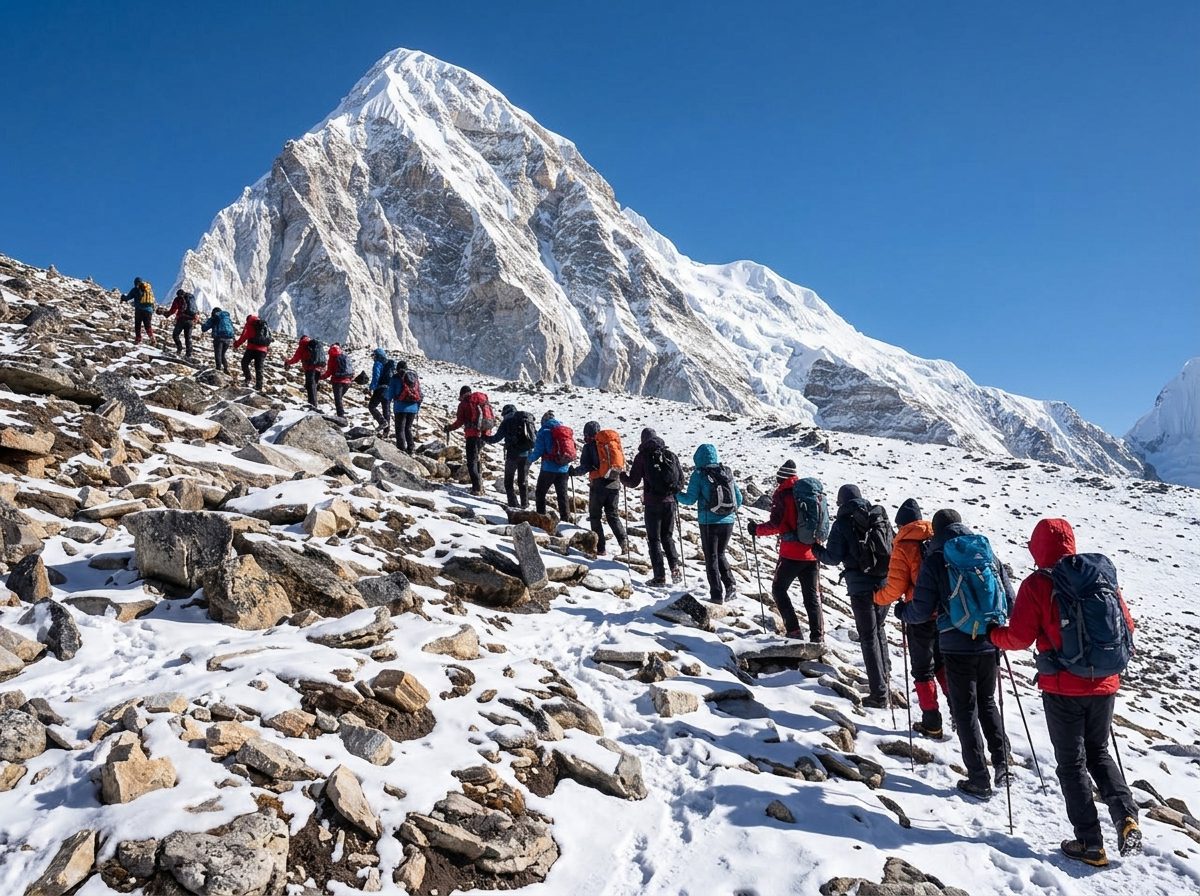
Somewhere in the last few years, a strange assumption took hold — that seeing Mount Everest up close requires signing up for a two-week trek, blisters, altitude headaches, and a shared dorm room in a teahouse with paper-thin walls. That assumption is mostly why more couples don’t consider Everest for their honeymoon at all. It sounds like an expedition, not a romantic getaway.
Which is a shame, because there’s a version of this experience that takes about four hours, starts with breakfast in Kathmandu, and ends with two people standing above 5,000 meters, looking at the tallest mountain on Earth, without either of them having trained for it, packed hiking gear, or spent a single night sleeping in a sub-zero sleeping bag. That’s the part most honeymoon planning guides miss entirely: an Everest helicopter tour isn’t a consolation prize for people who can’t trek. For a lot of couples, it’s genuinely the better option — not despite being shorter, but because of it.
Here’s what that actually looks like, and why it’s quietly become one of the more sought-after honeymoon additions for couples visiting Nepal.
Why This Works Better Than People Expect
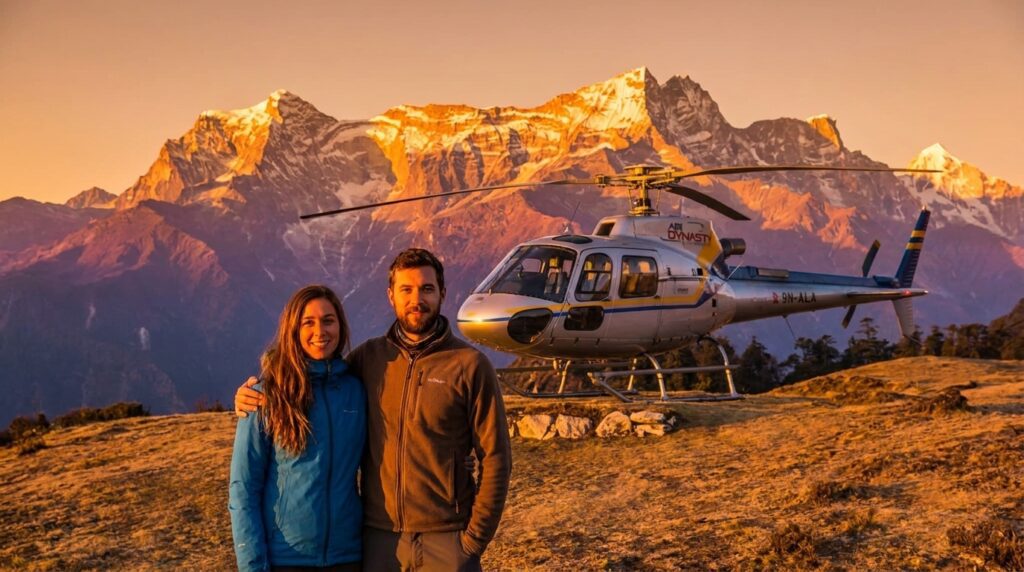
The instinct with a honeymoon is usually to build in some kind of “we did something incredible together” moment — the kind of story you tell at dinner parties for the next twenty years. A helicopter tour to Everest Base Camp delivers exactly that, but compresses it into a single unforgettable morning instead of asking you to trade two weeks of your limited honeymoon time for it.
That distinction matters more than people initially think. Most couples honeymooning in Nepal are also trying to fit in Kathmandu’s temples, maybe a few days in Pokhara by the lake, perhaps a jungle safari in Chitwan. A two-week trek eats the entire trip. A four-hour helicopter flight is something you can slot in on day two or three and still have the rest of your honeymoon intact for the parts that are actually about relaxing together.
What the Morning Actually Looks Like
Flights depart early — usually between 6 and 7 AM — because Himalayan weather is calmest and clearest before the day heats up and clouds start building over the valleys. Your day starts with a short transfer to the airport, and from there the helicopter climbs out of the Kathmandu valley and heads northeast toward the Khumbu region.
The first real payoff comes fast. Within twenty to thirty minutes, the terrain below shifts from green hillside terraces to the jagged, snow-covered wall of the Himalayas, and peaks most people have only seen in photographs — Everest, Lhotse, Nuptse, Ama Dablam — start appearing through the windows, close enough that they stop looking like postcard images and start looking real.
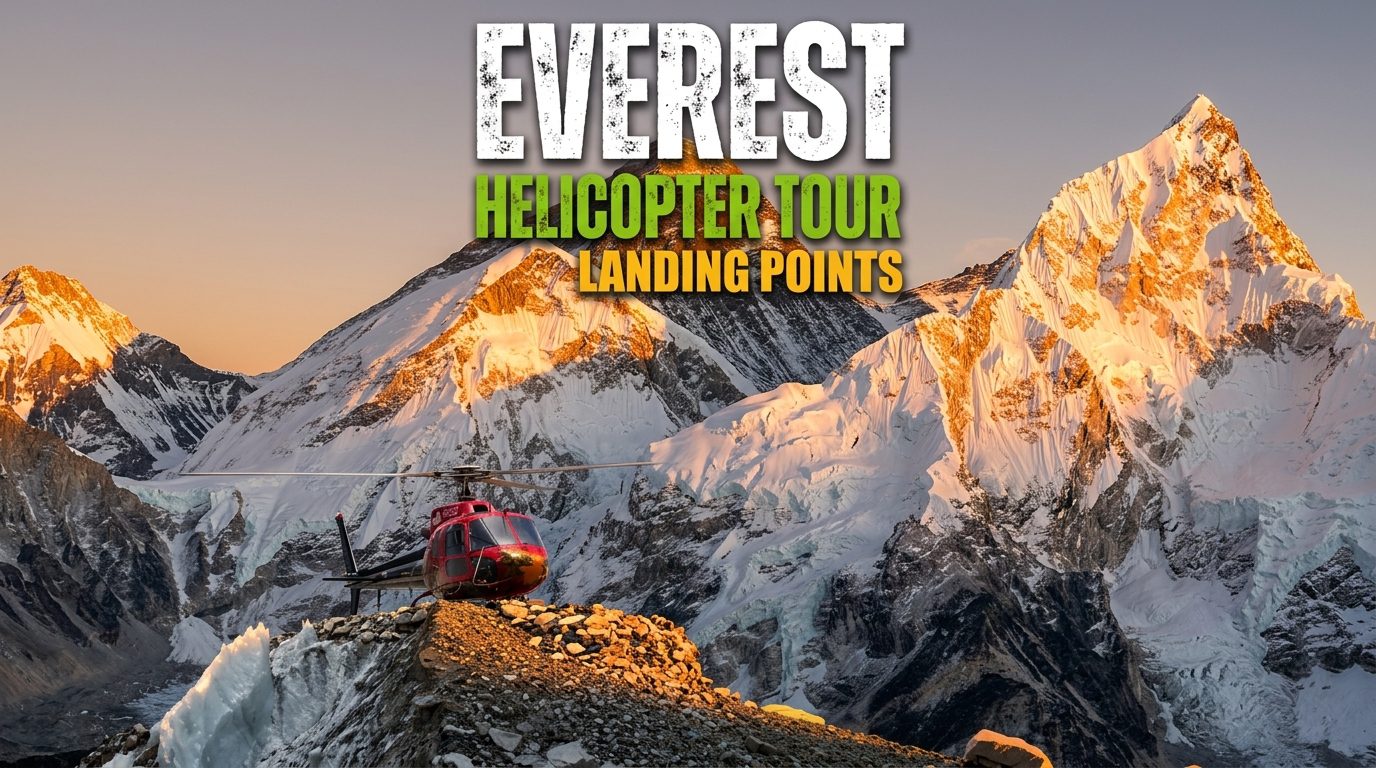
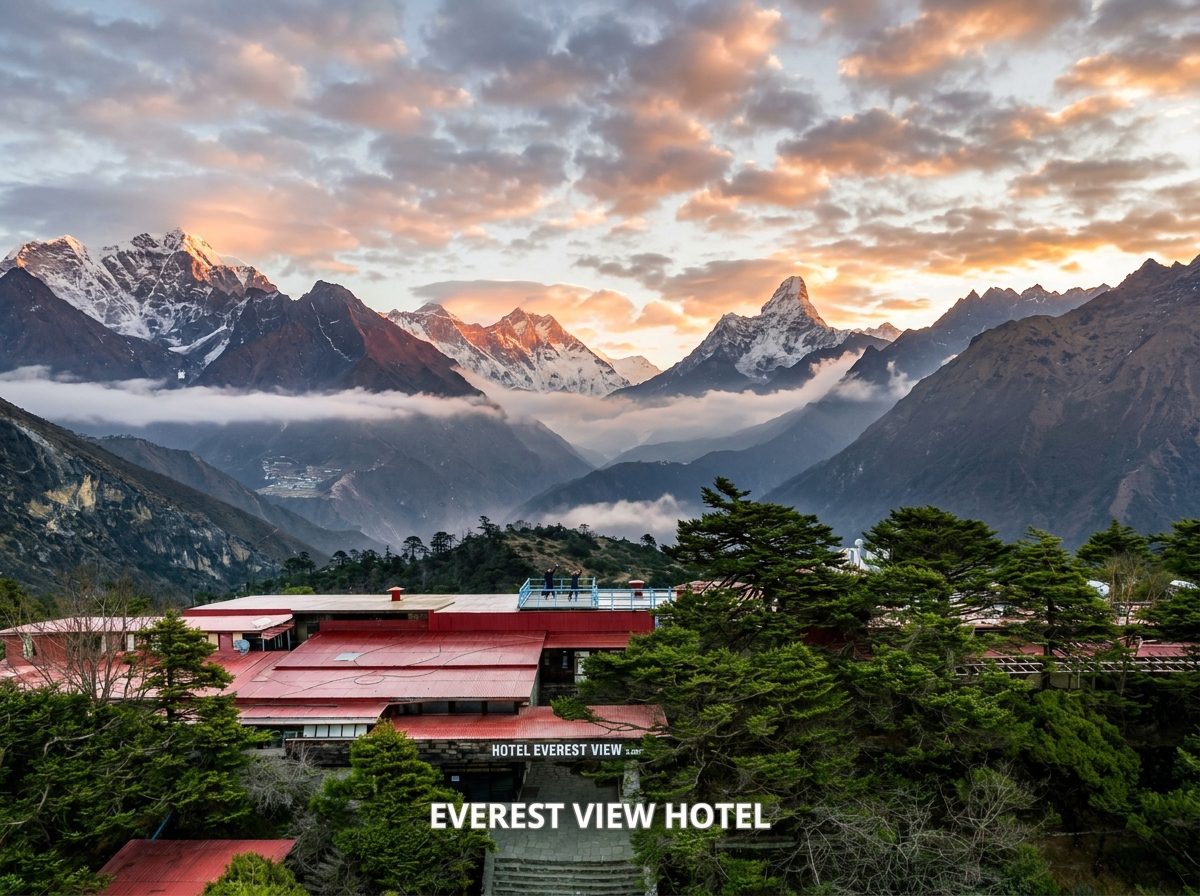
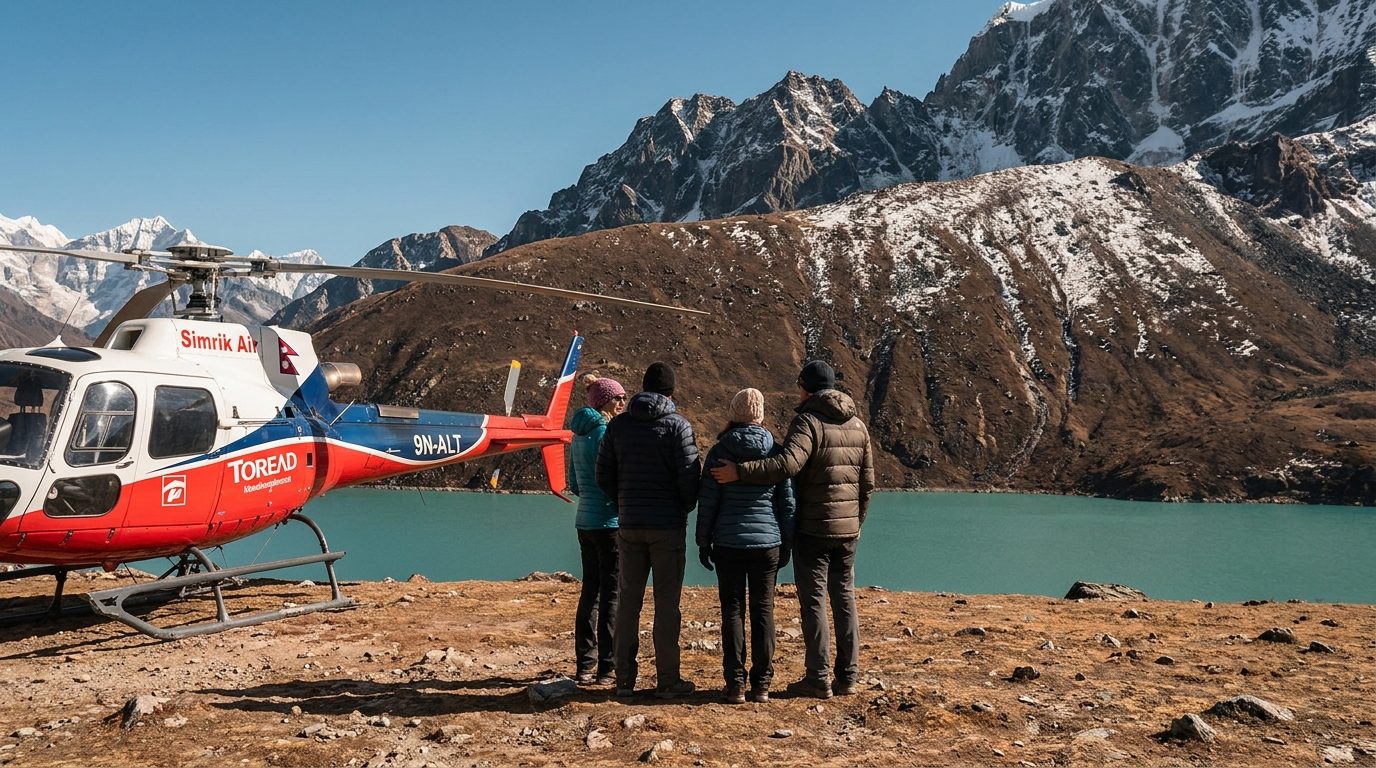
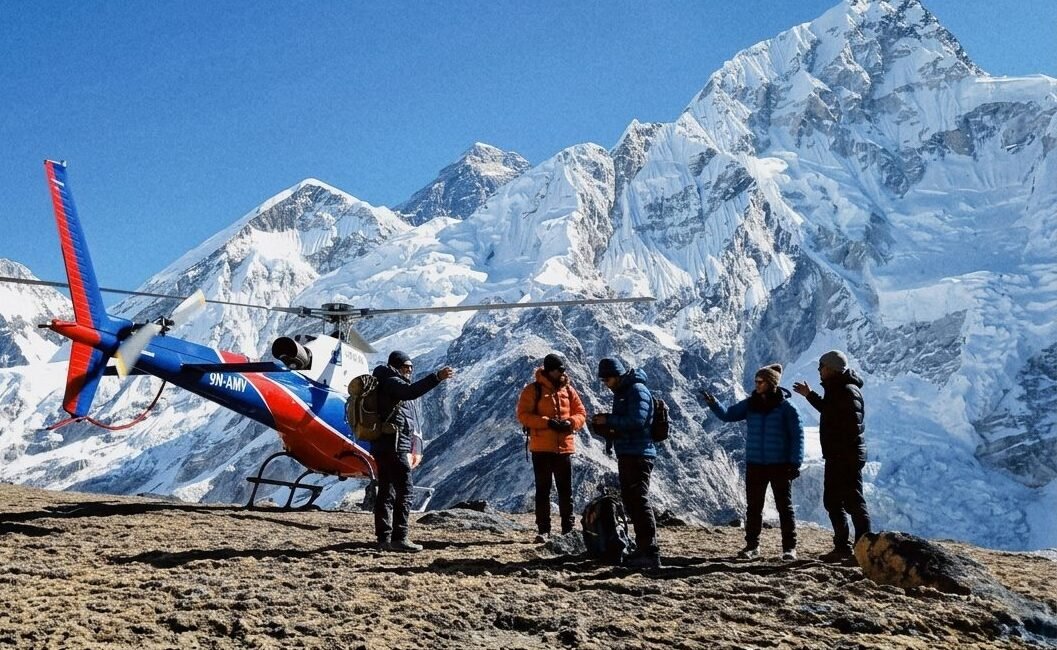
Most private couple’s tours include a landing near Kala Patthar or close to Everest Base Camp itself, at roughly 5,300 to 5,500 meters, giving you ten to fifteen minutes on the ground surrounded by the same amphitheater of peaks that trekkers spend two weeks walking toward. From there, many tours continue to Syangboche for breakfast at a hotel with a direct view of Everest, before the return flight back to Kathmandu.
Total time from departure to landing back in Kathmandu: roughly three to four hours. Total time you’ll spend talking about it afterward: considerably longer.
The Case for Booking It as a Private Charter
Group-shared helicopter tours exist, and they’re a genuinely good option for solo travelers or friends trying to keep costs down. But for a honeymoon specifically, a private charter changes the experience in ways that are worth the extra cost.
On a shared flight, you’re one of five or six passengers, on a schedule built around a group, with your landing time and photo opportunities split among everyone on board. On a private charter, it’s just the two of you — no strangers in your wedding photos, no rushing your ten minutes at Kala Patthar because four other people are waiting for their turn, and the flexibility to adjust timing slightly if weather conditions shift. Some operators will also work with you on small touches — a bottle of champagne on board, a specific song queued up for the flight, coordinating with your photographer beforehand so you get shots that actually feel like yours instead of a group tour photo with your faces in it.
If there’s one upgrade worth spending the extra money on for a honeymoon specifically, it’s this one.
What It Actually Costs
As of 2026, a private helicopter charter for a couple typically runs somewhere in the range of USD 2,500 to 6,500 depending on the operator, exact route, and season, while shared group seats with a landing run closer to USD 1,150 to 1,500 per person. That’s a real gap, and it’s fair to weigh it against everything else on a honeymoon budget.
But it’s worth framing that cost correctly. Compared to the price of a two-week trek — permits, guide and porter fees, teahouse accommodation for fourteen nights, gear rental, and the extra vacation days it requires — a private helicopter tour is often not actually more expensive once you account for the time it saves. You’re paying for compression: the same view, the same “we stood in front of Everest together” story, delivered in a morning instead of two weeks of your limited honeymoon calendar.
Do You Need to Worry About Altitude Sickness?
This is the question almost every couple asks, and the honest answer is: less than you’d think, but not zero. Because you’re not walking up gradually over multiple days the way trekkers do, your body doesn’t get the usual acclimatization window before reaching serious elevation. Landing briefly at 5,300+ meters can cause lightheadedness, mild shortness of breath, or a headache for some people, simply because you’ve gone from sea-level-adjacent Kathmandu to nearly 18,000 feet in about half an hour.
For most healthy travelers, a short ten-to-fifteen-minute landing doesn’t give altitude sickness enough time to set in seriously, which is exactly why tours keep ground time brief rather than lingering. Reputable operators will also brief you beforehand, watch you during landing, and cut the stop short if either of you shows real symptoms rather than pushing through for the sake of the itinerary. If either of you has a history of altitude sensitivity, it’s worth mentioning to the operator ahead of time — most have real experience managing this and can adjust accordingly.
The Best Time of Year to Book It as a Honeymoon Trip
If your wedding and honeymoon dates are flexible, timing this tour well makes a genuine difference to how it photographs and how reliable the flight schedule is. Spring — March through May — and autumn — September through November — are the strongest windows, with the clearest skies and most stable morning weather of the year. October in particular tends to deliver the sharpest, most dramatic mountain views, which matters if part of your goal is honeymoon photos you’ll actually want printed and framed.
If your wedding falls during monsoon season (roughly June through August), it’s not a dealbreaker — flights still operate — but expect a higher chance of delays or rescheduling, and build a spare day or two into your itinerary rather than scheduling the tour for your one and only free morning in Kathmandu.
Making It Feel Like Part of the Honeymoon, Not a Side Excursion
The easiest way for this to feel like a genuine honeymoon experience rather than just a scenic flight is in the small details you arrange ahead of time, rather than what happens automatically.
Tell the operator it’s a honeymoon when you book — most are happy to add small touches like champagne, a handwritten note, or slightly more flexible timing at no extra charge, simply because couples celebrating something specific tend to be memorable, appreciated clients. If photography matters to you, ask in advance whether the pilot or a crew member can take a few photos of you both during the Kala Patthar landing, since a phone selfie in bulky jackets rarely does the moment justice. And consider pairing the flight with something quieter afterward — a slow breakfast, an afternoon with no plans — rather than packing the rest of the day with sightseeing. Part of what makes this work as a honeymoon experience is giving yourselves room to actually process what you just saw, rather than rushing straight into the next item on the itinerary.
Who This Is Actually Right For
This isn’t a universal answer to “what should we do for our honeymoon in Nepal,” and it’s worth being honest about who it suits best. Couples who want a genuine trekking experience together — the shared effort, the days of conversation on the trail, the earned feeling of walking into Base Camp on your own legs — will get something from the full trek that a helicopter tour simply can’t replicate. That’s a real and valid honeymoon experience too, for the right couple.
But for couples with limited time, a partner who isn’t up for two weeks of high-altitude hiking, an already packed multi-stop honeymoon itinerary, or simply a preference for comfort over endurance as a shared value, the helicopter tour delivers almost all of the emotional payoff — standing together in front of Everest, sharing something neither of you will ever forget — without asking you to spend half your honeymoon getting there.
The Real Reason This Has Become a Honeymoon Trend
Ask couples who’ve actually done this what stands out most, and it’s rarely the technical details — the altitude, the aircraft, the flight path. It’s almost always some version of the same thing: a quiet ten minutes standing next to each other at nearly 18,000 feet, surrounded by peaks that took millions of years to form, at the very start of a life they’re building together. There’s something about that scale — genuinely enormous, genuinely permanent, right at the beginning of something new for the two of you — that a lot of couples describe as unexpectedly emotional, in a way neither of them saw coming going in.
That’s ultimately the pitch, stripped of the logistics and pricing details: not just a good photo opportunity, though it is that too, but a shared, slightly overwhelming moment that fits into a single morning of a honeymoon that still has plenty of time left over for everything else you planned.
Comments (0)
Write a comment- Why This Works Better Than People Expect
- What the Morning Actually Looks Like
- The Case for Booking It as a Private Charter
- What It Actually Costs
- Do You Need to Worry About Altitude Sickness?
- The Best Time of Year to Book It as a Honeymoon Trip
- Making It Feel Like Part of the Honeymoon, Not a Side Excursion
- Who This Is Actually Right For
- The Real Reason This Has Become a Honeymoon Trend
Read the latest Blogs & Insights
Explore our collection of articles and insights to gain in-depth travel knowledge, expert advice, and stay updated on the latest trends and tips.


No comments yet.