









Muktinath Helicopter Tour vs Road Journey: Which One Should You Choose?
Ask ten people who’ve been to Muktinath how they got there, and you’ll probably get two very different stories. Half will tell you about a 25-minute helicopter ride over the Himalayas that had them back in Pokhara before lunch. The other half will describe a bumpy, three-day jeep ride through the Kali Gandaki gorge, complete […]
-
 Adventure Master Trek
-
24 July, 2026
-
12 mins read
-
519 Views
-
0 Comments


Ask ten people who’ve been to Muktinath how they got there, and you’ll probably get two very different stories. Half will tell you about a 25-minute helicopter ride over the Himalayas that had them back in Pokhara before lunch. The other half will describe a bumpy, three-day jeep ride through the Kali Gandaki gorge, complete with a hot spring stop, apple brandy in Marpha, and a night in a teahouse with no hot water. Both groups will say it was worth it.
That’s the thing about Muktinath — sitting at 3,710 meters in the Mustang district, sacred to both Hindus and Buddhists, home to the temple’s famous 108 water spouts and the eternal Jwala Mai flame, it’s not a place you stumble into. You have to decide how you’re getting there, and the two options couldn’t be more different. So let’s actually go through it: what each route costs, how long it really takes, what it feels like once you’re on it, and who each one is actually built for.
The Short Version
| Factor | Helicopter Tour | Road Journey |
| Duration from Pokhara | 2–4 hours, same day | 2–3 days minimum |
| Duration from Kathmandu | 3–4 hours, same day | 5–8 days |
| Cost from Pokhara | ~$600–$799 per person (shared) | NPR 5,000–8,000 per person (shared jeep) |
| Cost from Kathmandu | ~$1,200–$1,300 per person (shared) | Higher, once you add extra days, meals, hotels |
| Physical demand | Low | Moderate to high — rough roads, altitude gain |
| What you see | Himalayas from above | Villages, gorges, hot springs, valleys at ground level |
| Works best for | Seniors, short trips, comfort seekers | Budget travelers, road-trip types |
| Altitude | Fast — higher AMS risk | Gradual — easier on the body |
| Weather risk | Flights cancel often | Landslides possible, but rescheduling is easier |
Why People Bother Going at All
It’s worth pausing on why Muktinath matters so much before getting into logistics, because the effort people put in only makes sense once you know what’s pulling them there. It’s counted among the 51 Shakti Peeths and sits alongside places like Tirupati and Badrinath as one of the eight holiest Vishnu temples anywhere. Hindus who bathe under the 108 spouts and dip into the Mukti Kunda ponds believe it clears the sins of past lives — moksha, essentially. Buddhists know the same site as Chumig Gyatsa, a place for meditation rather than liberation, but no less sacred to them. Add the setting — high desert, wind-carved cliffs, snow peaks in every direction — and you start to understand why people will happily spend three days on a jeep, or drop $700 on a helicopter seat, just to stand there for an hour.
Flying In: What the Helicopter Tour Actually Involves
How Long It Takes
Helicopters leave from either Kathmandu or Pokhara, though Pokhara wins out for most travelers simply because it’s closer.
From Pokhara, you’re looking at a 25 to 45 minute flight each way, and the whole outing — flight there, time at the temple, flight back — is usually done in 2 to 4 hours. From Kathmandu it’s a bit longer, closer to an hour to ninety minutes each way, with the full trip landing somewhere around 3 to 4 hours.
Which means, practically speaking, you can leave your hotel before sunrise and be sitting down for lunch having completed what would otherwise eat up most of a week.
What It Costs
Pricing splits into two categories — charter the whole helicopter yourself, or join a group and split the cost.
From Pokhara, a private charter runs about $3,000 for the aircraft, which seats up to five, so a full group pays roughly $600 each. If you’d rather join a shared flight instead of booking the whole thing, expect $700 to $799 per person — operators tack on around $100 per head as a group-joining fee.
From Kathmandu, charter cost jumps to around $5,400–$5,500, and group joining runs $1,200–$1,300 per person.
Most quotes cover the seat, fuel surcharge, hotel pickup, and airport taxes. They won’t cover temple offerings, food, souvenirs, or insurance. And because helicopters only hold four or five people, solo travelers often end up paying more unless they can slot into an existing group — book at least a week out if you’re hoping to share.
What You Actually See
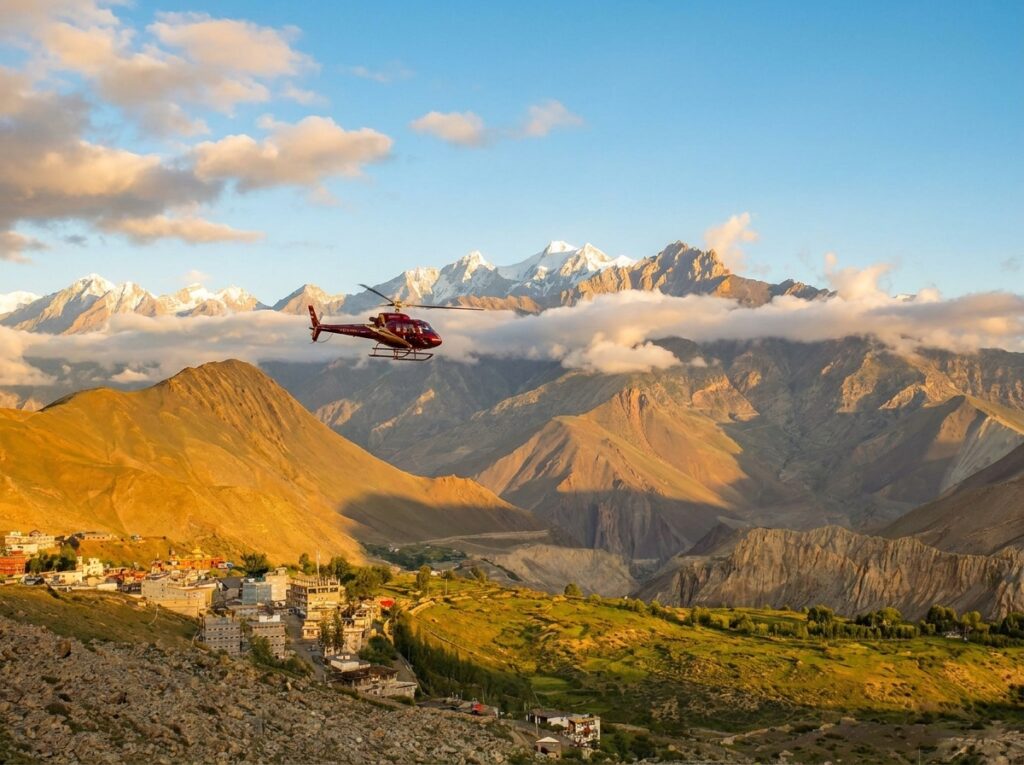
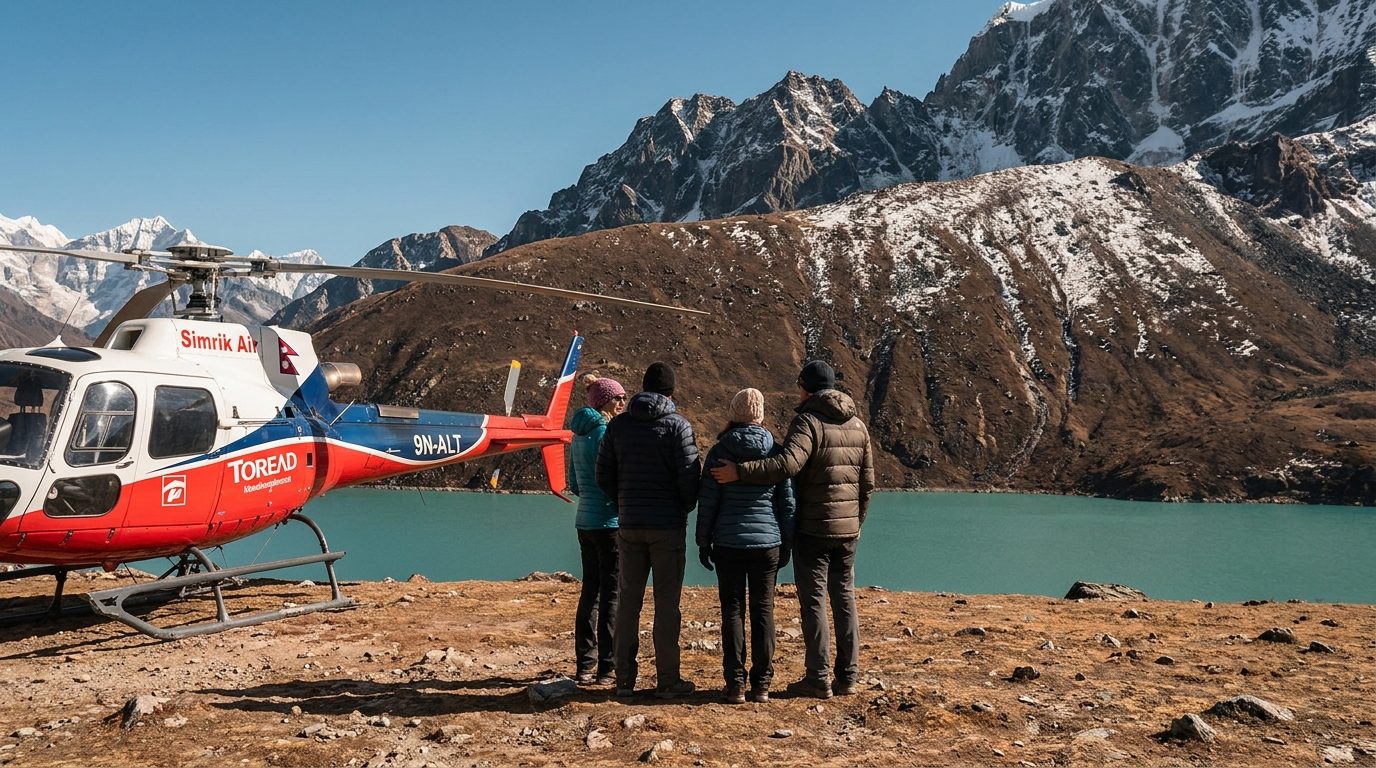
Leaving Pokhara, you pass over Begnas and Fewa lakes before climbing toward the Annapurna and Dhaulagiri ranges. The scenery flips fast once Mustang comes into view — green hills disappear and you’re suddenly over the raw, wind-scoured terrain of the Kali Gandaki gorge, one of the deepest in the world. Along the way you get close looks at Annapurna, Dhaulagiri, Nilgiri, Tukuche, and Machapuchare.
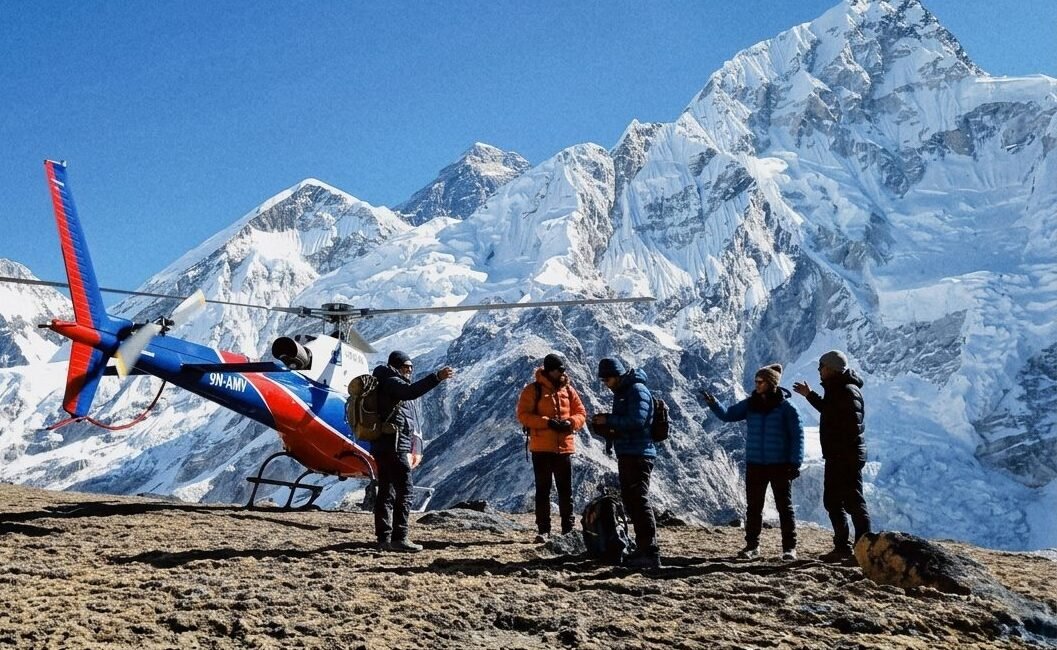
Landing spots vary — sometimes right near the temple, sometimes at Jomsom airport followed by a short walk or drive. Either way, you’ll typically get anywhere from 45 minutes to a couple of hours on the ground for darshan, the ritual bath, and a look around before heading back.
Why People Choose It
The obvious draw is time. A trip that would otherwise swallow a week gets compressed into a single morning, which matters a lot if you’re older, dealing with a bad knee, or just don’t have the days to spare. There’s also nothing else quite like watching the gorge open up beneath you, and most operators will reschedule or refund you if the weather doesn’t cooperate.
Where It Falls Short
It’s not cheap, and weather cancels flights more often than people expect — monsoon season especially. Gaining over 3,000 meters of altitude in under an hour also catches some people off guard; without time to acclimatize, mild altitude sickness is more common than on the road route. And you skip everything in between — the villages, the hot springs, the whole texture of the journey that road travelers get to experience.
Driving In: What the Road Journey Actually Involves
How Long It Takes
This is where the two options really diverge. The distance from Pokhara is only 160 to 185 km, which sounds short until you realize the road quality changes completely partway through. Pokhara to Beni is smooth, paved, about three hours. Past Beni, through the Kali Gandaki valley, it turns rough and unpaved — this is why everyone uses a 4WD jeep, usually a Mahendra Scorpio, rather than treating it as optional. All in, the one-way drive takes 6 to 12 hours depending on conditions, so most people break it into two days with a night in Jomsom or Marpha. Budget a minimum of 2 days and 1 night round trip from Pokhara — 3 days, 2 nights is more realistic if you want to actually enjoy it rather than just survive it.
Starting from Kathmandu adds the Kathmandu-to-Pokhara leg (206 km, 6–9 hours) on both ends, which pushes the whole trip out to 5–8 days.
What It Costs
A shared jeep seat from Pokhara runs NPR 5,000–8,000. If you can fill a private jeep with 6–7 people, the total lands around NPR 32,000–40,000, which works out to roughly NPR 5,700–7,000 per person — similar to the shared rate but with far more comfort and control over the schedule. Traveling solo and chartering your own jeep starts around $250.
That’s just transport, though. Add 2–3 nights of teahouse or hotel stays in Jomsom or Marpha, meals, and the required permits — ACAP and TIMS — which run about NPR 2,000 for foreign nationals and NPR 200 for SAARC nationals (often bundled into agency packages anyway).
What It’s Actually Like
This route has a reputation for good reason. You leave Pokhara through Beni, then trace the Kali Gandaki river past Tatopani — worth a stop for the hot springs — and Ghasa, where the first big peaks come into view. Most people pause at Tatopani to soak before pushing on.
Marpha comes next, known locally for apple orchards and the brandy made from them, and it’s a natural place to spend the night, along with Jomsom. From there the road continues through Kagbeni, sitting where two holy rivers meet, before the final paved stretch climbs to Muktinath. Ask anyone who’s done both routes and they’ll usually say the drive is where you actually feel Nepal — the terraced hills, the slow shift from green valley to bare high-altitude desert, small trading towns you’d otherwise never see.
Why People Choose It
Cost is the obvious one — it’s a fraction of the helicopter price, especially split across a group. The gradual climb also means your body has time to adjust, so altitude sickness is far less of an issue. And you get everything a helicopter skips over entirely: hot springs, orchard villages, a river gorge you can actually stand next to.
Where It Falls Short
It eats days you might not have. The stretch past Beni is genuinely rough, and during monsoon, landslides and road closures aren’t rare. It’s physically tiring — long hours on bad roads take a toll, particularly on older travelers or anyone with back or joint problems. And once you tally hotel nights, meals, and the extra days, the “cheap” option isn’t always as cheap as the per-seat jeep price suggests.
So, Which Costs More — Really?
On the surface, road wins easily. A shared jeep seat at NPR 5,000–8,000 (roughly $37–$60) looks nothing like the $600–$799 helicopter seat. But that comparison only holds if you ignore the extra nights, meals, and — depending on how you value your time — the 2–3 days you’re spending on the road instead of somewhere else in Nepal. If money’s tight and your schedule is flexible, road travel is the clear winner. If your vacation days are the scarcer resource, the helicopter’s price tag starts to make more sense.
Half a Day vs Half a Week
For most people, this ends up being the deciding factor more than cost. A helicopter trip from Pokhara can be wrapped up by lunchtime, leaving your whole afternoon free — Pokhara’s lakeside, or an onward flight to Kathmandu. A road trip, even compressed to its tightest two-day version, takes a real bite out of a Nepal itinerary. If you’ve only got a week in the country total, flying is often the only way Muktinath fits without pushing something else off the list.
Comfort, Safety, and the Altitude Question
Neither route is dangerous when you book with a decent operator — the risks are just different in kind.
Helicopter operators answer to Nepal’s Civil Aviation Authority, and the established companies have solid safety records and experienced mountain pilots. The real concern isn’t crash risk so much as weather cancellations, and for some passengers, how quickly the altitude climbs — going from near sea level to 3,710 meters in under an hour doesn’t give your body much chance to adjust, and a few people feel it.
The road comes with its own set of concerns: rough, occasionally landslide-prone stretches, especially June through August, plus the fatigue of a long day bouncing around in a jeep. What it gives you in return is a slower climb, which is generally kinder to anyone who struggles with altitude.
When to Actually Go
Spring (March–May) and autumn (September–November) are the sweet spots for either route — clearest skies, best mountain visibility. Spring adds mild weather and rhododendrons in bloom; autumn brings stable air right after the monsoon clears out. Avoid monsoon (June–August) if you can — helicopters get grounded by low visibility, and roads get hit by landslides and flooding. Winter (December–February) is workable but colder, with the occasional snowfall messing with both flights and road access up high.
If You’re Still Deciding
Go with the helicopter if you’re short on time, traveling with an elderly parent or someone with mobility issues, or you’d simply rather spend money than days. It’s also hard to beat if aerial photography is part of the appeal — the gorge from above is something else.
Go with the road if budget matters more than time, you’re the type who actually enjoys a long drive, you want to reduce your altitude sickness risk, or you’re traveling with a group that can split a jeep. A week or more in the Annapurna/Mustang area also makes the road option feel less like a chore and more like the trip itself.
Bottom Line
There isn’t a right answer here, just the one that fits how much time and money you’re working with, and how your body handles altitude. If you want Muktinath checked off without reshuffling the rest of your Nepal trip, pay for the helicopter and don’t think twice about it. If you’d rather let the journey be part of the story — hot springs at Tatopani, apple brandy in Marpha, watching the land turn from green to desert brown outside your window — take the road. A fair number of travelers end up doing both eventually, just not on the same trip.
FAQ
Can I fly one way and drive the other?
Plenty of people do. Flying in and driving out through Jomsom, Marpha, and Tatopani gets you the quick arrival plus the scenic overland experience on the way back.
Is the helicopter safe if I have a heart or breathing condition?
The fast altitude gain can be harder on people with existing cardiac or respiratory issues. Talk to a doctor before booking either route, honestly — Muktinath’s elevation isn’t nothing.
Do I need permits either way?
Yes — both routes run through the Annapurna Conservation Area, so you’ll need an ACAP permit, and road travelers may also need a TIMS card. Most agencies sort this out as part of the package.
How early should I book?
For a shared helicopter seat, about a week out gives operators time to fill the group. For road trips in peak season, aim for 2–3 weeks ahead so you’re not stuck with a bad jeep or a full teahouse in Jomsom.
Comments (0)
Write a comment- The Short Version
- Why People Bother Going at All
- Flying In: What the Helicopter Tour Actually Involves
- How Long It Takes
- What It Costs
- What You Actually See
- Why People Choose It
- Where It Falls Short
- Driving In: What the Road Journey Actually Involves
- How Long It Takes
- What It Costs
- What It’s Actually Like
- Why People Choose It
- Where It Falls Short
- So, Which Costs More — Really?
- Half a Day vs Half a Week
- Comfort, Safety, and the Altitude Question
- When to Actually Go
- If You’re Still Deciding
- Bottom Line
- FAQ
Read the latest Blogs & Insights
Explore our collection of articles and insights to gain in-depth travel knowledge, expert advice, and stay updated on the latest trends and tips.


No comments yet.