









Private Everest Base Camp Helicopter Tour : Complete 2026/2027 Guide
Not having two weeks free doesn’t mean you have to skip Everest. A lot of travelers land in Nepal with a tight schedule, a full list of places to see, and a quiet worry that the big mountain will have to wait for “next time.” The Everest Base Camp Helicopter Tour is built for exactly […]
-
 Adventure Master Trek
-
14 October, 2026
-
34 mins read
-
16 Views
-
0 Comments


Not having two weeks free doesn’t mean you have to skip Everest. A lot of travelers land in Nepal with a tight schedule, a full list of places to see, and a quiet worry that the big mountain will have to wait for “next time.” The Everest Base Camp Helicopter Tour is built for exactly that situation.
You leave Kathmandu early in the morning, fly toward the Khumbu region, and see Mount Everest and its neighbours from the air. Depending on the day, the flight can also include short stops at high-altitude spots in the Everest region. The whole experience takes about 5–6 hours, you walk very little, and you are usually back in Kathmandu before the afternoon is over. It works well for couples, families, friends and anyone who wants the Himalayas without a long trek.
One honest note before we go on. This is a mountain flight, so the weather and aviation conditions decide what is possible on the day. Adventure Master Trek plans every flight with that in mind, and this page tells you plainly what is realistic, what is not, and how to plan around it.
Quick Tour Facts
Here are the basics in one place, so you can decide fast if this tour fits your trip.
| Tour Fact | Details |
| Tour | Everest Base Camp Helicopter Tour |
| Starting point | Kathmandu |
| Duration | Approximately 5–6 hours |
| Shared helicopter | Up to 5 passengers |
| Kala Patthar landing | Possible, depending on weather and operating conditions |
| Everest Base Camp landing | Not a standard or guaranteed landing |
| Gokyo extension | Optional, subject to availability |
| Recommended buffer | 2–3 days in your Nepal schedule |
A few of these need a short explanation.
How long does the tour take?
Around 5–6 hours from hotel pickup to return. The exact timing moves a little depending on air traffic, weather and how many stops are made.
Where does it start?
In Kathmandu. Your hotel pickup is arranged by our team, and you fly out from the airport the same morning.
How many people can share a helicopter?
Up to five. You can also book a private helicopter if you’d rather have the aircraft to yourself.
Is the Kala Patthar landing guaranteed?
No. It is a real possibility on many days, but it depends on wind, cloud, visibility, aircraft performance and the pilot’s decision. We cover this properly in the landing section below.
What the Everest Base Camp Helicopter Tour Is Really Like
A Different Way to See the Everest Region
Picture this. You wake up in Kathmandu before sunrise, the city still half asleep, and within an hour or so you are in the air. The first stretch is hills, terraced farms and river valleys. Then the ground starts to climb, the ridges get sharper, and at some point the clouds (or the lack of them) open up and you realise the white wall in the distance is not a cloud at all. That’s the Himalayas.
Flying into the Khumbu feels very different from walking into it. On a trek, the mountains reveal themselves slowly over many days. From a helicopter, they arrive all at once, and you see the shape of the whole region: the valleys cutting through, the villages perched on the slopes, the glaciers tucked between the peaks. Both experiences are wonderful. They are just not the same thing.
If you are curious how the walking version compares, our Everest Base Camp Trek page explains the full journey on foot. The helicopter tour is not a replacement for that adventure. It’s a different door into the same region.
For Travelers Who Don’t Have Two Weeks
Most people who ask about an Everest helicopter tour from Kathmandu have the same story. They have ten days, maybe less, and Nepal has a lot to offer: Pokhara, Chitwan, the temples of the valley, maybe a short trek somewhere. A 12–15 day Everest trek simply does not fit.
The helicopter flight slots into a busy itinerary without wrecking it. You can do the flight in the morning, be back for a late lunch, and still have the rest of your trip intact. Some travelers combine it with a jungle safari or a few days in Pokhara. Others use it as the highlight of a short city-and-culture visit. Either way, one morning is enough to make Everest part of your story.
Less Walking, More Time for the View
On a trek, most of your energy goes into the trail. Steep climbs, long descents, tired legs. That is part of the charm, but it also means many trekkers spend hours staring at their boots.
A helicopter changes that. There is no daily trail schedule and no back-to-back uphill days. Your time goes into looking, taking photos and simply being there. When the helicopter does stop somewhere, the stop is short and the walking is minimal, usually a few steps around the landing area.
That said, don’t assume you will be completely effortless at altitude. Even short stops in the high Himalayas can feel strange for the body. We talk about this in the fitness section.
Comfort Matters More Than People Expect
We often hear that the comfort side surprises people. You sit in a proper helicopter seat with a headset, you get a window view, and you do not have to carry a backpack or worry about cold lodges and long queues for the bathroom.
This makes the tour a good choice for couples celebrating something, families with older members, and travelers who love mountains but do not love trekking. The early start is the only real “hardship.” After that, it’s mostly sitting back and watching the scenery roll by.
What You Can Actually See
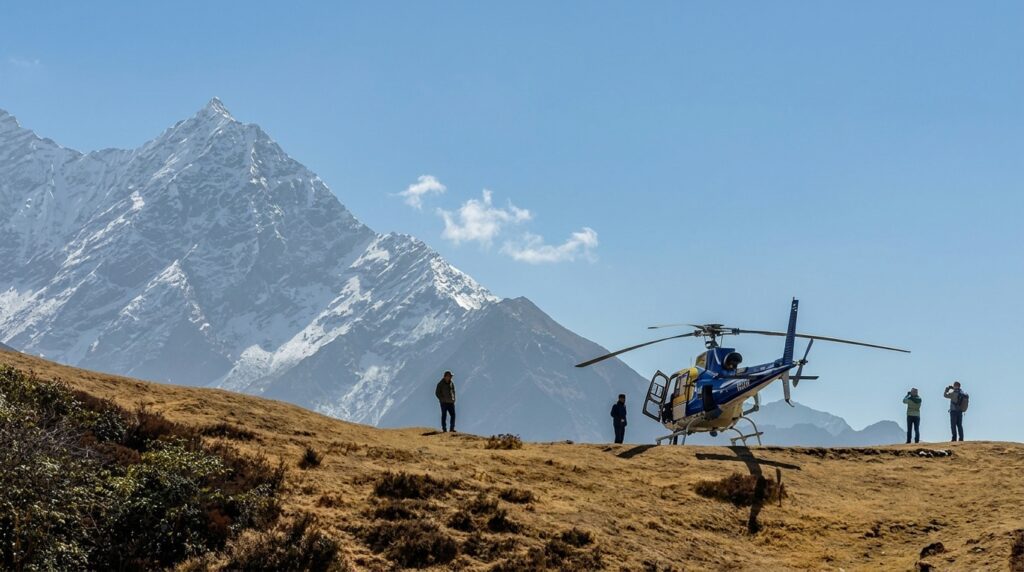
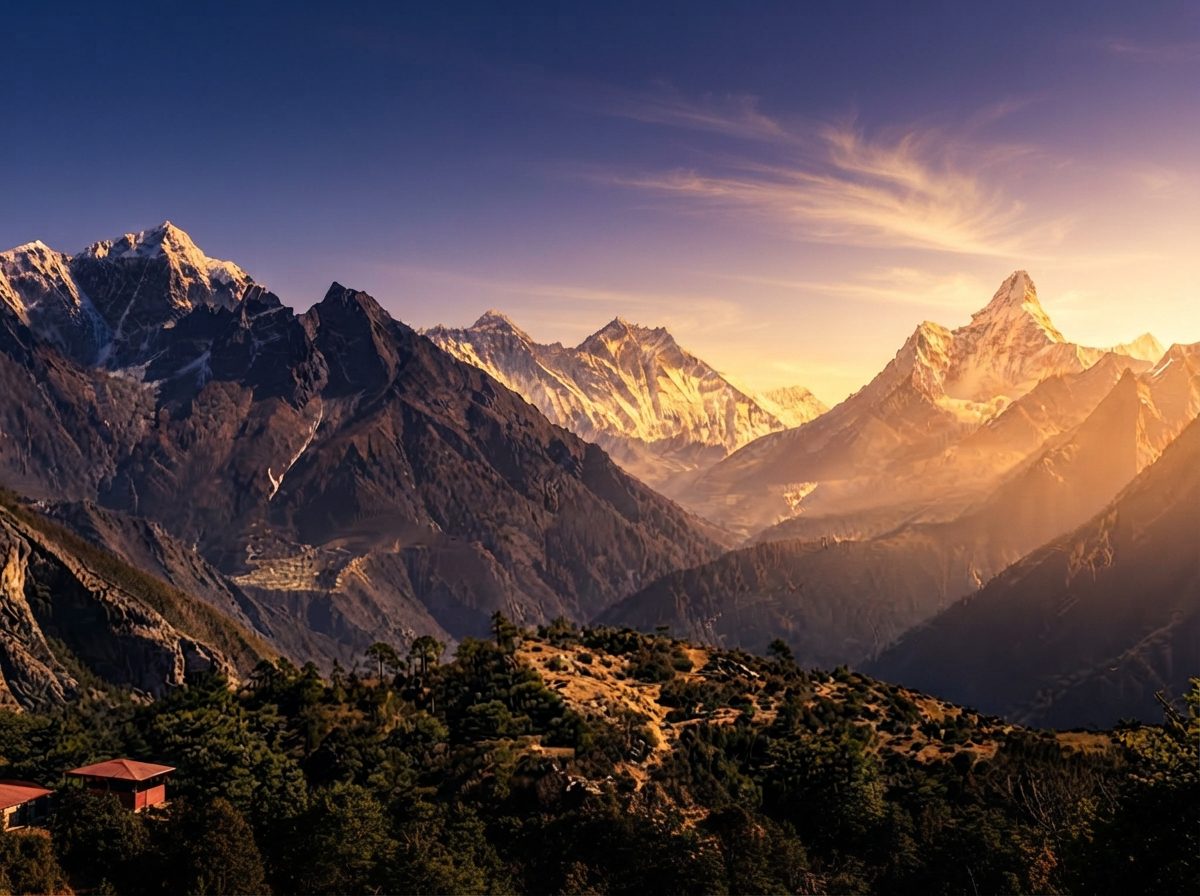
Once the helicopter reaches the Khumbu, the names you’ve read about start showing up outside the window. Mount Everest itself, of course. Lhotse and Nuptse beside it, forming that famous wall of rock and snow. Ama Dablam, the graceful peak that many people call the most beautiful in Nepal. Pumori, sharp and clean above the Khumbu Glacier. And below them all, the Khumbu Valley with its trails, bridges, yak pastures and small villages.
We give each of these a proper description in the “What Can You See” section further down.
Who Is an Everest Helicopter Tour Suitable For?
The tour suits a wide range of people, but it is not right for everyone, so let’s be practical about it.
Travelers With Limited Time
This is the biggest group. If your Nepal trip is short and Everest is on your list, the helicopter flight is the most realistic way to make it happen. You are trading trail time for air time, and for many people that’s a fair deal.
Couples
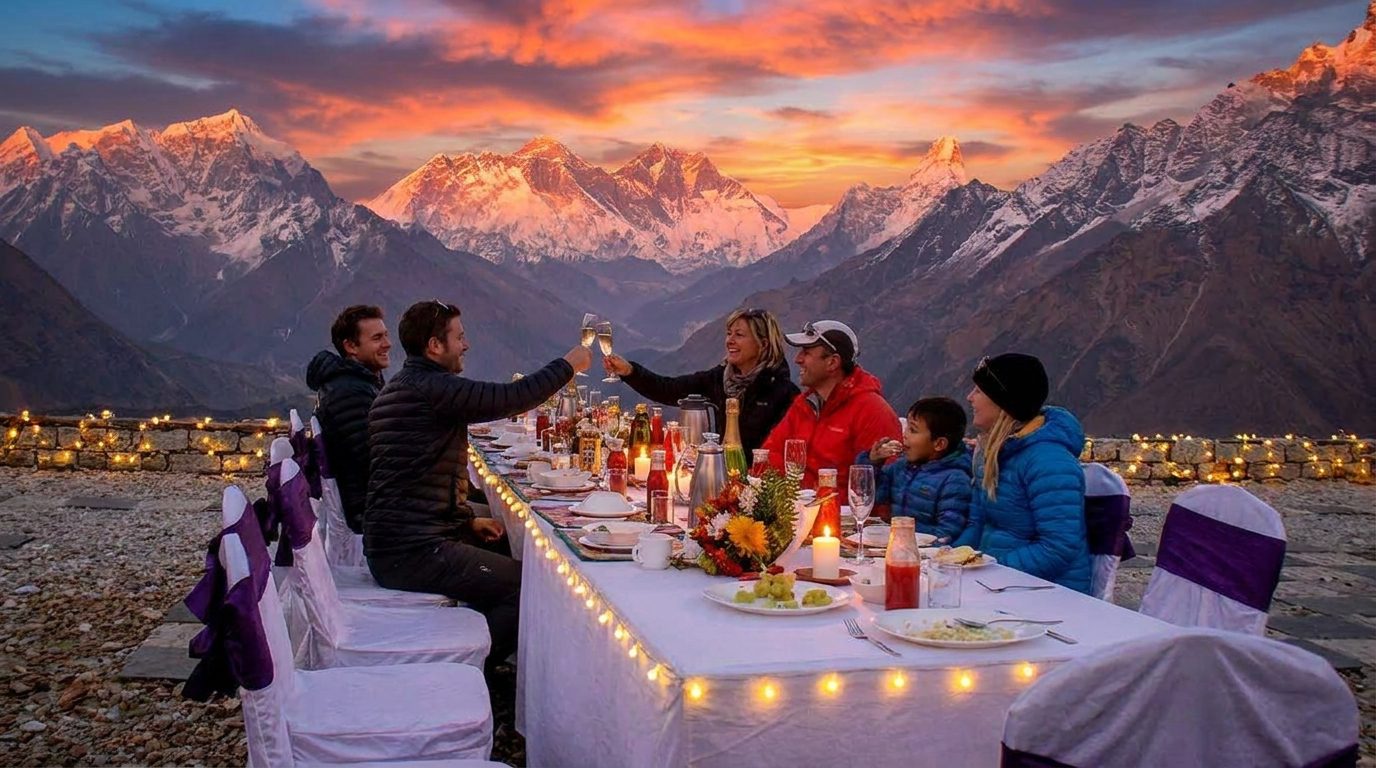
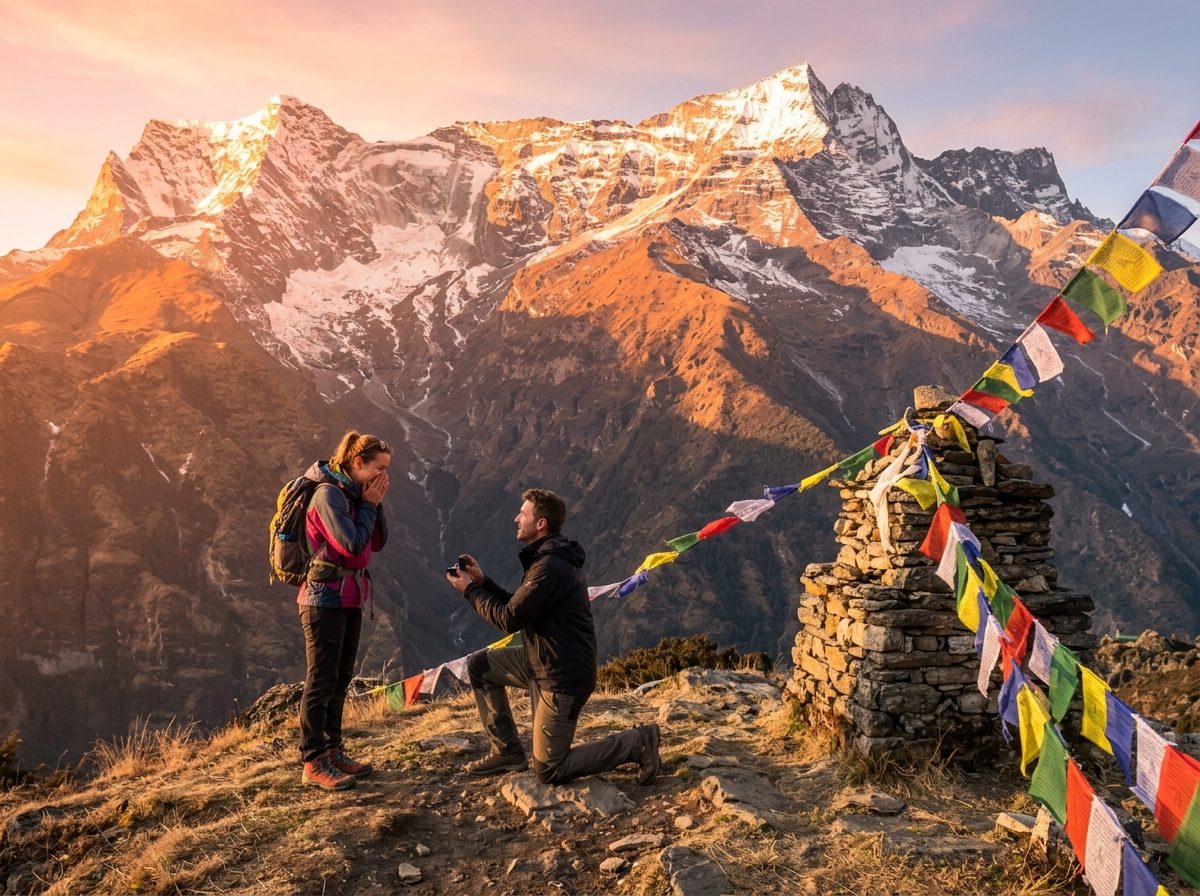
Couples often choose the tour for a special occasion: an anniversary, a honeymoon, a milestone birthday. A shared or private flight over the Himalayas is a memorable thing to do together, and the early-morning light adds to the mood. If you want more privacy for a proposal or a quiet celebration, the private option is worth considering.
Families
Families like flexibility. There is no long walking, no long days of tiredness, and no need to convince a teenager to hike for a week. Just keep in mind the weight limit per passenger and the effect of altitude on young children or older relatives. If you’re unsure, talk to us before booking and we’ll explain what to expect.
Older Travelers
Many travelers in their sixties and seventies have dreamed of seeing Everest but cannot manage a trek anymore. The helicopter tour makes that dream possible. It is much gentler on the body than a trek. Still, high altitude affects everyone differently, so anyone with a heart, lung or blood pressure condition should check with their doctor first.
Friends and Small Groups
A group of three, four or five friends can share one helicopter and split the cost, which makes the price per person more comfortable. It also makes for a fun trip, since everyone’s reaction to the first Everest view is half the entertainment.
People Who Want Mountain Views Without a Full Trek
Some travelers simply are not trekkers. They love mountains, but they don’t want cold rooms and long walks. If that sounds like you, this tour gives you the main visual reward without the heavy commitment.
One important reminder: even without a trek, this is a high-altitude experience. Being at 4,000 metres or higher, even briefly, is not the same as looking at mountains from a hotel in Kathmandu.
Everest Base Camp Helicopter Tour Highlights
Here is a quick look at what the tour can include. Every item is explained in more detail in the sections after this one.
- Hotel pickup in Kathmandu and an early-morning helicopter departure
- Views of Mount Everest, Lhotse and Nuptse
- Ama Dablam and Pumori in the Khumbu Himalaya
- Possible stops in Lukla, Pheriche or another high-altitude location
- A possible visit to the Everest View Hotel area
- A possible landing at Kala Patthar, when conditions allow
- A choice between shared and private helicopter
- An optional Gokyo extension
- Ground coordination from our local team
The words “possible” and “when conditions allow” show up a few times in that list, and that’s on purpose. A helicopter flight in the Himalayas is not a bus ride. The plan is always the plan, until the mountains say otherwise.
The Route: From Kathmandu Into the Khumbu
Every flight is a little different, but the general journey follows a similar shape. Think of it as a guide to geography rather than a fixed timetable.
Kathmandu to the Everest Region
Your day starts early, usually with a hotel pickup before sunrise. From Kathmandu Airport, the helicopter heads east and north, climbing over the green hills that surround the valley. The early light is often the best light, and the air is usually calmer in the morning, which is one of the main reasons flights leave so early.
Flying Toward Lukla
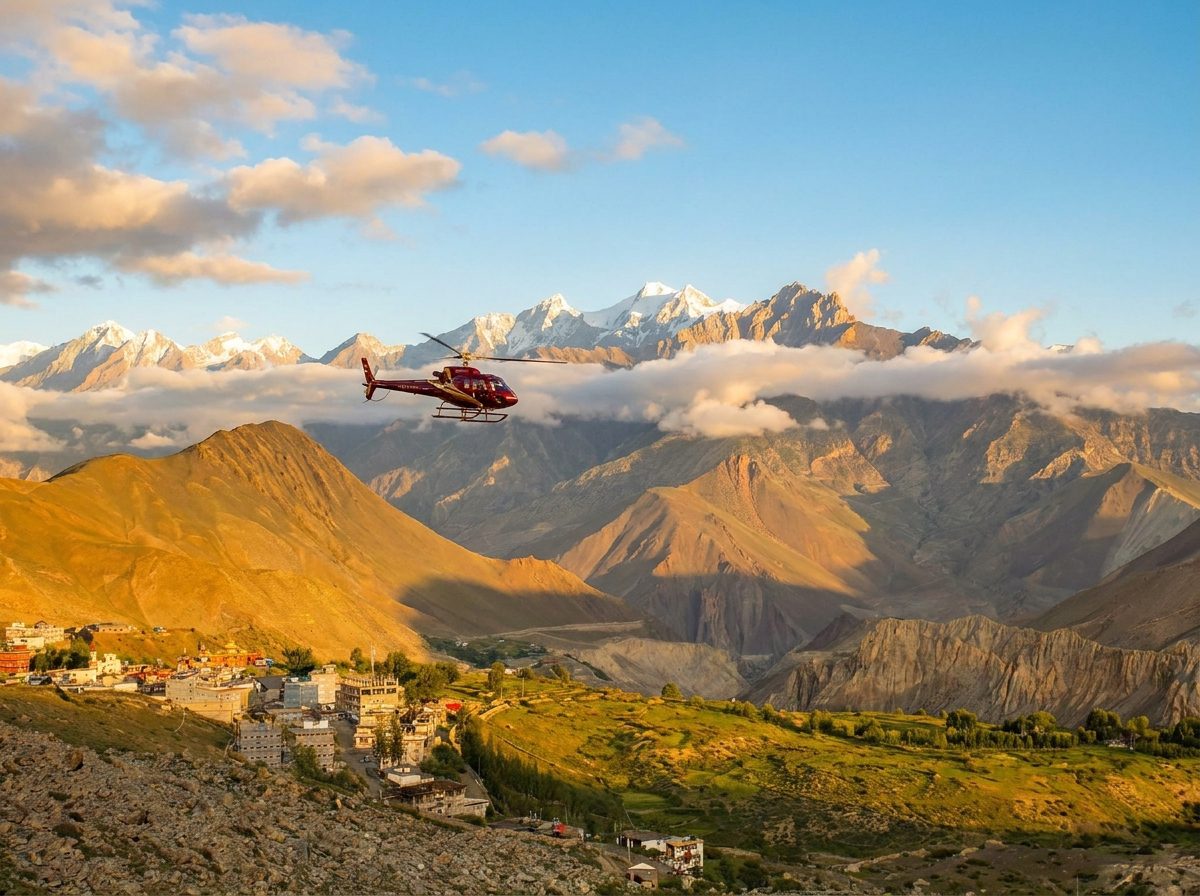
Lukla is the small mountain town most people know as the gateway to the Everest region. Its tiny airstrip sits on a sloping ledge, and it is where most trekkers begin their walk. From the helicopter you will have a good view of this area, and depending on the flight plan, there may be a short stop here.
Entering the Khumbu Valley
Beyond Lukla, the valley narrows and the mountains get taller. You’ll see the trekking trail, suspension bridges, Sherpa villages and monasteries, and the Dudh Koshi river running below. From above, you can trace the path trekkers spend days walking. It is a strangely satisfying view, especially if you’ve read about the route before.
Pheriche and the Upper Khumbu
Higher up, the landscape becomes wide, open and rocky. Pheriche sits at around 4,300 metres, in a broad glacial valley surrounded by big peaks. It is a real high-altitude location, and it gives you a sense of how different the upper Khumbu is from the green valleys below.
Everest Viewpoints and the Mountain Panorama
This is the part most people are waiting for. Depending on the day, the helicopter flies past or stops at places with big Everest views. We don’t promise one exact route, because the pilot chooses the best safe option based on clouds, wind and the conditions at each location.
Return to Kathmandu
After the mountain portion, the helicopter flies back to Kathmandu. Timing and routing can change on the day, but most passengers are back at their hotel by late morning or early afternoon.
If the Khumbu has caught your imagination and you would like to see more of the region on foot one day, our Everest region trekking page shows what’s out there.
Everest Helicopter Landing Options
This is the part of the page where honesty matters most. People often read “Everest helicopter tour” and assume it means landing at Everest Base Camp itself. That is not the standard picture, and we’d rather explain it now than let you find out on the day.
Landing options depend on weather, altitude, aircraft performance and aviation rules. Here is how each location fits in.
Lukla Landing
Lukla Airport is the gateway to the Everest region. For travelers who are not trekking, a short stop here is a nice way to see the place everyone talks about. You can step out, look around at the mountain town, and understand why it has become such a famous starting point.
A Lukla stop depends on airport operations, which can be busy and are sensitive to weather. We never promise it will happen, and it does not happen on every flight.
Pheriche Landing
Pheriche, at about 4,300 metres, is a high, open valley in the upper Khumbu. The scenery here is dramatic, with big peaks on both sides and a sense of real remoteness.
At this height, you will feel that the air is thinner. It’s a good place for a short stop to take photos and enjoy the surroundings. It also means passengers should move slowly and drink water. Whether a landing is possible depends on the weather at Pheriche on the day and on operational approval.
Everest View Hotel
The Everest View Hotel is a well-known viewpoint above the Khumbu Valley. It sits at a lower altitude than Kala Patthar and is famous for its big windows facing Everest, Lhotse and Ama Dablam.
For many passengers, this is a comfortable and rewarding stop, particularly for those who feel nervous about very high altitude. It may form part of the flight plan, but again, it depends on the conditions.
One thing to clear up: the Everest View Hotel is not Everest Base Camp. It’s a viewpoint. The names sound similar, and this is a common point of confusion in online searches.
Kala Patthar Helicopter Landing
Kala Patthar is the one most people want. It stands at roughly 5,545 metres and is one of the best-known viewpoints in the Himalayas. Trekkers climb it, usually before sunrise, to see Everest rising above the rocky ridges, with Nuptse and Pumori nearby.
A helicopter stop here is short. You step out, take in the view, take photos, and then you’re back on board. It’s not a long stay, and that’s on purpose. At more than 5,500 metres, every minute counts, both for the body and for the aircraft.
Can a helicopter land at Kala Patthar?
Yes, it may, when the flight, weather, aircraft performance, passenger weight and aviation conditions all allow it. It should never be treated as guaranteed.
What Determines a Kala Patthar Landing?
Several things have to line up on the day.
Wind. Strong or gusty wind near ridges and peaks can make a landing unsafe. Even a bright, sunny sky can hide dangerous wind.
Visibility. The pilot needs to see the landing area clearly, and the surroundings too. Clouds drifting through the valley can change things in minutes.
Cloud and weather. Clouds often build up in the Khumbu as the morning goes on. That’s one reason flights leave early.
Aircraft performance. At high altitude, thin air means less lift and less engine power. The helicopter has less margin than it would at lower levels.
Passenger weight. Total weight on board affects how the aircraft performs at altitude. This is why we ask for accurate weights when you book.
Altitude. Kala Patthar is very high, and helicopter performance drops noticeably at that height.
Aviation restrictions. Rules and permissions change, and operators must follow them.
The pilot’s decision. Whatever the plan says, the pilot has the last word. If something doesn’t feel right, the landing does not happen.
Can the Helicopter Land at Everest Base Camp?
Let’s answer that directly. Everest Base Camp itself should not be considered a guaranteed helicopter landing.
Standard helicopter tours use permitted landing areas and viewpoints in the Everest region. Any special operation at Base Camp would depend on current aviation rules, permissions and conditions, and it isn’t something we promise as part of the regular tour.
Why explain this so carefully? Because there are actually several different experiences that get mixed up under one name:
- Flying over the Everest region
- Seeing Everest Base Camp from the air
- Stopping at permitted viewpoints and landing sites
- Actually landing at Base Camp
The tour typically covers the first three, with Kala Patthar and other high stops as possible extras. The fourth isn’t something you should expect.
We’d rather set the right expectations than let you book a tour thinking you’ll walk around Base Camp for an hour. If you do want to stand at Base Camp, the traditional route is on foot, and our Everest Base Camp Trek itinerary explains how that works.
What Can You See During the Flight?
Let’s talk about what actually shows up outside the window.
Mount Everest
At 8,849 metres, Everest is the highest mountain on Earth, but from the air it can surprise you. It doesn’t always look like the tallest peak. It sits behind the Lhotse–Nuptse wall, and sometimes you have to look carefully to pick it out. When you do, there’s often a small plume of snow blowing off the summit in the wind. That little detail tends to stay with people.
Lhotse and Nuptse
These two neighbours form the giant wall behind the Everest Base Camp area. Lhotse is the fourth-highest mountain in the world, and Nuptse is a long jagged ridge. Together they create some of the most dramatic rock-and-ice scenery in the Himalayas.
Ama Dablam
Many travelers say Ama Dablam is their favorite. It has a graceful, pointed shape with a ridge that looks like a mother’s arms, and it stands out clearly from most angles. In good light, it’s a photographer’s dream.
Pumori
Pumori is a sharp, elegant pyramid near Kala Patthar and Everest Base Camp. From the helicopter, you’ll see it rising above the Khumbu Glacier, and it makes a great frame for photos with Everest in the background.
The Khumbu Valley
Below the peaks, the valley itself is worth looking at. You can see glacier tongues, moraines, blue-grey rivers and the winding trail used by trekkers and yak trains.
Himalayan Villages and Landscapes
Between Kathmandu and the high mountains, you pass villages, farms, forests and monasteries. It’s a nice reminder that the Himalayas are not just a mountain range, they are a place where people live and work every day.
Add Gokyo to Your Everest Helicopter Experience
If you want a bit more than the standard flight, the optional Gokyo extension is worth thinking about.
Gokyo is a valley to the west of the main Everest trail, known for its chain of turquoise lakes and its views of Cho Oyu, Everest and other big peaks. Trekkers often call it one of the most beautiful places in the Khumbu, and it’s a bit quieter than the Base Camp route.
Adding Gokyo gives you more time in the air, a different set of mountain views and a look at the lake system from above. Because it adds flight time, it also adds cost and needs to be confirmed in advance. It depends on availability, aircraft capacity and weather.
Current additional price: US$800 per person from Everest View Hotel, minimum 2 passengers, subject to confirmation at the time of booking.
This is separate from the main tour price, so you can decide whether it’s right for you. If you’d like to see Gokyo on foot someday, our Gokyo Valley Trek page gives a good picture of what the valley offers.
Everest Helicopter Tour Schedule and Duration
Typical Departure Schedule
| Approximate Time | Activity |
| 5:30 AM | Kathmandu hotel pickup |
| Around 6:30 AM | Airport departure |
| Approximately 5–6 hours | Overall experience |
Treat these as approximate times. They give you a picture of the day, but they aren’t fixed.
Why the Schedule Can Change
A helicopter flight can shift for reasons outside anyone’s control: weather, airport conditions, air traffic and aviation rules. Sometimes a departure moves by an hour or two. Occasionally, the plan is adjusted more than that.
Our team stays in touch with you before the flight, and we’ll let you know if timing changes.
How long is the Everest Base Camp Helicopter Tour?
Roughly 5–6 hours in total, though the exact schedule depends on operating conditions on the day.
Shared vs Private Everest Helicopter
| Option | Best suited to | Main difference |
| Shared helicopter | Solo travelers, couples, small groups | Lower cost per passenger |
| Private helicopter | Families, couples, private groups | More privacy and flexibility |
Shared Helicopter
A shared Everest helicopter tour carries up to five passengers. You split the cost with other travelers, which makes it the more affordable choice. It’s a good match for solo travelers, couples, friends and anyone who doesn’t need the whole aircraft.
Seating is arranged by our team, and it can depend on passenger numbers, aircraft and weight distribution. Everyone gets a window view, but the best seats can vary depending on the aircraft layout.
What If Only 2, 3 or 4 Passengers Book?
This is a very common worry. People wonder if the flight gets cancelled when the helicopter isn’t full.
A shared flight does not automatically get cancelled just because fewer than five passengers have booked. If 2, 3 or 4 passengers are confirmed, we can still operate the flight according to the confirmed arrangement, as long as weather, aircraft and aviation conditions allow it.
Private Helicopter
A private Everest helicopter tour means the aircraft is yours alone. It’s popular with families, couples who want a quiet experience, and groups who prefer to set the pace. It also gives more flexibility around timing and coordination with the pilot, within what’s safe and permitted.
The total cost is higher, since you’re paying for the whole helicopter, but for groups of four or five, the price per person can be more reasonable than you’d expect. We don’t say one option is “better.” It depends on your group, your budget and how you like to travel.
Passenger Weight, Seating and High-Altitude Flight Planning
Passenger Weight Limit
The maximum passenger weight is 100 kg per passenger.
That may sound strict, but it comes down to physics. At high altitude, the air is thin and the helicopter has less power available. Every kilogram on board affects how the aircraft performs, especially when landing or taking off at places like Kala Patthar.
Accurate weights help us plan the flight correctly. Please give us your real weight when you book. It’s not about judging anyone, it’s about safe flight planning.
Seating Arrangements
Where you sit can depend on how many passengers are flying, what aircraft is being used, how the weight is distributed and what the pilot needs for safe operation. If you have a strong preference (say, a window seat for photography), tell us and we’ll do what we can, though we can’t promise it.
Why Weight Matters More at High Altitude
Here’s a simple way to think about it. A helicopter uses its rotor blades to push air downward and lift itself. Thin air gives the blades less to push against. So at 5,500 metres, the same helicopter can carry less than it could near sea level.
That’s why the weight limit and passenger distribution matter so much on this route. It also explains why a flight might land at one place but not another, even on the same day.
Everest Base Camp Helicopter Tour Cost
How Much Does It Cost?
| Tour option | Price |
| Shared helicopter | From US$ per person |
| Private helicopter | From US$ per helicopter |
Current price: please confirm when booking. Prices can change based on season, availability and operating costs, so we’d rather give you the correct number at the time you ask than an outdated one on a web page.
What Determines the Price?
Several things affect the final cost:
- The number of passengers in your group
- Whether you choose a shared or private helicopter
- The season and time of year
- Aircraft availability
- The flight plan and any extra stops
- Optional add-ons like the Gokyo extension
- Operational requirements on your travel date
A group of five sharing one helicopter will pay less per person than a couple booking a private flight, for instance. And a busy season can affect availability more than a quiet one.
What Does the Price Represent?
Think of the price as covering the practical pieces that make the tour work: the helicopter flight itself, your transfers, coordination with our local team, the route and landing components that apply to your package, and ground support on the day.
The exact list depends on the package you confirm. We spell everything out in the “Included” section below, so you can see exactly what’s covered.
Permits and Additional Costs
“Will I have to pay anything else?” is a fair question, and we’d like you to have a clear answer.
Possible Additional Costs
Depending on your plans, you may have some extra costs that aren’t part of the main tour price:
- The Gokyo extension, if you choose it
- An upgrade from shared to private helicopter
- Extra flight time, if requested and approved
- Personal meals and drinks
- Additional hotel nights, for example if the flight is rescheduled
- Travel insurance
- Your Nepal visa
- Optional transportation outside the tour
- Extra services you ask for
- Costs from changes to your own itinerary
Regarding permits and fees: we’ll confirm at booking whether any separate charge applies to your package, so there are no surprises. If a fee isn’t included in the price, we’ll tell you clearly before you confirm.
What’s Included in the Everest Helicopter Tour?
Here’s what’s typically part of the package. Exact inclusions depend on what’s confirmed at booking.
Transportation
Kathmandu hotel pickup and the transfer to the airport are usually included, so you don’t have to organise early-morning taxis.
The Flight
The helicopter flight itself, according to the package you choose, either shared or private.
Coordination
Our team arranges flight coordination with the operator and handles ground support and operational assistance before and during your day.
Passenger Support
We provide the necessary safety arrangements and support throughout the tour, including briefings and guidance from ground staff.
The exact inclusions are confirmed when you book, so you’ll always see them in writing before you commit.
What’s Not Included?
To keep things simple, here’s what you should plan and pay for yourself.
Personal Travel Costs
- Your Nepal visa
- International airfare
- Travel insurance
- Personal expenses like souvenirs and tips
Accommodation and Food
Your Kathmandu hotel is usually not included unless we’ve said so specifically. The same goes for meals and drinks, and for any extra hotel nights you may need if the flight moves to another day.
Optional Services
- The Gokyo extension
- Upgrading to a private helicopter
- Additional helicopter time
- Extra transportation
- Any special requests
If you’re unsure about something, just ask before booking. It’s easier to clear it up early.
Physical Fitness and High-Altitude Considerations
Do You Need to Be Fit?
Not in the way a trek requires. You don’t need weeks of training or strong legs. But this is still a high-altitude experience, and it’s worth taking seriously.
What Passengers Should Be Comfortable With
- Sitting in a helicopter for a few hours
- Getting in and out of the aircraft
- Walking short distances where stops are made
- Spending a short time at high altitude
- Following instructions from the pilot and ground staff
High Altitude Still Matters
At 4,000 metres or higher, the air has much less oxygen than you’re used to. Even a short visit can leave you breathless, light-headed or with a mild headache. That’s normal for some people.
A few tips help: move slowly when you step out, drink water, avoid rushing around and let us know if you feel unwell. Because the stop is short, your body doesn’t have time to get seriously affected in most cases, but it’s not the same as looking at the mountains from a hotel balcony.
Travelers With Medical Concerns
If you have a heart condition, lung problem, high blood pressure or any other medical concern, please talk to your doctor before booking. We can’t give medical advice, and your doctor knows your health far better than we do.
Everest Helicopter Weather and Flight Conditions
Why Mountain Weather Can Change the Flight
Here’s a very common situation. It’s a bright, clear morning in Kathmandu, not a cloud in the sky. You feel great. Then you hear that the flight is delayed or a landing isn’t possible. What happened?
The Everest region is over 150 kilometres away and thousands of metres higher. It has its own weather, and it can look completely different from what you’re seeing in Kathmandu.
Conditions That Can Affect the Flight
- Cloud in the valleys and around the peaks
- Wind, especially near ridges
- Snowfall
- Poor visibility
- Airport conditions, particularly in Lukla
- General mountain weather
- Air traffic
- Aviation restrictions
Any one of these can change the plan. More than one can change it a lot.
Why a Clear Kathmandu Morning Doesn’t Guarantee a Clear Everest Landing
Mountain weather is local and fast. Clouds can gather in one valley while the next one stays clear. Wind speeds at high altitude can be very different from ground level. So a perfect start doesn’t mean a perfect landing at 5,500 metres, and a cloudy start doesn’t always mean a cancelled flight either.
The Pilot Has Final Authority
The pilot has the final authority to change the route, landing location, timing or flight plan whenever safety requires it. This isn’t something we can override, and we wouldn’t want to.
What “Weather Permitting” Actually Means
You’ll see these words a lot in helicopter tour descriptions, and they can affect several things:
- The departure time
- The route
- The landing locations
- The duration of the flight
- The return
- In some cases, whether the flight goes ahead at all
We cover what happens in each case in a later section.
If you’d like broader planning information for your trip, our Nepal trekking guide has helpful background information.
Everest Helicopter Tour: Best Time to Fly
Timing your trip well makes a difference, but no month gives a guarantee.
| Month | Season | General conditions | Flight consideration |
| January | Winter | Very cold | Snow and cold may affect operations |
| February | Winter | Cold | Weather-dependent |
| March | Spring | Improving | Generally favorable |
| April | Spring | Clearer conditions | Often favorable |
| May | Spring | Generally good | Cloud may increase later |
| June | Monsoon | Cloud and rain increase | More weather-dependent |
| July | Monsoon | Wet and cloudy | High weather dependency |
| August | Monsoon | Wet and cloudy | Visibility can be limited |
| September | Autumn | Improving | Conditions often improve |
| October | Autumn | Generally clear | Often attractive for flights |
| November | Autumn | Clear and dry | Often favorable, colder |
| December | Winter | Very cold | Winter conditions possible |
March to May
Spring is a popular time for flights. The air is usually getting clearer, temperatures are moderate, and the mountain views are often good, especially in April. By late May, clouds start building up more in the afternoon.
September to November
Autumn is the other favorite. After the monsoon clears the air, visibility is often excellent, and October and November are especially popular. It’s also the busiest travel season in Nepal, so booking early helps.
December to February
Winter can bring crisp, beautiful days with strong views, but it’s also very cold, and snow or wind can disrupt operations. It’s a good choice if you’re flexible and dress warmly.
June to August
The monsoon brings cloud, rain and less predictable visibility. Flights are still possible on some days, but the chance of delays or changes is higher. If you’re traveling in this period, keep your schedule loose.
To be clear, none of these months guarantees clear skies, a landing or a smooth flight. They just show when the odds tend to be better.
Is an Everest Helicopter Tour Safe?
Nobody should tell you a mountain helicopter flight is “100% safe,” and we won’t. What we can do is explain how risk is managed.
Experienced Pilots
Flying in the Himalayas is a specialised skill. Mountain pilots have to handle thin air, changing weather, tight valleys and short landing areas. Our operating partners use pilots trained for this kind of flying.
Aircraft Maintenance
Helicopters need regular inspection and maintenance according to aviation standards. That’s the operator’s responsibility, and it’s a basic condition of flying.
Passenger Weight Calculation
We collect passenger weights in advance so the flight can be planned within the aircraft’s limits, especially at altitude.
Weather Monitoring
Weather conditions are checked before and during the flight. Decisions to go, wait, reroute or cancel are based on what’s happening in the mountains, not just on the schedule.
High-Altitude Operating Procedures
Landings at high locations follow specific procedures, including short stops and careful planning for performance limits.
Aviation Regulations
Operators must follow Nepal’s aviation rules, including restrictions on where and when flights can operate.
Emergency Planning
Flights operate with emergency planning in place, and ground teams stay in contact with the operator.
Ground Coordination
Our local team coordinates with the operator, airport staff and your hotel to keep the day running smoothly.
Pilot Authority
The pilot has the final authority to modify the route, landing, timing or flight plan whenever operating conditions require it.
What Happens If Weather Stops the Flight?
Possible Outcomes
When weather interferes, things usually go in one of these directions: a delay, a reschedule, a route change, a landing change, or cancellation according to policy.
If the Flight Is Delayed
Sometimes it’s just a matter of waiting for clouds or wind to settle. We keep in contact with you and update you as the situation changes.
If the Route Changes
The route you fly can differ from the original plan. The pilot might avoid a cloudy valley and choose a clearer path, for example. You’ll still see the mountains, just possibly from a different angle.
If a Landing Becomes Impossible
If Kala Patthar or another stop isn’t safe, the pilot may choose another permitted location or adjust the flight. It might feel disappointing, but it’s the right decision.
If the Flight Is Cancelled
If the flight can’t operate, the outcome follows Adventure Master Trek’s cancellation and refund policy, which we’ll explain at booking. Please refer to the policy section below for details.
Why Keep 2–3 Buffer Days?
Don’t Put the Helicopter Flight on Your Last Day
This is probably the most practical tip in this whole article. If you schedule your Everest flight on the day before your international departure, and the weather doesn’t cooperate, you have no room to move. Then you’re stuck choosing between missing your flight home and missing Everest.
Why a Buffer Helps
A few days of flexibility protects you from:
- Mountain weather changes
- Flight delays
- Airport conditions
- Operational restrictions
- Schedule shifts
- Problems with connecting international flights
How Much Buffer Is Practical?
We suggest keeping 2–3 days free in your Nepal schedule. It’s not a rule, and some travelers fly on the first attempt without any issue. But it gives you a fair chance of catching a good weather window without stress.
Many travelers plan the helicopter flight early in their trip, then use the following days for other activities, so if the first day is off, there’s still time.
Why Choose Adventure Master Trek for Your Everest Helicopter Experience?
You don’t need a slogan here, so let’s focus on what we actually do.
Local Knowledge
Adventure Master Trek is a Nepal-based team that works in the Everest region and knows how travel in the country really functions: the weather patterns, the airport routines and the logistics that tourists don’t usually see.
Clear Communication
Before you book, we tell you:
- What’s included
- What’s not included
- What depends on weather
- Which landing options are realistic
That means fewer surprises later.
Operational Coordination
We coordinate with pilots and operators, airport operations, ground transportation and local logistics, so your day runs smoothly from hotel pickup to return.
Transparent Landing Expectations
We don’t present a Kala Patthar landing or an Everest Base Camp landing as automatically guaranteed, because they’re not. We’d rather explain the real situation than promise something the mountains might not allow.
Customer Support
You can reach our team before your trip with questions, and we stay available while you’re traveling. If plans change, you’ll hear from us quickly.
Shared-Flight Commitment
As we explained earlier, a shared flight isn’t automatically cancelled because fewer than five passengers booked. If 2, 3 or 4 passengers are confirmed, we can still operate it, provided the conditions allow.
What You Can Expect From Us
To sum it up: honest communication, realistic expectations, flexibility when things change, solid local coordination and real support from people who know Nepal. That’s the standard we work to.
If you’re also thinking about other trips in Nepal, our Nepal helicopter tours page shows other options.
How to Book an Everest Base Camp Helicopter Tour
Booking is simple, and we keep it that way.
Step 1: Send Your Travel Date
Tell us when you’d like to fly, and any flexibility you have.
Step 2: Tell Us How Many Passengers
Let us know how many people are in your group.
Step 3: Give Passenger Details and Weight
We need accurate details and weights for flight planning.
Step 4: Choose Shared or Private
Pick the option that suits you. If you’re not sure, we’ll help you compare.
Step 5: Receive Availability and Current Price
We check availability and send you the current price.
Step 6: Confirm the Booking
Once you’re happy with everything, you confirm and we lock in the arrangement.
Step 7: Receive Pickup and Flight Information
Before the flight, you receive your pickup time and the final details.
What Information Should You Send?
- Full names
- Number of passengers
- Travel date
- Passenger weights
- Hotel information
- Contact details
- Passport information where required
- Shared or private preference
Booking, Cancellation and Weather Policy
Booking Confirmation
To confirm your booking, we need the details listed above, plus any payment or deposit required. The final terms come from the operator and are confirmed in writing.
Passenger Information
Accurate names, passport details (where required) and weights aren’t just paperwork. They affect flight planning and safety, so please double-check them.
Weather-Related Changes
Your flight may be delayed, rescheduled, rerouted, modified or cancelled according to the applicable policy. Weather decisions are made with safety first.
Safety Takes Priority
Aviation safety comes before the original itinerary. If the pilot or operator says a flight can’t go ahead, or a landing can’t be made, that decision stands.
Cancellation and Refund Conditions
[Insert Adventure Master Trek’s actual cancellation and refund policy here, including deadlines, percentages and weather-cancellation terms.]
Ready to See Everest From the Sky?
If Everest has been sitting on your wish list, and time has been the only thing in the way, this might be your answer. One early morning, a good pilot, a bit of luck with the weather, and you could be looking at the highest mountain in the world through a helicopter window.
The easiest next step is to check availability. Send us your preferred date, the number of passengers, everyone’s weight, and whether you’d like a shared or private helicopter. We’ll come back with what’s possible and the current price, with no pressure to decide right away.
Check Everest Helicopter Availability
Not ready yet? You can also:
- Ask About Your Preferred Date
- Get the Current Shared or Private Helicopter Price
- Plan Your Everest Flight
Everest Base Camp Helicopter Tour FAQs
How much does the Everest Base Camp Helicopter Tour cost?
The shared tour starts from US[X]per person,and the private tour from US[X] per helicopter. The final price depends on the number of passengers, season, availability and any extras such as Gokyo. Please confirm the current price when you book.
How long does the Everest Base Camp Helicopter Tour take?
About 5–6 hours in total. The exact timing depends on weather and operating conditions.
What time does the Everest helicopter tour start?
Hotel pickup in Kathmandu is usually around 5:30 AM, with airport departure at about 6:30 AM. These times are approximate.
How many people can share one helicopter?
Up to five passengers, depending on the aircraft and operational arrangements.
Can 2 people book a shared helicopter?
Yes. A shared flight isn’t automatically cancelled if fewer than five passengers book. If 2, 3 or 4 passengers are confirmed, the flight can still operate as long as weather, aircraft and aviation conditions allow.
Can the helicopter land at Kala Patthar?
It can, when weather, aircraft performance, passenger weight and aviation conditions allow, and when the pilot agrees it’s safe. It’s not guaranteed.
Can the helicopter land at Everest Base Camp?
Everest Base Camp is not a standard or guaranteed helicopter landing. The tour flies over and near the area, and may stop at permitted viewpoints like Kala Patthar, but a Base Camp landing depends on rules and permissions that can’t be promised.
What happens if the weather is bad?
The flight may be delayed, rescheduled, rerouted or modified, or cancelled according to our policy. The pilot has final authority on safety decisions.
Can I add Gokyo to the Everest helicopter tour?
Yes, subject to availability. The current additional price is US$800 per person from Everest View Hotel, with a minimum of 2 passengers, confirmed at the time of booking.
Is the helicopter tour suitable for elderly travelers?
Often, yes. It’s far less demanding than a trek. But high altitude still affects the body, so travelers with health conditions should speak to their doctor first.
How many buffer days should I keep?
We recommend 2–3 days. It gives you more chances to fly if the weather changes, and it protects your onward travel plans.
Comments (0)
Write a comment- Quick Tour Facts
- How long does the tour take?
- Where does it start?
- How many people can share a helicopter?
- Is the Kala Patthar landing guaranteed?
- What the Everest Base Camp Helicopter Tour Is Really Like
- A Different Way to See the Everest Region
- For Travelers Who Don’t Have Two Weeks
- Less Walking, More Time for the View
- Comfort Matters More Than People Expect
- What You Can Actually See
- Who Is an Everest Helicopter Tour Suitable For?
- Travelers With Limited Time
- Couples
- Families
- Older Travelers
- Friends and Small Groups
- People Who Want Mountain Views Without a Full Trek
- Everest Base Camp Helicopter Tour Highlights
- The Route: From Kathmandu Into the Khumbu
- Kathmandu to the Everest Region
- Flying Toward Lukla
- Entering the Khumbu Valley
- Pheriche and the Upper Khumbu
- Everest Viewpoints and the Mountain Panorama
- Return to Kathmandu
- Everest Helicopter Landing Options
- Lukla Landing
- Pheriche Landing
- Everest View Hotel
- Kala Patthar Helicopter Landing
- Can a helicopter land at Kala Patthar?
- What Determines a Kala Patthar Landing?
- Can the Helicopter Land at Everest Base Camp?
- What Can You See During the Flight?
- Mount Everest
- Lhotse and Nuptse
- Ama Dablam
- Pumori
- The Khumbu Valley
- Himalayan Villages and Landscapes
- Add Gokyo to Your Everest Helicopter Experience
- Everest Helicopter Tour Schedule and Duration
- Typical Departure Schedule
- Why the Schedule Can Change
- How long is the Everest Base Camp Helicopter Tour?
- Shared vs Private Everest Helicopter
- Shared Helicopter
- What If Only 2, 3 or 4 Passengers Book?
- Private Helicopter
- Passenger Weight, Seating and High-Altitude Flight Planning
- Passenger Weight Limit
- Seating Arrangements
- Why Weight Matters More at High Altitude
- Everest Base Camp Helicopter Tour Cost
- How Much Does It Cost?
- What Determines the Price?
- What Does the Price Represent?
- Permits and Additional Costs
- Possible Additional Costs
- What’s Included in the Everest Helicopter Tour?
- Transportation
- The Flight
- Coordination
- Passenger Support
- What’s Not Included?
- Personal Travel Costs
- Accommodation and Food
- Optional Services
- Physical Fitness and High-Altitude Considerations
- Do You Need to Be Fit?
- What Passengers Should Be Comfortable With
- High Altitude Still Matters
- Travelers With Medical Concerns
- Everest Helicopter Weather and Flight Conditions
- Why Mountain Weather Can Change the Flight
- Conditions That Can Affect the Flight
- Why a Clear Kathmandu Morning Doesn’t Guarantee a Clear Everest Landing
- The Pilot Has Final Authority
- What “Weather Permitting” Actually Means
- Everest Helicopter Tour: Best Time to Fly
- March to May
- September to November
- December to February
- June to August
- Is an Everest Helicopter Tour Safe?
- Experienced Pilots
- Aircraft Maintenance
- Passenger Weight Calculation
- Weather Monitoring
- High-Altitude Operating Procedures
- Aviation Regulations
- Emergency Planning
- Ground Coordination
- Pilot Authority
- What Happens If Weather Stops the Flight?
- Possible Outcomes
- If the Flight Is Delayed
- If the Route Changes
- If a Landing Becomes Impossible
- If the Flight Is Cancelled
- Why Keep 2–3 Buffer Days?
- Don’t Put the Helicopter Flight on Your Last Day
- Why a Buffer Helps
- How Much Buffer Is Practical?
- Why Choose Adventure Master Trek for Your Everest Helicopter Experience?
- Local Knowledge
- Clear Communication
- Operational Coordination
- Transparent Landing Expectations
- Customer Support
- Shared-Flight Commitment
- What You Can Expect From Us
- How to Book an Everest Base Camp Helicopter Tour
- Step 1: Send Your Travel Date
- Step 2: Tell Us How Many Passengers
- Step 3: Give Passenger Details and Weight
- Step 4: Choose Shared or Private
- Step 5: Receive Availability and Current Price
- Step 6: Confirm the Booking
- Step 7: Receive Pickup and Flight Information
- What Information Should You Send?
- Booking, Cancellation and Weather Policy
- Booking Confirmation
- Passenger Information
- Weather-Related Changes
- Safety Takes Priority
- Cancellation and Refund Conditions
- Ready to See Everest From the Sky?
- Check Everest Helicopter Availability
- Everest Base Camp Helicopter Tour FAQs
- How much does the Everest Base Camp Helicopter Tour cost?
- How long does the Everest Base Camp Helicopter Tour take?
- What time does the Everest helicopter tour start?
- How many people can share one helicopter?
- Can 2 people book a shared helicopter?
- Can the helicopter land at Kala Patthar?
- Can the helicopter land at Everest Base Camp?
- What happens if the weather is bad?
- Can I add Gokyo to the Everest helicopter tour?
- Is the helicopter tour suitable for elderly travelers?
- How many buffer days should I keep?
Read the latest Blogs & Insights
Explore our collection of articles and insights to gain in-depth travel knowledge, expert advice, and stay updated on the latest trends and tips.


No comments yet.