









Kathmandu to Pokhara Flight: Cost, Travel Time & Is It Worth It?
Flying from Kathmandu to Pokhara is the fastest way to reach Nepal’s adventure capital, with the flight taking around 25 minutes. This guide covers ticket prices, flight schedules, airport tips, baggage, weather-related delays, and when flying makes more sense than traveling by road.
-
 Adventure Master Trek
-
24 September, 2026
-
11 mins read
-
193 Views
-
0 Comments


For most travelers, yes — flying from Kathmandu to Pokhara is worth it. The flight takes roughly 25 to 30 minutes and typically costs somewhere between US$90 and US$135 for foreign nationals, compared with a 7-to-9-hour drive on a winding mountain highway. If your schedule is tight or you’d rather not spend a full day on a bus, the time saved alone justifies the fare for most people. That said, there are real trade-offs worth understanding before you book, including Nepal’s aviation safety record, a genuinely scenic road alternative, and a domestic air network that’s changing quickly in 2026. Here’s the full picture.
Flight Time and Distance: Just How Fast Is It?
Kathmandu and Pokhara sit about 200 kilometers apart by road, but the direct flying distance is considerably shorter, and the route is served by short-hop domestic turboprops rather than jets. In the air, the flight itself typically lasts 25 to 30 minutes gate to gate, occasionally stretching slightly longer depending on air traffic and routing around weather.
That short flight time is the entire case for flying. The road route on the Prithvi Highway, by contrast, currently takes 7 to 9 hours by tourist bus, largely because of ongoing road widening and maintenance work along sections of the highway. Even a private car or jeep, which skips the bus’s scheduled meal and rest stops, rarely gets you there in under 6 hours. Put simply: flying trades 6 to 8 hours of travel time for a fare that, for most travelers, costs less than a single night in a mid-range Kathmandu hotel.
What Does a Kathmandu–Pokhara Flight Ticket Actually Cost?
Prices fluctuate by season, how far ahead you book, and which of the domestic carriers you fly, but as of 2026, typical one-way fares for foreign nationals run:
- Budget/early booking: as low as USD $85–100 when booked well in advance or during promotional fare sales
- Standard walk-up or moderately advance booking: roughly US$100–135
- Peak season (October–November, March–April) or last-minute booking: can push past US$150
Nepali and Indian citizens generally pay a separate, lower fare structure, often quoted in Nepalese rupees rather than dollars, so don’t be surprised if the price you see quoted to a Nepal-based phone number is dramatically different from the foreigner rate.
Round-trip tickets don’t usually offer a meaningful discount over two one-way fares on this route, so it’s worth comparing both booking methods before you pay. Booking a week or more ahead of peak season (autumn especially) tends to produce noticeably better fares than booking a day or two out, since seats on these smaller aircraft fill up fast during high season.
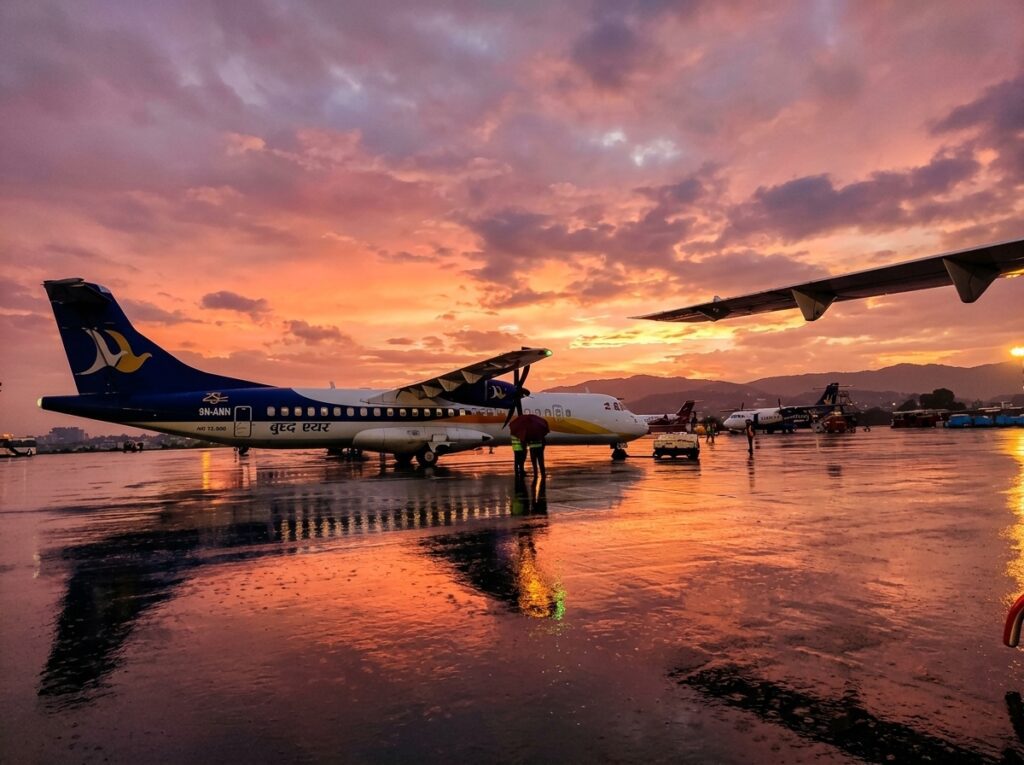
Who flies this route: Buddha Air operates the largest number of daily flights between the two cities, with Yeti Airlines also running frequent service. Both use turboprop aircraft (ATR-type or similar), which is standard for Nepal’s mountain-adjacent domestic routes and not a reflection of the airline’s quality — jets aren’t practical for these shorter, high-altitude-adjacent runways.
Recent Developments Worth Knowing About in 2026
The Kathmandu-Pokhara route, and Pokhara’s airport more broadly, has seen real change this year, and some of it directly affects travelers planning a trip in the coming months.
Pokhara finally has scheduled international flights. Pokhara International Airport, a Chinese-funded project inaugurated in January 2023, spent its first three and a half years handling almost exclusively domestic traffic, plus a handful of irregular charter flights. That changed when flydubai received approval to begin daily direct flights between Dubai and Pokhara starting September 23, 2026, becoming the first airline to operate a genuine daily international schedule at the airport. This doesn’t change the Kathmandu-Pokhara domestic fare directly, but it does mean some international travelers may now be able to skip Kathmandu entirely and fly straight into Pokhara, an option that didn’t meaningfully exist before this year.
The airport has struggled financially and politically. Despite the new Dubai route, Pokhara International Airport has faced ongoing scrutiny. A short-lived Pokhara-Lhasa route operated by Himalaya Airlines launched in March 2025 and was discontinued within about a year due to low passenger numbers, and the project itself remains tied up in corruption allegations involving several former government ministers. None of this affects the safety or reliability of the short domestic hop from Kathmandu, but it’s useful context if you’re wondering why an airport built for international arrivals has mostly handled domestic flights until now.
Let’s Talk About Safety, Honestly
Any thorough answer to “is flying from Kathmandu to Pokhara worth it” needs to address Nepal’s aviation safety record directly, rather than glossing over it.
On January 15, 2023, a Yeti Airlines ATR 72 flying this exact route crashed on approach to the newly opened Pokhara International Airport, killing all 72 people on board. It remains Nepal’s deadliest domestic aviation accident. The official investigation later determined the most probable cause was inadvertent movement of both engine condition levers into the feathered position during the approach, a crew-procedure failure rather than a mechanical or weather-related one. A separate accident in 2024 involved a Saurya Airlines aircraft that crashed during a ferry flight to Pokhara for scheduled maintenance, though that flight was not carrying paying passengers.
Nepal’s civil aviation industry has a documented history of accidents tied to mountainous terrain, rapidly changing weather, and, according to international aviation bodies, oversight gaps; the European Union has maintained a ban on all Nepali carriers operating in EU airspace since 2013, a restriction still in place as of last year. That ban doesn’t affect domestic flights within Nepal, but it reflects longstanding concerns from international regulators.
None of this means you shouldn’t fly the route — millions of passengers use Nepal’s domestic network safely every year, and Buddha Air in particular has built a reputation as one of the more consistently reliable carriers in the country. But it’s a legitimate factor to weigh, and if aviation safety statistics are something you take seriously when choosing how to travel, it’s worth doing your own further reading before booking rather than assuming this route carries the same safety profile as a domestic flight in Europe or North America.
The Road Alternative: What You’re Trading Away
If you skip the flight, the tourist bus is the standard alternative, and it’s worth understanding what that trip actually involves before deciding.
Cost: Tourist bus tickets typically run US$15–25 per person one way, depending on the operator and seat class (standard AC, deluxe, or “sofa seat” luxury buses). A private car or jeep hire costs more, roughly NPR 12,000–18,000 for the vehicle, but lets you skip fixed departure times and scheduled stops.
Time: Budget 7 to 9 hours for the tourist bus, including a lunch stop, and closer to 6 to 7 hours for a private vehicle. Road conditions along sections of the Prithvi Highway have been under ongoing maintenance and widening work, which has kept journey times on the longer end of that range in recent years.
What you get for the extra time: This is the part flight comparisons often skip. The drive follows the Trishuli river and Marsyangdi river valleys, passing terraced hillsides, small riverside towns, and, on clear days, distant mountain views that you simply don’t get from a 25-minute flight at cruising altitude. Many travelers who’ve done the trip both ways describe the road journey as a genuinely worthwhile experience in its own right, not just a necessary evil — particularly on a first visit to Nepal, when the overland scenery is part of the appeal rather than an obstacle to it.
The honest trade-off: Flying wins decisively on time and, for many travelers, on comfort, especially if you get motion sickness on winding mountain roads. The bus wins on cost for budget travelers and offers a scenic, cultural experience that some people actively want as part of their trip rather than something to avoid.
So, Is It Worth It? A Practical Breakdown
Fly if:
- You’re on a tight itinerary and need those 6-8 hours for trekking, sightseeing, or another leg of your trip
- You get carsick easily or have limited tolerance for long winding drives
- You’re traveling with young children, older relatives, or anyone for whom a long bus journey would be genuinely difficult
- Your onward plans (an Annapurna trek departure, for instance) start early the next morning and you can’t afford a travel-day buffer
Take the bus or drive if:
- Budget is a significant factor and the roughly $70-100 fare difference matters to your overall trip cost
- You want the overland scenery as part of the experience, not just a means of transport
- You have flexible dates and don’t mind building an extra day into your itinerary
- You’re already uneasy about small-aircraft travel and would rather avoid it, even at the cost of a much longer travel day
Practical Tips for Booking and Flying This Route
Book through the airline directly or a reputable local agent when possible. Third-party international booking sites sometimes show fares that don’t match what’s actually available once you try to complete the purchase, particularly for Nepali domestic carriers.
Check baggage limits before you pack. Domestic turboprops on this route typically enforce stricter checked and carry-on weight limits than international flights — often in the 15-20 kg range for checked luggage. If you’re arriving in Nepal with a large trekking duffel plus gear, confirm the specific airline’s allowance rather than assuming standard international limits apply.
Build in a weather buffer if you can. Mountain flying in Nepal is genuinely weather-dependent, and morning flights tend to have better on-time performance than afternoon departures, since cloud cover typically builds through the day. If your onward plans are inflexible, book an early morning flight and, ideally, avoid scheduling anything time-critical for the same day you land.
Confirm which airport you’re using in Pokhara. With Pokhara International Airport now the city’s main facility, this is less of a concern than it once was, but it’s still worth double-checking your booking confirmation, especially if you booked a while ago or through a smaller agency, since older listings sometimes reference outdated airport information from before the new airport opened in 2023.
Compare morning versus midday fares. Some travelers report slightly better pricing and more flight options earlier in the day, since this is also when demand from trekkers heading to or from the Annapurna region tends to be highest.
Arrive early. Domestic terminals in Kathmandu can be crowded and less streamlined than the international terminal, so give yourself more buffer time than you might expect for a 25-minute flight — arriving an hour to 90 minutes before departure is a reasonable standard.
The Bottom Line
For the large majority of travelers, flying from Kathmandu to Pokhara is worth the cost. You’re paying roughly $70-110 more than the bus fare to get back six to eight hours of your trip, land closer to your hotel, and avoid a long day on a highway that’s still under active construction in places. The exceptions are budget travelers for whom that price difference is meaningful, and travelers who genuinely want the overland journey as part of their Nepal experience rather than a logistics problem to solve. Either way, go in with accurate expectations: a short, functional turboprop hop in one case, and a long, scenic, occasionally bumpy river-valley drive in the other.
Planning a Trip to Pokhara or the Annapurna Region?
Get in touch with Adventure Master Treks to plan your Pokhara arrival and everything that comes after it.
Frequently Asked Questions
- How long is the flight from Kathmandu to Pokhara?
Around 25 to 30 minutes in the air, though total time at the airport (check-in, security, boarding) usually adds another hour or more on each end.
- Is it cheaper to fly or take the bus?
The bus is cheaper, typically by roughly US$70-110 depending on which flight fare and bus class you compare. Flying costs more but saves 6 to 8 hours.
- Which airline is best for this route?
Buddha Air operates the most frequent daily service and has a solid reputation for reliability among Nepal’s domestic carriers. Yeti Airlines also flies the route frequently. Both operate similar turboprop aircraft.
- Do I need to book far in advance?
Not usually for the domestic Kathmandu-Pokhara route outside of peak season, but booking at least a few days ahead during October-November or March-April tends to secure better prices and more flight time options.
- Is flying to Pokhara safe?
Nepal’s aviation industry has had a difficult safety record, including a fatal 2023 crash on this exact route, and domestic carriers remain barred from EU airspace. That said, the route is flown many times daily without incident, and safety oversight has continued to evolve since 2023. It’s a personal risk calculation rather than a simple yes-or-no answer, and worth researching independently if it’s a significant concern for you.
- Can I now fly directly into Pokhara from outside Nepal?
As of September 2026, flydubai operates daily flights between Dubai and Pokhara, making it the first genuine scheduled international route at Pokhara International Airport. Outside of that connection, most international travelers still need to fly into Kathmandu first and connect domestically.
Comments (0)
Write a comment- Flight Time and Distance: Just How Fast Is It?
- What Does a Kathmandu–Pokhara Flight Ticket Actually Cost?
- Recent Developments Worth Knowing About in 2026
- Let’s Talk About Safety, Honestly
- The Road Alternative: What You’re Trading Away
- So, Is It Worth It? A Practical Breakdown
- Practical Tips for Booking and Flying This Route
- The Bottom Line
- Frequently Asked Questions
Read the latest Blogs & Insights
Explore our collection of articles and insights to gain in-depth travel knowledge, expert advice, and stay updated on the latest trends and tips.


No comments yet.